When I start on a project, process, garden, or trip, I tend to think of it as an endeavor. I have my own understanding of the word, but I thought it might be wise to see what its background is. According to Etymologyonline, endeavor appears in English in the 15th c:
early 15c., "pains taken to attain an object," literally "in duty," from phrase put (oneself) in dever "make it one's duty" (a partial translation of Old French mettre en deveir "put in duty"), from Old French dever "duty," from Latin debere "to owe," originally, "keep something away from someone," from de- "away" (see de-) + habere "to have" (from PIE root *ghabh- "to give or receive"). One's endeavors meaning one's "utmost effort" is from late 15c.

~
Okay, I tend to think of the word as meaning not so much a dutyas the effort, or “pains one takes,” needed to pursue an objective or result of some sort. It is currently my duty to act as executor for my mother’s modest estate; but what I’m endeavoring to do is come to terms with being an orphan so late in my life, and to allow myself some minor mood swings, and to continue my daily activities–including writing. Because writing is so valuable when one is grieving. This is true even for people who are not writers, as James Pennebaker’s (and others’) research shows. [Here is a podcast from the APA as an introduction, if you are curious: https://www.apa.org/news/podcasts/speaking-of-psychology/expressive-writing]
This doesn’t mean that writing while grieving is easier for writers. It isn’t. We may be more disciplined about doing the writing. Or we may not.
And endeavoring differs slightly from trying. For me, trying is sort of experimental or exploratory. It need not have some sort of object, beyond the goal of gaining a new experience. I’m not trying to get over my sorrow or trying to get up and do what has to be done. There’s purpose to my activities around facing the day, weeding and watering the garden, and sitting down to think and write. Maybe the purpose is just to be a human in the world. Maybe writing is just part of my particular process.
I’m not sure where I’m going with this post. The object today is just to put words on the page, thoughts into my brain, and to write.
today’s light breeze I remember hearing her laughter ~
Many years ago, I drafted a poem that I worked on awhile and considered finished. I sent it out a few places, and then realized it wasn’t ready after all. I shelved it for a long while, then revised it, and I like it better now; but I don’t think I will submit it again. It feels like too personal a poem to me, and here’s why: when I felt more satisfied with it, I showed it to my mother (it’s about her). She was quiet for a fairly long time. Then she looked at me and asked, “How did you know this?”
Well, I’d imagined it. Guessed. But I felt floored that maybe I’d found words to say what she couldn’t say, and that she felt I had it right–her experience, I mean, her feelings. And now that feels important to me, because my mother died just a few days ago.
But this blog is sort of personal, after all, and so I am posting it here as a not-quite-finished, imperfect poem that nonetheless said enough to the person I wrote it about. My audience of one, in this case. Which is enough for me, and rare enough in the art of creative writing; and I really cannot come up with words this week given how I feel about my mom’s death. “Still processing,” as they say. Each of us does that differently, and each grief differs depending upon relationship and circumstances.
My mother’s passing was extremely peaceful, calm, accepting, about as uncomplicated as a death can be. Yet I will be holding onto the experience and my feelings about it for a long time to come.
~
Foreignness

1. 1955
Ten years after the war, my newlywed parents
leave a small, Midwestern town.
The lighted ball that marks its one-pump gas station
usurps the moon en route to the city.
At the railroad station, my father sets down luggage
and takes my mother’s hand.
She feels the platform tremble, sees one white
light heading eastward and away.
It takes all the silence out of darkness
as they rattle through tunnels far from home.

2. Marburg
My mother never learns to speak German.
She lives a year without language while my father
pursues his studies, relying on gesture
and interpretation. She holds the hands
of old women who’ve survived two wars,
the hands of kindergartners too young to recognize
the whining patterns of Allied bombers,
navigating a country suturing itself partially-
whole in the aftermath of its collision
with fascism. It’s a nation spoiled and bleeding.
For my mother, the first year of marriage
is a foreign land my father tries to translate.
She keeps her eyes open, never meets the enemy.

3. Harlem
After Europe, her hometown becomes
a thought she keeps at bay.
In white uniform and cap, she tries to balance
efficiency and compassion in the hospital’s
pediatric ward with its infant rat-bite victims,
steam-burned patients, malnutrition, poverty.
There is so much to learn.
Returning each night to the student apartment
on 122nd Street, she weeps quietly.
Too many reasons, no language to explain them.
The floor trembles as the IRT passes.
Each day wears a hard face.
She can’t put it into words, and my father
cannot interpret for her, not this time.
~
The haibun below is much newer, but also still a draft. And also perhaps not a piece to send out for publication, but rather to share with my readers, some of whom were acquainted with my mother.
Baptism by Sea
She never lived sea-side, the nearest she came was that square white house sixty miles west of the Atlantic. She’d grown up far away amid oceans of corn but loved the shore. She learned sand varies from place to place by walking on Baltic beaches, on Galway’s strands, the coasts—Amalfi, Cyprus, Cairns—Puerto Rico’s wavelets curling over her feet, but she was only ever a visitor, tourist to the locals whose neighbor was the ocean. It never was her familiar though she loved to stand and watch for signs of its vast unity, the way it touches every ragged cove, its calm beneficence in Virgin Gorda’s inlets, the salt clarity of those horizons she could reach but not imagine until she felt Bali’s fine-grained silt underfoot, went clamming near Maine’s slick-sided rocks. As a girl all these were unimaginable. She entered the sea as a woman, and what broke around her body with each wave was tactile, thrilling: an initiation.
When I was a second-grader in Yonkers, NY, our school took us on a class trip to an art museum in New York City. I could not tell you which art museum it was (possibly the Whitney, possibly MoMA), but I remember how vividly impressed I was by one of the things I saw there: a very large mobile suspended overhead, ever so slightly moving. I had never seen anything like it before, and it rocked my world. It was clearly art, but unlike any art I’d seen before. Thus began my lifelong love of art museums, which my parents were glad to encourage.
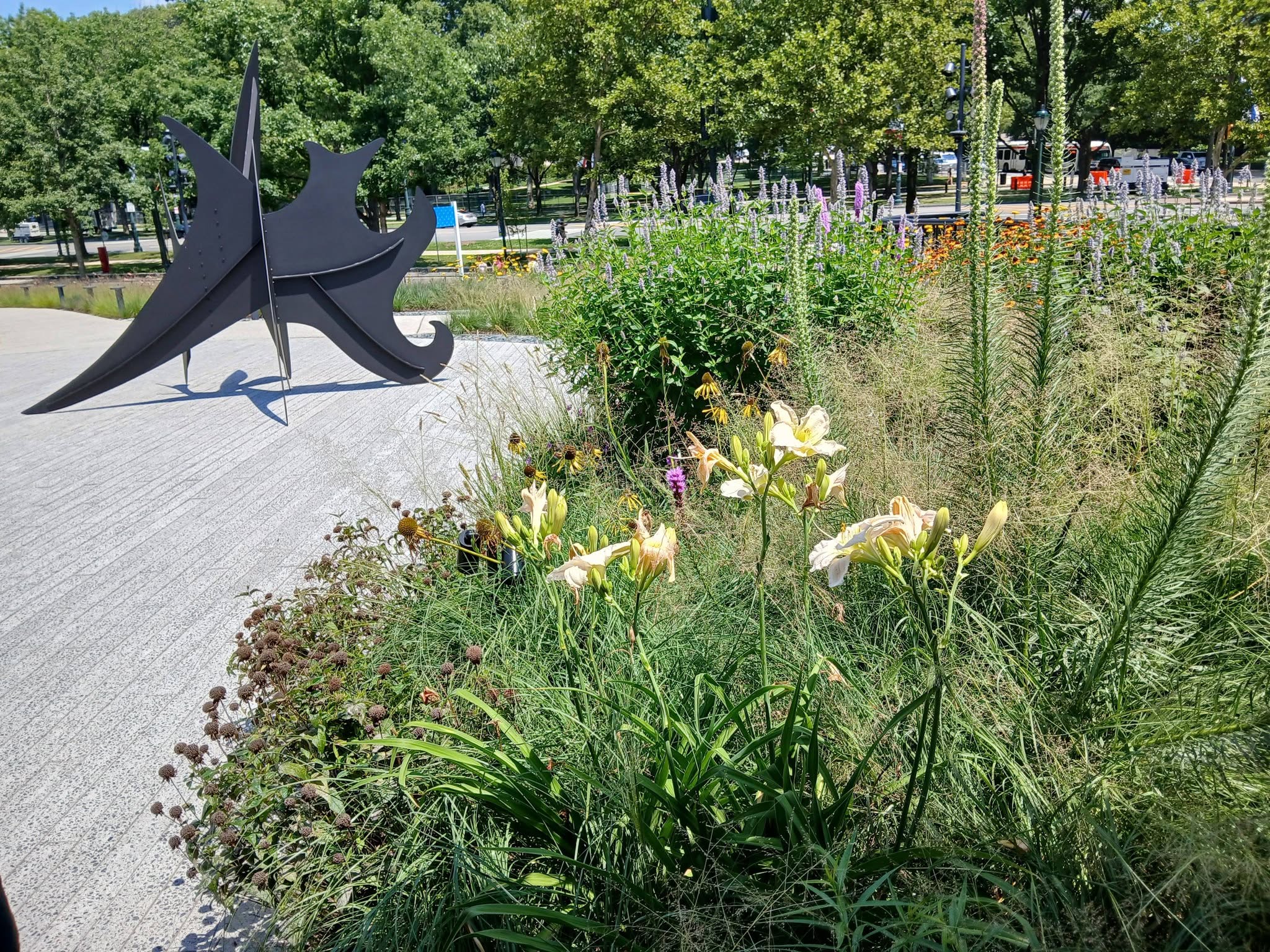
When a new art museum opens near me, which certainly isn’t all that often, I try to get to it. Philadelphia is a little over an hour away, so I was thrilled when I heard about the new Calder Gardens, (opened in late 2025) which combines two of my favorite things–art and gardens. Not to mention the opportunity to wander past old an favorite, the Rodin Museum, as well as the reflecting pools and tall pines surrounding the much newer Barnes Museum, and to stop at Buena Onda for fish tacos. The Calder gardens were designed by Piet Oudolf and are lovely. Evoking plains or meadows in the midst of a very urban environment, the landscaping proves that pollinators will find their way to plants even when surrounded by traffic and skyscrapers. Delicate grasses were setting seeds when we arrived, giving an airy lightness to what was a typical hot, muggy summer-in-the-city day. Bees and butterflies were as busy as the streets.
I have to say that I don’t much like the museum’s exterior, but the interior architecture suits Calder’s works perfectly. The galleries are unexpected, curving, textured, with walls that range from wood to lava-like to smoothly-polished stone, and they feature niches for seating and gazing, in addition to huge windows that look out onto Calder’s larger stabiles that are situated in well-like, below-ground outdoor spaces. Lighting allows intriguing shadows to be cast by the mobiles; a soundscape softly fills one of the galleries. Docents offer detailed talks and answer visitor questions. The whole place, though on the small side in terms of “quantity,” is a memorable experience.
~
On our way to the Calder Gardens, we passed the monumental Philadelphia Museum of Art and noticed that part of the Parkway and “the oval” were blocked off; there was a huge array of theater lights and speakers that technicians were raising in front of the museum’s famous steps. If we’d visited toward the end of the week, we’d have found the Parkway considerably more limited.
Oh, right. July 4 in Philadelphia: always mayhem, but this year the semiquincentennial.
We avoid Independence Day in Philadelphia because I don’t care for crowds, though I’ve been known to make exceptions for a march or a concert. Not to mention the traffic and parking or the fact that Philadelphia in July is miserably hot and humid, absolutely without exception. Anyway, the nation’s 250th doesn’t feel all that celebratory to me. I suppose I have become cynical.
But seeing all the setup in Center City took me back to Philadelphia on July 4, 1976, when my family lived across the river in New Jersey. My parents–they must have been crazy!–drove us into the city for the evening’s bicentennial party. I had just turned 18, my sister was 16, our brother was almost 12. We saw the musical “1776” on the big lawn in front of Independence Hall (no lawn there now–it’s the Liberty Bell Center). We then walked around the city, going from park to park to watch the fireworks, the five of us holding hands sometimes, trying to stay together and not get separated in the crowd. An enormous crowd! It was exhilarating and a bit scary, and I recall thinking that it gave me a sense of what a war zone must feel like. All those bangs and booms, so loud and so frequent I could feel the vibrations in my body; and sprays and fountains of light overhead, and actual fountains reflecting sparklers and fireworks, warning lights, streetlamps; cars driving past, honking; people singing and shouting. There were protesters, too, but despite the protests (we applauded their efforts and the right of citizens to protest), and despite the presence of police and federal troopers, I don’t recall feeling fearful or anxious. It may be the closest I’ve ever gotten to feeling “patriotic.”
Well, I was very young, and I wasn’t following the controversies very closely (curious about said controversies? See this article). I was aware of conflict and division in the USA, but youth tends toward optimism and energy; I was excited about art, music, books, my college education. That was 50 years ago. There’s much I have forgotten, but the arts haven’t let me down in all those years. Poetry, sculpture, music, painting, dance, and the “humanities” sustain me still.