Mortise & tenon

In a post late last year, I examined a Gerard Manley Hopkins poem for the way the lines and images might be considered as hinges. Another metaphor for how poems work–one I have been churning in my mind for a couple of years now–is joinery of another kind: mortise and tenon. What joinery does in woodworking is allow the cabinetmaker to connect separate pieces of wood together in such a way as to allow a little movement as the wood responds to temperature and moisture changes. Good wood joinery requires experience and thoughtful attention, as there are often additional challenges such as connecting end grain to long grain. Amateurs resort to screws, nails, and glue to cobble projects together because joinery takes time to learn and requires technique and practice that the average DIY “carpenter” does not possess.

True craftspeople learn, practice, and employ conventional joinery techniques and often develop their own signature styles. The craft of woodworking parallels the craft of poetry: there are tools and techniques, strategies and conventions, patterns to follow, and inventions and innovations to create. Both crafts join together materials that seem alike (wood to wood, words to words), and yet it can be damned hard to get those connections to hang together solidly and make a coherent and stable whole.

~
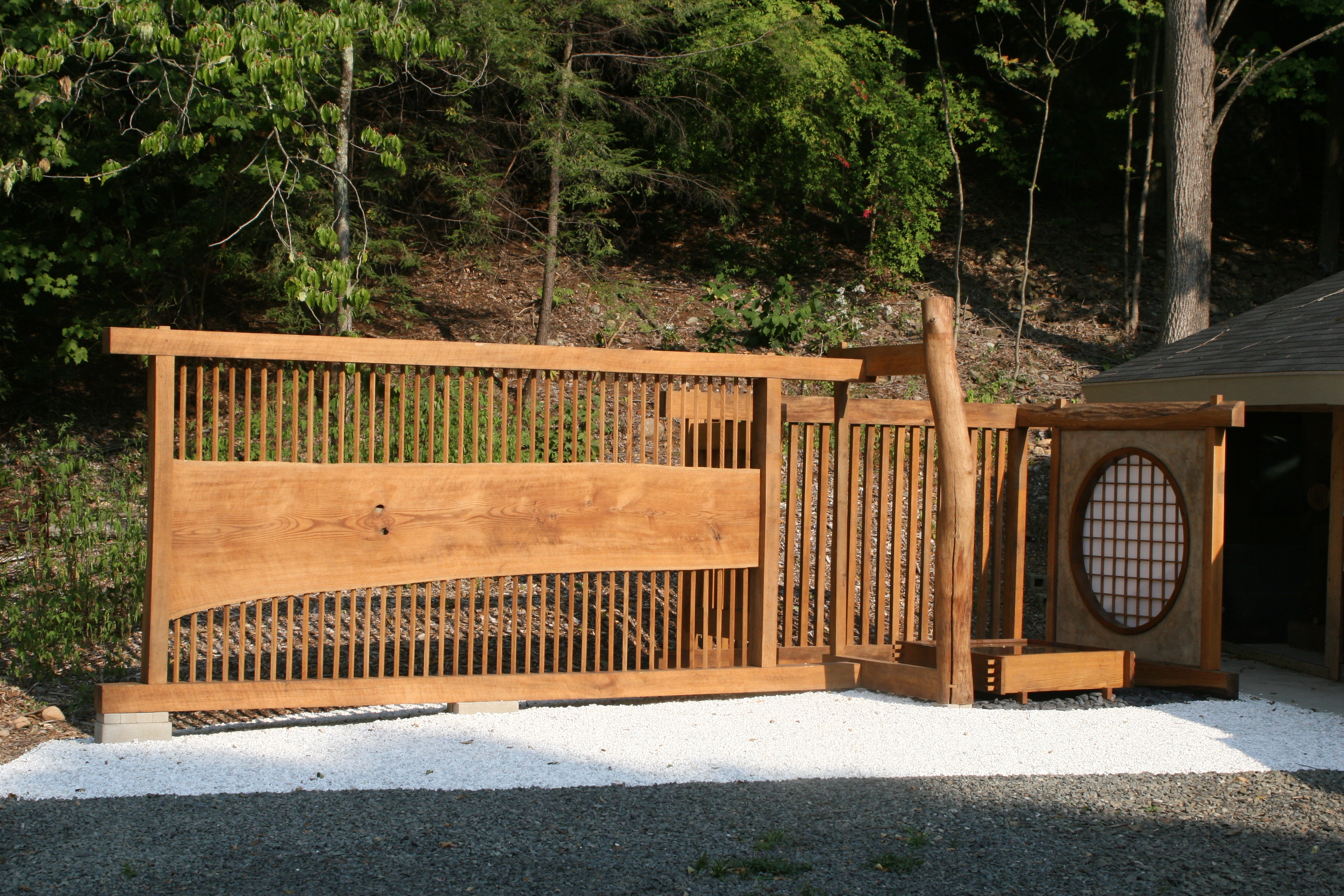
Odate's

Odate’s “Pride of New England” [1982] photo: Laure Olender

~

My friend Toshio Odate was trained as a shoji maker and has worked as an educator, artist (sculpture), and craftsman-in-wood for most of his 82 years. Possibly his best-known book is the practical but also spiritual Japanese Woodworking Tools: Their Tradition, Spirit and Use. This text will teach you how to choose, care for, sharpen and use traditional Japanese hand tools, meanwhile illuminating the history and spirit of the woodworking craft in Japan. Toshio reveres the work of humans, the human touch, the effort of making that goes into a handmade object; and his sculptural pieces reflect his passion. The large sculpture above, Pride of New England, stands on his property under the hardwood trees and above the nearby creek. Nothing holds these huge slabs and trunks of wood together but hand-cut joints: mortise and tenon, mostly.

~

I’m going to try to explain a connection between poetry and joinery through a brief examination of the poem “Whereof the Gift Is Small” by Maxine Kumin. This poem appears here, and I think you ought to check out the link to a Q & A on this poem, as it is enlightening and amusing (as Kumin so often is).

Whereof the Gift Is Small

       Henry Howard, Earl of Surrey

And short the season, first rubythroat
in the fading lilacs, alyssum in bloom,
a honeybee bumbling in the bleeding heart
on my gelding’s grave while beetles swarm
him underground. Wet feet, wet cuffs,
little flecks of buttercup on my sneaker toes,
bluets, violets crowding out the tufts
of rich new grass the horses nose
and nibble like sleepwalkers held fast—
brittle beauty—might this be the last?

~

This lovely small poem is framed by phrases from Henry Howard, Earl of Surrey’s sonnet “The Frailty and Hurtfulness of Beauty,” so right away we have an old poem joined to a new one; and as Kumin admits in her commentary on the piece, “Picking lines from others’ poems is hazardous and I don’t recommend it.” Woodworkers will recommend that old, seasoned wood not be joined to green wood for practical reasons. Good reasons, too. But that does not mean one should never attempt it or that it cannot be successfully done. A master like Maxine Kumin can succeed–but with caution.

How might one approach the joinery of words as apparently distant from one another in tone or image as “sneaker” and “rubythroat”? The grave of the gelding (a gap, into which something solid may be placed) gives the reader one opening. There is also the stepping-down aspect of the images, each connecting to the next. The bird appears higher in the poem, quite literally, up there with the lilacs fading on their tall stems; but the alyssum blooms much lower to the earth, as do the bleeding hearts where the bee is busy. The grave and beetles take us deeper. Then, up ever so slightly, to the low-growing buttercups and the damp cuffs of the speaker’s trousers and the noses of still-living, grazing horses…with a “brittle” reminder that this season is short (“the gift is small”). If you are familiar with Surrey’s poem, there’s a marvelous resonance here, though I feel Kumin’s tenor is a bit less cynical than Surrey’s.
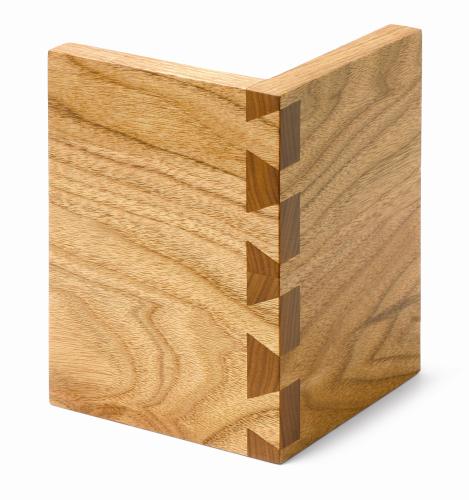
dovetail joint

dovetail joint

Kumin’s poem is not a full sonnet, and some of her end-rhymes are slant. A modernity pervades her piece, yet the older poem’s language and sensibility are evoked nonetheless. How elegantly she achieves this balance. I think the first joint in the poem appears at line 4, at which point the nature imagery of the first three lines, which could incline to the romantic, solidly connects with the real fact of death. This line also introduces us to our speaker: the gelding is “my” gelding. Line 6 provides another clear connection: the speaker here exists very much in the present moment, wearing sneakers, noticing the buttercups. This line fits into the poem like a well-cut dovetail, linking the pastoral descriptions with the reflective mode the speaker turns to after observing the horses. And there, between the em dashes, we find Surrey’s “brittle beauty,” a tenon that fits the space and holds the entire brief poem together.

Good joinery is often invisible except to those who appreciate the work and take the time to look for it. Toshio solved the engineering challenge of constructing his sculpture through a process of reflection, experiment, experience, and revision. How like a poet’s work that seems to me! When I told him I feel his work is analogous to poetry, he was initially flabbergasted. Maybe the surprise stemmed from a difference in the approach to poetry across cultures, or maybe from a difference in the way a plastic artist perceives a largely abstract art like poetry. Maybe I could not explain my idea adequately to a person for whom English is not a first language. Actually, I’m not certain he believed there is as much human touch and hand-work involved in poem-making as there is in woodworking or the sort of made-by-hand sculpture Toshio does. We agreed not to fully understand one another.

About a year later, I attended a special event at his home, a celebration of the Object as Being, for which I composed a poem. That summer, he called and said, “I think maybe I understand now what you mean.”

~

endnote: If you’re interested in learning more about Toshio Odate, here is a 1996 article from The New York Times and a 2009 blog post (including a short video) from Tom’s Workbench, as well as a short on making shoji screens–from Martha Stewart’s network.

Control

middle island ~

Human beings crave control. We want to be the masters of our own fate or to believe that there is a master of our fates who can be entreated or persuaded, propitiated or cajoled into helping us to gain control of our lives or the lives of others. We want to change the weather so that the rain falls when the soil needs rain, wetting the seeds we’ve sown, and so that the warmth comes when our plants need warmth. We want the sea to be calm and the fog to lift when we are ready to set sail. We want fine, sunny days when we visit the beach to swim or head out for a picnic. We want just enough snow so that school’s canceled, but not so much that our power goes out. We pray. We dance. We chant. We invent little private rituals and participate in community rituals.

We want to control our health. It does not seem to be an unreasonable aim. We want to control our relationships–just enough to keep ourselves happy. We want control over our careers and  our income–not so much to ask. We want to be able to make our own decisions. We want choices so that we feel we have control over our lives.

My gardens are my analogy today. I’m still endeavoring to exert some control over my vegetable garden, but I kept my purposes modest this year; I planted fewer beans, fewer tomatoes, fewer peppers, fewer potatoes, no onions, no peas, no edamame, no radishes…the walk-through rows are wider so it is easier to weed. Beginning with the dry warm winter and some assemblies of challenges that do not pertain to the garden, the season looked “iffy.” Then came lashings of showers in May. A challenging season, but not insurmountable. I have been gardening a long time, and I have methods of adapting to things I cannot control. It comes with the territory.

The ornamental beds have presented the most difficult struggle with my need to control the space I (somewhat ridiculously) consider my own. When the beds get overgrown–as they are now–I know that I can accept their exuberant rioting with the successful weeds. I can say, “This is what nature intends. There is beauty here.”

overgrown

I do know that. But the controlling mind–the monkey mind–says, “Too much penstemon; it’s gotten aggressive. Deadhead the peonies. Pull up the plantian, the wild asters, fleabane, wild garlic, crabgrass, bermuda grass, creeping charlie, five-leaf vine. Get the seedlings out of there (mulberry, redbud, oak). Mulch. Keep the rabbits off the hostas. Move the marybells. Get the weeds out of the alchemilla…”

My head clouds with fog. The seas get rough and I despair, because I cannot control things. Not even a small garden.

Instead, I could be meditating on green. On the amazing variety of leaf-shapes, on dappledness (like G. M. Hopkins):

Pied Beauty

Glory be to God for dappled things—
For skies of couple-colour as a brinded cow;
For rose-moles all in stipple upon trout that swim;
Fresh-firecoal chestnut-falls; finches’ wings;
Landscape plotted and pieced—fold, fallow, and plough;
And áll trades, their gear and tackle and trim.

All things counter, original, spáre, strange;
Whatever is fickle, frecklèd (who knows how?)
With swíft, slów; sweet, sóur; adázzle, dím;
He fathers-forth whose beauty is pást change:

Práise hím.

~

Here is one aspect of my ornamental garden. Overgrown, yes. Lush, diverse, lovely in its unrefined way. Until I have the wherewithal to tear through and divide and move and mulch, this is not a bad view, the definition of … lack of restraint, ornamentals gone wild. Freedom, I suppose.

A little too much of some good things.

As we grow, we learn to let go. So I am told. Garden, you have a chance to go wild!

And I guess I have the opportunity to learn to live with that.

Poetry Break.

I took a break from difficult reading to read Eluard’s “Last Love Poems” as translated by Marilyn Kallet. Alas that I am mono-lingual and cannot read poetry in any language other than English. I have to take the translator’s word for it (literally and figuratively) that the beauty in the lines can be nearly portrayed in English. The struggle translators must have to go through to transform such a studied thing of language as a poem is into a different tongue amazes me. Inevitably there is some loss of connotation, wordplay, music, rhythm, cultural freight; the careful reader understands that there may be lacunae of some kind, and a mono-lingual reader recognizes that she will not be able to track down where those subtle gaps occur. A good translation, however, manages to maintain the beauty.

“Beauty”—now, there’s a moving target. Quine devotes a few pages to the discussion of the concept in his “intermittently philosophical dictionary.” He writes: “The aesthetic pole is the focus of belle lettres, music, art for art’s sake. But it is a matter of emphasis, not boundaries. Scientists in pursuing truth also seek beauty of an austere kind in the elegance of a theory, and happily some of them seek literary grace in their expository writing.” Quine ends his brief entry on Beauty by suggesting that truth and beauty are not a binary system, that we need not see them as poles apart; yet he does not quite agree with Keats’ conflation of the two. We need ethics and rhetoric in addition to truth and beauty, says the philosopher.

Peter de Bolla, writing two decades or so later, inclines toward a less binary way of looking at beauty and truth when he writes that, since the art of music is  an “articulation of the temporal,” there is a “philosophical argument music makes about relationships between time and being.”  And that argument results in beauty, when it is a well-composed argument, I suppose.

Suddenly the welcome earth
Was a rose of luck
Visible with fair mirrors
Where everything sang to open rose

(“Seasons,” Paul Eluard, tr. Marilyn Kallet)

de Bolla asks: What does the poem know? This poem knows music, and beauty “in the gentle desert of the street” and “beneath life overpowering and good.”

Ah.

ann e. michael, waterfall, poetry