Abstraction, evolution, & sky-beauty

I awakened this morning to a sunrise of surpassing beauty. As I drove to work, I remembered that the first poems I recall ever writing were about the wind and about dawn–perhaps I wrote other poems as a child, but these two are the only ones I remember: poems that celebrated something I found lovely in nature.

After the vivid morning sky, we had a day of rain; and on my commute home, a compelling sunset bookended the working day. I call these skies “beautiful” and would definitely regard my experience of looking at them as aesthetic.

And yet, it’s only the sky, some clouds, the sun, phenomena that science has explained. What makes it beautiful?

photo: Beejay Grob

photo: Beejay Grob (North Carolina coastal sky)

David Rothenberg’s 2011 book Survival of the Beautiful: Art, Science, and Evolution has accompanied me for the past week; I have been reading it when I can find time to read and to cogitate. Rothenberg speaks directly to the question of what makes us experience beauty, whether beauty is a human-only construct, and from where the qualities of aesthetic experience arise. He explores among other things whether beauty (especially in the form of art) evolved along with us, what makes it timeless (if it is indeed timeless), and whether our grounding in nature as earthly beings formed the grounding for what we deem beautiful.

And he considers symmetry and biology and abstract art and math and music. There’s quite a good deal of synthesis and speculation going on in this book.

~

Rothenberg writes that he is interested in whether humans’ developing education in abstractions–concepts and abstract arts–might produce an outcome that increases our appreciation of things in nature and the cosmos. He writes:

It might seem this century has freed us from interest in any kind of constricting form or function in art, but I want to test out a different theory: that abstraction in the arts has made us find more possible beauty in the natural world…as art exalts pure form and shape, the laws of symmetry and chaos found in mathematics and science seem ever more directly inspirational. Aesthetically, we become more prepared to see beauty where before we saw only the clues of beauty, its glimmers or possibilities…our minds are more attentive to an abstract kind of beauty that we can discover but not necessarily build or create.

It takes him several chapters to braid together the many strings of his interdisciplinary inquiries; but the upshot is that while I feel he does not answer the questions he begins with, he does deepen the reader’s thought process about art, beauty, and the evolution of ideas as well as of organisms. He says the interesting discussion lies not with what is or is not art, nor how to evaluate the individual merit of works, but rather “how artistic expression changes how we think in ways only art can accomplish.”

~

In light of Rothenberg’s musings on how natural-feeling abstract art can be, here are some examples: Barlow, Ellis, (contemporary) and Klee (modern).

Rothenberg concludes with some ambiguity about aesthetics and evolution, which suits his book-length and life-long explorations on the interweavings of these ideas; but he adds with certainty that “[b]iology is not here to explain away all that we love in terms of the practical and rational. That is not how nature works. Nor should we shrink from our natural astonishment at the magnificence evolution has produced.”

~

He mentions John Cage’s work and approach to composing, and I think Cage’s main point in so much of his work is getting us to listen, to see, getting us to be attentive. Viz Rothenberg’s words quoted above, maybe an integration of abstraction does open us to be more attentive to the beauty that exists in the world without any artist making it. We could not, in the past, have appreciated the fractal values of river deltas viewed from airplanes; and perhaps only natural (or trained) artists noticed how the twigs of a tree reiterate the shapes, angles, and curves of the branches, boughs, sometimes even bark. Now we know about Mandelbrot sets and fractal geometry, and those abstractions can generate beautiful patterns. Now we know the Fibonacci sequence of numbers–an abstraction–appears in snail shells and sunflower seed-heads.

We do not have to be mathematicians, chemists, art critics, environmental scientists, physicists, sculptors, violinists, composers, dancers, college professors or biologists to recognize patterns and symmetries, or to find that slight variations in the pattern enhance the experience through the kind of surprise and delight that I discover in great poems.

We just have to be attentive.

~

sunset1

Trees & tombs

On a brisk and clear autumn day, I visited Brooklyn’s magnificent and park-like Green-Wood Cemetery. Established in 1838, the burial grounds were planned as a gently-rolling landscape of hills, winding paths, ponds, and specimen trees in what was then rural Long Island. The “History” tab of the National Historic Site’s webpage says:

By 1860, Green-Wood was attracting 500,000 visitors a year, rivaling Niagara Falls as the country’s greatest tourist attraction. Crowds flocked to Green-Wood to enjoy family outings, carriage rides and sculpture viewing in the finest of first generation American landscapes. Green-Wood’s popularity helped inspire the creation of public parks, including New York City’s Central and Prospect Parks.

These days, US citizens feel far less connected to death, and the concept of picnicking among gravesites may seem creepy. The organization devoted to keeping up the cemetery as a historic site (it is, by the way, still an active cemetery) offers tours: visitors can tour the catacombs, visit graves of famous people, take an architectural monument & mausoleum tour, and see the sculptural highlights of the cemetery.

The sculptures are largely figural pieces and tend toward the Gothic sentimentality of the late 19th century: draped urns, weeping maidens wearing Greek chitons, triumphant angels, busts and full-length portraiture, columns and more columns (Corinthian being far and away the favorite). If such monuments appeal to you, Green-Wood is decidedly worth a visit; it is also a favorite among history buffs. A Revolutionary battle was fought on those grounds, and there are some early graves from the Dutch pre-Revolutionary era, not to mention the inherent historical interest of a major city mortuary established in the 1830s.

Here’s a flickr site devoted to images of Green-Wood.

~

While history and art interest me a great deal, what most arrested my attention at Green-Wood were the trees. Seldom do I get to see dozens of 170-year-old oaks, 100-year-old weeping beeches draping their boughs over paths and tombstones, large female gingko trees that drop their smelly orange fruits on the ground, old elms that survived Dutch elm disease, enormous cedars and firs of every description, majestic walnut trees (the woodlot at my house sports only some weedy black walnuts). Three tall, long-armed people embraced the circumference of one of these old oaks…

GreenwoodTree2-26Oct2013

Loving up the trees at Green-Wood.

~

There are hundreds of species of trees at Green-Wood, aptly named; and in fall the colors are handsome. I can imagine the pastel colors of the flowering trees there in spring!

So I think of the place of the dead as a fantastic terrarium of living things encased in city streets, a bubble of micro-environment–470+ acres–wherein thrive trees, a wide variety of birds, ornamental grasses and flowers, shrubs (too many hydrangeas, perhaps), squirrels and, judging by the dug-up divots evident in grassy areas, skunks, opossums, and possibly raccoons.

And yes, I recognize that cemeteries have a reputation for good soil because the plants are “fertilized” by human remains–undeserved reputation in modern times due to sanitation requirements and at Green-Wood, where many of the interred are not even in the ground. Even if and when human decay complements the soil nutrients, the idea doesn’t bother me. I am enough of a scientist, and enough of a Buddhist, to appreciate the biocycle.

Objects and stories

I’ve been occupied with many things lately that take me away from blogging and even from poetry. I have been re-reading Hard Times which seems, suddenly, relevant and appropriate to life. I deeply value my world of the imagination, which is not bi-modal, black-and-white, straight facts, simple storyline, no diversions. It is rich and complex and worthy of exploration. It is mysterious and loving and paradoxical, a puzzle and a joyful muddle and a pool of sorrows. It loves to divulge and elaborate and dwells in velvety ambiguities.

I post herein a quote not from Dickens, however, but from Edmund deWaal’s book The Hare with Amber Eyes–in hopes that it will jog my memory for a further post on this topic eventually.

“It is not just things that carry stories with them. Stories are a kind of thing, too. Stories and objects share something, a patina….perhaps patina is a process of rubbing back so that the essential is revealed, the way that a striated stone tumbled in a river feels irreducible, the way that this netsuke of a fox has become more than a memory of a nose and a tail. But it also seems additive, in the way that a piece of oak furniture gains over years and years of polishing…

You take an object from your pocket and put it down in front of you and you start. You begin to tell a story.”

ipomoea

Or something that is not in your pocket. Something you may see along the road, on a path in a park or forest, reflected in a window. The story, perhaps, of a story you thought you knew well–one your father told you, which his father told him, and to which there is truth but also layers and about which you may be able to weave another tale.

Art, story, story, art

Yesterday, I attended a reading by former US Poet Laureate Kay Ryan in a more intimate setting (a luncheon) than I’ve ever been privileged to hear her at in the past. An audience member asked her how she would define art. Alas that I don’t write quickly enough to have taken her words down verbatim, but she offered a lovely answer.

She said that if a person cannot really be happy without doing it, and cannot keep from needing to do it, and if it nourishes or gives back to that person in ways nothing else can–then that “it” is art, in her opinion.

~

I suppose art also ought to speak to others, but I am not sure that is as necessary as art critics think it is.

~

Speaking of critics, and of art, I was impressed with Hilary Mantel’s 1998 novel The Giant, O’Brien for reasons that made a few critics rather lukewarm about it. The author is best known for her amazing historical works, well-researched and full of believably human perspective. O’Brien is a departure in several respects although still historical fiction. I read this book as an ambiguous moral tale, a myth, a story about stories (and art) and a depiction of ways the Enlightenment created significant losses in the midst of its gains. So I was less bothered by the exaggeration of certain personalities or minor plot gaps. O’Brien, a storyteller of the most shamanistic/primitive sort, also possesses a modern (Enlightenment) intellect and an artist’s “intuition.” But he never achieves fame, or the goal of restoring a beloved pub–the place he learned his craft–and dies painfully and slowly, impoverished and nearly abandoned.

As O’Brien nears death, Mantel writes that there comes “a point in fatigue or pain when logic slowly crumbles from the world, where reason’s bricks sieve to crumb. Where content flits from language…and departs.” And her character, the giant–who embodies in his hugeness the epitome of mythical narrative, the kind that sustains us even in dire poverty–eventually comes to the conclusion that the poor among us lose all. Of the poor man, he muses:

Stories cannot save him. When human memory runs out, there is the memory of animals; behind that, the memory of the plants, and behind that the memory of rocks. But the wind and the sea wear the rocks away; and the cell-line runs to its limit, where meaning falls away from it, and it loses knowledge of its own nature. Unless we plead on our knees with history, we are done for, we are lost. We must step sideways, into that country where space plaits and knots, where time folds and twists: where the years pass in a day.

What within us plaits and knots and folds and twists but the brain itself? We pass along our knowledge and, more importantly, our stories. That is done from brain to brain through language and music and art, even as the individual brain comes to the end of its viability and vitality. We step sideways into another person’s brain, just as O’Brien’s listeners memorize his tales, his cadence, his figurative speech. So, in the end, O’Brien is wrong.

~

I attended a funeral today at which the officiant encouraged us to keep the departed alive in our hearts and for the future by telling stories he had told or by relating stories about him to anyone who might listen. I know I have previously written about this idea in conjunction with readings and philosophers and art and literature. The more I encounter it, the truer it seems to me.

The bereaved spouse at this funeral is a person who is losing her own story through senile dementia, though she has some occasional awareness of her memory loss. Her ability to carry on her husband’s narrative is already deeply diminished or perhaps completely gone.

These are among our risks.

~

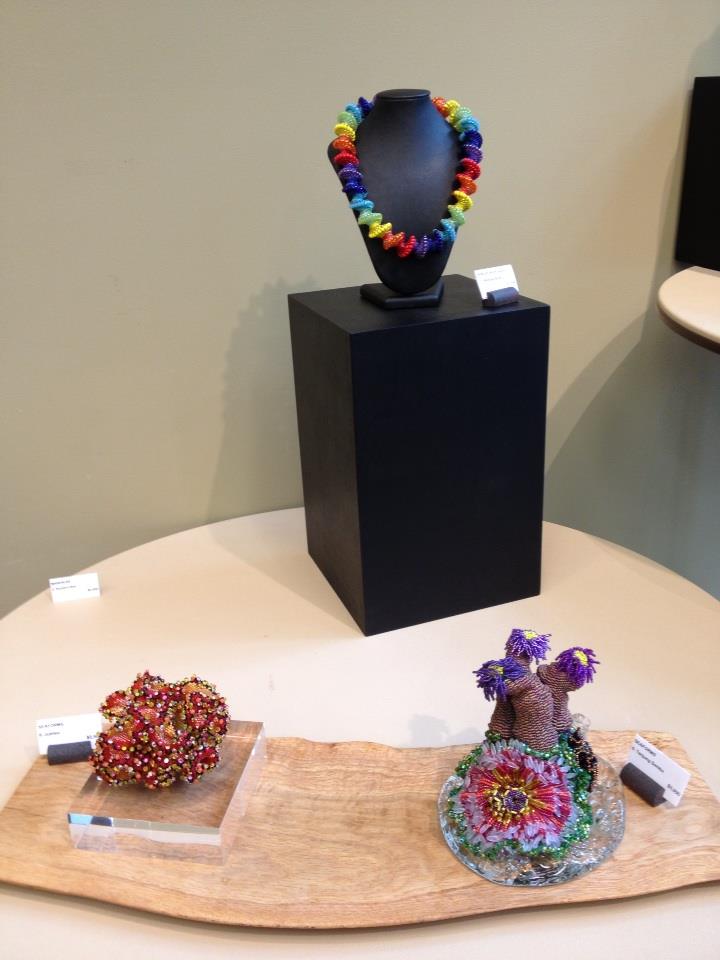
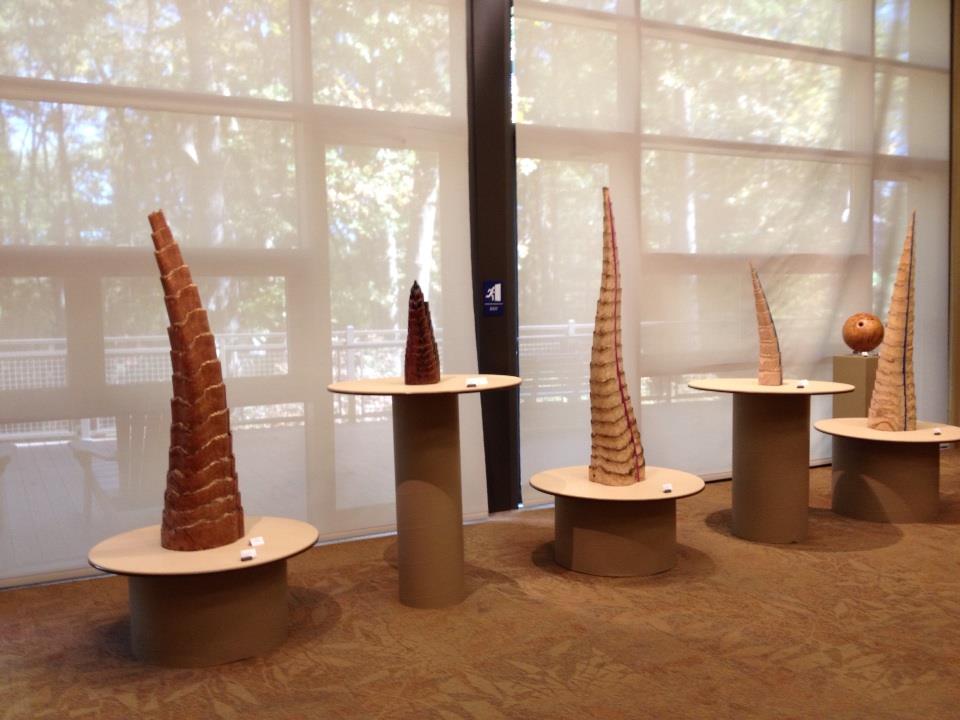
These words brought to mind my long-time friends, the craft-artists David Ellsworth (turned and other wooden forms) and Wendy Ellsworth (beaded forms). This month, for the first time in their many years together, they have a joint exhibit in the gallery space at Jenkins Arboretum (Devon, PA). The photos below are snapshots Wendy took, and their individual work is best viewed in person or on their studio website. [Contact the artists for permissions, photos, information about workshops and talks.]

Wendy Ellsworth's seaforms, and a necklace

Wendy Ellsworth’s seaforms, and a necklace

Wendy's "Sunset" (with David's turned-wood frame/container)

Wendy’s “Sunset” (with David’s turned-wood frame/container)

David Ellsworth's "Emergence" series

David Ellsworth’s “Emergence” series

I have known Wendy and David for over 25 years, and I can testify that the work each of them does fits Kay Ryan’s description of art. They are artists, and their work nourishes both of them–and nourishes us, the beneficiaries, as well.

~

For today, these are my stories.

www.ellworthstudios.com

Er – sur –

Mary Ruefle writes, in her book of “lectures,” Madness, Rack, & Honey: “I remember being so young I thought all artists were good, kind, loving, exceptionally interesting, and exemplary human beings.”

I was a child like that. It’s good to know there was at least one other. We grow up to know that such artists are far from common. But they do exist.

Each time I learned a “bad” thing about an artist, poet, or writer I loved, I felt a little deflated. Something was being taken away from my idea of the person who made such wonderful work.

Later, I rather empathized with Roland Barthes’ theorizing about the death of the author. Not because I was necessarily post-modern but because sometimes, I wanted the artist-as-person to be erased so that I could go back to loving the art-as-art. This was a juvenile way of thinking about both human beings and about art.

But: the lure of erasure…

~

Ruefle muses about time, about art, literature, and the human being. Her assays to determine what endures among us often feel a bit cryptic or aphoristic at the first encounter. The wisdom in them, and the layeredness–and the awareness of what is “missing” in her texts–evolved in my own mind as I read her book, slowly.

She has used erasure as a means to expression and to beauty, as it happens. Examples of her erasure poems appear on The Poetry Foundation’s website here.

~

The closing epigraph of Madness, Rack, & Honey (is it an epigraph if it falls at the end of the book?) is from Samuel Pepys’ Diary following the Great Fire “…an abundance of pieces of burnt papers were cast by the wind as far as Cranborne; and among others she took up one…which was a little bit of paper that had been printed, whereon there remained no more nor less than these words: “Time, it is done.”

Time.clock

~

For Dave Bonta’s interpretation of erasure poems–based upon Pepys’ diary–see via negativa here.

~

“Exhibit 13,” by Blue Man Group, follows an abundance of pieces of burnt papers cast by the wind, as well.

Brains on literature

Here’s a brief article that references a small study of how the human brain responds to reading poetry:

http://www.exeter.ac.uk/news/featurednews/title_324631_en.html

“Some people say it is impossible to reconcile science and art, but new brain imaging technology means we are now seeing a growing body of evidence about how the brain responds to the experience of art. This was a preliminary study, but it is all part of work that is helping us to make psychological, biological, anatomical sense of art.”

Here’s another short write-up from The New York Times on a somewhat similar topic, research into how reading literary work (specifically fiction, in this experiment) improves social skills–empathy and the ability to interpret other people’s feelings in particular.

http://well.blogs.nytimes.com/2013/10/03/i-know-how-youre-feeling-i-read-chekhov/?_r=2&

The article says that “after reading literary fiction, as opposed to popular fiction or serious nonfiction, people performed better on tests measuring empathy, social perception and emotional intelligence.” The psychologist researchers are from my alma mater, The New School for Social Research, and their work connects intriguingly with theory of mind studies.

What makes literary fiction challenging to read is the same thing that makes it so richly rewarding to the human brain: critical thinking is required, inference, active engagement with the text, the need to recognize and validate other points of view than one’s own and, often, to speculate on motives and meanings:

In literary fiction, like Dostoyevsky, “there is no single, overarching authorial voice,” [David Comer Kidd] said. “Each character presents a different version of reality, and they aren’t necessarily reliable. You have to participate as a reader in this dialectic, which is really something you have to do in real life.”

Interdisciplinary understanding of the importance of the arts to human consciousness, learning, and compassion: Am I surprised?

Autumn, time transfixed

IMG_0127

When we were initially landscaping our property, I chose to plant a particular species of zelkova known for its lovely fall foliage color. I cannot recall the variety now, although I am sure I recorded it in my garden journal 16 years ago. The leaf color is challenging to capture in a photograph. If only I were a painter, then I might manage. Of course, the color varies depending upon time of day, cloudiness, and atmospheric changes.

It is a lovely tree that announces the equinox quite articulately.

~

Equinox, autumnal: a slowing of crickets, the brief visits of migratory birds, quieter dawns, fewer bats at dusk, longer shadows. Time is far from transfixed.

~

I visited the Museum of Modern Art, New York City, on a warm October day to see the René Magritte exhibit. Magritte’s work is so easy to parody, so graphically amusing, that my brother–who was not all that familiar with the artist–at first said, “This reminds me of mediocre high school art.” After viewing the entire gallery, however, he had changed his mind about Magritte.

Magritte did a great deal of commercial art and, like Warhol years later, felt comfortable with the kind of graphic representation to which wide audiences respond. And then he played with that audience’s expectations, sometimes more effectively than others. One painting which certainly upends expectations and which I was glad to see again is La Durée poignardée, on loan from the Art Institute of Chicago; it was a favorite of my late friend David Dunn.

La Durée poignardée (1938)

time-transfixed-1938(1).jpg!BlogThis image of the painting appears at http://www.wikipaintings.org/en/rene-magritte#supersized-featured-211652

~

Here’s some playfulness concerning the title. The French word poignarder means to stab, and the implication is to stab with something pointed, ie, a dagger, since the verb is transitive. It interests me that the accepted English translation for this painting is “Time Transfixed.” The meaning I associate with transfixed in terms of, say, holding in one place (pointedly?) is that of pinning insects to a board as in lepidoptery displays. In this painting, the “stabbing” seems to be reversed: the pointy end emerges rather menacingly from the static, domesticated mantelpiece. If this image depicts the verso side of the display, it could be time itself that has been killed, spread open, and pinned, invisible from this aspect. Or perhaps the translation should be “Time Stabbed through Its Continual Duration,” stabbed with a poniard in the shape of something almost as ongoing, the contemporary barreling locomotive engine.

As it is a genuine surrealist painting, no particular meaning can be assumed. The images are random; make of them what you will. Magritte came up with wonderful, mysterious titles for his work–his paintings and their titles have inspired quite a few poets over the years. David Dunn was among them.

No wonder, really; this artist was quoted as saying, “The function of painting is to make poetry visible.”

~

Meanwhile, since I am not a painter, I will let the zelkova tree make poetry visible to me for a few days…and then get back to writing some myself.

Virtual, physical, personal

~

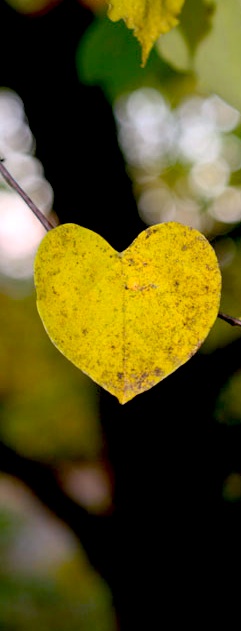
Redbud leaf in fall

Through the blogosphere, I’ve met some fascinating and talented people. The virtual connection, although I have learned to value its scope and immediacy, generally seems a bit wanting in connection for me. Even though I tend toward introversion, my favorite way to connect with people remains face-to-face. [Go ahead, call me old-fashioned.]

In the days of listservs and message boards, I first began “meeting” colleagues online. I signed up for the Women’s Poetry listserv (Wom-Po), which is still active today. One of the best things about that list, besides the fact that I learned a great deal about poetry/women’s poetry/teaching poetry/contemporary and historical female poets, is that I met many of my colleagues in person while attending writer’s conferences, readings, and similar events.

What joy for a person like me, who tends to be a bit reserved about meeting new people. For introverts, a virtual introduction and conversational exchange online–even just recognizing a name on the listserv–has made possible a route to social icebreaking at conferences like AWP.

This past Saturday, another virtual connection joined the realm of the physical when I got the chance to meet–in person–artist Deborah Barlow at the opening of her show at Morpeth Contemporary gallery. I’ve seen her artwork on her homepage; but as is often the case, viewing the work in person was revelatory and beautiful. And meeting the artist herself–also revelatory and beautiful!

I recommend her blog, Slow Muse, which has alerted me to many a terrific book on creative thinking, the creative process, and poetry as well as introduced me to several wonderful contemporary artists’ work.

As the seasons undertake the dying-toward-renewal process, I welcome musings and inspirations. The shining, textural depths of Barlow’s paintings offer another way of looking. As do good books and sunny mornings on the back porch.

Gratitude & Qigong

My mother is still living. I am grateful for that.

My mother and I get along well. In that, we are fortunate.

Furthermore, although she is an octogenarian, my mother is in reasonably good health. Another reason for gratitude.

Her interests are varied, and she’s willing to try new things. My mother has always been quietly innovative about life. She has pursued alternative therapies for health and emotional well-being, read difficult texts, studied disciplines and subjects that challenged her, traveled the world, lived in foreign lands.

Mostly, she has been a care-giver of one kind or another. This past weekend, I took my mother with me to a Qigong and Mindfulness retreat, thinking she could use a couple of days of restorative practices and a little time off from care-giving for others in order to care for herself. In addition to several hours of “medical qigong” (Yi gong), we learned some practices for spiritual qigong (Tao gong), got information about implementing a plant-based diet, observed a tea ceremony, tried our hands at Chinese bamboo brush painting, and followed a labyrinth path in a walking meditation. It was quite a significant conclusion (of sorts) to my recent weeks of thinking about consciousness as presented by various “Western” thinkers on the subject.

Yin-Yang

Kirkridge Retreat Center hosted the weekend. Kirkridge’s organization is dedicated to peace, compassion, and community–to the concerns of social justice and to individual healing. It is a peaceful place, located on a steep, wooded hill. The setting alone fosters a sense of restorative energy. Our teachers were excellent, informative, and full of grace. The meals were terrific. The crickets sang sweetly and the moon shone amidst the clouds. My mother and I felt grateful for the event, the weather, the place, the people, for the breaths animating our bodies and for one another.

Gopnik enters the English major fray

The New Yorker‘s columnist Adam Gopnik contributes his views about why the English major does or doesn’t matter in the blog accompanying a recent issue. He says, in response to apologists (like me) who contend that English, literature, and the humanities generally contribute to a person’s life experience in subtle, long-term ways:

Well, a humanities major may make an obvious contribution to everyone’s welfare. But the truth is that for every broadly humane, technological-minded guy who contributed one new gadget to our prosperity there are six narrow, on-the-spectrum techno-obsessives who contributed twenty.

Then he points out:

Nor do humanities specialists, let alone English majors, seem to be particularly humane or thoughtful or open-minded people, as the alternative better-people defense insists. No one was better read than the English upper classes who, a hundred years ago, blundered into the catastrophe of the Great War. (They wrote good poetry about it, the ones who survived anyway.) Victorian factory owners read Dickens, but it didn’t make Victorian factories nicer. (What made them nicer was people who read Dickens and Mill and then petitioned Parliament.)

Okay, he’s a bit broad and snarky there–but that’s his style. And nonetheless, Gopnik argues for space in society–if not necessarily in the academy–for the study and discussion and obsession with books and literature. He claims that “the best answer I have ever heard from a literature professor for studying literature came from a wise post-structuralist critic” who said the reason he was a literature professor was because he had “an obsessive relationship with texts.”

I would agree with that reasoning, though I am not a post-structuralist, so far as I know.

I believe that education ought to allow us to follow our passions to whatever logical or surprising ends appear. In light of the huge expense of a university education in the USA, however, perhaps the best question to ask is how to motivate citizens to pursue education individually (see my post on autodidacts). Gopnik calls the estimable Dr. Johnson “the greatest English professor who ever lived,” though he never taught in a university and though his title of “doctor” was honorary, and reminds us that other antecedent writers-on-literature, such as Hazlitt and Sydney Smith, “had to make their living doing something else narrowly related.” Colleges at least offer some employment and a modicum of respect to the humanist interpreters and researchers among us, but we need not be employed by the academy to exercise our obsession with books. That can be done on our own.

Dr. Johnson

Gopnik adds this lovely, wise sentence near the close of his column, and I wish I could convey the value of his idea to every college student I advise: “You choose a major, or a life, not because you see its purpose, which tends to shimmer out of sight like an oasis, but because you like its objects.”

Poems, stories, paintings, sculpture, dance, philosophy, books, books, books…I don’t know my life’s purpose, but I know the “objects” that entrance me.