Energy & stamina

I have been thinking about energy and stamina, and the difference between the two, and how they relate to creative practice. The word “energy” conjures up, for me, vigor and forcefulness, vitality, strength–a sort of bustling intensity, the kind my son exhibited when he was five years old, for example. I have never considered myself a particularly high-energy person.

Think of the cat. A cat is capable of intense bursts of energy but will also husband that energy until the moment it’s needed. The cat will also sleep most of the day, storing up energy for the necessary predatory expenditures of strength. The feline form of energy use does not suit me very well, though I am partial to naps.

Stamina, however–stamina I have possessed. Stamina is also strength, also energy, but it is of a different nature. Plodding sometimes, headlong other times, but steady in the main. The sort of focus and determination a person needs to get through the long haul strikes me as stamina. Stamina is the energy to endure.
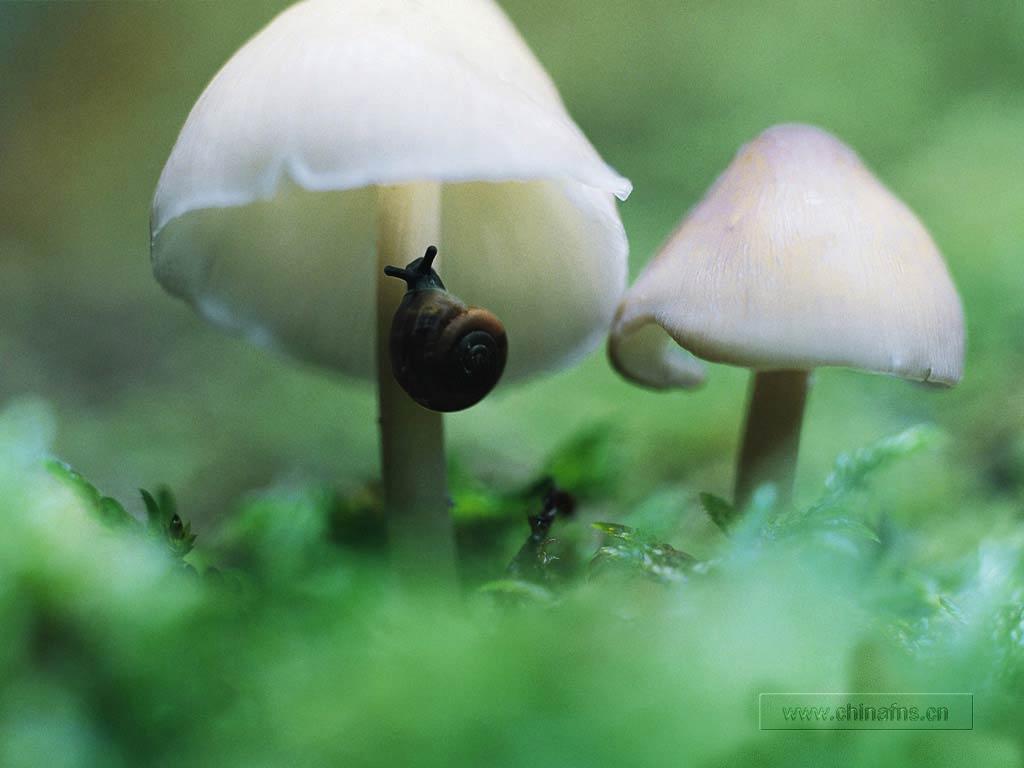
free kewlwallpaperWe have the mayfly and the bee, always buzzing actively, bursting with lively energy. Or the cat, conserving and then pulsing with strength and force. And we have the snail, constant and enduring, slowly edging its way toward its object.

My writing practice requires endurance, because I only occasionally get flashes of inspiration or insight and rarely feel surges of creative energy. Nonetheless, I have been told I am a “prolific” writer (by whose standards, I always wonder; compared to Georges Simenon and Alexandre Dumas, I am a piker). I think the reason is that I keep on. Everyone experiences setbacks, rejection, dry spells, discouragement, dull days. How we choose to deal with those situations becomes part of our practice of the discipline of art, and many approaches “work.” Whenever I read biographies of artists of any kind, or interviews with poets and writers and choreographers and composers, I recognize that (despite post-modernist critique) the life, in terms of personality and approach, does to some degree influence the art.

But the results are impossible to stereotype. A talkative, energetic artist may produce quiescent, meditative art. A dour personality can produce hopeful poetry, a still and soft-spoken person may create fierce, kinetic work.

A highly energetic person like Rimbaud can “burn out” on a major art form rapidly (though his busily-spinning, adventurous life kept going). And then there are the energetic sorts who just keep making work with boundless, apparently inexhaustible fire (see Simenon). One method or personality is not better nor more suited to art than another.

~

This is my minuscule revelation for the day: The one time I visited a shaman, I was told that my totem animal is the snail. The idea gave me a moment’s pause, but then seemed somehow very apt.

Except I was a little queasy about the slime trail.

~

I decided I can reframe the fact of slime once I recognize its purpose. It is not merely a lubricant, helping the gastropod to glide along, but also a glue that enables the creature to climb difficult surfaces, walls, and even ceilings. The layer of mucous also acts to protect the snail from dehydrating.

There must be a metaphor there somewhere. Poetry as…snail slime?

~

Time to keep plugging away, I  think.

Silence (John Cage, Zen, head-noise)

Slow Muse blogger Deborah Barlow–artist, critic–recommended Kay Larson’s recent book on John Cage, Where the Heart Beats. Silence was so significant in Cage’s work and thinking that, given my recent reflections on noise or lack thereof, this seemed the right time to pick up that text. Lo and behold, synchronicity of several kinds. The author, Kay Larson, thanks John Daido Loori, a rōshi of the Mountains and Rivers order of zen Buddhists and long-time abbot of Zen Mountain Monastery near Woodstock, NY. She studied with him beginning in 1994.

In 1992 and 1993, I attended two weekend retreats there; the brief days remain vivid in my memory. Perhaps more on that another time. Haiku is involved…and silence.

Recently, given some irregular bumps along the walk of life that have led to excessive “head-noise” (my term for stress I can’t quite let go of), I have been returning to some zen-influenced texts and trying to remember to breathe and to be here now. Arne Naess’ writings on joy and environment and Buddhism–I’ve just finished reading a collection of his essays–dovetail very neatly into this reflective book on Cage’s life, work, and influences. Larson’s “Zen” approach to writing about Cage is so gentle and refreshing that reading this book soothes me. I find within myself a kind of inner silence, my breathing returning to its slower, quieter pace, as I read the brief selections of prose Larson uses to explore the life of the mind of this peculiar and innovative artist/composer/writer.

Very like philosophical analogies, Confucian fables, parables of many cultures, koans, meditations, prayer and other forms of contemplative practice.

What reduces head-noise? For me, the best strategy is calmness, but I am not an adept at meditation. I have sat zazen badly, and learned much from the practice of sitting zen badly, but I have never managed to make meditation a genuine practice in my life. Deep breathing and slow movement, such as tai chi or qi gong, seem to work better for me. In addition, the Quiet Place. I settle down better when I can detach from computer, phone, electric lights, appliances. Art reduces head-noise: art requires attentiveness. Poetry, yes. Gardening, walking out of doors–good choices. Music, sometimes.

Philosophy, not so much. (Alas.)

Politics? Weather reports? Analysis? ….as the Buddhist monks might say: mu. Translation into teen-speak from five years ago: “not.”

And also, compassion. The practice of compassion keeps a person attentive and also relaxed. It is a form of active prayerfulness, of acceptance of self through the acceptance of others. After the bruises and bashings of a presidential election year in 21st-century United States, a little compassion would reduce the malaise and anxiety we have had to endure intellectually, emotionally, and–in the wake of bad storms on the east coast–physically.

I give you Quan Yin, or Guanyin, or Kannon Bodhisatttva, known as Avalokitesvara  in Sanskrit and termed the goddess of mercy, a counterpart to the Christian Jesus or Mary. This being represents the compassionate, merciful, kind, non-judgmental, accepting aspect of the cosmos, the universe, or god. I realize that it seems I may have wandered a bit far afield of Cage at this point. But read Larson’s book; I haven’t drifted as far from my topic as it seems.

And just because it does seems as though I am rambling considerably in this post, I think I can close with a poem from my collection Water-Rites, and somehow make it fit with these topics:

Intervention

I am thinking about the cowbirds who fought
in my driveway this morning
and how they struggled, one overbearing the other,
pecking at its head, keeping it pinned
to gravel. I wonder, now, why I chose to stop
and free the losing bird from its aggressor,
lift its bloodied damp body in my hands,
rescue it even though
it was also a cowbird, a pest
that usurps the nests of thrushes—
although I respect the dominion of beak & claw,
I want to preserve the generation
of songbirds; there was no reason for me
to intervene, no logic but somehow I felt
surely there is a place,
in the battle that is this world,
for the mandate of compassion.

© 2012 Ann E. Michael

Another Reading reading

On All Saints’ Day, November 1st, I’ll be reading poetry in Reading Pennsylvania–again! And this time, I’ll be accompanied by my fellow Goddard alumna, the dynamic and talented Barbara DeCesare, author of Jigsaw Eyesore and Silent Type.

Reading, PA is home to GoggleWorks, a former goggle-making factory that now serves as studio, theater, and gallery space for Berks County area artists and craftspeople of all kinds. Small, struggling cities like Reading are turning to the arts as a means to fill abandoned factory space and create an economic and cultural reason to keep downtown areas alive. Sometimes these efforts succeed, sometimes they don’t. GoggleWorks opened in its current incarnation in 2005. So far, that’s a 7-year run, supported through grants and donations and rent. I am optimistic about GoggleWorks and about other such endeavors, including Bethlehem PA’s Banana Factory, which is a little closer to my neighborhood. I strongly believe the arts belong in our neighborhoods, in our school curricula, and in our lives.

I’m thrilled, therefore, to be reading from my book, Water-Rites, at 6 pm November 1st at GoggleWorks’ Cucina Cafe.

And I’m thrilled to be reading with Barbara, whose work is funny, poignant, imaginative, fierce, and charming by turns.

November 1st is the Day of the Dead in Mexico, a good day for elegies and to celebrate the lives of those we’ve loved and lost. I will be thinking of David Dunn, among other dear ones. And in honor of All Saints’ Day, I may also read a poem or two about saints; recently, I’ve composed a few imaginary lives of saints poems.

I have no idea what Barbara DeCesare has up her sleeve for this event, but it is certain to be delightful. If you are in the region, stop by at 6 pm. I believe an open mic follows the reading.

water-rites by Ann E Michael

Arts festival

Early autumn is a lovely time for festivals. The city of Easton, PA–situated on the Delaware River–is hosting its 15 annual Riverside Festival of the Arts. There will be music, art shows, food, etc. on September 22 and 23.


At noon on the 23rd, I will be reading poetry with Diane Lockward at the amphitheater. Next to the river: a perfect site to read from my book Water-Rites.

~

The link is here. Or check the Events tab above.


Poetry, art, & a little bit more about libraries

After writing about some memorable libraries lately, I realize that I have been able to pursue my passions–indeed, discover my passions–largely through the help of these marvelous civic institutions. It is time I brought my posts back to those passions, however, particularly to my love of poetry.

My family introduced me to poetry through nursery rhymes and hymns and taught me to love narratives through story-telling of several kinds, so the foundation for my lifelong love of stories and poems existed before I ever set foot in a library; but books solidified and focused my various enthusiasms, and libraries offered more books than I could hope to read (though I tried!). Libraries led me not only to novels and poems but to books on visual art, art museums, artists, art history, and art criticism. If I couldn’t get to the Louvre or Rijksmuseum, to Venice or to Rome, I could borrow an art book from the library and be on my way via imagination.

When I got to college, I spent many hours in the library on campus borrowing books I couldn’t afford to buy. Few of those books were required for my academic studies; in fact, I don’t recall doing much research for term papers. I was reading up on and diversifying my own interests, often unrelated to coursework. A look back at my undergraduate transcripts reveals only two classes specifically devoted to poetry, but I recall reading many poetry collections in the campus library. As a junior, I had a work-study job in an office in the library basement. When my hours were up, I’d walk upstairs to the stacks.

I was finding my own way to what I loved.

~

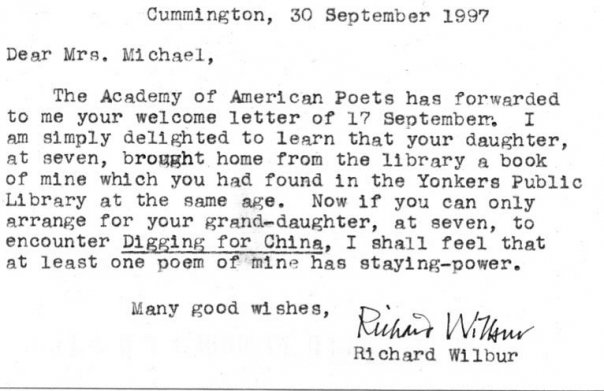
Needless to say, once I had children of my own, we visited the library often. Years ago, I wrote to the poet Richard Wilbur to tell him about my 2nd-grade daughter’s encounter with Digging for China and how, nearly 30 years earlier, I had been fascinated by the book too. He replied with this modest note. June 2009, I saw Wilbur at the West Chester Poetry Conference. What a talented writer, and what a sweet man.

~

Richard Wilbur

Libraries & book love

In my last post, I drifted onto the topic of libraries–and stirred up images of favorite places. Libraries have certainly been among my favorite places and loom large in my childhood memories. Two of those libraries were new when I entered their doors: the Grinton I. Will Library in Yonkers, NY, which opened in 1962 (I first visited in 1964) and the W. Leslie Rogers Library in Pennsauken, NJ, which opened its doors in 1971. I recall a few distinct discoveries even from my first-grade forays to the Yonkers library. It was there I discovered Richard Wilbur’s Digging for China, a book I adored.

Free public libraries represent one of the best uses and most noble purposes of the tax dollars and philanthropic gestures of citizens in a democratic society. These buildings, some grand and some exceedingly modest, harbor banned books and out-of-print books and sections devoted especially to children’s books; a library admits of free speech and liberated thinking for people of all ages. A library, by its very existence, reminds citizens that education matters and that information can be free, can be borrowed, can be disseminated and shared.

When I was a child, libraries were safe places to hide, to explore, and to pursue my own interests–which often varied quite a bit from the interests of my peers. The library in Pennsauken offered me an early education on visual art. I probably borrowed every book in the place that had anything to do with art or artists, from Aesthetic Inquiry; Essays on Art Criticism and the Philosophy of Art to The Agony and the Ecstasy. The library stocked a book chronicling  the letters of Theo and Vincent van Gogh as well as huge, heavy, hard-cover museum books with color plates of famous artwork. Some of these were stamped more than a few times with my library card’s number.

I also borrowed, and read–enthusiastically and, occasionally, dutifully–classic novels that I had somehow learned I “ought” to read. I read a fair number of junky novels, too, and young adult fiction, and children’s books. Even though I was nearly ten when Leo Lionni’s Frederick was published, I loved it and never considered it a “little kid’s book.” Interestingly, Frederick the mouse gathers images and turns them into words. He is a poet. (A word-artist).

Books: Anything, everything, as bibliophile overlaps with autodidact.

Books were my first and often my best teachers, though I have been fortunate enough to have had some wonderful teachers (formal and informal) in my life. One of them, my grandmother Edna Michael, will always be closely associated with libraries in my heart and memory. She was the Story Lady at her small-town library in South Whitley, IN; and my siblings and I spent many hours in the small white building that housed South Whitley’s free circulating books. We read, and we listened to her read. She would don “an olden-times dress” she’d designed and sewn herself, tie on a large matching bonnet, and gather the town’s youngsters in a circle on the library floor for story time.

She always left the library with at least a couple of grownup books for her own reading material. I was proud to be like her.

A few years ago, the town enlarged its library, added a new children’s wing, and dedicated it in my grandmother’s name. Edna Michael, the Story Lady.

I’m pretty proud of that, too.

ann e michael

The South Whitley Library as it was in 1967, with my grandmother in her Story Lady attire.

“Not Writing”

~

Above, a lovely Jane Kenyon poem and a brief, relevant post from Deborah Barlow, artist, from her blog Slow Muse.

Deborah Barlow's avatarSlow Muse


Wasp’s nest: Entrances abound, but are hidden

Not Writing

A wasp rises to its papery
nest under the eaves
where it daubs

at the gray shape,
but seems unable
to enter its own house.

–Jane Kenyon

This poem is so succinct and so artfully constructed. Haven’t we all had that daubing frustration of madly circling and yet not being able to enter in to where we need to be?

The texture of my life in the studio is like the texture of my life in general: full tilt highs, full tilt lows, and lots of miles in between.

I’m just back from three magical days in Vermont, visiting friends and basking in a landscape that is richly rewarding on so many levels. I didn’t miss being in the studio once. In fact this protracted channel change felt like much needed relief from a fierce summer stance to rouse the inchoate…

View original post 45 more words

Poems that help us to endure

I’ve recently completed reading Eugenia Semyonovna Ginzburg’s memoir Journey into the Whirlwind. What has struck me about the memoir is, in particular, Ginzburg’s reliance on poetry as a means to enduring prison, deprivation, oppression.

In several selections, she reiterates how reciting or recalling poetry–Pushkin, Pasternak, Blok, Mandelstam, and lesser-known (to us Westerners) poets such as Tyutchev, Chorny & Nekrasov–gave her hope or encouraged her to keep on in the face of awful situations, or just to remind her that others have endured harsh and terrible conditions and found the means to express themselves despite it all.

I believe poems–and art of all varieties–help us to endure. Some poets who have helped me to endure include Anna Akhmatova, Mark Doty, Mary Oliver, Gregory Orr, John Donne, Yehudi Amichai, Stanley Kunitz, Donald Hall, Emily Dickinson, Adrienne Rich, Marie Ponsot, and others. Too many to name.

Who has helped you to endure? Whose art, whose poetry, whose stories, whose music?

When we reflect on these creations, perhaps we can learn more about ourselves.

Love is all you need?

My daughter made this collage when she was nine years old. This is a poorly PhotoShopped version (the original has faded pretty badly):

~

Love is all you need

I was listening to The Beatles recently, music that takes me pretty far back into my childhood. I’ve been thinking about musical cues to memory for another poetic project on which I am currently working, so the concept of music evoking imagery, subjects, memoir has been uppermost in my mind. More on that project perhaps later, when I have arranged my thoughts more cogently. Meanwhile, some thoughts on “All You Need is Love.” Or more correctly, some musings that begin with “All You Need Is Love.”

When I was an adolescent, that Beatles’ song seemed to signify on several levels. One level was the universal: Love as the root of human sharing, as the means to peace and understanding, as the solution to the Big Problems. Another level was the romantic: Love as the way to solve personal loneliness, finding the partner with whom I could mesh, forge a permanent and personal understanding.

Love as solution. I view that ‘philosophy’ as a non-philosophy now; it is simplistic and impossible. Love is not a solution; it is a verb, active and engaging. Love certainly does not fix things. Its necessity, however, I do not question. Not for those who wish to be fully human.

Wait, you’re going to object–love is a noun, too. In most dictionaries, love as a noun is the entry before love as a verb. Arbitrary on my part to assert precedence for the verb, but I am cautious of abstractions even though I relish philosophy. Love as noun is abstract.

Merriam-Webster: “strong affection for another arising out of kinship or personal ties.” My OED (compact, print edition) contains 9 columns defining Love as a noun and two defining Love in the verb sense.

When I say love is a verb, I mean that in definition 3b in the OED: “to entertain a strong affection; in the reciprocal sense” and 4c: “to take pleasure in the existence of (a virtue, a practice, a state of things) in oneself, in others, or in the world generally.” Love need not be reciprocal, though that feels best to us–hypersocial beings that we are (see my post on Brian Boyd). Love is the greater part of compassion, in which case love is something we do.

I know people who have chosen to take their own lives. A few felt the sense of despair that comes from feeling there is no love (and therefore, no hope). But that is not always the case; some who took their lives did feel love, knew love deeply, knew that others loved them and would miss their physical presence. Love was not all these people needed.

And love was not the solution.

I think we damage ourselves when we believe that love is the solution to our problems. We need other strategies, other fullness in our lives, the tools to overcome or bear with many obstacles; we need perspective and humor and grace. Love alone, in and of itself, doesn’t make peace break out. It does not solve all the issues in a truly profound and sharing relationship–not on its own. Love needs other actions, and other abstractions (trust, communication, compassion, patience, for example) to do its work. It does not solo well–that is not what love needs. Altruism cannot exist in a vacuum, nor can romance, nor compassion.

It takes some effort not to become sentimental here (but Bachelard defends a certain amount of sentiment…)

This is not my definitive post on the subject of love! I need to read more philosophers on love, and to consider love’s evolutionary role, and its spiritual role, in human existence. I’ve done reading on t his in the past, but it was all very long ago. Now might be a good time to begin anew (since “I was so much older then, I’m younger than that now”).

Empty nest

robin nest empty nest Ann E. Michael