Altered perspectives

One of the arguments Arthur W. Frank makes in his book The Wounded Storyteller–and in his subsequent books about “illness narrative”–is that there’s a compelling ethics for medical diagnosticians and caregivers involved in just listening to the other person’s story. The difficulty emerges when the storyteller cannot put his or her story into words or lacks enough objective distance from the illness to narrate the kind of story that others are expecting.

When people’s circumstances push into the chaos realm, they’re in the midst, overwhelmed; few of them can construct a cogent and concise narrative. In their pain, in their grief, everything seems equal–no beginning, no end, all middle.

The listener expects: a beginning. a middle. an end.

The listener expects: chronology. a goal. a desired outcome.

If the listener’s job means determining a course of healing, the listener requires history, onset, comparisons. Truly good diagnosticians therefore need more than sleuthing skills, experience, and education. They need to listen well in the midst of the storyteller’s chaos; Frank calls this listening with.

That often means taking a deep breath and endeavoring to change perspective.

~

[Which, by the way, is excellent practice for poets.]

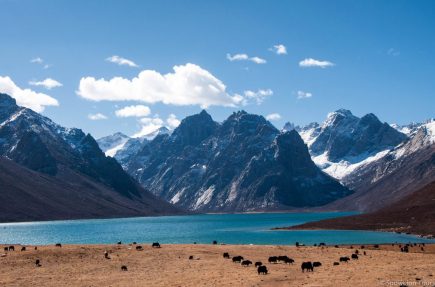
Tibet-Mountains-Everest-Kailas-Tibet-tours-Tibet-travel-Tibet-trekking-Tibet-hiking-3-of-8-1024x676

Himalayas: view from a high lake plateau (Snow Lion tours)

natural_fractals_tibet

Himalayas from satellite: a fractal view

~
We cannot climb into an airplane and get an overview of a human being’s situation. Nor can we get into another person’s thought processes to determine what’s going on. Listening without rushing the person, without offering advice, without finishing the sentences with what we expect to hear–that’s a hard task.

In a previous post, I tried to replicate what it was I could hear when someone I cared for experienced cognitive damage.

It was very, very difficult to listen. For me, heart-breaking because of my previous understanding of who the person was. It was only in her final days that I started to realize I’d needed to change in my relationship with her in order to get some idea of what she wanted to say. And it was too late, really.

~

As another Best Beloved is now experiencing significant cognitive changes, I want to do better. I need to acknowledge the chaos narrative, the interruptions, the lacunae in the person’s story. It’s important that I develop a new perspective on what a conversation entails, too; my expectations surrounding a conversation no longer hold, and both of us will get frustrated if we stick to former habits.

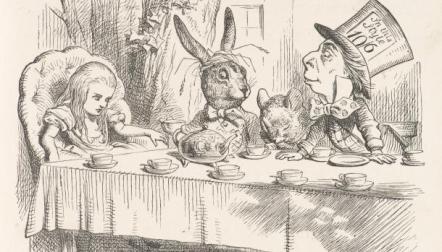
If sometimes a visit feels a bit like the Mad Hatter’s tea party, so be it. There’s a story in that, after all, thanks to Charles Lutwidge Dodgson.

mad hatter tea party tenniel

Tenniel’s sketch for Alice’s Adventures in Wonderland

And, just as an aerial view of the Himalayas alters the perspective of what the mountains are and how they appear, an altered perspective of a loved one keeps the person, as a human being still in the world (no matter how changed), in view. True, perhaps with changed patterns and unexpected gaps that we who love them may grieve the loss of. The conversations may be interrupted and chaotic, or full of long pauses and grasping for words and concepts. It is just a different kind of human communication.

Not what I expect, but what I am given. I’m trying to listen with, before it is too late.

Listen better

Arthur W. Frank’s The Wounded Storyteller, which I’m currently reading, deals with medical ethics, personal narrative, illness, and the community (all of us, really) who may need care, give care, and/or who realize there is a socio-emotional impact when friends, coworkers, and family members become ill and thus require care. A sociologist by training, Frank examines illness stories as testimonies that point to a social ethic and asks all of us both to tell more when we experience pain and to listen better when others are telling us about their experiences of illness.

“Tell me about your despair, yours, and I will tell you mine.”

Mary Oliver, from “Wild Geese

At first this idea sounds unpleasant–one thinks of the stereotype of tedious conversations among the elderly about various surgeries and too-intimate revelations about prostates, livers, stomachs, and bowels (my dad calls these monologues “organ recitals”). That response–evasion, withdrawal, revulsion–is exactly what Frank seeks to change.

But then I consider the way I have heard stories of illness experience from hospice patients. How varied they can be. Some fragmented, some specific, some pious, some stoic, some anxious. And some that are beautiful. These stories aren’t just for (about) the person who has undergone the suffering. They are also for me, the listener. “When any person recovers his voice,” says Frank, “many people begin to speak through that story.”

He later writes:

One of our most difficult duties as human beings is to listen to the voices of those who suffer. The voices of the ill are easy to ignore, because these voices are often faltering in tone and mixed in message, particularly in their spoken form before some editor has rendered them fit for reading by the healthy. These voices bespeak conditions of embodiment that most of us would rather forget our own vulnerability to. Listening is hard, but it is a fundamental moral act…in listening for the other, we listen for ourselves. The moment of witness in the story crystallizes a mutuality of need, when each is for the other.

He would like to see an ethics among medical people and caregivers that dictates not just a compassion for the lot of the ill person but a perspective that the person, as a person, is not diminished by the fact of illness–not made into data, case study, or even into patient or client, any of which reduces the person to a body containing disease or disability. He argues for a full embodiment of pain in narrative as well as in physiology, for only with and through storytelling can we begin to experience the perspective of the other.

I am not very far into the book yet, but I’m finding the concepts relevant to my current life circumstances. I know how deeply I treasure a good listener. So working on listening better, myself, offers more people the chance to recover their voices, to speak through story.

Trees

The catalpas are blooming, really putting on a show this year–huge crowns full of white blossoms. I suppose the climate this year contributed to this show somehow, but my research says catalpa speciosa is drought resistant and requires little water compared to other tree species.

casp8062

catalpa in bloom

Eastern Pennsylvania has not had drought lately, and two wet springs in a row have meant burgeoning iris pseudacoris and particularly floriferous honeysuckle vines in my yard. The river birch seems happy with its feet all wet; the firs–though in a slightly less waterlogged area of the yard–are, by contrast, miserable.

~

I’ve been thinking about trees because I’m reading Peter Wohlleben’s 2016 book The Hidden Life of Trees. The text reads like a friendly forester inviting readers to learn what he loves about trees and their encounters with us, with the environment (soil, air, sun, water, pollutants, pests, fungi), and with one another. I have to say I remain somewhat skeptical about the scientific veracity of his source material, but I do enjoy his warm enthusiasm for his subjects and his reminders that we humans don’t know even the smallest fraction of what goes on in the planet’s interconnected and unplumbed depths.

Although some critics object to what they see as too much anthropomorphism in Wohllebehn’s book, his use of the analogy of the human and the tree “bodies” makes his information about how trees and forests work easy to grasp.

For science nerds, there are other texts. The Hidden Life of Trees is meant to make the less scientifically-inclined reader more aware of his or her environment, to convince the average human being to consider plant life more consciously.

~

I take many photos of trees; and they appear in my poems pretty regularly, not as main characters but in supporting roles–not symbolic, but actual. Wohllebehn’s book may influence my work somehow…possible inspiration? But then, the trees themselves, especially the oldest ones, are inspiration enough.

sycamore

This 200-year-old sycamore resides at Bartram’s Garden in Philadelphia


Collection

As I’ve previously mentioned–I have been putting together another manuscript of my poems–a collection. I had a few ideas on how to make the poems work as groups, but it turns out they are not happy together. I don’t think a poetry collection needs an “arc,” but I like to have the poems converse with one another in some way. Resonate with or inform one another. That’s what I am enjoying in Louis Simpson’s 1980 collection Caviare at the Funeral. I realized my aim in collecting my work was off when reading his book just recently…and now, I am reconsidering my manuscript approach. Again.

This may be one reason why, despite being a fairly prolific and reasonably well-published poet (in journals, etc.), I am so pokey at getting books into the world.

But I am considering what it means to be a collector, which is not the same as a curator. There is a difference between collecting one’s work and curating it into an experience for a reader (including oneself). Curating has never been my strength: I was the kind of child who collected things randomly, attempted to organize a doll or rock collection, but mostly just had little piles of stuff that interested me.

That’s poetry, too…little piles of stuff that interest me.


Cartography

Reading Mark Monmonier’s 1995 book Drawing the Lines: Tales of Maps and Cartocontroversy got me thinking about names and boundaries.

Human beings name things so we can communicate with one another, and then we tell stories to remember the names, encoding them in the language of later generations. New occupants–and colonizers or conquerors–claim and rename to communicate to their followers.

This mountain is Mount McKinley (or is it Denali?), this one is Sagarmatha (or is it Everest?). Keep it in view to your left side and you will be progressing northward.

Big objects accrue many names. When you come to the river called Misi-Ziibi (or Yununu’a, or Báhat Sássin, or…), you must ferry across at the place just south of X. Furthermore, the big river moves, as Mark Twain* knew (see Life on the Mississippi); and as it moves it affects human-made boundary lines that we use to determine tax-base and property ownership and state borders.

Not to mention nationhood.

Monmonier rightly observes that most people assume that maps are factual representations of the physical and legal/abstract/imagined aspects of the “real” –and that assumption is incorrect. Maps can be manipulated. They can be propaganda. They can be drawn to reflect anything the people hiring the cartographer want to emphasize, or erase.

My husband has a German map from 1941. There is no Poland on it, no Austria, no Lithuania, no Ukraine…

~

When we built our house, I wanted to come up with a good name for it. Then I realized that the housing developments in our region all seemed to be named after things that weren’t there any more: Field Crest, Orchard Acres, Stony Meadows, Fox Stream…and the urge to name my house began to quiet down. Besides, all along I have recognized that the area around boundaries is more interesting to me than what is in the middle. Edges–the fringes, the spaces along and between–

And yet I’m trying to create boundaries around my garden to keep out the field voles, stands of cleome to discourage the deer, as another rainy spring keeps my shoes and gloves muddy and the weeds vigorous and tall. Paradoxes.

Reminds me that my favorite Whitman** quote when I was a teenager was: “Do I contradict myself? / Very well then I contradict myself.” At 16, however, I never thought to include his marvelous parenthetical line “(I am large, I contain multitudes.)”

(I am large, I am boundaryless).

~~


*Another example of name-changing that humans are so fond of.

** The 31st of this month is his bicentennial! I’m participating in a reading–see my Readings & Events page.

Etc. & refrains

Some years, I have devoted my National Poetry Month energies to attending readings, getting out in the world to listen to writers; some years, I’ve tried hard to submit at least 30 poems to magazines and journals; some years, I have read two poetry books a week for the month of April. This year, I wrote a poem draft a day. OK, now what?

When you love poetry, you do all of these things anyway. Having a month to celebrate the art merely acts as a public awareness campaign, though it has reminded me, year after year, to aim for a bit more discipline in my creative life.

~

I have also been reading, of course, bookish person that I am; this past month, a real standout–and a difficult book in a few ways–was An Orchestra of Minorities by Chigozie Obioma. The novel offers a way in to the cosmology of the Igbo people (Nigerian, mostly) while wrenchingly capturing the anxieties of modern life and the timeless agonies of lovers separated by class, race, status, religion (whatever gets in the way of lovers). Obioma successfully interchanges voices, languages, creoles, narrating from the point of view of a guiding spirit. Spoiler alert, the book ends with tragedy, and there are tragedies large and small throughout. The tension of human anxiety works really well, and all of our fears.

The guiding spirit, who has accompanied centuries of human hosts through their lives, has a refrain: “I have seen it many times.” I thought of Vonnegut’s “So it goes.”

Trying to imagine my own refrain…it might be something on the lines of: Life’s difficult, so we have art and poetry and love and one another to get us through.

alice-heart1 copy

art by my daughter at age 8


Rhyme

Rhyme comes easily to some people. For me, rhyme presents no problem as far as lighter verse, parodies, ditties–which have their place in literature and in culture. In more introspective or reflective verse, though, rhyme tends to elude me and often seems not to mesh with the poem’s mood. Revising toward rhyme often succeeds in assisting the metaphors, imagery, or tone, however. Usually assisted by some sort of metrical strategy.

Today my poem-draft-a-day offers evidence of how rhyme can appear spontaneously in a poem’s first version.

If you are interested, here’s an excellent book on rhyme in poetry: Rhyme’s Reason, by John Hollander & Richard Wilbur–welcome authorities on the subject.

Quite long ago now, I dwelt in cities for a few years. The contrast to my current environment startles me now and then, makes me remember those years.

~

Outmoded

His back aches. It hurts to move.
How did he ever get so old?
The work it takes to walk a block
to buy a paper! Then he’s told
the news is found online, where he
can read it on a mobile phone.

He hates the sound of that idea–
the text so small–and, when alone,
he likes the paper’s rustling noise.
It’s domestic. One of life’s joys.
The work and pain are thus worthwhile.
That, and the newsstand vendor’s smile.

~

man sitting reading newspaper

Photo by Daria Obymaha on Pexels.com

Poetic naturalism

I have been reading poetry, as usual, and also non-fiction about various aspects that could be deemed scientific, such as Michael Pollan’s Changing Your Mind and physicist Sean Carroll‘s book The Big Picture. 

On my way to work, I posed (in my mind) an argument with Carroll about his use of the word “poetic” in his definition of poetic naturalism, which he defines thus:

Naturalism is a philosophy according to which there is only one world — the natural world, which exhibits unbroken patterns (the laws of nature), and which we can learn about through hypothesis testing and observation. In particular, there is no supernatural world — no gods, no spirits, no transcendent meanings.

I like to talk about a particular approach to naturalism, which can be thought of as Poetic. By that I mean to emphasize that, while there is only one world, there are many ways of talking about the world…

The poet Muriel Rukeyser once wrote, “The universe is made of stories, not atoms” … There is more to the world than what happens; there are the ways we make sense of it by telling its story… The world is just the world, unfolding according to the patterns of nature, free of any judgmental attributes. But these moral and ethical and aesthetic vocabularies can be perfectly useful ways of talking about the world … We just have to admit that judgments come from within ourselves.

Despite my doubts about his use of “poetic,”  it may be that Carroll’s term describes me; at any rate, his definition comes close to my own thinking about the world.

And hence, another draft for my poem-a-day challenge.

~

Brown leaves bouncing across Preston Lane
late afternoon, air currents swirling.

Road shoulder cradles raccoon carcass,
fur shudders, though body’s still, and sun

highlights the gray-white hairs as travelers
speed past. Chlorophyll greens local lawns

and ditches beside the creek, molecules moving,
nitrogen atoms taken up through root and rhizome.

Sudden, yellow, early–narcissus blooms near
the neighboring farmhouse–all of which

recommends itself as The World As It Is.
A reality for at least one universe,

even though there exist other possibilities
in the realm of Undiscovered.

daffodil photo Ann E. Michael

Book review, mind review

My book group chose to read Michael Pollan’s latest: How To Change Your Mind. The subtitle says a lot: What the New Science of Psychedelics Teaches Us About Consciousness, Dying, Addiction, Depression, and Transcendence. That’s a bundle of complicated concepts Pollan takes on, but he recognizes his task looms large and that he can only make forays into the many overlapping arenas the book explores.

His approach–he uses this in his other books and articles, too–is a mix of serious research and journalism (interviews, mostly) and personal inquiry and experiences. If you have read Second Nature or The Omnivore’s Dilemma, you might find this one to be a more “difficult book.” It is heavily documented and features neuroscience (brain pathways and structure, mostly), psychology, pharmacology, and chemistry (tryptamine-related molecules). Not to mention mushroom biology and mushroom hunting, and serum produced by plants, toads, and ergot.

What attracted my book group members to this text is its chapters on dying; as a hospice volunteer myself, and having read articles on the potential value of psychedelics among people with terminal illnesses, this part certainly interested me.

Pollan writes: “The uncanny authority of the psychedelic experience might help explain why so many cancer patients in the trials reported that their fear of death had lifted or at least abated: they had stared directly at death and come to know something about it, in a kind of dress rehearsal.”

These outcomes seem significant enough that we ought to find ways to employ them in our palliative care work. In my own, somewhat limited, experience with dying people, those who are less fearful of death–for whatever reason that may be–stay alert longer, respond better to palliative efforts (pain medicine, massage, positioning, and so on), and are more likely to comfort their loved ones. They die more “easily,” if dying can ever be called “easy.”

~

Yet I found the parts of Pollan’s book which deal with the huge question of what consciousness is and where it resides most relevant to my own interests. Yes–that difficult neurobiology stuff. Pollan suggests, with the healthy pragmatism of the skeptic, that empirical approaches to consciousness based on the idea that “the brain is meat” (viz, medical science) are unlikely ever to explain consciousness fully or to anyone’s satisfaction. In other words, consciousness may possess a component one might name “spiritual.” Here is how he frames this concept:

“…it seems to me very likely that losing or shrinking the self would make anyone feel more ‘spiritual,’ however you choose to define the word, and that this is apt to make one feel better. The usual antonym for the word ‘spiritual’ is ‘material.’ That … is what I believed when I began this inquiry—that the whole issue with spirituality turned on a question of metaphysics. Now I’m inclined to think a much better and certainly more useful antonym for spiritual might be ‘egotistical.’ Self and Spirit define the opposite ends of a spectrum, but that spectrum needn’t reach clear to the heavens to have meaning for us. It can stay right here on earth. When the ego dissolves, so does a bounded conception not only of our self but of our self-interest. What emerges in its place is invariably a broader, more openhearted and altruistic—that is, more spiritual—idea of what matters in life. One in which a new sense of connection, or love…seems to figure prominently.”

~~

When I was much younger, I considered myself “spiritual.” I stopped using the term once I began a more serious exploration of my life and began to study philosophy, psychology, aesthetics, phenomenology, and consciousness more intentionally. But the crucial components–connection, relation to and with others (sentient and not), and love–those I have always understood as necessary. Even though my ego has never “dissolved” quite the way Pollan describes.

So maybe I can go back to considering myself somewhat spiritual. At this moment in life, Nature and Others matter more than accomplishments and outcomes.

Welcome Spring, welcome Spirit. Namaste, Amen.

iris reticulata

iris reticulata

Deer metaphor

I think the best poem about a car-struck deer is Stafford’s “Traveling through the Dark.

Like Hayden Carruth’s “Mother,” (see my last post) Stafford’s poem is, for me, a kind of zenith–something to which I might aspire, but look, it’s already been done. So why pen my versions of the experience? Especially when I am not the writer Stafford was.

And might a reader accuse me of hijacking Stafford’s imagery when I write about similar incidents? I suppose I do run that risk. Nonetheless, the whitetails occur often in my poems from the past 20 years because I live in eastern Pennsylvania. Pennsylvania has an estimated 1.5 million deer—about 30 deer per square mile–and I suspect that in the suburban-rural zones such as the region where I reside, the number is higher. ann e michael

As a writer, my inclination has pretty much ever been to write about environment and place and to supply anecdote or lyrical narrative. Deer abound in my environment and in my work; and deer get killed on the roads here. The imagery lodges in my consciousness. After so many years observing them, deer have become both subject and metaphor. I may swerve, but I cannot always avoid them.

The following poem is from my collection Water-Rites, and here it is the speaker’s husband who pushes the doe’s body off to the side of the road. The presence of children changes the perspective considerably, despite other similarities to the Stafford poem. Maybe that is all I can offer: a slightly changed perspective, a different closure. I cannot un-moor myself from the images and places that inhabit me.

~

Yellow Forsythia

We glimpsed the doe
trying to rise, and failing,
in the roadside darkness.

“Stay here,” my husband said—
and a moment later,
“She’s hit.” I nodded. I’d seen
skidmarks on macadam.

The doe lay on her side and thrashed
while our engine idled,
thrashed, shuddered;
my husband placed his hand
on her neck.

In the car, our son stared
at the darkness. Our daughter wept:
“He’s frightened the deer.
She’s kicking to get away.”

The doe jerked, paused. “No,”
I said, “Your father is touching it.
Soothing it, so it will not die alone.”

He knelt by the quieting body.
Blood ran from the muzzle.
One ear twitched, I could see it
in the headlights. Death
closed in, a gentle exhalation.

My husband eased the carcass
off the road shoulder. He said,
“She must have suffered awhile.”

“Stupid cars,” my daughter muttered.
Her outrage engulfed our station wagon.

My son watched the white-
throated body, the yellow
forsythia lit by car lights.
He said, “Close the windows, please.”

~~

Poet and blogger Molly Spencer recently posted a lively consideration about recurring and repeating images here: https://mollyspencer.wordpress.com/2019/03/07/the-spider-why-the-spider-or-a-defense-of-recurring-images/

Worth a read, and worth discussion, too.