Diversity. Not.

I must admit, it is challenging to read Elizabeth Kolbert‘s book The Sixth Extinction without feeling a bit of dread.

Nonetheless, the book is informative and fascinating–even funny at times–and well worth reading if you are the type who can get beyond your anthropocentric leanings and attempt to view the long-range picture from a scientific, if not exactly neutral, viewpoint. Her main argument is that we are, indeed, in the midst of a 6th mass extinction era and that human beings are “the weed” that most likely is the cause of these numerous extinctions–and not just since the industrial revolution, but eons before that. Humans travel more effectively than almost any life form, and that leads gradually to a loss of diversity. Read the book to find out how that works.

I find interesting parallels with socio-cultural trends in the ecological struggle for and against diversity. Niche-dwelling creatures or societies adapt to some challenging environment and develop or evolve ways to deal with adversity–cold temperatures, constant rain, saline soils, whatever. Nomadism, for example, is a way to adapt to seasonal weather challenges.

When an ‘alien’ enters a niche area, it usually dies off; but if it can adapt, there is hybridism or conquering. Tolerance, it turns out–living peacefully in tandem using the same resources–is not a common evolutionary strategy, though there are examples of symbiotic ecological relationships and, of course, parasitism of the sort that does not quickly kill off the host. Conquering generally means lost diversity.

When a niche organism ventures, accidentally or otherwise (forcibly, sometimes) into a new region as ‘alien,’ the special characteristics of the creature cause it to die or, in some cases, to have to adapt to a different set of circumstances…and diversity gets lost pretty quickly that way. In my region, for example, wetlands have experienced overruns of phragmites.

Does this sound like emigration? War? Forced removal of peoples? Indigenous populations killed off by measles or smallpox? Young people leaving remote areas to try to find work in cities? I see a metaphor here!

While human beings may try to celebrate diversity (which is better than using diversity to identify and exclude or punish “the other”), we probably cannot keep ourselves from becoming, over the centuries, less and less various. A homogeneous world seems, to me, to be a place impoverished through lack of niches and creative adaptation–but that’s what happens when mass extinctions take place: a depletion of kinds in the fossil record.

You might want to read Robert Sullivan’s New York Magazine article for even more recent scientific evidence if you’re not up to reading a whole book, though Kolbert is an engaging writer and I found her book to be a quick read. And below, some graphic illustrations from LiveScience. Fascinating stuff.

Here in the USA, alas, we seem to be helping the extinction of our own kind along by viewing diversity among people as dangerous. Compound this with a society that permits the ownership, hoarding, and use of deadly weapons on others and which cultivates a cultural tone of fear, anxiety, and entitlement, and there is strong evidence that the human weed will continue the slow but decided progress of the Holocene extinction.

~
Chart of extinction events that wiped out most life on Earth.

Source:LiveScience

Noesis

noesis~

  1. Cognition; perception.
    2. The exercise of reason.

Interesting that definition number two is dependent upon definition number one. Lately I have been thinking about the difference between consciousness and conscience; the latter seems to me to be specifically human, I guess, because isn’t conscience a sort of cultural or judgmental entity based upon rules? Yes, I am talking about morality, a term I tend not to use much when I consider cognition, consciousness, narrative, being.

I recently perused Patricia Churchland’s Braintrust and found myself intrigued about where and in what ways morality and consciousness or sentience mesh. Churchland is a moral philosopher, but this book relies largely on arguments premised on neurology, biology, evolution, and animal studies. Her critics pose interesting rebuttals, too. I found her book readable and often convincing–and it’s the kind of book that leads me to other writers and scientists; I love that in a book!

braintrust~

The phenomenology of consciousness–the carbon body brain-based “real world” idea of the word–involves intentionality, sentience, qualia, and first-person perspective. We can identify qualities based upon our first-person consciousness and respond to them. This process has led Western thinkers toward the concept of reason or rational thinking. The exercise of reason derives from perception.

This does not mean that phenomenology is the sole form of consciousness or even that it is necessarily human-only, but it seems to me to be the easiest one for human beings to wrap their minds around. Yet the earlier philosophers were not phenomenologists. Their speculations about what consciousness originated in and what morality inhered in were quite abstract.

For a good sum-up of how contemporary scholars define and discuss consciousness, go to Stanford’s site here.

~

Being cognizant or conscious does not necessarily lead to moral behavior or reason…or does it? Here we have an idea that has been debated for centuries. In her book, Churchland often returns to Hume, who wrote about morality from what, eventually, became known as the utilitarian stance (though I would argue Hume is not really utilitarian). Stanford offers an overview of morality as defined by philosophers over the years; The Internet Encyclopedia of Philosophy says this of Hume:

In epistemology, he questioned common notions of personal identity, and argued that there is no permanent “self” that continues over time. He dismissed standard accounts of causality and argued that our conceptions of cause-effect relations are grounded in habits of thinking, rather than in the perception of causal forces in the external world itself. He defended the skeptical position that human reason is inherently contradictory, and it is only through naturally-instilled beliefs that we can navigate our way through common life.

These concepts should feel modern to most of us thanks to cultural anthropology, sociology, and psychology, among other disciplines. Hume’s position conflicts with much religious dogma, but his ideas were not out of line with many of his fellow Enlightenment-Era thinkers. During the Enlightenment, intellectuals were enamored of the exercise of reason (noesis).

~

So: consciousness and conscience. First we have the one–however it arises within us*–and the other develops (or evolves?) thanks to the need for social beings to navigate common life. And thanks, perhaps, to brain evolution adapting to social common life (see Churchland for more on this).

Much to mull over during my brief summer break.

~

Jiminy Cricket copyright Walt Disney Co.

Jiminy Cricket copyright Walt Disney Co.

*See my numerous previous posts on consciousness!

⇐ “And always let your conscience be your guide!”


Unknowable

While reading up on some recent theories on evolution and reading for the first time (other than in excerpts) The Descent of Man, and Selection in Relation to Sex by Charles Darwin, I have returned to mulling over the problem of consciousness. What fascinates me is how this topic (consciousness) overlaps with philosophy, physiology, evolution–how and why we developed the brains we have with their attendant egos, theory of self, what-have-you–and with human constructs such as art and religion and morality, which I value for complicated reasons.

And out of curiosity, I took up Barbara Ehrenreich’s Living with a Wild God, which seemed to me a departure from her books until I realized that I was unfamiliar with her earlier work.

Ehrenreich’s book stems from her inquiry into a period of her own late adolescence when she experienced a kind of awakening that defied expression. For another sort of person, this might have been a spiritual encounter; but she was a self-described solipsist atheist who wanted explanations. The why of the world mattered to her–she was headed toward an education in science at Reed and Columbia University, though she did not know that yet when she had her ecstatic sensation. Reading Living with a Wild God reminded me of watching an animal tear and tear and worry at a carcass, not quite able to let go. The author fumes at her younger self for being so unforthcoming with details and suggests she may have been having a dissociative event, a small psychological break. Yet there were no symptoms of such a problem in her diary or in her memory.

She writes a bit about psychology, human consciousness, adolescent daydreaming, rational thinking versus imaginative beliefs, systematic or otherwise. After considerable wrestling and intriguing memoir, she admits that all she can do is speculate about what she felt:

There were no visions, no prophetic voices or visits by totemic animals, just this blazing everywhere. Something poured into me and I poured out into it. This was not the passive, beatific merger with “the All” as described by the Eastern mystics. It was a furious encounter with a living substance that was coming at me through all things at once, and one reason for the terrible wordlessness of the experience is that you cannot observe a fire really closely without becoming part of it…you will be recruited into the flame and made indistinguishable from the rest of the blaze…the only condition was overflow. ‘Ecstasy’ would be the word for this, but only if you are willing to acknowledge that ecstasy does not occupy the same spectrum as happiness or euphoria, that it participates in the anguish of loss and can resemble an outbreak of violence.

In the Bhagavad-gita, when Arjuna sees Krishna-manifest-as-All, the experience is not beatific, any more than Moses’ encounter with God as the burning bush relates an enmeshing with the One; the sense of merger with the energetic being remains absent–there is awe and a sensation that the human consciousness has been irrevocably rattled, altered, changed, but not that the human consciousness melds with that unknowable and indescribable Other.

What drew me to this book is that I had similar, though briefer, experiences when I was young. They tended to occur in flashes, and I associate them now with daydreaming and with a “losing of self”–I really have no words for it, though Ehrenreich’s “overflow” seems about right…one reason Bachelard’s writings on childhood and reverie resonate with me. It’s heartening to find another person, a well-known author, who also has found the experience impossible to formulate in language. I especially appreciate her suggesting “that ecstasy does not occupy the same spectrum as happiness or euphoria, that it participates in the anguish of loss and can resemble an outbreak of violence.” I identify deeply.

Some meditative practices aim to erase, temporarily, the boundaries that keep us from being truly in the world. Some religious practices aim to make the faithful “one with” the deity. Ehrenreich does not possess the kind of mind or personality that seeks answers in those ways. She’s frighteningly intelligent, well-educated, worldly, scholarly, sensible, socially and culturally aware, fiercely atheistic. Yet she cannot quite believe that what she felt, saw, knew, in her body and in her mind, was “simply” something her brain invented. After 50 years, she continues to wonder. I sense she is still tearing obsessively at the unresolved.

Maybe that is enough, to wonder. At any rate, wondering may be as far toward why as any of us human beings will ever get.

Let me remember joy

A good companion

A good companion

Excerpts and links to some vivid poetry as a kind of consolation, thanks to The Poetry Foundation and Poetry magazine, and to some wonderful writers:

Alicia Ostriker’s celebration of animal exuberance in Poetry:

…Pursuing pleasure
More than obedience
They race, skid to a halt in the wet sand,
Sometimes they’ll plunge straight into
The foaming breakers…

~~

A Dog Has Died” by Pablo Neruda

…all his sweet and shaggy life,
always near me, never troubling me,
and asking nothing.

Joyful, joyful, joyful,
as only dogs know how to be happy
with only the autonomy
of their shameless spirit…

~~

Bob Hicock’s “Unmediated Experience”

She does this thing. Our seventeen-
year-old dog. Our mostly deaf dog.
Our mostly dead dog, statistically
speaking. When I crouch.
When I put my mouth to her ear
and shout her name. She walks away.
Walks toward the nothing of speech.
She even trots down the drive, ears up,
as if my voice is coming home…

~~

Mary Oliver has a recent book of dog-related poems. Critics have derided it as sentimental–but that’s part of the role dogs play for us humans. Only part, though. There’s more, I think; but at present–no intellectualizing. Emotion–feeling–is fundamental to the human physiology.

Here’s my favorite photo of her.

524860_10200306585091559_756123494_nLooking out. Living in the moment.

~~

“Because of the dog’s joyfulness, our own is increased. It is no small gift.” ~Mary Oliver

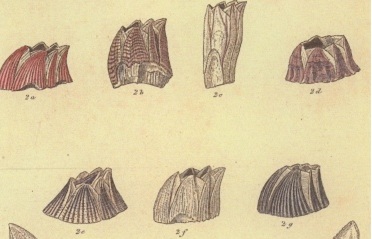
Barnacles, finches’ beaks, art

Cirripedia, the barnacles, occupied Mr. Charles Darwin for many years, even though his extensive studies of the class are not what he’s famous for (except among cirripedists). The average layperson knows Darwin as the man who came up with the theory of evolution–though that is not strictly what he did, and none of his books bear that title. After the publication of On the Origin of Species and The Descent of Man, and the subsequent and ongoing controversies that followed, pretty much everything in the world could be–and has been–examined “under an evolutionary lens.”

The original “lens” involved finch beaks, pigeon-breeding, and early geology studies. It was fueled also by taxonomy, anatomy, and barnacles, by a member of the landed gentry who stayed at  home, more or less, for 45 years after his five-year journey on the Beagle. A scholar, an “armchair naturalist” by today’s standards; a genius.

finch beaksMany people who interpreted what evolution suggested went off the deep end one way or another, which is what happens with ground-breaking ideas. Both critics and supporters re-interpreted and often misinterpreted Darwin and the implications of his work, as well, all of which means he accomplished something truly significant. Why not, therefore, examine fundamental human traits to see whether evolutionary currents can be discerned? Certainly Darwin and a few of his contemporaries speculated that altruism might have an evolutionary basis, a concept that was taken up, debated, and temporarily dismissed in the 1960s-70s; recent neurobiological and genetic studies have brought the possibility of a biological basis for kindness back into discussion (see also Damasio).

There is also the question of art (and aesthetics, though taste seems more likely to be social than biological–but who knows?), which brings me to Denis Dutton’s delightful book The Art Instinct: Beauty, Pleasure, and Human Evolution.

Rather than summarize my responses to his thought-provoking and rather convincing arguments, I’m posting some quotes. These are ideas I find juicy to consider; perhaps other readers will feel similarly.

~

Wondrous aesthetic experiences are possible in the absence of a sense of larger community: the response of an individual to a beautiful landscape, for instance, …or to a recording of the Goldberg Variations heard in solitude. If the arts were intrinsically social in the way that social-cohesion theory claims, people…would prefer standing in a crowd to see a painting in a museum, rather than standing alone.

Because of sexual selection, the arts retain an incorrigible sense of being made by one individual person for another…the motives of art, as even Darwin knew, are ancient and complicated–directed toward a community perhaps, but also created to captivate an audience of one.

~

The artist…probes the content of human emotional life with an eye toward articulating, or making clear, a unique emotion, an individual feeling.

Can you imagine taking [a] pill to save the expense of concert tickets, or even the time spent in listening to a recording of the piece? The answer is very likely to be no, and the reason tells us something about the nature of artistic expression. It is not just the emotion as bare feeling we want from art, it is the individual artistic expression of emotion–how emotions are revealed in the art, through technique, structure, balance, and the blending of sounds….Yes, we want feeling from art, but not as an end for which the art is a means: with art, the means is the end itself.      [italics mine]

~

Extending Darwin’s original suggestion, I believe this intense interest in art as emotional expression derives from wanting to see through art into another human personality: it springs from desire for knowledge of another person….talking about art is an indirect way of talking about the inner lives of other people.

~

All of the above excerpts are from Denis Dutton, The Art Instinct, 2009.

http://taxo4254.wikispaces.com/file/view/darwins_barnacles.jpg/274764236/409x262/darwins_barnacles.jpg

wikispaces.com/file/view/darwins_barnacles.jpg

Consciousness as story

Some recent questions to myself:

Reading philosophy and psychology for so many years, was I looking all along for an explanation of consciousness?

Through neurological and evolutionary science, and more philosophy and more psychology and, in addition, some anthropology, some history. And fiction. And rhetoric. Trying, perhaps, to understand the self? Through criticism, through art, through literature?

Looking carefully at art, reading literature closely: were those also endeavors to comprehend what mind is? Other minds? My own mind? Through the creative act, perhaps?

Is the ars poetica a kind of manifesto of human consciousness from an individual perspective, yet open to interpretation by other human minds? And the beautiful–what is it that even makes beauty a significant concept? Where did that come from? Evolution and the sexual drive (see Dutton riffing on Darwin)? Society? Synthesis? Ego? Inspiration? Angels?

Is every story a scaffold to consciousness? A hedge against oblivion? (Self-oblivion, the hardest navigation act there is: depression, hopelessness, loss of self-knowledge, coma).

I wonder if the stories we tell to others and to ourselves, employing memory selectively whether or not we realize it, act as a kind of (modern-day, metaphorical) Chain of Being through which we develop Theory of Mind and, beyond that, a sense not just of ego but of neurological consciousness. If stories are what make us human.

~

The chain of being, from Charles Bonnet, Œuvres d'histoire naturelle et de philosophie, 1779-83

The chain of being, from Charles Bonnet, Œuvres d’histoire naturelle et de philosophie, 1779-83

[Note: I do not hold the medieval concept of a hierarchy in which Man, angels, and God stand above all other things; the stone and the plankton have as much value–likely more–than I do in the workings of the cosmos, as far as I am concerned. I post this Enlightenment-Era engraving here for metaphorical and aesthetic reasons because I take pleasure in the delightful monkey.]

~

Stories have tremendous value to human beings in ways we are still discovering; see my previous posts here, here, here, and here (among others). I keep coming across claims for the significance of story in surprising places–most recently in Dutton’s The Art Instinct and in Atul Gawande’s latest book, Being Mortal. Widely different texts, similar observations.

How is it we know who it is we are?

Possibly, in the process of inventing the story of ourselves, we become human. Perhaps the story of ourselves is fundamental to conscious “human” minds.

Speculation. But I love recalling that my children, when they were very very young, consistently made one particular demand of me: “Mama, tell me a story!”

~

Key images

I had intended to post on Denis Dutton’s book The Art Instinct: Beauty, Pleasure, and Human Evolution; and I will (I suppose) at some point, because I enjoyed it immensely. Looking through my files, however, I found the transcripts from the initial interview Karen Jogan and Hernán Pereira conducted with me when they were compiling the book So Far…So Close and realized that my answers to some of their inquiries connect with my last post about poetic voice and Kunitz’s thoughts on key images. (The longer, but edited, version of the interview appears in the book).

~~

  1. What colors or aromas remind you of your childhood?

Cinnamon toast, mown grass, onion grass (wild garlic), lily-of-the-valley, cedar-water and pine trees, the scent of a muddy river in summer, wintergreen, play-dough, school paste, steam-irons, fresh peaches, campfires, burning leaves, talcum powder, Pepto-Bismol, air-dried clothes and linens, mimosa blossoms, roses, strawberries.snowdrops

  1. Describe yourself as a child.

I wonder from whose perspective I should attempt to answer this question. I know from others that I was considered to be shy and polite, talkative when comfortable, imaginative. I certainly felt uncomfortable among groups of people, preferring small groups of friends with whom I played make-believe. I made up stories which I told my sister and brother, and when I was old enough to write I made little children’s books that I illustrated and bound in cardboard.

My sister was my best friend, but I spent a good deal of time all by myself. When alone, I walked my dog, climbed trees, played on the swings, sketched and painted, and read books. I really was a bookworm and spent many happy hours with books and in libraries. Being alone was, and still is, deeply satisfying for me—it helps me regain creative energy.

  1. At what moment in your life did you begin to write?

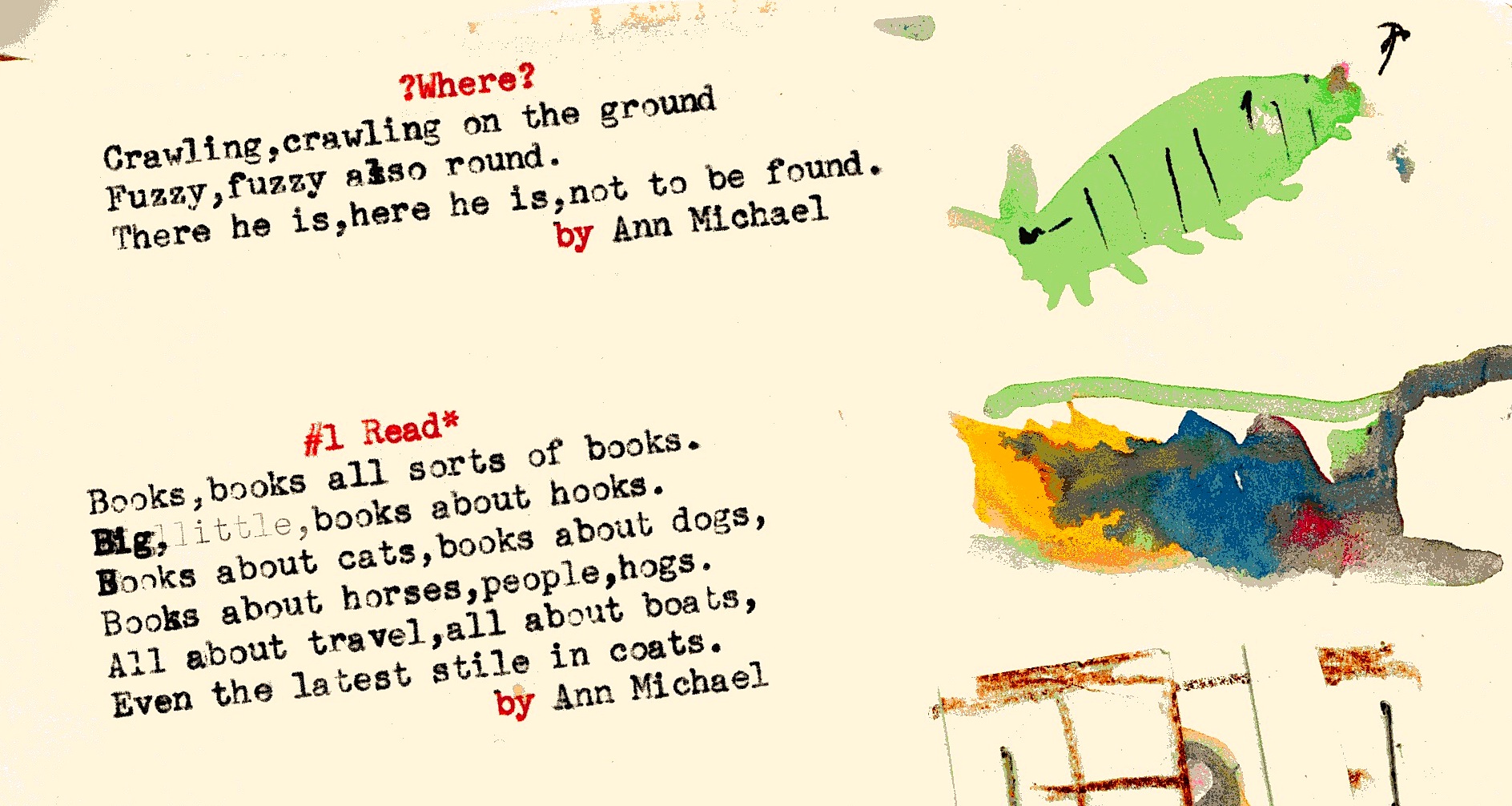
I don’t remember when I began writing. My storytelling began early, and I suppose the writing developed from there. The first story I recall writing down was about a princess; I was in second grade. I felt proud of myself, even though the story was only about three sentences long. Apparently, the poems started when I was about nine. I don’t remember writing poems then, but I recently found some that I had composed and typed up (I was fascinated by the typewriter), and my mother’s notes said I was nine when I wrote them. What I really wanted to be was an artist, but writing seemed natural to me. I started keeping a journal when I was ten…

9yroldpoems010

Rhyming and typing and illustrating and bookmaking– at nine years old.

  1. What influences have been important to you?

Other writers, naturally, but first of all, visual art. From the time I was very small, I’ve loved paintings and sculptures and architecture. Church hymns and Bible verses and nursery rhymes were influential to me, as well as folk music and the lyricists of popular music when I was growing up. I am also influenced by non-fiction work, especially in the sciences, and philosophy. My early poetry influences were Donne, Shakespeare, Blake, and the King James Bible; but then I fell in love with contemporary women writers, then surrealist poets, then Latin American writers, then Asian poetry, then contemporary lyric poems…it goes on and on. It might be easier to say what I have not found particularly influential!

~~

With further reflection, I could go deeper about early images that have become, for me, “key” aspects of my writing voice…a particular landscape, the feeling of an empty nave, bees and birds, milkweed, cloud patterns, my parents singing, my little sister beside me in our shared bed, the sound of a symphony. They may not appear in my poems as such, but these images connect with me in ways I probably don’t understand. What do such keys unlock, I wonder?

~

Spaces

Ah, the traditional New Year’s blog post! 🙂 I have spent time away from the computer to tend to other things, among them, my own “space” for being less busy. Finding that space has not been easy, but it is the sort of discipline we human beings ought to practice in this Age of Information. Without a little inner space, it is far too easy to become anxious and overwhelmed.

So I think of Bachelard’s quiet exhortation to cultivate the creative or childhood space, which I contemplated in 2013 at about this time of year (in this post). And I think of Jon Kabat-Zinn and other writers–often classed as spiritual self-help authors but whose writings need not be considered spiritual at all (Kabat-Zinn, in particular, avoids using the term)–who remind us to be attentive, aware, mindful, compassionate even to ourselves, and willing to take ourselves away to inner stillness now and again.

I am particularly drawn to the notion that contemporary human beings can come to mindfulness through actions rather than through withdrawal from the body and the world. Really, we hardly have any other choice. Although I enjoy solitude more than most people do, I am ill-constituted to be a hermit or a renunciate. My temperament precludes noisy advocacy against injustice or for specific good causes; but I could certainly do more helping, more of the kind gesture, more listening, and more giving of the type that lets not my left hand know what my right hand doeth (Matt. 6:3).

There were difficulties this past year, and aggravations, and sufferings both personal and social. So be it; we can learn from failure and adversity. The best way to learn to problem-solve is by being faced with problems!

In his 2000 book about aging and dying, Ram Dass wrote: “My guru once said to a visitor complaining about her suffering, ‘I love suffering. It brings me so close to God.’” Well, that is another way of looking at things; and perspective matters. Creative thinking involves full analysis (even when the analysis seems intuitive, immediate) and often employs a total restructuring of the problem at hand–a widening or narrowing of scope, a different point of view, a new set of tools or skills for puzzle-solving, or quiet cogitation while the thinker digests the whole situation…which may be, for some folks, prayer.

Or poetry. When I am not writing poetry, I am always reading it. Other writers’ words open me to a sense of communal understanding, a sense that we are not alone, not a single one of us, who can hear or read or remember a poem or a word of love or praise. Even when those poems depict sorrow or suffering, for then we know we are not the only ones who feel troubled.

“And our problems will crumble apart, the soul
blow through like a wind, and here where we live
will all be clean again, with fresh bread on the table.”

Pablo Neruda, 100 Love Sonnets

Let the wind make space for fresh bread on your table in 2015 and always.


bread

bread

The empathy button

Human nature being what it is, and our feelings being so rooted in often physiologically-based emotions, negative responses tend to aggregate. The book I just finished reading–Damasio’s The Feeling of What Happens–offers neurological, evolutionary, and psychological reasons for the human tendency toward negativity. Dozens of psychological studies concur that humans in general feel more “bad” feelings, and more frequently, than “good” feelings.

Facebook has a “like button,” as do many blog hosting pages (see below for mine!). This ingenious algorithmically-programmed information-gathering software–I hesitate to call it a device, but I guess it is–offers social media users a shortcut to social interaction, a way to show conformity and agreeability among friends, to support a statement or cause, or to indicate pleasure at seeing a photo, work of art, or shared piece of information.

Other sites, such as YouTube, have the additional option to “dislike;” and though I have not read any research supporting this inference, I would speculate that the option to dislike could lead to the generation of more negative feelings. Human nature being what it is.

If social media users cannot take the time to type their feeling-based responses and just need something to click, why not offer a “compassion button?”

I am not serious, of course. The compassion button is internal, and it isn’t an immediate gut reaction for most of us. It moves us from emotions such as anger or ideas like reason and duty to shared human experience. It takes us from simplistic liking or disliking to understanding. It takes more than a mouse click to get to compassion.

“Love and compassion are necessities, not luxuries. Without them, humanity cannot survive.”
― Dalai Lama XIV, The Art of Happiness

Continuing the discussion

The semester is almost over, and my students and I have spent a few weeks doing writing that relates to Cass Sunstein’s book Why Societies Need Dissent. As it turns out, this semester coincides with considerable current-event attention on protest, conformity, stereotyping, and other issues Sunstein explores in that text. Social media pushes the herd mentality, the “troll” mentality, and the ease of using shortcuts in thinking: justification through bad analogies, irrational responses, barely-considered ideas, culturally-entrenched concepts, knee-jerk reactions.

In other words, the gamut of human social psychology in 140 characters or thereabouts, with links, memes, and dudgeon.

A case in point that appeared on social media last week is a photo of a black man holding a sign that reads, “No mother should have to fear for her son’s life every time he robs a store.”

That was a photoshopped “joke” in which someone altered the last line of the protester’s poster. The intent was to assert that Michael Brown had robbed a store before walking down the middle of a Ferguson street, and the intent was clearly meant to suggest that Brown deserved to be shot by police–or, at any rate, to suggest that he was not “innocent.” I agree with the poster even in its altered state because I propose that none of us are innocent, and that none of us deserves to be killed. A suspected robber should be tried by jury and should be considered innocent until proven guilty because that is the way US law reads.

I do not claim that “It’s that simple.” Indeed, the situation is far from simple, which is why it feels so fraught and inflames such exertions of logic, law, and character defamation, and so many conflicting opinions–not to mention Facebook “purges” and irate newspaper columns and public protests. These are reasons that discussion can be useful. We need to continue the discussion, even though it is awfully difficult to do so.

~

If only we could listen to other perspectives. If only we could engage in discussion. I listened to two of my male students talking about being stereotyped. One claimed he was seldom troubled by harassment and not really bothered when people tried to stereotype him. “You’re not black,” his friend responded, “You’re Latino, or whatever.” The first man held up his arm: “Hey, man, I’m darker than you. What makes you black and me not?”

“Neighborhood. Money.”

“Look at you, bro! You’re wearing $185 shoes and new jeans. Dollars to donuts your family has more money than mine.”

They continued in this fashion awhile, sometimes asking me what I thought. If it was history that made them different, couldn’t the black man put it behind him? And he didn’t even really know much about “his” history, it turns out. If it wasn’t skin color that made one man feel less sure of himself on the street, warier, even in a “good” neighborhood, to what could it be ascribed? Was it just a personal issue? A neurosis? Was the Latino man clueless, or oblivious? Or just lucky up to now? Are these issues of confidence, self-esteem, bravado, or fear? Social issues or private ones? All of the foregoing?

And how does all of this relate to how young people of any background, religion, or color comport themselves in the world, deal with society and its assumptions, codes, expectations?

~

I teach writing. My job consists in instructing students in the perhaps arcane code that clear, concise, informational, and persuasive writing requires if they are to succeed in writing for academia and, later, the world of business information. I tell them: “This is what you should expect others/authorities to expect of you. It’s your choice to follow the conventions or not to follow the conventions, but you need to at least know what the conventions are.”

Meanwhile, I hope they recognize that they should follow the conventions of the rule of law; and if they choose to oppose the law, they should do so with forethought and initially, at least, within the structure of the law. But bad laws do need to be changed, and bad protocols need to be changed, and unarmed people should not be killed for brooking authority; and stereotyping–a very natural and automatic human behavior though it is–should be consciously questioned, even though yes, that can make the discussion difficult.