Still more difficult books

I am perpetually out to confound myself.

After reading Larson’s odd but lucid koan-like “biography” of John Cage’s creative interpenetrations with Buddhism, I have begun Maurice Merleau-Ponty’s 1961 text The Phenomenology of Perception. Already I have encountered some thoughts in Merleau-Ponty that relate to the indeterminate, a concept that excited Cage and that Larson demonstrates shares a great deal with Zen. But reading Merleau-Ponty is more challenging than reading Larson’s book, as I have less background in early 20th-century philosophy than I do in Zen studies. I enjoyed reading Bachelard’s imaginative, image-based take on phenomenology because I could relate to it on a poetry level even when I missed some of the philosophical antecedents (or contemporaries) he references. That possibility isn’t available to me with Merleau-Ponty.

I do appreciate that his writings were formulated before technologies that made neurological processes visible and while psychology was still bickering with the “hard sciences” about empirical measurements. (Actually, that bickering continues in some areas of study.) I do not think Merleau-Ponty would agree with, say, E. O. Wilson’s rather reductionist idea of consilience. Yet clearly, the philosopher was willing not to discount the sciences or empirical study–he just felt those areas were not of particular use to a philosopher, particularly a phenomenologist.

The body is what we have with which to experience the world, Merleau-Ponty tells us. But the human body is limited by its perceptual experiences. Structures–and that includes abstract structures such as thought–appear to have recognizable patterns, and the perceiver may posit cause and effect as a result. But another body may perceive differently, due to a different biological process or a different time or any number of physical or environmental variables. We perceive yellow with the cones and rods of our human eyes; the dog or the bee, the spider or the hippopotamus, may have eyes that do not see yellow as we do. Is yellow a quality or a perception? Merleau-Ponty seems to be saying (I am not very far into the book, so I  may be in error) that science cannot be objective, even though it is science that made us question our senses: “We believed we knew what feeling, seeing, and hearing were, and now these words raise problems.”

And how does this all relate to consciousness? Maybe I’ll figure that out as I go along.

ann e. michael poet

~

Here’s a sentence I love because it speaks to me of poetry and the arts on the level of ambiguity: “[Science, with its categorization] requires that two perceived lines, like two real lines, be equal or unequal, that a perceived crystal should have a definite number of sides, without realizing that the perceived, by its nature, admits of the ambiguous, the shifting, and is shaped by its context.”

Or perhaps by observation? A little Uncertainty Principle going on there. I feel that good poems change when observed, and change in the context of the reader’s time, place, experience; that they possess ambiguity not in the sense of rhetorical wishy-washiness but in the rich sense of complex possibilities, indeterminacy, transformation.

~

I’m especially pleased to have found Bernard Flynn’s article in The Stanford Encyclopedia of Philosophy (the link to the entire article is above), which ends with the following reflections on Merleau-Ponty:

If we think how the thought of Merleau-Ponty might prolong itself into the 21st century, or as it portends a future, then we cannot not be struck by the fact that his philosophy does not entertain any conception whatsoever of an ‘apocalyptic end of philosophy’ followed by the emergence of some essentially different mode of thought. Unlike Heidegger, there is no anticipation of an ‘other beginning’, also there is nothing like Derrida’s ‘Theory’ which is waiting in the wings to displace philosophy, and unlike Wittgenstein, Merleau-Ponty’s thought does not await the disappearance of philosophy. In the academic year 1958–1959, Merleau-Ponty gave a course at the Collège de France entitled “Our State of Non-Philosophy.” He began by saying that ‘for the moment’ philosophy is in a crisis, but he continued, “My thesis: this decadence is inessential; it is that of a certain type of philosopher…. Philosophy will find help in poetry, art, etc., in a closer relationship with them, it will be reborn and will re-interprete its own past of metaphysics—which is not past” (Notes de cours, 1959–60, p. 39, my translation). After writing this he turns to literature, painting, music, and psychoanalysis for philosophical inspiration.

The theme of the indeterminate frequently recurs in the thought of Merleau-Ponty. Philosophy is enrooted in the soil of our culture and its possibilities are not infinite, but neither are they exhausted. In an essay entitled “Everywhere and Nowhere, ” Merleau-Ponty explicitly reflects on the future of philosophy, he writes that philosophy “will never regain the conviction of holding the keys to nature or history in its concepts, and it will not renounce its radicalism, that search for presuppositions and foundations which has produced the great philosophies” (Signs, 157). In his Inaugural Address to the Collège de France, he claimed that “philosophy limps” and further on that “this limping of philosophy is its virtue” (In Praise of Philosophy, 61).

What will philosophy do in the 21st century? It will limp along.

Apparently, I shall be limping along with it.

The value of noise

Having posted several times on the value of silence, I feel I ought to balance things out by writing about the value of noise. These thoughts likewise stem from my recent reading: Kay Larson’s book about John Cage, creativity, and Buddhism.

This morning, there were a few hours of intermittent sunshine; the air, still nippy from a recent cold front and some high winds, had warmed up a few degrees. I felt inspired to prune some shrubs and start the rather significant task of removing fallen branches from the lawn. I did not realize how big a job this will be until I started the work because the grass is long and the leaves provide a bit of cover. Every few steps, though, I encountered clumps of twigs, broken branches, sticks of all sizes. We won’t want to run a lawnmower over this mass of debris, and it will get caught in our rakes when we try to remove the leaves. The best way to rid the lawn of storm-downed branches will be the old-fashioned way: human power, gathering one or two sticks at a time. The fresh air streamed into my lungs, the sun shone on my back. I pulled on my husband’s old sweater and my daughter’s old coat and my son’s gloves and my own boots and started to work.

What I noticed this morning was noise. John Cage, a man whose later compositions often engaged with silence, also loved noise. His percussion pieces were scored for tin cans, plates, pipes and modified pianos, and he was prescient about the incorporation of electronically-produced sounds into music. I love reading about his experiments with noise, and today I recognized the music in everyday sounds very clearly.

Today’s noises:

Leaf-crunch. The damp leaves produce difference tones from the dry ones. Leaves of different species vibrate in a range of tones depending upon their thickness, brittleness, serrated shapes, oiliness.

Vehicles. The roads are not terribly close to the house, but when the trees are bare we get a range of vehicle sounds from as far as the highway. Large trucks still growl, wheeze, squeal, rumble, and beep as neighbors get trees removed from their properties and department of transportation crews work at street clean up. Cars drive past.

Somewhere, a leaf-blower. Several chainsaws in the distance.

Mockingbird–not all of them have flown south just yet. The buzzy twittering of starlings and small flocks of sparrows. Woodpeckers drilling at trees.

My breathing.

The sound of the nippers and hedge clippers, the sound that pruned branches make as they whoosh and scratch and shimmy earthward and get tangled in the shrubs. The different noises of a cut made on dead wood and on live wood. The snap of twigs. The silken whisper of long grass underfoot.

Creak and groan of the walnut trees as a stiff breeze hits the woodlot. A dog, barking. The hens, chuck-chucking in their run.

The telephone from inside my house. An overhead jet.

And it isn’t cacophony; it’s a kind of music, certainly. The randomness and the patternedness work together. As do the silences.


Here’s one of Cage’s most melodic works, “In a Landscape,” very apropos … very lovely.

YouTube/John Cage “In a Landscape” Stephen Drury pianist


Silence (John Cage, Zen, head-noise)

Slow Muse blogger Deborah Barlow–artist, critic–recommended Kay Larson’s recent book on John Cage, Where the Heart Beats. Silence was so significant in Cage’s work and thinking that, given my recent reflections on noise or lack thereof, this seemed the right time to pick up that text. Lo and behold, synchronicity of several kinds. The author, Kay Larson, thanks John Daido Loori, a rōshi of the Mountains and Rivers order of zen Buddhists and long-time abbot of Zen Mountain Monastery near Woodstock, NY. She studied with him beginning in 1994.

In 1992 and 1993, I attended two weekend retreats there; the brief days remain vivid in my memory. Perhaps more on that another time. Haiku is involved…and silence.

Recently, given some irregular bumps along the walk of life that have led to excessive “head-noise” (my term for stress I can’t quite let go of), I have been returning to some zen-influenced texts and trying to remember to breathe and to be here now. Arne Naess’ writings on joy and environment and Buddhism–I’ve just finished reading a collection of his essays–dovetail very neatly into this reflective book on Cage’s life, work, and influences. Larson’s “Zen” approach to writing about Cage is so gentle and refreshing that reading this book soothes me. I find within myself a kind of inner silence, my breathing returning to its slower, quieter pace, as I read the brief selections of prose Larson uses to explore the life of the mind of this peculiar and innovative artist/composer/writer.

Very like philosophical analogies, Confucian fables, parables of many cultures, koans, meditations, prayer and other forms of contemplative practice.

What reduces head-noise? For me, the best strategy is calmness, but I am not an adept at meditation. I have sat zazen badly, and learned much from the practice of sitting zen badly, but I have never managed to make meditation a genuine practice in my life. Deep breathing and slow movement, such as tai chi or qi gong, seem to work better for me. In addition, the Quiet Place. I settle down better when I can detach from computer, phone, electric lights, appliances. Art reduces head-noise: art requires attentiveness. Poetry, yes. Gardening, walking out of doors–good choices. Music, sometimes.

Philosophy, not so much. (Alas.)

Politics? Weather reports? Analysis? ….as the Buddhist monks might say: mu. Translation into teen-speak from five years ago: “not.”

And also, compassion. The practice of compassion keeps a person attentive and also relaxed. It is a form of active prayerfulness, of acceptance of self through the acceptance of others. After the bruises and bashings of a presidential election year in 21st-century United States, a little compassion would reduce the malaise and anxiety we have had to endure intellectually, emotionally, and–in the wake of bad storms on the east coast–physically.

I give you Quan Yin, or Guanyin, or Kannon Bodhisatttva, known as Avalokitesvara  in Sanskrit and termed the goddess of mercy, a counterpart to the Christian Jesus or Mary. This being represents the compassionate, merciful, kind, non-judgmental, accepting aspect of the cosmos, the universe, or god. I realize that it seems I may have wandered a bit far afield of Cage at this point. But read Larson’s book; I haven’t drifted as far from my topic as it seems.

And just because it does seems as though I am rambling considerably in this post, I think I can close with a poem from my collection Water-Rites, and somehow make it fit with these topics:

Intervention

I am thinking about the cowbirds who fought
in my driveway this morning
and how they struggled, one overbearing the other,
pecking at its head, keeping it pinned
to gravel. I wonder, now, why I chose to stop
and free the losing bird from its aggressor,
lift its bloodied damp body in my hands,
rescue it even though
it was also a cowbird, a pest
that usurps the nests of thrushes—
although I respect the dominion of beak & claw,
I want to preserve the generation
of songbirds; there was no reason for me
to intervene, no logic but somehow I felt
surely there is a place,
in the battle that is this world,
for the mandate of compassion.

© 2012 Ann E. Michael

Hurricane & silences

Having been through some big hurricanes before, I was prepared as possible for the weather that hit along the MidAtlantic states of the USA (and west to Pittsburgh PA, and north to the New England states).

We are somewhat rural, and we do not have city water or sewer; so if the electricity fails, we lose those modern amenities along with lights and computers and a stove. In Europe, and in newer developments in the US, power lines are more often underground. A wise idea, but not in our current infrastructure at my home.

So weather events–as the news media terms them–are significant to us. They alter our relationship with our house, our land, the earth. That is not necessarily a bad thing. Sometimes, it is pleasant to wake at dawn and hear no humming, no sounds of modern appliances at work. We note, instead, the noise of owls or wind or starlings. The rustle of grasses.

We miss hot water the most. That the well pump isn’t working and the water heater’s not heating: that means our standards of cleanliness necessarily fall. We can get used to it, but we miss it. Cooking on charcoal or a camp stove takes longer but isn’t really a problem for us, however. We can sleep in the livingroom by the fireplace if the cold weather sets in before the electricity comes back on to make the furnace fans operate.

We lost power Monday evening, and since then the human-made sounds are those of vehicles, chainsaws, and generators. And a pleasanter noise: my windchimes.

~

When the winds were very high, I sensed the resolute structure of our house, which did not shudder, though the windows made some alarming sounds–a kind of whistle, a bit of rattling, the occasional thump.

~

Days without electricity take me back ten years when my family spent a week on an island off of Nova Scotia. Our host lived off the grid by necessity–no electricity or plumbing on the island even though it had been inhabited since the mid-1800s. Tides, sunrise and sunset were our time-keepers. The natural sounds were restful and healing.

~

So, too, the kinds of silence I experience when a large tree falls on the powerline, though the sense is less restful because of anxieties over family members, job, and the awareness that there are messes and expenses to deal with once we are reconnected to the 21st century. For a day or two, however, I feel my breath returning to a more animal pace and fullness. I watch things more closely. The line of water droplets beading irregularly under the porch handrail, the grass tassels’ subtle color variations as they move in a breeze, a toad’s progress across the patio slate, a few brilliantly yellow trees that kept their foliage despite the gale.

~

Weather like this is refreshing, my sister says, even if frightening, because people need to be reminded that technology cannot control everything. The hurricane interrupted cell phone use, communication systems, transport networks, traffic, electrical grids. We ended up wet and cold and we needed to take shelter with friends and to share supplies and stories, to wait awhile before we hurry on our way.

~

So here’s irony, that I am using technology to enter these words into a system that keeps them in an electronically-maintained, digitized data ‘cloud’ so people in the Netherlands or Norway, Seattle or Colorado, India or Britain can retrieve and read them…even though my theme is the joy of low-tech lifestyle (for awhile, at least). My power at home is still out, so I am posting these thoughts from a borrowed computer an hour from home; but I composed these thoughts at home, on paper, with a pen, by kerosene lamp. And I will be going back to that quiet, chilly environment later this evening to feed our pets and continue waiting for the valiant and hardworking utility crews to get to our backwater…

~

My reading material during this ‘weather event’ has been The Ecology of Wisdom by Arne Naess, an excellent philosophical companion for study by lamplight. I was struck by his essay “The Place of Joy in a World of Fact” which is so life-affirming. Not playful–Naess is serious about joy–but sensible. Environmentalists need to get out and find joy in the environment, he says, not just focus on the joyless losses. He urges all of us to give up the “cult of dissatisfaction” and promote good causes by example.

“One may say, somewhat loosely, that what we now lack in our technological age is repose in oneself. The conditions of modern life prevent the full development of the self-respect and self-esteem required to reach a stable, high degree of acquiescentia in se ipso [self-acceptance].”

~

What I feel when the power goes off is repose in myself. While it may not reside within me for long, the fact of its appearance–its existence–is gratifying, joyful, powerful. I do not require the fridge, the computer, the lights. I am an animal alive in an animate, changing, living world.

It’s good to be reminded, now and then.

Another Reading reading

On All Saints’ Day, November 1st, I’ll be reading poetry in Reading Pennsylvania–again! And this time, I’ll be accompanied by my fellow Goddard alumna, the dynamic and talented Barbara DeCesare, author of Jigsaw Eyesore and Silent Type.

Reading, PA is home to GoggleWorks, a former goggle-making factory that now serves as studio, theater, and gallery space for Berks County area artists and craftspeople of all kinds. Small, struggling cities like Reading are turning to the arts as a means to fill abandoned factory space and create an economic and cultural reason to keep downtown areas alive. Sometimes these efforts succeed, sometimes they don’t. GoggleWorks opened in its current incarnation in 2005. So far, that’s a 7-year run, supported through grants and donations and rent. I am optimistic about GoggleWorks and about other such endeavors, including Bethlehem PA’s Banana Factory, which is a little closer to my neighborhood. I strongly believe the arts belong in our neighborhoods, in our school curricula, and in our lives.

I’m thrilled, therefore, to be reading from my book, Water-Rites, at 6 pm November 1st at GoggleWorks’ Cucina Cafe.

And I’m thrilled to be reading with Barbara, whose work is funny, poignant, imaginative, fierce, and charming by turns.

November 1st is the Day of the Dead in Mexico, a good day for elegies and to celebrate the lives of those we’ve loved and lost. I will be thinking of David Dunn, among other dear ones. And in honor of All Saints’ Day, I may also read a poem or two about saints; recently, I’ve composed a few imaginary lives of saints poems.

I have no idea what Barbara DeCesare has up her sleeve for this event, but it is certain to be delightful. If you are in the region, stop by at 6 pm. I believe an open mic follows the reading.

water-rites by Ann E Michael

Poetry, art, & a little bit more about libraries

After writing about some memorable libraries lately, I realize that I have been able to pursue my passions–indeed, discover my passions–largely through the help of these marvelous civic institutions. It is time I brought my posts back to those passions, however, particularly to my love of poetry.

My family introduced me to poetry through nursery rhymes and hymns and taught me to love narratives through story-telling of several kinds, so the foundation for my lifelong love of stories and poems existed before I ever set foot in a library; but books solidified and focused my various enthusiasms, and libraries offered more books than I could hope to read (though I tried!). Libraries led me not only to novels and poems but to books on visual art, art museums, artists, art history, and art criticism. If I couldn’t get to the Louvre or Rijksmuseum, to Venice or to Rome, I could borrow an art book from the library and be on my way via imagination.

When I got to college, I spent many hours in the library on campus borrowing books I couldn’t afford to buy. Few of those books were required for my academic studies; in fact, I don’t recall doing much research for term papers. I was reading up on and diversifying my own interests, often unrelated to coursework. A look back at my undergraduate transcripts reveals only two classes specifically devoted to poetry, but I recall reading many poetry collections in the campus library. As a junior, I had a work-study job in an office in the library basement. When my hours were up, I’d walk upstairs to the stacks.

I was finding my own way to what I loved.

~

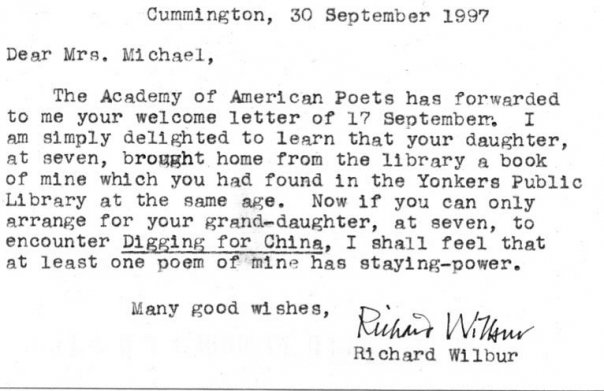
Needless to say, once I had children of my own, we visited the library often. Years ago, I wrote to the poet Richard Wilbur to tell him about my 2nd-grade daughter’s encounter with Digging for China and how, nearly 30 years earlier, I had been fascinated by the book too. He replied with this modest note. June 2009, I saw Wilbur at the West Chester Poetry Conference. What a talented writer, and what a sweet man.

~

Richard Wilbur

Libraries & book love

In my last post, I drifted onto the topic of libraries–and stirred up images of favorite places. Libraries have certainly been among my favorite places and loom large in my childhood memories. Two of those libraries were new when I entered their doors: the Grinton I. Will Library in Yonkers, NY, which opened in 1962 (I first visited in 1964) and the W. Leslie Rogers Library in Pennsauken, NJ, which opened its doors in 1971. I recall a few distinct discoveries even from my first-grade forays to the Yonkers library. It was there I discovered Richard Wilbur’s Digging for China, a book I adored.

Free public libraries represent one of the best uses and most noble purposes of the tax dollars and philanthropic gestures of citizens in a democratic society. These buildings, some grand and some exceedingly modest, harbor banned books and out-of-print books and sections devoted especially to children’s books; a library admits of free speech and liberated thinking for people of all ages. A library, by its very existence, reminds citizens that education matters and that information can be free, can be borrowed, can be disseminated and shared.

When I was a child, libraries were safe places to hide, to explore, and to pursue my own interests–which often varied quite a bit from the interests of my peers. The library in Pennsauken offered me an early education on visual art. I probably borrowed every book in the place that had anything to do with art or artists, from Aesthetic Inquiry; Essays on Art Criticism and the Philosophy of Art to The Agony and the Ecstasy. The library stocked a book chronicling  the letters of Theo and Vincent van Gogh as well as huge, heavy, hard-cover museum books with color plates of famous artwork. Some of these were stamped more than a few times with my library card’s number.

I also borrowed, and read–enthusiastically and, occasionally, dutifully–classic novels that I had somehow learned I “ought” to read. I read a fair number of junky novels, too, and young adult fiction, and children’s books. Even though I was nearly ten when Leo Lionni’s Frederick was published, I loved it and never considered it a “little kid’s book.” Interestingly, Frederick the mouse gathers images and turns them into words. He is a poet. (A word-artist).

Books: Anything, everything, as bibliophile overlaps with autodidact.

Books were my first and often my best teachers, though I have been fortunate enough to have had some wonderful teachers (formal and informal) in my life. One of them, my grandmother Edna Michael, will always be closely associated with libraries in my heart and memory. She was the Story Lady at her small-town library in South Whitley, IN; and my siblings and I spent many hours in the small white building that housed South Whitley’s free circulating books. We read, and we listened to her read. She would don “an olden-times dress” she’d designed and sewn herself, tie on a large matching bonnet, and gather the town’s youngsters in a circle on the library floor for story time.

She always left the library with at least a couple of grownup books for her own reading material. I was proud to be like her.

A few years ago, the town enlarged its library, added a new children’s wing, and dedicated it in my grandmother’s name. Edna Michael, the Story Lady.

I’m pretty proud of that, too.

ann e michael

The South Whitley Library as it was in 1967, with my grandmother in her Story Lady attire.

Autodidacts & higher education

An early-morning drive to work, low sun gleaming through the remnants of fog, Vivaldi on the radio: Concerto for Two Cellos, a deeply mellow, haunting work of music…and I tried to recall my first encounter with Vivaldi’s music. I am quite sure it was an old Angel Records LP of The Four Seasons in my parents’ modest record collection. When I was old enough to read, I was curious enough about the music to study the record cover, where I learned that Vivaldi was born in 1678 in Italy and had red hair. Our ancient set of encyclopedias (The Book of Knowledge) said he taught music to little girls in convent school. These details, which taught me little about baroque music itself, nonetheless appealed to me as a child who wanted stories. The music seemed to tell me stories, as well–thunderstorms, blizzards, birds at daybreak, mountain streams, slow rivers in the summer sun.

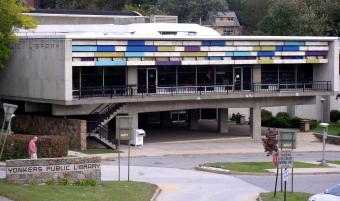
Because I wanted stories, because I sought information and details, I turned to what seemed to me the most obvious place: the library. For three years of my early reading life, that was the Yonkers Public Library’s “new” branch, which seemed impressively modern at the time and which had a fabulous children’s area.

Why I associate Vivaldi with colored light filtering through the clerestories of the library, I don’t know. That’s just how memory works. I also associate my visits to the children’s room at the library with the beginnings of a lifetime of self-teaching through books, music, museum-going, travel, art, conversation, observation, research, and writing. That connection is a little easier to make. Because I was an introverted child, I watched more than participated in the events going on around me. When I wanted to know more, I was often too shy to ask–so I tried to find the answers myself in the place I imagined to be the best repository of stories and information. It was also the only place I knew that could offer such knowledge.

This brief explanation suggests that I became an autodidact because I was socially maladaptive. Or maybe because I was passionately curious about the world. Or because the library room was so magical.

Any of which may be at least partially true. But what I want to say in this post–far too briefly because the idea deserves further reflection–is that while I work in an institution of higher learning and while I believe in the value of higher education, I also believe we can educate ourselves exceedingly well without college degrees. Lack of a degree can limit people in the job market, no doubt; yet some of the most intelligent, interesting, best-educated people I know happen to be largely self-educated. The autodidact has the motivation of personal passion and the ability to be directed by chance and interest, not just to be guided through coursework considered culturally or economically valuable. Most of my older friends have become wise and clever by attending the school of hard knocks and through their personal curiosity and inventiveness; they are true autodidacts, even the ones who actually do have PhDs…but especially the ones who don’t.

Can I go so far as to suggest that we need our libraries more than we need our universities? Why not? I think I started my “college education” when I was six or seven years old because I had the desire to know, the curiosity, the interest. My parents encouraged me, which helped. (For one thing, I could not have gotten to the library if my mother hadn’t taken me there!) Some of my school teachers were also encouraging, but their encouragement mattered surprisingly little. What made the difference was the reward of finding something new, learning a new story, adding details to a foundation of things that interested me.

One of my tasks as a teacher, a poet, and as a mother is to foster that element of excitement when I sense it in someone and to encourage self-directness in each person’s education. Delight: a crucial ingredient in learning that can take awhile to locate but that will motivate a lifetime of knowledge-gathering. Maybe you can find it at the library, too.

A moment of self-promotion

It’s a busy week. I am glad to note that my local newspaper (yes, our area still has a local newspaper) published the following article about my new book, Water-Rites. Many thanks to Collin Roche and Jodi Duckett at the Call.

Profile of Ann E. Michael in Allentown Morning Call.

Thanks for reading, and for everyone’s support for poetry.

Reasonable, calming…

Campaign rhetoric is  hardly deserving of the name. The commentator who attempts to persuade or question through the means of valuable, thoughtful rhetoric endeavors to avoid fallacies and ballyhooing. But such commentators are scarce as hen’s teeth. Apparently, we citizens of the USA are not considered intelligent enough, are not respected enough, by our politicians and their media handlers to be worthy of genuine discourse or reasonable argument. We are also far too emotional and prone to grand-standing and stereotyping, the media-savvy promoters must imagine. With a certain amount of dismay, I admit there may be some truth to that pathetic view of the average US voter; but I want to believe we are better than that.

In the thick of a presidential election, therefore, I find it pleasant to retreat to the calming, reasonable, optimistic (though cautioning) prose of Marilynne Robinson. For those of you who, like me, feel a sickening pressure around the whole election brou-ha-ha, I suggest a few hours reading and re-reading her recent book of collected essays, When I Was a Child I Read Books. Robinson makes no secret of her perspectives as a Christian, Protestant, US citizen, and reasonable, thinking, person of letters (humanities canon through and through…). She also establishes how her perspective widens rather than narrows her views, offers her “gentler” interpretations of the Old Testament and of Calvin’s writing and teachings, and argues her opinion with an erudition, elegance, simplicity and wisdom that is exceedingly rare today, particularly during presidential election years…and among people identifying themselves as “Christians.”

In “Open Thy Hand Wide,” Robinson parses the difference between rationality and reason and reminds us of what the word “liberal” originally meant (and how its meaning has changed and become vague). By the way, though a rational person in terms of her use of rhetoric, Robinson is squarely in the arena of reason, which she defines — with sources, thank you — as less numerical and more courageous and intuitive, ie human, than the merely rational.

Is her work ever political? Is it ever not political? It depends upon  how one defines “political.” Robinson is deeply engaged with the human community. I think she would agree with Lewis Mumford on the city’s best purpose as being there to protect the welfare of its citizens, even the least of its citizens, and would agree that one of the most significant values of civilization is the creation of art. Certainly she here asserts that the highest purpose of nationhood is to establish justice (civic, human justice), to keep domestic peace within the nation itself, to secure freedom and liberty for all members of the society equally, and to keep the populace safe while promoting the common welfare of all the people.

I believe she is well aware–though she doesn’t say it even  once in this book–that this stance makes her a classic patriot, a defender of the US Constitution, even as it also means that she can easily be branded a “liberal” for her well-argued stance that the USA was not established as a capitalist nation but as a generous democratic one devoted to the public welfare (ie, “good”), and what the difference between those theories are.

Just a week or two ago, I visited the US Constitution Center in Philadelphia. The performance offered there (“We the People”) and the interactive and non-interactive exhibit halls do a good job of reminding US citizens that the Constitution is a living document that established a government like no other before it, a document amenable to change and interpretation even as it establishes fundamental rights. Let us look at the Preamble and connect it with Robinson’s essays and ideas:

“We the People of the United States, in Order to form a more perfect Union, establish Justice, insure domestic Tranquility, provide for the common defence, promote the general Welfare, and secure the Blessings of Liberty to ourselves and our Posterity, do ordain and establish this Constitution for the United States of America.”

Reasonable. Generous–even Liberal. Secure for the people–no caving in to irrational fears; offering human justice because divine justice is not for us to determine; defense, not aggression; attentiveness to the general welfare (not of the privileged few)…and liberty: the chance to live as safe a life as God and the randomness of earthly environments allow without the oppression of other human beings to weigh us down.

You really have to read Robinson’s measured, calm prose and clear reasoning to feel the optimism; I cannot do it justice. I will just say that reading her book has made me feel much less depressed during a time when lack of discourse and logic has made me almost lose my hope about the democratic process.

Molte bene, Marilynne.