Too difficult?

Another difficult book, Poetry, Language, Thought by Heidegger offered me less insight than I’d hoped and irritated me more than other philosophical readings I’ve been perusing lately. I do see a link between Heidegger and Merleau-Ponty, Bachelard, etc.; these essays also connect to linguistic and semiotic philosophies. In the semiotic-etymological vein, however, I much prefer Umberto Eco‘s writing.

Of the essays in Poetry, Language, Thought, my favorites are “The Thinker as Poet,” “Building Dwelling Thinking,” and “The Origin of the Work of Art,” although that last one is problematic in a number of ways. Heidegger uses etymology, history, and his own concept of the fourfold making  up the onefoldedness of being (crucial to his philosophical cosmos but unconvincing to me) to question being and origin. The problem, always, is language. How to express the inexpressible? How can we use words to communicate when we cannot even reasonably define them–there’s no staying-in-place with words. Wittgenstein proves that even so simple a word as “game” has no single, stable definition that can serve as a premise for a logical assertion–yet, he notes, we do not need a definition in order to use the word. [For a ‘cave-man’s explanation’ of this topic, see the section called “Meaning and Definition” in this Wiki article: philosophical investigations.]

Dwelling: a light-house

Dwelling: a light-house

As a poet, I work with words, so these ideas interest me. Heidegger hasn’t helped much, though his discussion of what it means to “dwell in” will stay with me, resonating a bit with Arne Naess’ writing. I also found helpful his assertion that the best meaning for the word truth is unconcealedness. I like the idea that Truth, that vague abstract Big Concept we invoke so often as pursuit or justification, is always and ever present–but that we must un-conceal it, a slight variance in connotation from the usually-cited revealing of truth.

~

Some Heidegger quotes of note:

“Truth is at work in the work [of art]”

“Art…is the becoming and happening of truth. All art is essentially poetry” –because, “poetry is the saying of the unconcealedness of what is.”

~

So onto what irritated me. Among other things, most of all the essay “What Are Poets For?” The discussion stems from a famous line of Hölderlin‘s: “…and what are poets for in a destitute time?” Heidegger proceeds to use this famous inquiry to examine a lesser known poem by Ranier Maria Rilke–in the sort of philosophical critical analysis that drives me bonkers. Granted, this is a personal bias of mine and I won’t go into a rant upon it in this post. But, if you have read Nabokov’s novel Pale Fire, you’ll have some idea of what I mean by interpretation for one’s own purposes. This essay could almost have been Nabokov’s inspiration.

Maybe it’s me, and Heidegger is just too brilliant for my limited depth in philosophy and art. But I am pleased to be leaving him behind now and am already enthusiastic about the lectures and essays in Octavio Paz’s The Bow and the Lyre.

I suppose I ought to stick with poets who philosophize about poetry.

Hail and Heidegger

hail and roses

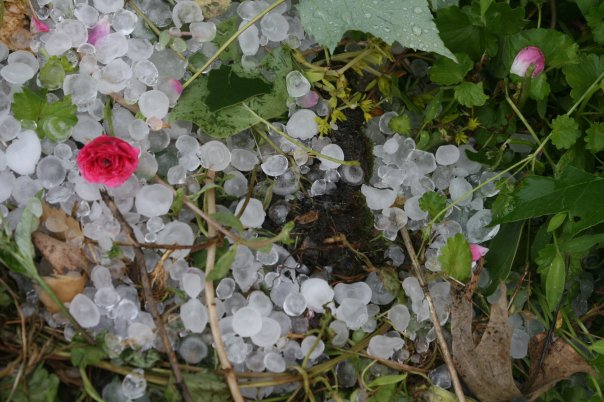
Another freakish, brief summer storm swept through–this time bringing wind, fog, downpours, and hail. Not a gardener’s favorite weather system under any circumstances. Some years ago, a June 9 hailstorm literally decimated (reduced by 10%…though I think it was more like 25%) my gardens and produced the mammatus cloudforms that show up on my “About” page. Yesterday’s hailstorm was–thankfully–not as damaging. Most of the plants will recover fairly rapidly, I think.

~

Meanwhile, I’m trying to educate myself a bit more on the history of phenomenology as it relates to poetry, art, and poetics by reading a bit of Martin Heidegger. This is a backwards chronology, but I’m not feeling ready to take up Husserl yet. Heidegger’s also problematic because of his early embrace of the Nazi party (he resigned early, too, in 1938, but never made a full repudiation). I understand that great thinkers can nonetheless be very flawed human beings. Michael Wheeler’s thorough essay in the Stanford Encyclopedia of Philosophy touches on some of the contradictions and covers Heidegger’s major work. But I am reading Hofstadter’s translation of “Poetry, Language, Thought” and six other shorter essays, such as “What Are Poets For?” and “The Origin of a Work of Art.” Actually, it is hard to consider the first text as an essay. It’s more like a poem in aphorisms. An excerpt:

~

When through a rent in the rain-clouded
sky a ray of sun suddenly glides
over the gloom of the meadows .  .  .  .

We never come to thoughts. They come
to us.

That is the proper hour of discourse.

Discourse cheers us to companionable
reflection. Such reflection neither
parades polemical opinions nor does it
tolerate complaisant agreement. The sail
of thinking keeps trimmed hard to the
wind of the matter.

From such companionship a few perhaps
may rise to be journeymen in the
craft of thinking. So that one of them,
unforeseen, may become a master.

~

Almost Confucian, no?

~

Later in his life, Heidegger moved on from his earlier philosophizing on the ontology of being (he pointed out the need to define “exist” as a premise in any such inquiry) and began to suggest that art exists within the materials/tools of the artist as well as within the artist’s being and abilities, all in a perhaps simultaneous collection of conditions. Wheeler says, “poiesis is to be understood as a process of gathering together and fashioning natural materials in such a way that the human project in which they figure is in a deep harmony with, indeed reveals—or as Heidegger sometimes says when discussing poiesis, brings forth—the essence of those materials and any natural environment in which they are set.”

Heidegger writes, for example, that “a true cabinetmaker…makes himself answer and respond above all to the different kinds of wood and to the shapes slumbering within wood—to wood as it enters into man’s dwelling with all the hidden riches of its essence. In fact, this relatedness to wood is what maintains the whole craft. Without that relatedness, the craft will never be anything but empty busywork…” Wheeler calls this manifestation of the art within the materials (which the artist must understand in order to use her talents and tools to bring forth) a “process of revealing.” Kin, I suppose, to the words often attributed to Michelangelo: I saw the angel in the marble and carved until I set him free.

~

Art, gardens, weather, poetry, the craft of thinking…all processes of revealing and transformation. “We never come to thoughts. They come to us.”ann e. michael hail foot

“Next Big Thing”

A friend & colleague-in-poetry, April Lindner, has invited me to participate in the round-robin writing blog event (termed a “blog hop”) called “The Next Big Thing.” Thanks to Molly Spencer for coordinating this web-event, which has been going awhile, so she is no longer curating it as actively. At the end of this post, I’m linking my readers to a handful of other participants. From their sites, you can locate others…and so on! We hope to foster discovery of writers our own blog followers–or random visitors–are not yet familiar with, and to spur readership in general. I love to read, and I have a mission to introduce more people to reading, to poetry, and to contemporary artists–especially word-artists. Therefore, I’m thrilled to be asked to add my 2¢ to The Next Big Thing…even though some of the formulated “interview questions” lend themselves more to fiction writers than to poets. Some of the answers may end up sounding a bit far-fetched, or simply silly.

But poets do possess senses of humor, folks. We are not all depressive garret-dwelling introverted cynics. [Ha!]

~

Now to commence with the interview questions:

What is the working title of your next book (or story, or project)?

I have two. One manuscript is finished, and I am seeking a publisher–that one is titled The Red Queen Hypothesis. The work-in-progress is tentatively called Barefoot Girls.

Where did the idea come from for the book?

imagesThe Red Queen Hypothesis seems to be culled from a bunch of my poems musing on science. I love science because it is so weird, much odder than so-called real life. Also, the nomenclature…I swoon over those latinates, Greek roots, and things-named-after-other-things. Here’s the biological definition of the Red Queen Hypothesis from Wikipedia: “an evolutionary hypothesis which proposes that organisms must constantly adapt, evolve, and proliferate not merely to gain reproductive advantage, but also simply to survive while pitted against ever-evolving opposing organisms in an ever-changing environment.” As Alice and the Red Queen are hurriedly running through the chessboard of Wonderland in Through the Looking-Glass, the Queen remarks, “Now, here, you see, it takes all the running you can do, to keep in the same place.” Don’t we often feel that way?

PBS has a good little article on it here, for those who want to learn a little science with their poetry.

Barefoot Girls evolves as I revise. As of now, the poems are memoir-based about being a teenaged girl in New Jersey, and many of them allude to Bruce Springsteen songs. The collection is, I suppose, lyrical narrative in style. Mostly free verse but with some ballad-type pieces and even a sonnet or two. I may have some trouble getting that manuscript into print because I have to get Springsteen’s permission to use a couple of epigraphs. God knows how long that will take–or if it is even possible!

What genre does your book fall under? Poetry. No other genre need apply.

Which actors would you choose to play your characters in a movie rendition?  

I would love to have Gary Cooper or Barbara Stanwyck play characters in my poems, which makes about as much sense–since they are dead–as making a movie of a poetry collection.

What is the one-sentence synopsis of your book?   

Life, love, family, environment, death, memory, animals, youth, curiosity, god.

Will your book be self-published or represented by an agency?

1) No.

And 2) –you have got to be kidding! Literary agents in the USA generally avoid poets as though we harbor west Nile virus.

How long did it take you to write the first draft of your manuscript?

Four years, generally, though some individual poems evolve more slowly. My first full-length collection, Water-Rites, took much longer…closer to ten years.

Who or what inspired you to write this book?

Ah, the “inspiration” question. I have a deep indifference to the question of inspiration. I suggest you read other writers on this topic.

What else about your book might pique the reader’s interest?

The Red Queen Hypothesis includes numerous poems that employ formal strategies, as well as plenty of nonce forms; I think of them as experiments, the way scientists frame their work though experiment.There are also philosophical undertones. It is a book of questions that are scientific, speculative, spiritual and philosophical. Barefoot Girls, the project in process, also poses questions–but of a different kind. More social and gender-related questions, more coming-of-age curiosity. The fact that these poetry pursuits came one after the other intrigues me since they seem in many ways fairly unrelated. Perhaps I will discover the relationship as I continue to revise Barefoot Girls.

Meanwhile, if anyone can suggest a publisher for RQH, I’m all ears!

Who are you tagging for The Next Big Thing?

~As The Next Big Thing is on hiatus, I suggest my readers browse for it or follow the links below that will lead to other links & literary discoveries!!

Here are some other Next Big Thing posts:

http://boysinger.wordpress.com/2013/02/24/the-next-big-thing/

Discourse: talking about poetry

This post is a response to Fox Chase Review‘s post which can be found here: Poetry in Decline?

“G” asked for responses to the need for a revolution in (USA) poetry, stemming from Diane Sahms-Guarnieri’s comments. Her ideas were excerpted, so I may be missing some of her assertions or evidence. In one way, she echoes Dana Gioia’s famous “Can Poetry Matter?” essay and book (1992): that is, in terms of questioning the isolated, academic support of poetry, poetry study, MFAs, and university publishers as elitist and as dampening a wider audience for poetry. While Gioia tends to support the literary canon in general, he stresses in his early essay that poetry has its own specialized, “frenzied” little circle of literary lights but that the art itself no longer exerts much influence on life, culture, and thinking in the USA.

From Gioia’s introduction:

The situation has become a paradox, a Zen riddle of cultural sociology. Over the past half century, as American poetry’s specialist audience has steadily expanded, its general readership has declined. Moreover, the engines that have driven poetry’s institutional success—the explosion of academic writing programs, the proliferation of subsidized magazines and presses, the emergence of a creative-writing career track, and the migration of American literary culture to the university—have unwittingly contributed to its disappearance from public view.

Sahms-Guarnieri further suggests that isolated, academic styles of poetry are partially to blame for poetry’s “decline” among US readers and calls for a return to realism.

I’m not sure “realism” is the answer, because many infusions of style, energy, or revolution that have done poetry good as a whole have not exactly fallen into that category (was Lorca a realist? just as one example). I embrace the idea of the narrative-lyric mode, which may be considered a kind of realism; but I also love many, many other styles of poetry, some of which are “difficult” and not easily accessible to the general reader. The main means through which I learned the diverse structures and approaches to poetry is through reading on my own, autodidact that I am. Yet formal study and literary criticism increased and deepened my passion for this art. I teeter on the fringe of academia though I am a poet who writes outside of the classic academic framework.

I feel compelled to defend the teaching of poetry, though I admit the process is often done badly. Still, one of the things academia does best is to examine the work, and I feel readers who examine what they love more closely will benefit from doing so (rather than taking the “I know what I like” stance). Academics have, since the 1970s, begun seriously to read beyond “the canon,” and that is all to the good. Academia doesn’t produce the best art, however. Knowing how things work in theory does not equal expertise. I know how a bicycle works, but I am pretty sure I couldn’t build one from scratch.

~

The poems that remain timeless are seldom elitist. The problem with the elite is that it eventually falls from grace. When that occurs, the allusions and puns and, often, the entire foundation of the piece get lost. This issue can be equally true of poems that are “realistic.” If the poem offers no recognizable aesthetic, purpose, or sensation, it ceases to be valuable to future readers. Many of today’s poems will suffer this fate–mine among them–and that’s not a bad thing. We don’t get to judge which art is revolutionary, prescient, timeless; later generations make those judgments.

And that is one reason many writers resent academia and university presses: it seems as though these institutions are “at the top of the mountain” and trying to keep their situations exclusive; in other words, they are acting as cultural, literary judges. So they are…in their time. They cannot enshrine themselves for the future. Art doesn’t work that way.

~

Contemporary Poetry Review claims it is there to resuscitate contemporary poetry, which implies poetry’s suffering a near-death experience. I do not think poetry is dying. I think it is changing, which it has always done, because art is responsive to and entangled with culture and therefore defies stasis.

Poetry, like most art, tends to exist on the cultural fringe, where it hangs out with curious, inventive people who bother to seek for it. Some of them look on the mountain top, and some of them look online, or in pubs that host open mics, or at independent bookstores, long may they thrive. With luck, and maybe some encouragement, those people might buy a book or two–including POD-published or self-published books (why not? –and while you’re at it, Water-Rites is still available!). This last point coincides somewhat with Larry Robins’ perspective in the Fox Chase Review piece.

If you really do know what you like, regardless of how you make that judgment, buy a copy of the book. And don’t get it second-hand from Amazon if you can help it–buy from the small press or the author or an indie book shop if you can find one in your area. Read it again and again, and figure out why you like it. Tell someone else. Discuss what you love.

That’s what keeps poetry alive.

water-rites_cover

Beauty & awe–briefly

I have been reading lately (currently Leonard Shlain’s Art & Physics and Donald Revell’s The Art of Attention: A Poet’s Eye), but not much inspired to write. Instead, I work in the garden or sit on the porch and listen to birdsong.

I muse upon beauty. Partly such musing falls under the pursuit of aesthetics: the world of my garden becomes especially beautiful in spring. The sounds birds make seem beautiful to my ears. Water droplets on emerging leaves appear beautiful in the morning light.

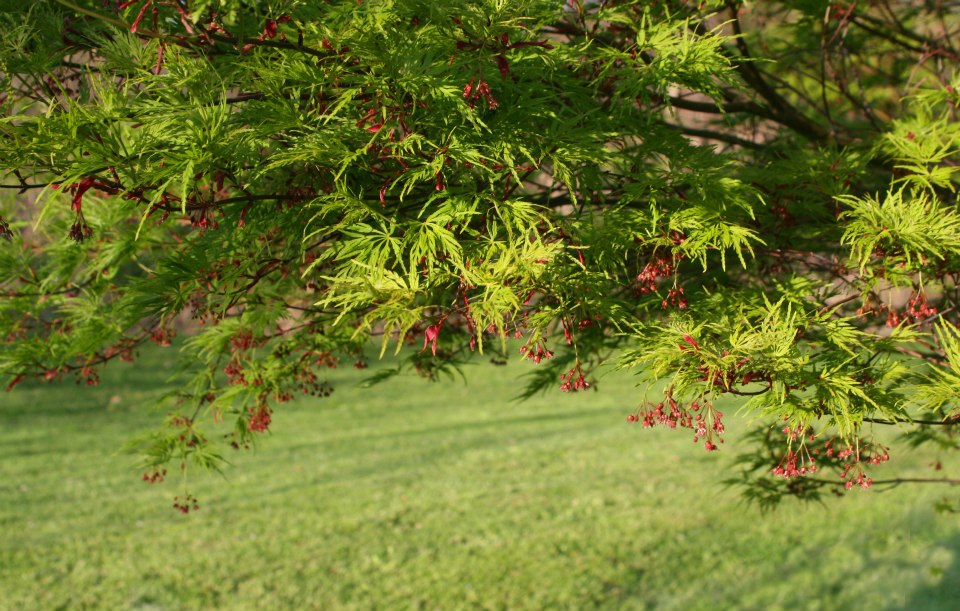
japanese mapleThese are phenomena. The world of things I can take in with my senses, process through my body and brain, and create–out of whatever “mind” may be–a concept of the beautiful. The phenomena are not physically affected by my categorization. It is I who am changed, I suppose, by virtue of my aesthetic appreciation of the beautiful.

I am reminded of Kierkegaard:

“Love does not alter the beloved, it alters itself.”

Aesthetic appreciation does not alter the thing-in-itself, it alters the person who finds beauty in the thing-in-itself. If this is so, I am altered by my love of what I deem beautiful.

~

While I was searching the web to find the quote above–I couldn’t quite recall it exactly–I found the Kierkegaard quote on the blog of pastor Jonathan Martin, whose theology I can’t completely get my mind around but whose words (below) reminded me of the Bhagavad Gita:

The most beautiful thing a person will ever see may well also be the most terrifying.

Is this not the nature of true beauty? To not just be soft and delicate, but to be so powerful, so overwhelming, so altogether other from ourselves as to threaten? Beauty does not intimidate, but it can overpower. Beauty is a coup to our senses. It holds an unruly power over us. Beauty can move us, haunt us, carry us, compel us. To feel ourselves beholden to the raw power of something beautiful is to be upended, not just inspired but assaulted.

On the lines of such thinking, we might find beauty in a tsunami, hurricane, earthquake, meteor strike the same way Arjuna feels paralyzed by the awesome beauty of the revealed godhead Krishna.

Perhaps that is why we often find ourselves fascinated by photos of natural disasters. Having lived for a couple of years along the northern end of Tornado Alley in the USA, I fear tornadoes. But they possess a kind of beauty in their awesomeness, if we can remove ourselves from the anguish we feel for people whose livelihoods, homes, and lives are destroyed by the big winds.

I wonder if human beings can ever bear that kind of awe; Martin says it transfigures us, Kierkegaard implies something similar, the Mahabharata and other sacred literature suggest that our bodies and our minds can withstand such revelation but cannot describe or truly comprehend it. It seems to me a kind of spiritual post-traumatic stress disorder! This is the “fear and trembling” of the psyche, whether the mind decides the experience is physical, mental, spiritual, or religious.

And that manner of beauty is not aesthetic.

Martin later writes, “Objectively speaking, the beauty of God is already present in our beloved, whether we recognize it or not. Rather, when we encounter beauty in another person, we are changed–we are transfigured…[those we love] do not become beautiful because we recognize their beauty; rather their beauty makes us beautiful.”

Is this experience awesome or aesthetic? Does the beauty of the azalea, the lilac, make me beautiful because I recognize it as such? Am I altered, fundamentally, in my admiration for an artist’s work, a poet’s words?

~

Favorite poems

In my last post, when writing about reading poems of grief, I mentioned Robert Pinsky–former US Poet Laureate. When Pinsky was Laureate, he promoted the program now called “The Favorite Poem Project.” The concept was to demonstrate that poetry appeals to a diverse audience; there are so many styles and types of poetry, on so many topics, that anyone can find a poem that appeals. Teachers, plumbers, teenagers, soldiers, business executives, mail carriers, truckers, grandparents, schoolchildren–anyone who had a poem that had special meaning was invited to say a bit about why or how that poem meant so much and then to read the poem aloud to an audience. Pinsky’s project included favorite poem reading events, and videorecordings of such events, now archived at the site…and a book.

This year–this past Tuesday, to be quite exact–I took part in a favorite poem reading at the college where I work. I find these readings rejuvenating. Sometimes the stories that surround the poem choice are heartwarming, sad, or funny. Some readers tell an anecdote about a favorite teacher, relative, friend, or book; it’s wonderful how those stories “work” with the chosen poem. The director of information technology related the story of how, when her mother was in labor with her, her mother was taken to the hospital by hearse because taxis in the south did not serve her “black neighborhood.” A dance professor offered the romantic story of his long-distance courtship with his (now) wife via letters and poems…and Neruda. An instructor spoke of his fascination with attics and his father’s estrangement from the family and then read Stanley Kunitz‘s amazing poem “The Portrait.”

The poem I read was also a Kunitz poem, “The Snakes of September,” one of his later works. I am not sure this is my favorite poem–indeed, I would be hard pressed to come up with one only, and I might choose Ben Johnson’s “On My First Son” or Mary Oliver’s “Wild Geese” or Li-Young Lee’s “The Gift” or…well, there are dozens. I just chose one I thought would suit the evening, a poem with a garden in it, and an allusion to Eden, and the lovely phrase “the wild/braid of creation/trembles.” It speaks to me.

Look for poems that speak to  you. Keep them near  you, on the fridge or by your desk, in a notebook by your bed, or in your heart. Share them if you feel the urge; you will be doing good.

Blessings for National Poetry Month and always.

“The difference between Despair/And Fear”

~

Events such as the tsunamis in Indonesia and Japan, devastating earthquakes or hurricanes that result in high death tolls, industrial accidents that destroy communities—these seem impossible to control and blame is hard to place, even in the latter case. News coverage in such situations tends to focus on damage and recovery efforts, then shifts to the next drama. Tragedies wrought by specific human perpetrators, however, become media spectacles here in the USA. The same few seconds of terrible footage repeatedly fill television and computer screens; viewers feel drawn into the activities of SWAT teams and reporters and the compelling speculations of forensic psychologists, terrorism experts, social commentators, politicians, witnesses. There are heated exchanges on social media forums.

~

I’m beginning to believe societies get the popular culture they want or, alas, deserve (late Rome’s “bread and circuses,” anyone?). The circuses give us what society’s members, apparently, want to consume. Art, however, offers what they need, whether or not they want it. During times of media frenzy, when the culture in which I live seems numbed by “infotainment” and nonstop visual and audio coverage of tragic events, I find myself turning to art—usually poetry—for grounding, for solace, for affirmation of the human spirit and for a way to confront human truths.

~

I do not suggest that poetry necessarily comforts. Often, it wears me ragged, forces me to wrestle with ambiguities, to question my values. Sometimes, art brings me to tears.

I do not consider these results to be negative results. These reactions are human reactions; I am reminded of my humanity through my engagement with art.

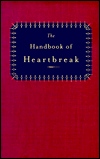
A good little anthology for times of grief is The Handbook of Heartbreak, edited by Robert Pinsky. Pinsky’s selections cover the human spectrum of sorrows: broken romances, dead pets, war, disaster, family and social losses and the desolate emptiness of depression, sorrow that is concrete and existential, spiritual and personal and cultural.

~

Speculation is something inquisitive minds do well, but it is easy to believe our speculations, to forget they are merely imaginings that may or may not be valid. When a crime becomes a widely-broadcast web of information blips, the suspect is forejudged in the court of public opinion; I feel concerned about our nation’s commitment to the concept of innocent until proven guilty in a court of law (how on earth will that be possible?). What irks me most about media coverage of the Newtown, Virginia Tech, Aurora, Tucson, Boston Marathon, Columbine and other killings is the retreat into a kind of contorted deductive reasoning based on imaginative constructions of human intent and purpose—the search for motivation that drives the forensic end of these crimes becomes a news story led by experts who imply they can get to the truth. But can we ever know the truth? Each human being is unique and ultimately unexplainable, and often the way we are best reminded of that fact is through art: fiction, theater, paintings, poetry. On his New Yorker blog, Adam Gopnik notes:

Experts tell us the meaning of what they haven’t seen; poets and novelists tell us the meaning of what they haven’t seen, either, but have somehow managed to fully imagine. Maybe the literature of terrorism, from Conrad to Updike (and let us not forget Tolstoy, fascinated by the Chechens) can now throw a little light on how apparently likable kids become cold-hearted killers. Acts of imagination are different from acts of projection: one kind terrifies; the other clarifies.

~

We need clarity.

~

I might add that in my day job, I work with young people between the ages of 17 and 24, day in, day out. These young adults experience varying levels of frustration, confusion, numbness, fear, anxiety, excitement, need for risk, need for security, withdrawal, social discomfort, and inner turmoil. I cannot look at the perpetrators of recent civilian massacres without thinking of my students. I do not mean that I am wary or that I think one of my students might snap; what I mean is that I feel compassion for the conflictedness each human being is capable of feeling and that I understand all too well that not all of us are capable of contending with that conflict.

Some of us can accomplish through acts of imagination the confrontation with what terrifies or numbs us. These people include our artists. Those who cannot express or embrace the confrontation are at risk of projecting the inner conflict, fear, or insecurity elsewhere, as Gopnik makes clear.

Can art make us safe? We live in the world: not an inherently safe place. I think if we embrace what art offers us we will not be in retreat from the truths of the human experience but will learn to confront truths, even those that are uncomfortable. Art gives us insight, a step toward understanding. Can art grant us clarity? I think so.

Therefore, Emily Dickinson (305):

The difference between Despair
And Fear—is like the One
Between the instant of a Wreck—
And when the Wreck has been—

The Mind is smooth—no Motion—
Contented as the Eye
Upon the Forehead of a Bust—
That knows—it cannot see—

~


I celebrate myself…

April is National Poetry Month in the USA, and I begin the month with Walt Whitman’s famous phrase and will attempt to duplicate the joyous urgency of his call to celebration. That means I am going to try to post just a little more frequently in April.

Poetry month began this year with a wonderful act of creative largesse on the part of a friend who sent me a poem…dedicated to me. Receiving a gift like this one is humbling; and it has been quite a long time since anyone’s written a piece for me. David Dunn, to whom my collection Water-Rites is dedicated, wrote a few poems for me or inspired (indirectly or directly) by our friendship or my family and surroundings. But he died over a decade ago, and since then I suppose I have had to learn to celebrate myself.

Not that this is a bad thing–celebrating the self–but for some of us it presents certain cultural or psychological obstacles. In this, Whitman has been an important teacher for me. As a great observer, loafer, lover of the world and all its beings, he was able to include himself among the beloved. My background, Protestant, agrarian, modest, surrounded by the biblical entreaty to remain always humble before God, combined with a natural shyness, means that I have had trouble admitting of self-celebration in any form and under any circumstances. I don’t take praise comfortably. The left hand shouldn’t know what the right hand is doing.

However, Whitman seems contented in his skin and in his world and follows a different parable as model: he does not hide his light under a bushel.

Walt Whitman in mid-life

Walt Whitman in mid-life

Furthermore, his passion admits of compassion and of aesthetic appreciation for all of the “Kosmos.” Each breath, scent, texture, color, hue, person, idea, object, sentient or non-, living or inert or dead long-past or recently, religious or scientific or imagined comes to life in language through line, syntax, lists, descriptions, words. I think there is a hint of zen-like acceptance in Whitman’s most lasting poetry, the vulnerable willingness to accept all that we experience and to do so non-judgmentally.

Thank you, Beejay, for the poem. I feel inspired anew. And as I celebrate all poets and the valuable, irreplaceable, gorgeous, ancient art of poetry this month, I shall endeavor to embark upon the celebration of myself (davening to ol’ Walt with humble pleasure). Therefore, a reminder:

My book Water-Rites is still in print, and Brick Road Poetry Press sells it (as does Amazon.com, where poetry-lovers can purchase the book in e-book form for Kindle). Dawn Leas reviews it at Poets Quarterly this month. Click for the link here!

May April be full of revelations in the form of poems for you.  water-rites by Ann E Michael

Endemophilia

This poem is sort of my version of endemophilia, describing (as Albrecht defines it) “the particular love of the locally and regionally distinctive in the people of that place. It is similar to what Relph … called “existential insideness” or the deep, satisfying feeling of being truly at home with one’s place and culture.” You might want to check out Glenn Albrecht’s site for more detailed definitions and philosophical/psychological reasons for inventing names for such concepts.

My long-poem in Water-Rites, “The Valley, the Whitetail: A History,” probably fits the term endemophilia more closely than the poem I’ve posted below–which may one day appear in print if I can find a publisher for my next manuscript. But the long-poem is a little too long for a blog post.

[I have an idea: buy a copy of Water-Rites from Brick Road Poetry Press, and read it there!]

~

Suburban Georgic

A mild day in February. Good chance
there’ll be more snow or ice. Walk slowly,

note the footprint of a hosta, dormant, or
the arrow-shaped deer hoof in hardened soil.

Look more closely for the ravages and burrows
of rodentia—woodchucks, voles and mice.

You may discover where squirrels have
hidden seeds or laid waste to crocus corms—

try to restrain your wrath. Decide
how best to counter such yearly looting;

strategy keeps the mind sharp. Grubs,
for instance, in your lawn—a different tack,

and this year you may succeed, and keep
the skunks from rooting through the grass.

Weigh, in your mind and pocketbook,
the relative costs of pesticide and herbicide.

It might be the year to go organic,
though there’s even odds the dandelions will thrive.

Ease your troubled breast from lawn woes.
Raise your eyes to forsythia, to witch-hazel,

observe critically the shrubs’ bare bones,
decide what needs the kindest cut,

find your saw and pruners, time to oil
and sharpen—your fingers itch—

but it’s a little soon. To assuage your
yearning, cut back the redtwig osier

so its new growth will flush crimson.
Consider forcing blooms indoors—

aren’t there soft, small swellings on
the slim wands of pussywillow?

When the next storm hits, dream of columbine
and narcissus. Get out your Horace, and wait.

ann e michael

quince blossoms

~

© 2008 Ann E. Michael

~

Waiting, in the place I call home, for spring.

AWP follow-up

photo Ann E. Michael

winterhazel

Snow fell on Boston. Not a big snow, however, and rather typical for a late-winter storm: damp, swirling but not biting, swift-melting once the sun appeared two days later. Early Friday morning, I trudged with a friend over the as-yet unshoveled sidewalks to breakfast on Newbury Street at Steve’s. We met with conference buddies who are all members of the WOM-PO [women’s poetry] listserv. It is lovely to meet face-to-face people who have been virtual colleagues and splendid to discuss poetry over a good breakfast.

~

It is also a relief to realize that I have finally learned how to manage conference-going. It is all a matter of pacing and, I suppose, of taking poet William Stafford’s advice and lowering one’s expectations. The hardest challenge is making the choice between blowing the budget on terrific food (in a big city, wonderful restaurants abound) or on books, because the bookfair at the Associated Writing Programs’ annual conference is enough to inspire swooning among literary bibliophiles.

In three huge exhibit rooms, small presses and literary and university presses displayed chapbooks, literary journals, and books that range from minuscule to tabloid-sized, books that are handmade, letter-pressed, offset, print-on-demand, stapled, ribbon-sewn, die-cut, fancy-boxed, reprinted, spare, florid, illustrated, edgy, deckle-edged, marbled, second-hand, one-of-a-kind, limited-edition, mass produced, commercial, educational…in all genres including mixed-genre, collaborative, collage, anthology, with an emphasis more on the literary than the commercial text. These books can be devilishly hard to locate, even with the existence of Amazon and online sellers; and holding them in your hands is a far more convincing sell than seeing a picture file on your computer screen.

Heaven for poetry-readers, there are also wonderful creative non-fiction books, collections of short stories, novels, books on prosody and poetics, the craft of writing, on creativity and inspiration and toil and revision and on the complex and controversial topic of teaching writing. Oh, and there are people, too. Most of the attendees are writers of one stripe or another who are congenial and curious or else walking about with the glazed expression of the overwhelmed.

Or some combination of the two.

~

I exercised considerable restraint and managed not to load my bedside table with two months or more of reading material (see a related post here). And I got some terrific ideas for teaching writing to college students and found some wonderful poets whose work I want to study. The last night of the conference, I listened to the mesmerizing Anne Carson read an indescribable take-down of the fifth book of Proust’s À la recherche du temps perdu, the section titled The Captive (Albertine). It’s been years since I read Proust, which I did almost out of stubbornness in my junior year of college, but the book came back vividly enhanced by Carson’s peculiar approach to pacing, language, scholarship, whimsy and satire. I like what the Poetry Foundation’s biography says about her after the release of her text The Autobiography of Red:

According to John D’Agata in the Boston Review, the book “first stunned the classics community as a work of Greek scholarship; then it stunned the nonfiction community as an inspired return to the lyrically based essays once produced by Seneca, Montaigne, and Emerson; and then, and only then, deep into the 1990s, reissued as “literature”and redesigned for an entirely new audience, it finally stunned the poets.” D’Agata sees Carson’s earlier work as an essayist everywhere in her poetry, along with her deep absorption in Classical languages. Carson’s work, D’Agata alleges, asks one to consider “how prosaic, rhetorical, or argumentative can a poem be before it becomes something else altogether, before it reverts to prose, to essay?”

~

Altogether, Boston provided nourishment of many kinds: gustatory, intellectual, emotional, poetical…food for thought.