Gardening in April

Spring seems serious at the moment. Bumble bees already busy at the barely-open pear blossoms. Hyacinths and daffodils everywhere, and muscari and the redbud opening up. Time to spend more hours in the dirt!

The past two years, I have made the vegetable garden less crowded; the children are grown and I do not want to can, freeze, or give away tons of vegetables the two of us cannot consume. I’ve decided to offer a larger portion of the garden to bees and butterflies by adding more flowers to the mix. Also, I have added wood mulch paths. Shredded wood mulch provides a good environment for salamanders, toads, useful insects, and other “minor fauna” (see my book–The Minor Fauna). This year, while tooling around in the soil doing preparation for plantings, I’ve been thrilled to find toads and salamanders–as well as isopods, (pillbugs, sowbugs and woodlice) and, of course, several varieties of worms.

I’ve been in the garden and taken a woodsy walk; every politician and world leader ought to stop whatever they are doing and take long, quiet walks in nature and long, deep breaths and then do some thinking before they make any more decisions. They might want to read some Wendell Berry, too.

Works for me.
~
Berry was only 30 years old when he wrote these poems (and also “The Peace of Wild Things,” which many people tell me is their favorite poem). He has labored on his thinking in the decades since, and remains a poet worth reading.
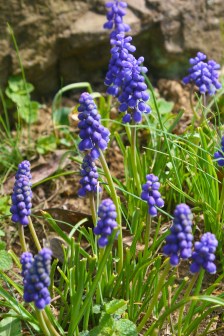
muscari

April Woods: Morning

Birth of color
out of night and the ground.

Luminous the gatherings
of bloodroot

newly risen, green leaf
white flower

in the sun, the dark
grown absent.

~~

To My Children, Fearing for Them

Terrors are to come. The earth
is poisoned with narrow lives.
I think of you. What you will

live through, or perish by, eats
at my heart. What have I done? I
need better answers than there are

to the pain of coming to see
what was done in blindness,
loving what I cannot save. Nor,

your eyes turning toward me,
can I wish your lives unmade
though the pain of them is on me.

Citizen scientist

From as far back as quite early childhood, I have been interested in science: zoology, botany, biology, entomology, physics–if I had been mentored differently, I might have become a researcher instead of a poet. I possess that quality of curiosity that pushes for details, a trait that people refer to as ‘geeky.’ For me, it is fun to contribute my backyard observations to The Dragonfly Woman’s research or to the Eastern Pennsylvania Phenology Project, which asks for assistance from ‘citizen scientists.’ This evening, I am taking some elderly best beloveds to a fundraiser concert for March for Science.

17498711_10158425599030261_5744494573695525358_n

March for Science logo. The March is April 22, 2017.

~

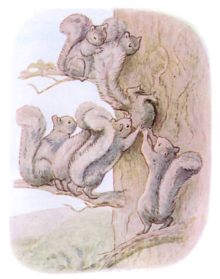
Empiricists have to begin as observers, and here’s where my science and poetry passions twine. Today’s backyard notes involve gray squirrels and the hypothesis that they learn behavior swiftly through their (many) generations.

My backyard is essentially a lawn and meadow, quite open, with two pear trees and a quince almost halfway between the property lines, both of which feature narrow woodlots and brush hedgerows. For 16 years, we had a dog; between the dog’s presence and the fact of hawks–of which there are many–gray squirrels seldom ventured from one side of the property to the other. Both woodlots are replete with walnuts and sumac and wild cherries, so squirrels really did not need to get across the meadow.

As of last year, though, they have learned they can cross the lawn in relative safety, as long as they exert haste and stop nowhere along the way. The dog died, but the hawks are still around.

27

Gray squirrels by Beatrix Potter, “The Tale of Timmy Tiptoes.”

They may have learned this behavior last summer, when a mid-season drought led to very thirsty squirrels who were brave enough (no dog!) to dash to the pear trees and harvest pears. Juicy!

So now, they race across the lawn…to have sex. Squirrel sex is a frolic of prinking, rolling, tumbling–a bundle of tails and feet, a flurry of gray and white fur at the foot of a tree, dry leaves scattered by the wrestling. Then the pair scurries off side by side. Today is actually the first time I have witnessed squirrel mating, though clearly it occurs frequently to judge by the numbers of these creatures in our yard.

~

19

From Potter’s “The Tale of Timmy Tiptoes”

I think of Beatrix Potter as an excellent example of the citizen scientist. While her paper on mycology concerning the reproduction of fungi via spores [“On the Germination of the Spores of Agaricineae“] was not accepted as science at the time she wrote it, her observations were correct.

Her drawings of animals are marvelously accurate, even when she puts them into dresses, jackets, bonnets, and tiny slippers. Though she personifies them, she chooses human attributes that suit animal behavior rather than the other way around.

~

Science, then, is close reading of the world’s phenomena, not really so different from literary scholars with their close reading of texts. Poets also view the world with close reading–observation, curiosity, changing perspective–asking questions about what we think we know. And revelations sometimes occur. Like squirrel behaviors, including squirrel sex; like spores, and the life cycle of salamanders, and dragonfly swarms.

Beautiful brain

While waiting for the snow to evaporate and melt, the gardener experiences agitation; the days are longer–it must be time to plant seeds…but the soil is too wet and too cold.

Fortunately, there are always books! I have read Daniel Dennett on religion, George Lakoff on the embodied basis for philosophy, and am plowing rapidly through Ruth Whippman’s (acerbic and very funny) America the Anxious.  Also I am slowly savoring an anthology of Jewish women’s poems, The Dybbuk of Delight, that I randomly discovered in the library.

beautifulbrainbook04-1080x644

But here’s a book I want to own, when I can justify more book purchases: Beautiful Brain: the Drawings of Santiago Ramon y Cajal, because Art! because Neuroscience! because Beauty! The blog Hyperallergic says the drawings are going to be touring museums (see The Dynamic Brain Drawings of the Father of Neuroscience), which might also become a must-do for me when the exhibit travels to New York City next January.

What Cajal was doing back at the turn of the last century still inspires artists, not just medical scientists, today (see my post on Greg Dunn’s neuro-artworks). These compellingly beautiful and quite accurate drawings may also inspire poets and armchair philosophers who have lately spent a great deal of time pondering the resilience of the brain and the challenges that rupture a sense of self when cognition is interrupted.

beautifulbrain01-1080x1373

~

Credit goes to Abrams Books for these graphics and for the decision to publish this beautiful text.


Randomness & poems

The past weeks unloaded upon the blogger a host of responsibilities and reasons for reflection: reams of student essays to read and grade, piles of snow and the resultant delays and work closure leading to backlogs, and such usual complaints. In addition, the dropping-of-everything while attending to the death of our no-longer-resident nonagenarian, not to mention the bureaucratic heaps of forms and notifications that follow a passing.

I’m writing poems. It seems to be what I need to do at present, despite the state of my household environment and the backlog at work.Untitled-writer

~

The blizzard put my gardening on hold, though I remembered to purchase some seeds and thus can get to the tomato-starting process within a week or so. Before the snow came, I did get outside to prune and deadhead a bit while the weather was unseasonably warm. A little at a time. Such things are sustaining to me, emotionally.

And watching the birdfeeders has been soothing and delightful. Today a small nuthatch joined the party. My youngest cat spends large segments of his day crouched by the window, as fascinated as I am (but for different reasons, I suppose).

scoot window

~

I am thinking of a friend-in-poetry who has need of special care and financial assistance while going through and recuperating from some extremely painful, delicate, dangerous and potentially-disabling surgery-&-rehab. She will need more than the initial $4K this GoFundMe portal suggests, so if any of my readers feel inclined toward a random act of (financial) kindness: Jessamyn’s Medical Fundraiser. Thanks.

~

Addendum: Yes, I’m sticking to my determination to read more poetry. And it is helping. Most recently, re-reading early Li-Young Lee, Mark Doty’s Deep Lane, Dave Bonta’s Ice Mountain: An Elegy, and a really wonderful new collection by Kim Roberts: The Scientific Method.


Nesting

When I go out of doors on a splendid day, I keep finding things to observe and tasks to do–before long, I realize I have spent more time than I intended (and indoor tasks are calling). Today’s yardwork entailed cutting back weed brush and vines before the trees and shrubs leaf. It can be challenging, as it requires the intrepid gardener to crawl into the woodlot and under the large pines and tamarack to yank loose entwined wild grape, Asiatic rose, elderberry, blackberry, and poison ivy stems, there in the tangled vitality of plants-that-thrive-where-I-don’t-want-them.

The mourning doves kept me company with their coos, and small birds busily checked out the birdhouses in the meadow. Soon it will be nesting time (already is, for the owls).

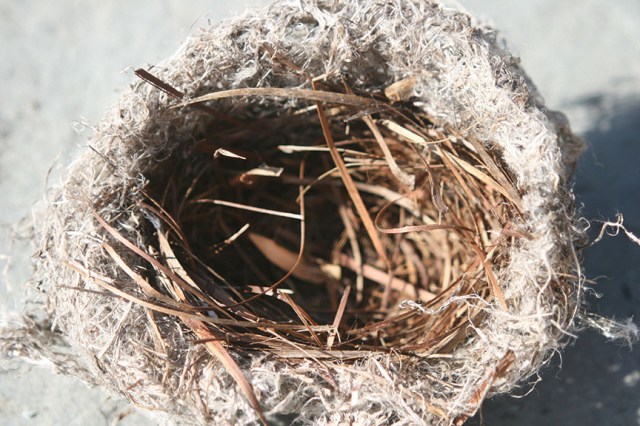
Always, when I cut brush, I find last year’s nests. Look at this one:

oriolenest

A bird made this! Probably an oriole. It is a sweet little bag woven or knitted without any tools but the animal’s own body. Beak and feet, saliva, and the nestling body rounding out the basket within.

Here, you can see the interior of the nest; I folded back the strong but delicately-woven sack and the interior nest is visible.

nest2

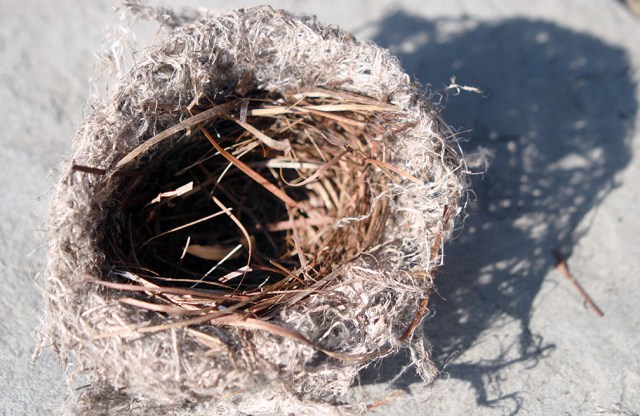
I was a little surprised at how well the bird-made mesh held up as I handled it. It is really resilient–those birds know what they’re doing!

Here is a more detailed photo of the little nest-basket inside of the sack:

nest4

The process of gardening heals me in so many ways. I sense the need to write poetry again, and I get the urge to tidy up the landscape and prep the vegetable patch. Things will return to themselves in their own time and their own ways. The birds return. The flowers return. My own nest needs attention, and the energy for that attention will also return.

Give it time.

In this photo, the shadow on the right shows how porous the nest’s weave is, almost like macrame. It seems like a miracle to me. And so beautiful.

nest3

Museum musing

On a drizzly, quite autumnal day, I returned to one of my favorite places, the Philadelphia Museum of Art.

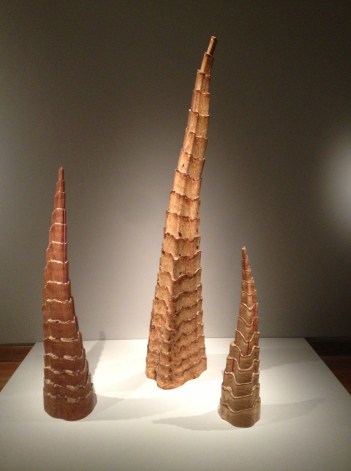
Our main purpose this trip was to visit the American Craft galleries, where wood-turner and artist David Ellsworth’s work, including some collaborations with his wife, glass-bead artist Wendy Ellsworth, currently resides for a one-year exhibit. It’s not every day that I can enter a world-class museum and say, “I am friends with the artist who created this marvelous object!” Kudos to the Ellsworths and to the museum for recognizing the importance of David’s astonishing work.

photo-3

Crafted from a dense burl of wood, precisely bandsawn, these sculptures from Ellsworth’s “Line Ascending” series range from 2 to 5 feet in height and conjure possibilities from dinosaur horns to mountains to minarets.

I had not had a chance on previous visits to walk through the Anne d’Harnoncourt Sculpture Garden at the museum, so despite the drizzle, we followed the paths through the 1-acre urban park. The hardscaping is very nice, though by now a bit cliched, since it seems every city garden in the US uses New York’s (admittedly amazing) High Line as its model. The Anne d’Harnoncourt garden likewise utilizes native plants in the garden areas–a trend of which I approve. The views of Philadelphia, its fountains and the river, are nicely framed, and the park is laid out well for “rooms” to contain or display large sculpture. I am sorry to report that few of the sculptures resident at present are appealing, though. My spouse remarked that one of the Sol Lewitt pieces “looks like a barbecue grill platform.” In another setting, that might not have been so obvious (or so funny). Nonetheless, it was pleasant to wander the sculpture garden paths and muse on things aesthetic instead of thinking about the large stack of student essays awaiting my attention.

Evaluating freshman composition papers requires a different aesthetic altogether.


Growing, watching

Garden update: my valley experiences, once again, a bit of drought.

And I have scored a victory–possibly temporary–against the bunnies, thanks to some very hard, hot work by a pair of my best beloveds and lots of chicken wire. Now, as the weather gets into long spates of heat and humidity, I watch and wait while the garden does its growing.

I watch the tomatoes ripen. I watch the birds:

IMG_2310

Three swallows among the tomatoes

The bluebirds enjoy perching on the fenceposts. This one doesn’t look too blue, but I promise it is a bluebird.

IMG_2312

I guess I need a longer lens.

I watch the herbs and vegetables flower. The cilantro and dill flowers bring all kinds of pollinators to the garden. I found a new kind of very tiny bee this morning, but my camera doesn’t have the best close-up lens. It was a cute bee, very small, grey, and fuzzy.

IMG_2309

The borage gets a bit thuggish but attracts pollinators; cilantro and dill manage to sow themselves among the onion rows.

The beans rows are missing, because the rabbits ate them all.

~

Speaking of bees and pollinators in general, I have found some lovely blogs by entomologists online, full of close-up photos, environmental information, and fascinating tidbits about bugs and their interactions with the flora and fauna that surrounds them. I am continually struck by the amazing interconnectedness of life when I read these posts. In addition, something about the sort of scientists who observe insects at close range and study their anatomy and life cycles seems to inspire a kind of geeky humor as they follow their biology passion into the field. Or maybe that quality exists only among the sort of entomologists who also blog!

Here’s one I like, Standing Out in My Field, the nature of a punny field biologist.

Possibly I should have followed my own third-grade dream of becoming “a scientist.” My tendency to watch things, especially as they grow–to be an observer–would have served me well in a scientific field discipline. Though it isn’t a bad quality for a writer to possess, either.

Beatrix Potter, interdisciplinary artist

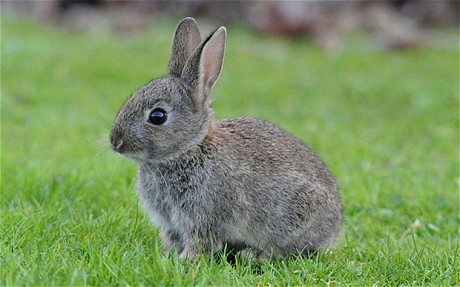
Beatrix Potter came to mind yesterday when I watched a young rabbit struggle into a fix as it tried to escape from me through the newly-reinforced fencing. It had gotten in at a spot we left open after some hours of work on a hot day yesterday, but it could not locate the open span when I cornered it among my beans.rabbit-014

In “The Tale of Peter Rabbit,” Potter writes: “Peter was most dreadfully frightened; he rushed all over the garden, for he had forgotten the way back to the gate…he ran on four legs and went faster, so that I think he might have got away altogether if he had not unfortunately run into a gooseberry net…”

Very observant description of cornered-bunny behavior. I felt rather sorry for the bunny in my vegetable patch. It had squeezed itself between a gap and then found itself impressed against chicken wire, and for a few seconds there was a mash-up of fur, feet, and fencing in a whir of sheer panic. The rabbit freed itself, however, with an acrobatic twist through a gap, ran back into the garden; and after a few false tries, finally located an unreinforced section of the garden fence and escaped toward the hedgerow.

~

Potter was an admirable writer of engaging prose, a terrific watercolorist and an amateur mycologist whose careful observations of the plants and animals in her Lakes District farm environs still draw admirers to her work. I think of her as a kind of turn-of-the-century interdisciplinary artist, though I cannot imagine she would ever perceive of herself in that light. She might agree that she was an excellent observer of the world–a quality that benefits scientists, artists, writers, journalists, and farmers. If all you think of when you see her name is “children’s books,” go to the Beatrix Potter Society’s website and learn how much you did not know about her.


Wasp redux & reading

Last year, I had my first encounter with a grass-carrying wasp.

Today, I noticed some waxy, crumbly, yellowish bits around the post in which last year’s wasp had built its nest. Then I saw an adult grass-carrying wasp hovering to and fro with a stem of grass grasped in its legs, which led me to this year’s nest–in a different hole in our post-and-beam porch. Who knew the wood had so many little holes in it? The wasps sure found them! Today’s wasp has built in a much harder place to photograph, a vertical spot, behind a post. So last year’s photo will have to suffice.

nest of the wasp

Isodontia: nest construction in progress

~

I am not quick at writing poems in response to events, personal or public; generally I need time to consider deeply, to process. I am glad to participate in an upcoming event, however, taking place in Bethlehem PA as a public response to the Orlando Pulse shooting. LGBT citizens of the region, and families, friends and supporters of compassion and awareness, are gathering for a memorial and celebration of support for everyday Americans, which includes–we must recognize, and it would be wise and sane to accept–people who are LGBT/gender fluid & who are just human beings notwithstanding, as are we all.

For those in the Lehigh Valley area of Pennsylvania, the poetry reading is at Sun Inn’s courtyard on Friday July 1. I may not have a poem of my own to read, but I have been reading through my library and have already located several poems by other writers that will serve well as responses to tragedy, personal or national, or which speak to the human-ness of all of us.

~

I am doing a little nesting of my own this week, retreating into a metaphorical burrow for a couple of days, I hope. And with any luck, I will emerge with some new drafts of poems.


Garden breach

Summer solstice. The robins are on their second brood; mulberries are ripening, and the bluebirds have arrived for the feast.

Fifteen years ago, we set up my garden to be as impregnable as possible from incursions by deer, groundhogs, and rabbits. We accomplished this by digging a narrow trench on the perimeter, lining the trench with wire mesh fabric, and filling the trench with gravel–after setting the steel posts and putting the steel wire fencing in place. The strategy even deterred weeds for about three years.

But rain and snow and air and therefore rust, along with ground heave and the occasional bump by lawnmowers, have had their way. While deer still ignore the plot, this year, bunnies have breached the fence. It’s time to find a new way to keep them from the edges.

rabbit-014

I have previously written about how fringes and perimeters can be boundaries or places of activity and fluidity, so it seems I am a hypocrite for keeping my rabbits at bay. Maybe I ought to find a balance? Living with their denuding of my carrot tops?

–No, they’ve plenty to eat in my lawn and in the meadow. The balance goes both ways.

Their persistence interests me. Their movements are both awkward and graceful. Their ears are translucent in the early morning sunshine. I don’t mind having them around as long as they stay out of my vegetable patch, and they feed the owls and hawks, whom I also enjoy.

All along the edges…

~

Curious information note of the day:

According to neuroscientific studies, less than 0.1% of the information carried in the optic nerve at any given moment passes through the visual attentional gateway (“bottleneck”) after the attentional gateway recognizes a cue; the cue evidently serves as a gating mechanism to regulate the flow of image data.*

What this implies (I think) is that the bunny I manage to spot under the leafy tomato plant in my garden gets processed as “bunny” once my saccadic eye movements, taking in the huge quantity of data from a day outdoors in summer, recognizes something in the shadows that signals “rabbit?” and then filters out other, distracting data from my view.

At which point, behavioral habit kicks in and, like Mr. McGregor, I dash after Peter with a hoe.

~

*partial quote/paraphrase from “Dynamic Routing Strategies in Sensory, Motor and Cognitive Processing,” Van Essen, Anderson, and Olshausen 1994 MIT Press Large-Scale Neuronal Theories of the Brain, ed Koch & Davis.