A break

I took a break from weeding and lay in the hammock awhile. Cloudless, breezy, equinoctial day–in no time, acorns and oak leaves hastened down to join me (nothing quite like having a large acorn ping on the forehead to remind one of the force of gravity and the inevitability of seasonal change). Hammock time is being pared away by the longer nights.

When I can be out of doors, I keep an eye out for migratory dragonflies, monarchs, flocks of robins, assemblages of chipping sparrows. Yesterday, I spied a kestrel in flight, zooming pointedly, clearly on the hunt. Today, we heard the weirdly rasping, short-stopped honks of herons, a stately pair of whom were being followed by an oddly-silent flock of crows.

smallcornsThis brief post is likewise a break for me. Post-weeding and post-hammock, I have student papers to grade and a busy work week ahead. Well, that’s what happens in the fall! I may as well be ready for it.

In the meantime, specific observations from the hammock or the back porch may act as feeder streams for future poems.

Swarms of dragonflies

September pretty much ushers in the season of southward migrations. I have already noticed some gathering and flocking action among birds in my region. Certain insects, short-lived though they are, also migrate. Studies show that, like monarch butterflies, several species of dragonflies also fly south in fall, north in spring (here’s a link to a brief National Geographic post on the phenomenon). The Dragonfly Woman is one of several entomologists tracking dragonfly swarms. I recommend her site; I’ve learned a great deal about my own back yard (the insects in it) from her blog.

I just witnessed a dragonfly swarm. Probably green darners, as they were large and as darners are one of the species known to swarm and to migrate.

© 2009-2015 C. L. Goforth

© 2009-2015 C. L. Goforth

This evening, around six, I watered the remaining tomato and cucumber plants; we have had not one drop of rain in three weeks, and daytime temperatures have been consistently above 85º F. The earth beneath my feet feels like cobblestone. I try to conserve water, but there are still a few fruits on those vines and I’d love to harvest them. So I was out with the hose, enjoying the slow movement toward twilight and listening to birds and brown crickets while dousing the roots of the vegetables.

In June and July, barn swallows liked to dip in and around the sprinkler at the evening garden shower. I haven’t seen them for a few weeks–perhaps they are early migrators. This evening, I looked up at a cloudless sky and saw: dragonflies, at least two dozen of them, high above the rooftop of the house and darting in wide circles over the garden and lawn.

I was curious whether they’d be attracted to the water, so I directed the hose upward. I couldn’t reach them with the spray, of course, but I wondered if they would notice the droplets and be attracted to them–they are aquatic insects, after all. And due to this region’s lack of recent rain, many of the little streams and smaller ponds have dried up. Mostly I just watched them, their fast-moving, translucent wings fanning either side of their dark, elegant bodies. I tried counting them, but they’re small and quick and additional ones kept appearing from the treeline.

A darner dived toward me and passed through the sprinkles, and some of its fellow migrants moved closer, tightening the circle around the vegetable garden. A spiral of fliers–some of them a smaller species–flew down and up again, playing with the stream of water. Okay, I know I’m anthropomorphizing an insect; but it was pretty startling. My husband thought so, too–he was observing the action from our back porch. The…group? flock? gathering? swarm, I guess…stayed in our back yard for about 20 minutes, then vanished.

I have observed swarms like this once or twice before in my region, but the only time I witnessed a huge swarm of dragonflies was when I was a child in southern New Jersey. That time, there were hundreds, and the experience was almost frightening–awesome in the truest sense of the word.

Desire

In a comment on my last post, M. mentioned the sensuality of gardening. Truly, there is little that can offer more joys to the senses or more opportunity for sensual encounters of various kinds than a garden. Bees, wasps, butterflies, moths, all those pollinators going about helping the flowers have sex; the pistils and stamens, the ovaries fruiting, the scents and colors and attractions doing the work of creating what is juicy, spicy, tasty, fortifying, fragrant, or gloriously beautiful. While picking beans in the heat of late July or weeding in the dog days of August, however, the gardener may be forgiven for occasionally overlooking these aspects.

ann e michaelBut the garden can be considered sensual–the garden is all about desire. My desire to feed my family with fresh foods, or to decorate my view with blooms. My desire to share the garden bounty with friends, or to try new varieties of vegetables, or to see what happens if I let that volunteer melon grow.

And if plants can be said to possess any so-called human quality, I can easily anthropomorphize them as desirous. The desire to live, and to live in order to reproduce: these are the most basic purposes of our DNA, and of the plant’s. As a gardener, I manipulate the plant’s desire. I pick the beans before the seeds have ripened in the pods, and the bean plant in its urge to produce seed sends out more flowers, more young and tender green beans. It will continue in its desperate output until the roots are exhausted. Quite the pathetic metaphor, I guess.

The plants evolve each to its own specialty. Those that “choose” dispersal of seed via bird digestive tracts grow vivid against foliage, easy to see. Those that rely on maturing into pulpy rot, to ensure their seeds get nurtured in the soil beneath the parent plant, hide under large leaves close to the earth. The hard pit, the soft seed pouch that requires fermentation to germinate, the barbed husk that gets carried off in the fur on a mammal’s leg–gardeners often foil some of these strategies, but only temporarily. We turn them to our own uses because we desire the sweet kernels, the juicy flesh, the ripe scents.

Meanwhile the plants continue making more of themselves. The wind blows, and delicious summer fragrances enhance it as it floats the pollen toward awaiting receptors; the bees collect pollen on their legs while climbing into and out of flowers (how sexy), the female flowers of the squash stems swell…

What makes our purpose any different from the plants’? Maybe we experience desire not because we are human, but because we exist, as plants do, to leave something of ourselves behind. That something will not always be our DNA, however. It may be a system, a process, a work of art, a story. Something, perhaps, that we desire.


IMG_1547


Too busy to write (sigh)

May’s dry weather affected the peas, but otherwise the garden’s been outdoing itself this year–with no real help from me. The tomatoes have expressed their vine-nature, stretching to 7 feet in height, with the gold cherry tomatoes flinging their branches far into the tomato patch and other areas of the garden. That means I can pick cherry tomatoes and zucchini at one go! And whenever I get a free moment (not too many lately), I am harvesting or cooking or freezing the produce instead of writing.

I had two “volunteer” vines this year, cantaloupe and butternut squash. Their seeds survived winter in the compost bin, and they sprouted near the fence at opposite sides of the patch. I let them be, and was surprised to find they fruited well (the cantaloupe was from a grocery-store purchase, was surely a hybrid, and therefore might have produced flowers only, or bland fruit). The squash is terrific; and the melon, while not as sweet as one might hope, nevertheless had good flesh and flavor.

At this time of year, the garden’s become a butterfly and bee haven as well as a cutting garden. It looks a mess: tall cosmos of several varieties, sunflowers and perennial sunflowers and queen-anne’s-lace, cornflowers and zinnias and tithonia clustered together, colors clashing, pollinators buzzing, finches and other small birds busy at the seed-heads.

For I have not been weeding, as I have not been writing. Other priorities are claiming the be-here-now of my life; but I’m happy to find that the garden, and my writing life, can be sustained through other things and returned to at better times. Namaste. Have a tomato.

Bounty

Bounty


Clouds

Mid-summer, and the sudden swift storms pass through. Indoors during the excessively warm rains, I try to write a bit. And I play around with clouds on Photoshop.

abstract1

impasto-like


abstact2

outlines

~

But the real sky is truer and more beautiful, ultimately.


IMG_1650~

IMG_1654


House & home

Falling Water

Falling Water

I went on a trip to visit Frank Lloyd Wright’s historic Fallingwater house, which is located in a forested state park area in the southwestern region of the state where I live, Pennsylvania. Pennsylvania is a large state, and in all the years I have lived here I’ve never managed to get to Falling Water; so I was excited. The day we arrived, the weather was perfect, the water was high, and we toured two Wright houses–this one and Kentuck Knob, one of Wright’s last residential design commissions.

Millions of people tour Fallingwater, so the Western Pennsylvania Conservancy folks (who have stewardship of the property) have their hands full maintaining the place, training docents and volunteers, and just keeping crowd control working. Kudos, by the way. They do a good job. Send them donations.

~

At the café (there’s always a museum café), my partner pointed out a letter reproduced on the informational wall–a note from Mrs. Kaufmann, owner of the house. She wrote that initially the home intimidated her a bit, as Wright’s designs tend to force the homeowner to live the way the house dictates, rather than the other way around. Curtains, a typical decor requirement for a 1930s residence in town, were anathema to Wright. In the middle of Bear Run forest, did Mrs. Kaufmann need curtains? No, she eventually decided–the trees provided color and changing light and privacy and were far more interesting than curtains. What initially seemed too austere for her tastes grew on her; she learned to do with less “stuff” and found that the simplicity made the things she did add to the house seem all the more valuable and aesthetically pleasing. The Kaufmanns must really have been special people to embrace the challenges of living comfortably in one of Wright’s homes, indeed, in his most unique residential design.

~

My husband and I designed our current home 17 years ago and have some idea of the compromises owners have to make, most commonly for financial reasons (that was not an issue for the Kaufmanns, who were department-store magnates). As we toured Fallingwater and Kentuck Knob, one thing that hit us is that building codes have changed the way Americans build; you couldn’t get a Wright home design past most local zoning commissions in Pennsylvania nowadays.

For example, 19″ hallways? Nope. 6′ ceilings? I don’t think so. Some of the tight interior stair turns would be disallowed. And, let’s face it, the whole cantilevered balcony situation would set off a hundred bureaucratic red flags.

~

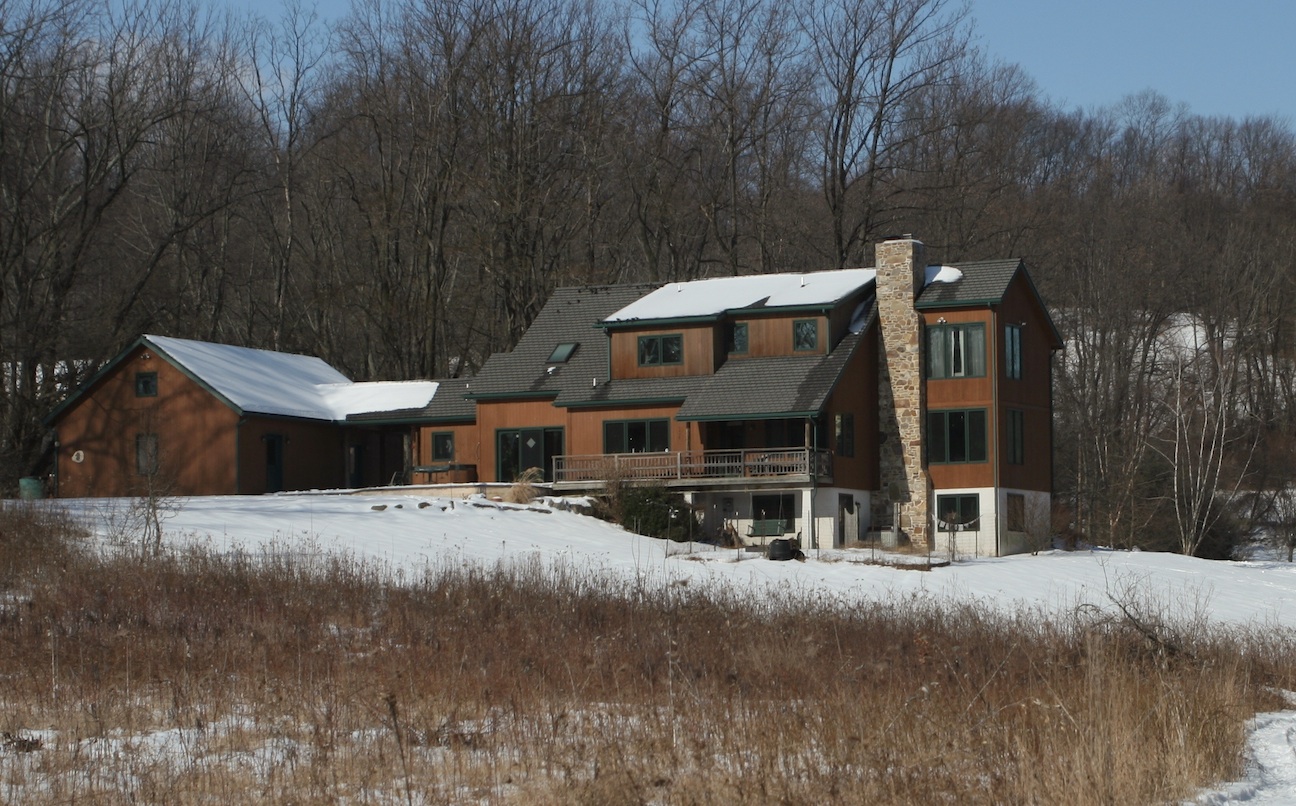
house 2009

My house in snow, 2009.

My own house had to agree with the local building code. There was also a budget we really could not exceed. Over the years, we have added to the deck, improved the porch railing, completed building interior doors ourselves, worked extensively on landscaping (first adding to it, then pruning back, then…well, there’s been a bit of mostly benign neglect recently). But we have generally lived comfortably in the house and adapted it to fit our needs, the way most people live in a home. As our living situation changes, with children growing into adulthood and moving away, with fewer pets and no more chickens, with less need for a large vegetable garden, we’re thinking of ways to alter the house. Or even to move out of it, and let some other family have a go at its joys and responsibilities.

Its sensibility leans toward a meadow-type or agricultural feel. That suits the region in which we have settled. Which may be the only way our house parallels Fallingwater: it suits the environment and the region in which it is situated. To me, that is one of the main purposes of good architecture, and the rule most frequently ignored by homebuilders.

~

Our home can boast an improvement over Wright’s houses: it doesn’t leak (I lived in one in Grand Rapids Michigan in the 1970s, and can attest to the leaking factor).  🙂

~

For a 3-D computer-animated “flyby” of Falling Water and a half-hour documentary on its history, see this page (Mental Floss). Pretty interesting!

Buddhism, philosophy, consciousness (poetry)

IMG_1440~

Sometimes, a startling morning.

A few minutes that feel time-free, when the phrase “Be here now” inheres in the body, the air, the mind, the moment.

Free to recognize consciousness as a grounding, not as an end-in-itself. Part of the world, part of the cosmos.

~

Reflecting, I realize another thing: poetry does that for me, hands me a moment. When I listen to or read a poem, it moves me into a moment suspended in “now-ness.” I am with Seamus Heaney’s father, digging; I watch the horses in Maxine Kumin’s field. The poems that move me do so by allowing me, the reader, to enter that moment or that consciousness, that perspective, which I may or may not relate to, and may or may not layer through perspectives of my own. Yet there I am, in a real way.

~excerpt from “Digging” (see this link for the whole poem, and audio)~

Under my window, a clean rasping sound
When the spade sinks into gravelly ground:
My father, digging. I look down


Till his straining rump among the flowerbeds
Bends low, comes up twenty years away
Stooping in rhythm through potato drills
Where he was digging.


The coarse boot nestled on the lug, the shaft
Against the inside knee was levered firmly.
He rooted out tall tops, buried the bright edge deep
To scatter new potatoes that we picked,
Loving their cool hardness in our hands.


By God, the old man could handle a spade.
Just like his old man.

objects, stories

contemplation

~

Sometimes the momentary sense of time-free, liberated unity occurs on its own, smacks me by surprise. Or it may arise from mediation, contemplation, or during “mindless” work–such as digging.

Philosophy and criticism tend not to evoke that sort of free consciousness. They require the brain to operate in a different way, a distancing from one-ness; but I like that sort of brain-work because the intelligent and inquisitive people who write, or write about, philosophy, neurology, psychology, and criticism of all kinds offer insights I would not likely find on my own. They ask the interesting questions (it doesn’t matter to me if they do not have the answers).

~

So there’s a balance, right?

~

Poets also ask the interesting questions. Through reading a good poem, I am there in the poet’s moment, curious and uncertain. It is a kind of contemplative practice to read, with an open mind and an open heart, poetry.

(The criticism and the analysis come later. Let them wait!)


Back to the garden

June brought much-needed rain, a little late for the peas, which were sparse and small this year, but in time to nourish the later-bearing vegetables. Zucchini and beans abound. It is still too early for the zinnias, sunflowers, and cosmos to bloom; but the butterflies have arrived to check out the buddleia. I recognize that buddleia has become an aggressive invader and is overused in US landscaping–and may not even be a good host for certain varieties of lepidoptera–yet I confess I love the huge purple blooms that draw so many winged creatures to sport where I can watch them from my kitchen window.

~

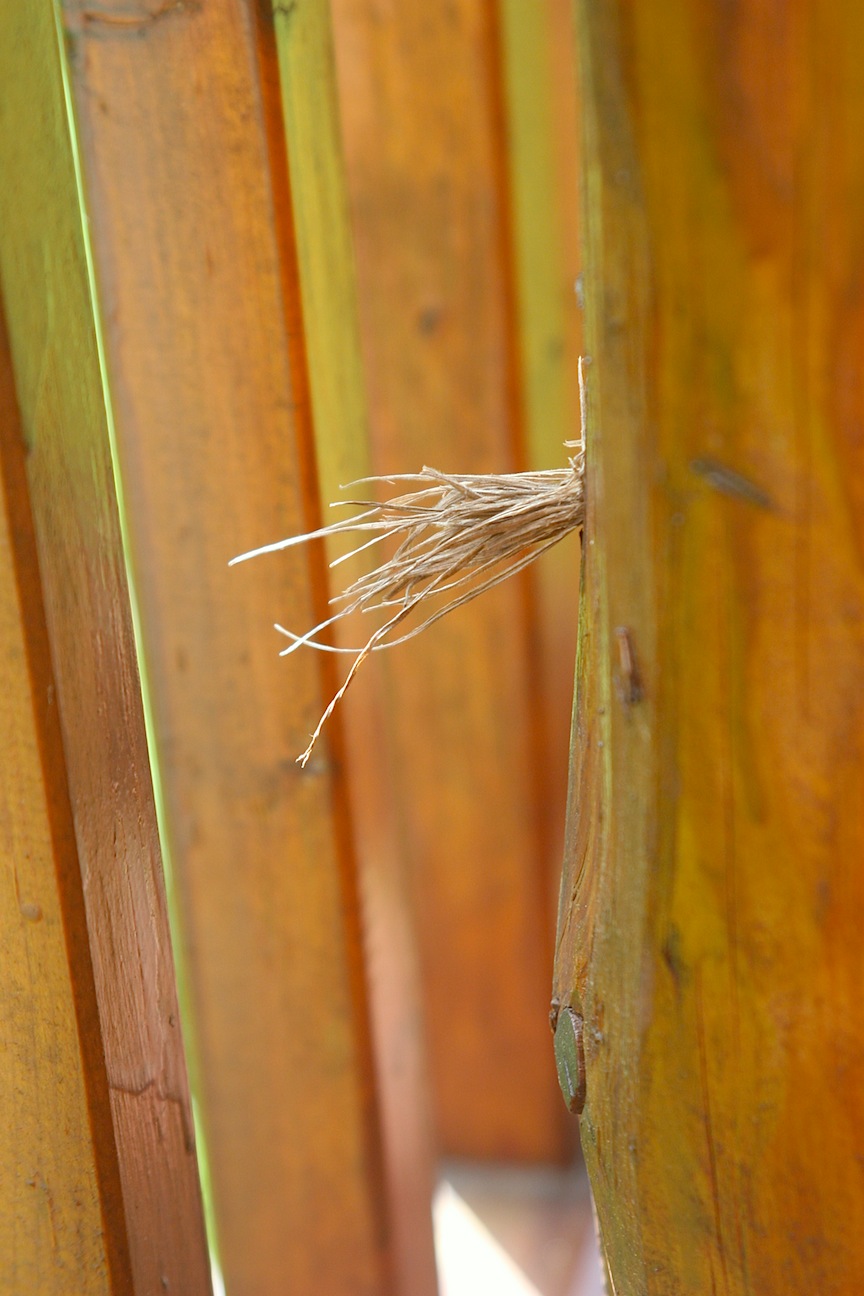
Speaking of winged garden creatures, I have encountered a new one. New to me, that is. While sitting on my porch, I watched with fascination as a large wasp, carrying a blade of straw in its legs, poked at a hole in the wooden post. The wasp pushed the straw into the hole, then crawled in after it, stayed a few seconds, then flew out. Some minutes later, it returned with a piece of grass and proceeded to repeat the process.

nest of the wasp

nest of the wasp

Isodontia, apparently: the appropriately-named grass-carrying wasp. I imagine this insect will eventually crawl its way into a future poem.

Here’s a video of grass-carrying wasps at work from Dick Walton’s Natural History Services site (a terrific resource, by the way). And thank you, Google. It’s this sort of thing that I can celebrate about the internet…my library for all things weird and natural, paradoxical as that sometimes seems.

~

My walkway garden

My walkway garden

~

Meanwhile, my perennial beds flourish (with a few too many weeds, ferns, and hostas–but oh well!!). I plan to make pilgrimages to a few gardens further afield later in July. We shall see if the planets align.

And a nod to Joni Mitchell; when I hear the words “back to the garden,” I can’t help but think of her song “Woodstock.”

~

Second brood

This morning, I noticed catbirds engaged in nest building activities. Then I saw mourning doves mating near the garden–must be time for the second brood.

I do not know a great deal about bird behavior; but many of the smaller birds in my region raise two broods, one in spring and one in early summer. My not-very-scientific observation tells me that the second brood is often less successful–that fewer eggs are laid (or hatch). I could be wrong about that generality, but it seems to have held true in my yard for the past ten or 12 years. A little research would inform me, I suppose. For now, though, I am happy to rely on observation.

Sometimes I am eager to track down information (such as facts on songbird reproduction cycles). This week, though, I prefer to spend my time on looking about and writing. I’m working on a kind of “second brood” of new poems, and that is exciting.

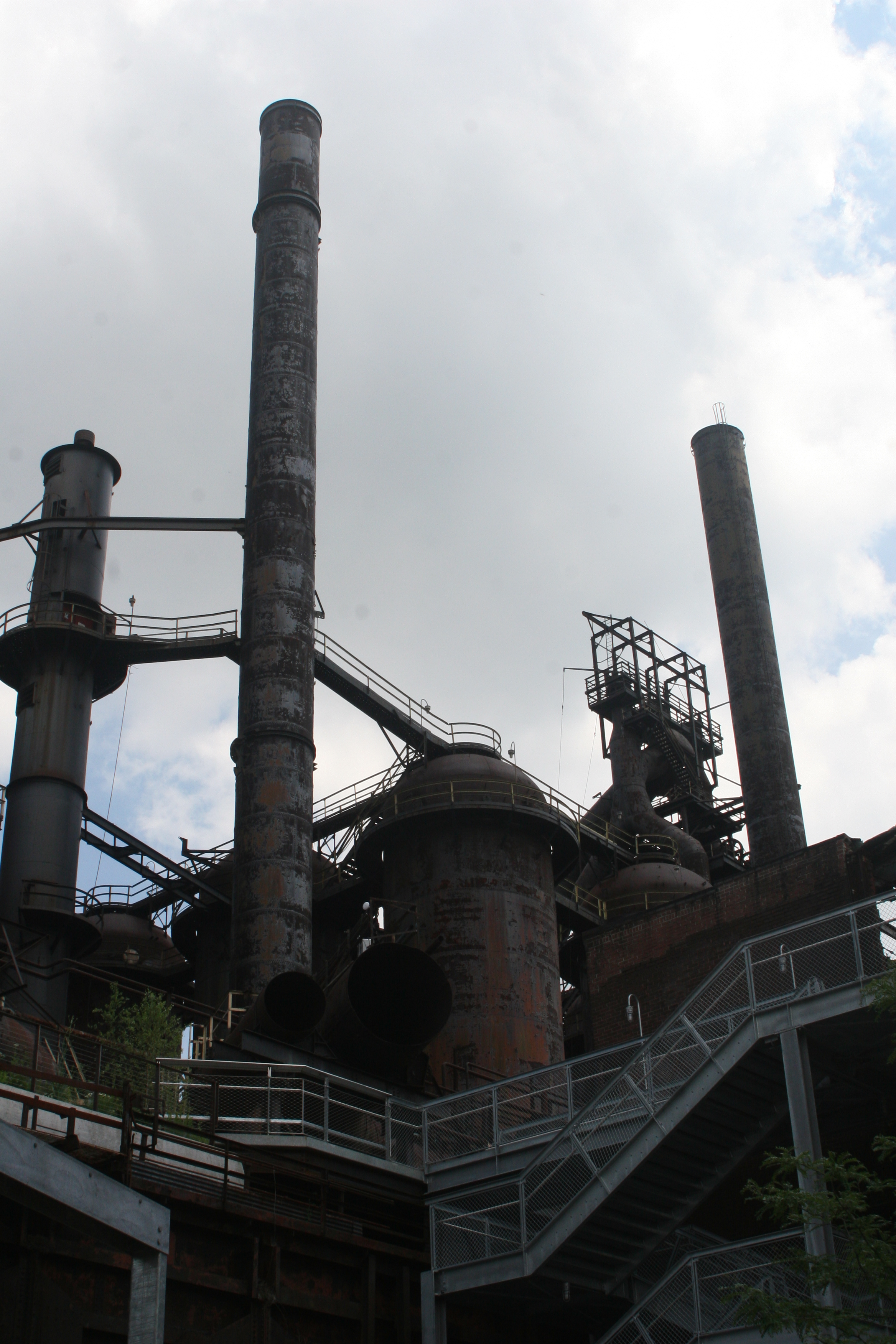
I have also taken walks on two urban above-street-level parks, one in New York City (the Highline) and one in Bethlehem, Pennsylvania, the Hoover-Mason Trestle Park at Steel Stacks. The former park is pretty well-known; the latter just opened to the public and ought to be better known than it is.

Here’s some information on the site itself from the Landezine website that highlights the work of SWA group on the Sands Casino/Bethlehem City project and some of the challenges:

One of the most prominent examples of redirecting the environmental legacy of a post-industrial landscape can be traced to the south banks of the Lehigh Canal, in the city of Bethlehem, Pennsylvania. Comprising 1,800 acres (20 of which belong to this project) and 20 percent of Bethlehem’s total land mass is the former headquarters of Bethlehem Steel Corporation (BSC). Founded in 1904, the company continued to operate until 1998, when US manufacturing divestment, foreign competition, and short-term profit goals finally led to its demise. After almost a century of operation, the effects of Bethlehem Steel’s [1995] closure on the city were heartbreaking, as thousands of jobs disappeared instantly, along with 20 percent of the city’s total tax base. All that remained was an impending bankruptcy claim and the largest brownfield site in the country.

You read that correctly–the largest brownfield site in the USA. The EPA defines a brownfield as “real property, the expansion, redevelopment, or reuse of which may be complicated by the presence or potential presence of a hazardous substance, pollutant, or contaminant.” Acres and acres of said brownfield were left by Bethlehem Steel, and about 20 acres are being redeveloped at present. The park around the steel mill, which follows the elevated trestle around the enormous works, offers a fascinating view at what remains of the United States’ industrial heyday and highlights how significant these mills were. Nice bit of history, nice walk.

I’m not sure these urban parks really move us toward sustainability, but they are at least creative “repurposing” that may help make people more aware of the things that have brought us to where we are today (for good or ill). Perhaps another form of second brood?

IMG_1514

IMG_1485

IMG_1515

Diversity. Not.

I must admit, it is challenging to read Elizabeth Kolbert‘s book The Sixth Extinction without feeling a bit of dread.

Nonetheless, the book is informative and fascinating–even funny at times–and well worth reading if you are the type who can get beyond your anthropocentric leanings and attempt to view the long-range picture from a scientific, if not exactly neutral, viewpoint. Her main argument is that we are, indeed, in the midst of a 6th mass extinction era and that human beings are “the weed” that most likely is the cause of these numerous extinctions–and not just since the industrial revolution, but eons before that. Humans travel more effectively than almost any life form, and that leads gradually to a loss of diversity. Read the book to find out how that works.

I find interesting parallels with socio-cultural trends in the ecological struggle for and against diversity. Niche-dwelling creatures or societies adapt to some challenging environment and develop or evolve ways to deal with adversity–cold temperatures, constant rain, saline soils, whatever. Nomadism, for example, is a way to adapt to seasonal weather challenges.

When an ‘alien’ enters a niche area, it usually dies off; but if it can adapt, there is hybridism or conquering. Tolerance, it turns out–living peacefully in tandem using the same resources–is not a common evolutionary strategy, though there are examples of symbiotic ecological relationships and, of course, parasitism of the sort that does not quickly kill off the host. Conquering generally means lost diversity.

When a niche organism ventures, accidentally or otherwise (forcibly, sometimes) into a new region as ‘alien,’ the special characteristics of the creature cause it to die or, in some cases, to have to adapt to a different set of circumstances…and diversity gets lost pretty quickly that way. In my region, for example, wetlands have experienced overruns of phragmites.

Does this sound like emigration? War? Forced removal of peoples? Indigenous populations killed off by measles or smallpox? Young people leaving remote areas to try to find work in cities? I see a metaphor here!

While human beings may try to celebrate diversity (which is better than using diversity to identify and exclude or punish “the other”), we probably cannot keep ourselves from becoming, over the centuries, less and less various. A homogeneous world seems, to me, to be a place impoverished through lack of niches and creative adaptation–but that’s what happens when mass extinctions take place: a depletion of kinds in the fossil record.

You might want to read Robert Sullivan’s New York Magazine article for even more recent scientific evidence if you’re not up to reading a whole book, though Kolbert is an engaging writer and I found her book to be a quick read. And below, some graphic illustrations from LiveScience. Fascinating stuff.

Here in the USA, alas, we seem to be helping the extinction of our own kind along by viewing diversity among people as dangerous. Compound this with a society that permits the ownership, hoarding, and use of deadly weapons on others and which cultivates a cultural tone of fear, anxiety, and entitlement, and there is strong evidence that the human weed will continue the slow but decided progress of the Holocene extinction.

~
Chart of extinction events that wiped out most life on Earth.

Source:LiveScience