Complexity & simplicity

I revel in complexity. Yet I seek simplicity.

Are the two incompatible?

I think not, if one is comfortable with paradox and ambiguity and remains willing to view experiences from various perspectives.

Anyway, if a person is not willing to encounter complexity, that person is essentially trying (hopelessly) to escape life. Exhibit A, the Stanford Encyclopedia of Philosophy’s delicious entry on “Life,” by Bruce Weber:

Living entities metabolize, grow, die, reproduce, respond, move, have complex organized functional structures, heritable variability, and have lineages which can evolve over generational time, producing new and emergent functional structures that provide increased adaptive fitness in changing environments. Reproduction involves not only the replication of the nucleic acids that carry the genetic information but the epigenetic building of the organism through a sequence of developmental steps. Such reproduction through development occurs within a larger life-cycle of the organism, which includes its senescence and death. Something that is alive has organized, complex structures that carry out these functions as well as sensing and responding to interior states and to the external environment and engaging in movement within that environment.

Interior, exterior, replication, variability…a look at computational complexity models shows us that the possibilities are indeed endless.

No matter how complicated the specifics become, however, there are these simple phenomena: birth, death; with (usually) some sort of transformation/transition or action occurring in the gaps. While I do not think that most of the questions human beings ask are “simple”–indeed, even the process of asking “do you want cake?” is more complicated at the physiological and cognitive levels than most of us would care to explore–it may be possible to quiet the mind and heart a bit to a level closer to simplicity.

The moment of awe offers, to my way of thinking, a kind of simplicity we can access on even the most ordinary days, even as we relish the amazing complexity of the phenomena of the physical world with its fractal tree branchings, its crystalline-structured cloud formations, and the elements in the atmosphere that, through the processing of light (about 4400 angstroms) through the rods and cones of human eyes, make up the quality we call sky blue.

Simply beautiful. Breathe in. Breathe out.
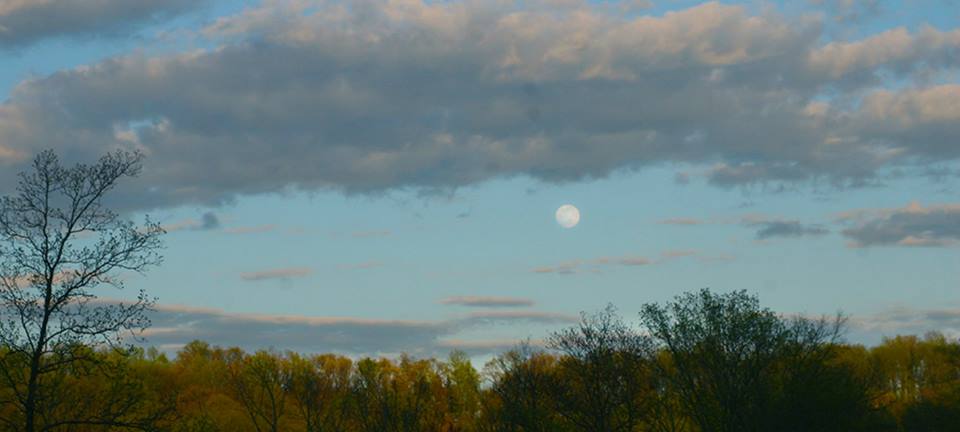
May Moon Ann E. Michael

Quiet earthiness

The beloved life partner of a long-time friend was interred in a green burial today, a glorious May morning full of flowers (she loved gardening…); and I find myself with little to say.

It’s been that way for the past two weeks. Not exactly writer’s block, as I have in fact drafted several poems, but an extreme sense of turning-inward. My nature is reflective–I’ve always fallen into the introvert category (INFP for those who are familiar with the Myers-Briggs assessment)–but my job requires pretty constant interaction with other people, students and colleagues for the most part, and quite a bit of listening and talking. I enjoy my job and find it rewarding; but the stressful weeks just before exams, when term papers are due, can be challenging for a person whose inclination is to read books and putter in the dirt.

I planted seeds in the earth, and picked flowers. And then placed flowers on a coffin woven of reeds which was lowered into the earth.

Returning home the quiet overcame me. I’ve been reading poetry today instead of the Sunday New York Times.

Also, I’ve been reading books on “good death” and “mindful dying,” and the guidance of some sensitive and experienced authors seems appropriate and grounded.

But grief is hard. It’s probably one reason we invented philosophy, religion, and poetry.

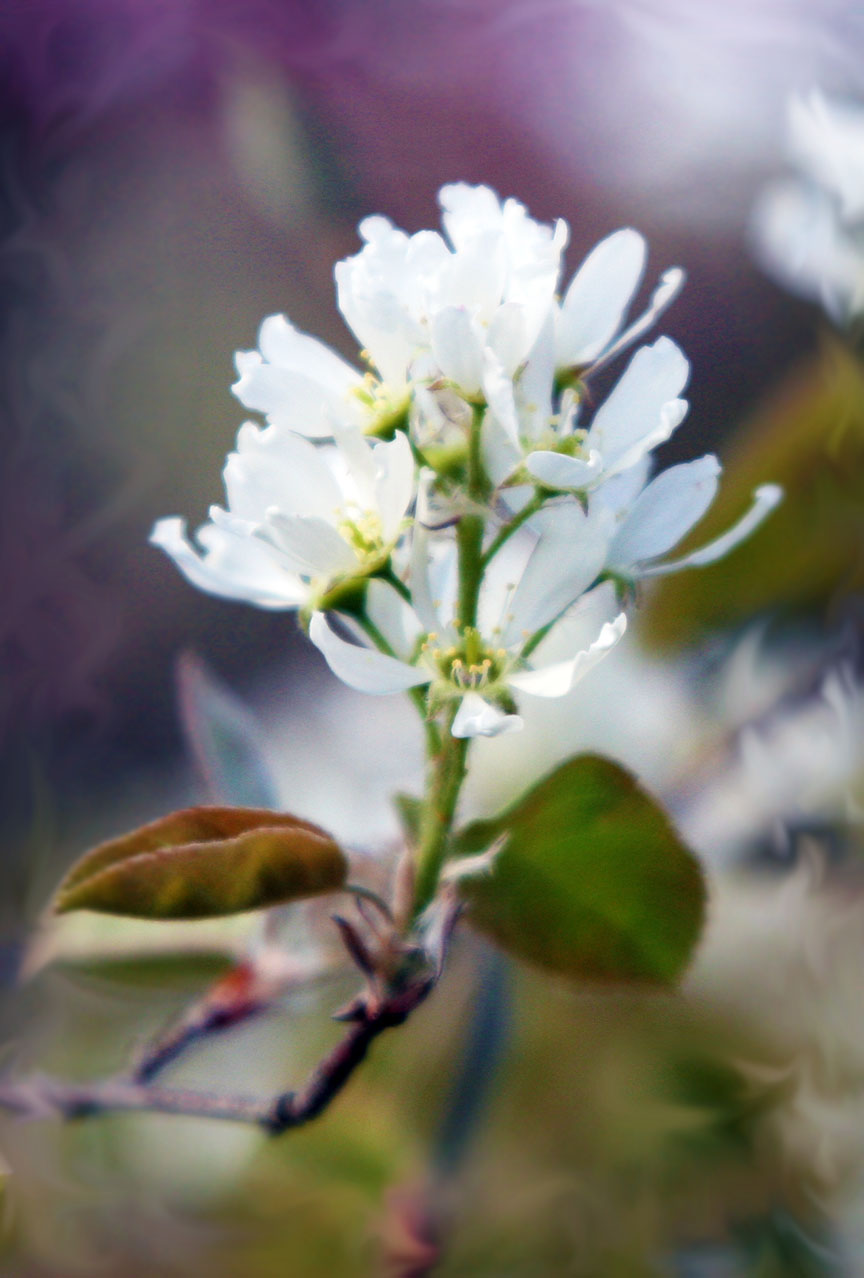
Shadblow, also known as serviceberry.

Shadblow, also known as serviceberry.

One of my go-to anthologies for sorrow is Pinsky’s The Handbook of Heartbreak, which I’ve mentioned in a previous post. In addition, I opened Christian Wiman’s book Every Riven Thing at random and came upon his poem “From a Window“–

Incurable and unbelieving
in any truth but the truth of grieving…


The poem comforted me (and I read other poems today, by other poets, that also comforted me). This one ends with the following stanzas:


Of course that old tree stood
exactly as it had and would


(but why should it seem fuller now?)
and though a man’s mind might endow


even a tree with some excess
of life to which a man seems witness,


that life is not the life of men.
And that is where the joy came in.


~
The joy comes in, somehow, through the quiet and the dirt and the trees.

Written by a human

Here’s a controversy for National Poetry Month–there are an amazing number of controversies surrounding poetry–which takes up the idea of whether a “machine” can write poetry. A good introduction is this CCR interview with Oscar Schwartz, who developed Botpoet as an experiment that is not so much about artificial intelligence as it is about what humans consider to be poetry. And perhaps about what language really is. If you follow the link to the site, you can participate in his research by playing “Bot or Not,” a game in which the player reads a series of poetic lines and then chooses between written by a human or not written by a human.

If you’ve read a great deal of classic and contemporary poetry, you may recognize some of the poems (I did); I suppose that is a way to cheat the system, since I have insider information. Nevertheless, I was wrong embarrassingly often. What, exactly, was I looking for in those words?

I think Schwartz is correct in his assessment of the more general population (though literary types may disagree with general assessments) when he says:

People generally seem to associate rhyming, “Romantic” poetry as being human. And they consider highly abstract, non-traditional poems to be of human provenance. Investigating as to why this might be the case is the project of my PhD.

He points out that written language is arbitrary and abstract, “an artificial medium” to begin with, and may have less to do with being human than we might like to think. Maybe the qualities that make a poem a poem are qualities that reside in the reader/interpreter rather than in the poet, another individual’s aesthetics or sense of what seems “creative.” That might be an unsettling thought for many writers, though it rather appeals to me.

Schwartz continues,

“So the results of Bot or Not, rather than telling us what human really is, is actually telling us that the category of the ‘human’ is an ideological, political space…The Bot or Not project works not because it tells us about computer software, but because it reveals things about what we assume to be human. It destabilizes the category of the human.”

As it turns out, the study of consciousness also tends that way–destabilizing our long-held category of what-a-human-is or what, if anything, differentiates us from other animals. Some interpreters of Zen philosophy suggest that Zen consists in finding balance within the inherent instability of the corporeal world. Or, perhaps, acceptance that humanness may be something we cannot categorize; the challenge then is to learn to flourish in a state of destabilization.

Let me sing the body electric…and the mind (possibly) electronic.

Walt Whitman in mid-life

Walt Whitman in mid-life

Online reading, online learning

I blog, therefore I am part of the digi-technological consciousness.

Here’s a situation Descartes might have had fun imagining…have we invented our own “evil genius” in Boolean or algorithmic forms? I won’t venture there, as I am not tech-savvy or social-media savvy enough to philosophize around tech aspects of modern culture; though, yes, I do use portal systems when I teach; I do use (limited) forms of social media for communication and to publicize my work; I do take part in the networks community online; my poems and essays appear in online journals; I read blogs and online journals although in general I prefer paper, especially for book-length works.

It isn’t as if I don’t consider the intellectual challenges these communication platforms offer. It would be silly to ignore them. They are not going to go away any time soon. One question is, however, to what extent should I employ or embrace them?

~

Recently, I’ve had a poem published in Carbon Culture Review, an online and print journal that states, as part of its mission, that the publication “advocates a creative, thoughtful and visually appealing dialogue about our complex relationship to technology. We strive to promote the work of those who employ technology and utilize technological designs and terms in art and literature.” The Intersection of Technology + Literature + Art, says the masthead; interdisciplinary in scope–that’s something I find fascinating, so I’m happy to report a rather atypical poem of mine has found a place in the new issue (“21st Century Research”).

I read Chronicle of Higher Education online and have linked to several of its essays in past posts. Lately, I find much of interest in Hybrid Pedagogy, a fairly new digital source about technology, teaching, radical re-thinking of the educational framework, and exploring the possibility of intentional, compassionate connections between teachers and students–even in the digital world. Here’s a recent essay that appeals to me: “Teaching as Wayfinding.” I am still wrestling with the challenges of how to create a genuinely interactive and personal learning space in the classroom, let alone via distance education. There is so much to learn, and welcoming interdisciplinary synthesis into the discourse of the humanities offers intriguing potential.

~

Speaking of the interdisciplinary: I am pleased to report that The College of Physicians of Philadelphia chose one of my poems, “How the Body Works” as an honorable mention in its Poetry Month contest celebrating medical/health themes in poetry. [You can also check my Events page for information and tickets.]

The College, a professional medical organization founded in 1787 (same age as the U.S. Constitution), is also the site of the Mütter Museum, which has a terrific slogan: “Are you ready to be disturbingly informed?” The College boasts a library of historic significance.

It’s a great venue for a reading, and if you are in the area, please join us. My brother says the food is really good, too–the ticket price includes a dinner. How festive is that!?

Poetry, awe

Welcome, National Poetry Month. This year’s poster was designed by one of my favorite cartoonists, author/artist Roz Chast. She illustrates Mark Strand’s famous poem. Click the link to order a copy! You can donate to Poets.org while you’re at it.

~

Apropos of my last post (here), it turns out that Berkeley Social Interaction laboratory (BSI) has done studies on…awe. Awe might be what Ehrenreich experienced in a fashion more ecstatic or charged than the more garden-variety awe that BSI’s Dacher Keltner writes about in this essay in Slate. Some of the early findings from social research suggest that awe, even more than compassion and joy, contributes to a sense of personal well-being and counteracts depression.

Possibly more surprising is the indication from respondents that awe is not as uncommon as we think:

[A] study from our Berkeley lab speaks to the promise of daily awe. Amie Gordon gathered people’s daily reports of awe for two weeks and found that it is surprisingly common in everyday living. Every third day, people feel that they are in the presence of something vast that they do not immediately comprehend. For example, seeing gold and red autumn leaves pirouette to the ground in a light wind; being moved by someone who stands up to injustice; and hearing music on a street corner at 2 AM all elicited such an experience. Intriguingly, each burst of daily awe predicted greater well-being and curiosity weeks later.

When I reflect on my own daily life, I realize that’s true–this sort of experience grounds me many days when I feel I am losing purpose or overwhelmed or simply sad. It might be the sight of a raptor in an amazing dive toward prey, or the shimmer of light on a bird’s feathers, or a particularly stunning sunrise. It might be a story a student tells me, something moving or courageous.

Every once in a rare while, awe is larger, encompasses more, displaces my sense of self, flames into ecstasy. That kind of experience exhausts, whereas “everyday awe” invigorates, calms, balances life toward the bearable. And often, reading a poem pushes me into the state of awe. For Poetry Month, I will grant myself the daily possibility of awe by reading poetry.


Unknowable

While reading up on some recent theories on evolution and reading for the first time (other than in excerpts) The Descent of Man, and Selection in Relation to Sex by Charles Darwin, I have returned to mulling over the problem of consciousness. What fascinates me is how this topic (consciousness) overlaps with philosophy, physiology, evolution–how and why we developed the brains we have with their attendant egos, theory of self, what-have-you–and with human constructs such as art and religion and morality, which I value for complicated reasons.

And out of curiosity, I took up Barbara Ehrenreich’s Living with a Wild God, which seemed to me a departure from her books until I realized that I was unfamiliar with her earlier work.

Ehrenreich’s book stems from her inquiry into a period of her own late adolescence when she experienced a kind of awakening that defied expression. For another sort of person, this might have been a spiritual encounter; but she was a self-described solipsist atheist who wanted explanations. The why of the world mattered to her–she was headed toward an education in science at Reed and Columbia University, though she did not know that yet when she had her ecstatic sensation. Reading Living with a Wild God reminded me of watching an animal tear and tear and worry at a carcass, not quite able to let go. The author fumes at her younger self for being so unforthcoming with details and suggests she may have been having a dissociative event, a small psychological break. Yet there were no symptoms of such a problem in her diary or in her memory.

She writes a bit about psychology, human consciousness, adolescent daydreaming, rational thinking versus imaginative beliefs, systematic or otherwise. After considerable wrestling and intriguing memoir, she admits that all she can do is speculate about what she felt:

There were no visions, no prophetic voices or visits by totemic animals, just this blazing everywhere. Something poured into me and I poured out into it. This was not the passive, beatific merger with “the All” as described by the Eastern mystics. It was a furious encounter with a living substance that was coming at me through all things at once, and one reason for the terrible wordlessness of the experience is that you cannot observe a fire really closely without becoming part of it…you will be recruited into the flame and made indistinguishable from the rest of the blaze…the only condition was overflow. ‘Ecstasy’ would be the word for this, but only if you are willing to acknowledge that ecstasy does not occupy the same spectrum as happiness or euphoria, that it participates in the anguish of loss and can resemble an outbreak of violence.

In the Bhagavad-gita, when Arjuna sees Krishna-manifest-as-All, the experience is not beatific, any more than Moses’ encounter with God as the burning bush relates an enmeshing with the One; the sense of merger with the energetic being remains absent–there is awe and a sensation that the human consciousness has been irrevocably rattled, altered, changed, but not that the human consciousness melds with that unknowable and indescribable Other.

What drew me to this book is that I had similar, though briefer, experiences when I was young. They tended to occur in flashes, and I associate them now with daydreaming and with a “losing of self”–I really have no words for it, though Ehrenreich’s “overflow” seems about right…one reason Bachelard’s writings on childhood and reverie resonate with me. It’s heartening to find another person, a well-known author, who also has found the experience impossible to formulate in language. I especially appreciate her suggesting “that ecstasy does not occupy the same spectrum as happiness or euphoria, that it participates in the anguish of loss and can resemble an outbreak of violence.” I identify deeply.

Some meditative practices aim to erase, temporarily, the boundaries that keep us from being truly in the world. Some religious practices aim to make the faithful “one with” the deity. Ehrenreich does not possess the kind of mind or personality that seeks answers in those ways. She’s frighteningly intelligent, well-educated, worldly, scholarly, sensible, socially and culturally aware, fiercely atheistic. Yet she cannot quite believe that what she felt, saw, knew, in her body and in her mind, was “simply” something her brain invented. After 50 years, she continues to wonder. I sense she is still tearing obsessively at the unresolved.

Maybe that is enough, to wonder. At any rate, wondering may be as far toward why as any of us human beings will ever get.

Awareness, openness, & … magic mushrooms?

In a recent New Yorker article about potential medical uses for psilocybin (“The Trip Treatment”), science, culture, and food writer Michael Pollan interviewed researchers in neuroscience, medicine, and psychology. The medical potential of psychedelic drugs is not something I can comment on from reading just one article; what intrigued me most about this piece is how these drug studies overlap with studies on cognition, metacognition, consciousness, and spirituality. The medically-controlled “tripping” that volunteers have undergone overwhelmingly resulted in some form of what we term mystical or spiritual (for lack of a scientific term) feeling.

It’s almost impossible to consider these realms of experience without questioning concepts such as “soul” or “self-awareness.” Pollan writes:

Roland Griffiths is willing to consider the challenge that the mystical experience poses to the prevailing scientific paradigm. He conceded that “authenticity is a scientific question not yet answered” and that all that scientists have to go by is what people tell them about their experiences. But he pointed out that the same is true for much more familiar mental phenomena.

“What about the miracle that we are conscious? Just think about that for a second, that we are aware we’re aware!”

A man after my own heart. It is amazing, a kind of miracle. And we get consciousness and metacognition without any drug intervention at all. It just springs into our beings at some point, as we create ourselves from lived events and construct speculative worlds and an understanding (though often flawed) of other minds.

Here is another fascinating result from the psilocybin studies that may make us revise our ideas of interpersonal relationships, personhood, and creating a self. Pollan writes:

A follow-up study by Katherine MacLean, a psychologist in Griffiths’s lab, found that the psilocybin experience also had a positive and lasting effect on the personality of most participants. This is a striking result, since the conventional wisdom in psychology holds that personality is usually fixed by age thirty and thereafter is unlikely to substantially change. But more than a year after their psilocybin sessions volunteers who had had the most complete mystical experiences showed significant increases in their “openness,” one of the five domains that psychologists look at in assessing personality traits. (The others are conscientiousness, extroversion, agreeableness, and neuroticism.) Openness, which encompasses aesthetic appreciation, imagination, and tolerance of others’ viewpoints, is a good predictor of creativity.   [italics mine]

Openness, aesthetic appreciation, imagination, tolerance, creativity…and one researcher in neuropsychopharmacology suggests that this sort of un-boundaried openness signifies a temporary regression to an infantile state, very much as Freud hypothesized. I thought instead of Bachelard and the childhood reverie state.

Intriguing, that pharmacological work of this sort makes neuroscientists resort to citing William James and Sigmund Freud on mystical experience and the subconscious!

[Robin] Carhart-Harris believes that people suffering from other mental disorders characterized by excessively rigid patterns of thinking, such as addiction and obsessive-compulsive disorder, could benefit from psychedelics, which “disrupt stereotyped patterns of thought and behavior.” In his view, all these disorders are, in a sense, ailments of the ego. He also thinks that this disruption could promote more creative thinking. It may be that some brains could benefit from a little less order.    [italics mine]

I wonder if the aesthetic experience itself, when wholly engaged, can sometimes act like a drug on the art-viewer’s or art-maker’s being. When one reads the poem that rearranges one’s world, doesn’t it disrupt stereotyped, familiar, habitual patterns of thought? That’s what happens for me when I encounter great art of any kind. It is close to mystical.

~


Consciousness as story

Some recent questions to myself:

Reading philosophy and psychology for so many years, was I looking all along for an explanation of consciousness?

Through neurological and evolutionary science, and more philosophy and more psychology and, in addition, some anthropology, some history. And fiction. And rhetoric. Trying, perhaps, to understand the self? Through criticism, through art, through literature?

Looking carefully at art, reading literature closely: were those also endeavors to comprehend what mind is? Other minds? My own mind? Through the creative act, perhaps?

Is the ars poetica a kind of manifesto of human consciousness from an individual perspective, yet open to interpretation by other human minds? And the beautiful–what is it that even makes beauty a significant concept? Where did that come from? Evolution and the sexual drive (see Dutton riffing on Darwin)? Society? Synthesis? Ego? Inspiration? Angels?

Is every story a scaffold to consciousness? A hedge against oblivion? (Self-oblivion, the hardest navigation act there is: depression, hopelessness, loss of self-knowledge, coma).

I wonder if the stories we tell to others and to ourselves, employing memory selectively whether or not we realize it, act as a kind of (modern-day, metaphorical) Chain of Being through which we develop Theory of Mind and, beyond that, a sense not just of ego but of neurological consciousness. If stories are what make us human.

~

The chain of being, from Charles Bonnet, Œuvres d'histoire naturelle et de philosophie, 1779-83

The chain of being, from Charles Bonnet, Œuvres d’histoire naturelle et de philosophie, 1779-83

[Note: I do not hold the medieval concept of a hierarchy in which Man, angels, and God stand above all other things; the stone and the plankton have as much value–likely more–than I do in the workings of the cosmos, as far as I am concerned. I post this Enlightenment-Era engraving here for metaphorical and aesthetic reasons because I take pleasure in the delightful monkey.]

~

Stories have tremendous value to human beings in ways we are still discovering; see my previous posts here, here, here, and here (among others). I keep coming across claims for the significance of story in surprising places–most recently in Dutton’s The Art Instinct and in Atul Gawande’s latest book, Being Mortal. Widely different texts, similar observations.

How is it we know who it is we are?

Possibly, in the process of inventing the story of ourselves, we become human. Perhaps the story of ourselves is fundamental to conscious “human” minds.

Speculation. But I love recalling that my children, when they were very very young, consistently made one particular demand of me: “Mama, tell me a story!”

~

Voice

I follow the Women’s Poetry Listserve (Wom-Po), and recently there was a discussion there concerning what poetic voice is. Can it be defined clearly? Does it differ, and if so how, from style? Is it personal, belonging to the writer herself–an attitude? Is it distinct from the creator of the poem, as the “speaker” of the poem arguably is in the case of poetic voice/persona?
A listserv member offered this quote from Kunitz:
“One of my convictions is that at the center of every poetic imagination is a cluster of key images which go back to the poet’s childhood and which are usually associated with pivotal experiences, not necessarily traumatic. That cluster of key images is the purest concentration of the self, the individuating node. You can tell the poets who are working at their center by the distinctiveness of their voice, their constellation of key images, their instantly recognizable beat.” … from Stanley Kunitz‘s 1975 lecture at the Library of Congress, “From Feathers to Iron.”

A constellation of key images may seem to be imagery, not voice at all; but Kunitz’s decision to connect distinctive voice with a recognizable beat and images, and to further suggest that these mesh to in the compositions of a poet who is writing with clarity and authenticity (my interpretation of what he means by “working at their center”), indicates that voice is a critical component of poetry. I have read the above-mentioned lecture, but Kunitz does not there elaborate on whether he means the writer’s personality, style, or attitude or whether he means, instead, persona. It seems to me, though, that he wasn’t talking about persona (the “speaker” or mask the writer uses in an individual piece). I interpret that the key constellation of images, the “individuating node,” would have to be personal experience of the actual writer–Roland Barthes be damned.

CH Chucrch

Gaston Bachelard’s phenomenological approach to poetics and, to some extent, psychology, appears to jive with Kunitz’s pivotal childhood images. It is easier to recognize one’s own key images in one’s work, of course…and I cannot help but recognize that Kunitz has nailed it for me, at least, if not for all poets (writers, artists, musicians, etc.). My own cluster of images, drawn from childhood, include the church. Also the beat of hymns and responsive readings and the King James and RSV Bibles. Also the bleat and wail of diesel engine horns, the progression of fields and trees and flowers, the hum of highways, the sluggish flow of certain rivers. To mention but a few that stay with me.

I am not an adherent to any particular style or form of literary critique, and I am not a whole-hearted phenomenologist, either–but I have to admit that these concepts (the individual’s key images, the individual voice and the persona voice, the rhythm or beat of a writer/speaker) intrigue me. I find them well worth exploring, mulling over.

See Dave Bonta’s Via Negativa post here for a mini-photo-essay that illustrates what I mean.

Spaces

Ah, the traditional New Year’s blog post! 🙂 I have spent time away from the computer to tend to other things, among them, my own “space” for being less busy. Finding that space has not been easy, but it is the sort of discipline we human beings ought to practice in this Age of Information. Without a little inner space, it is far too easy to become anxious and overwhelmed.

So I think of Bachelard’s quiet exhortation to cultivate the creative or childhood space, which I contemplated in 2013 at about this time of year (in this post). And I think of Jon Kabat-Zinn and other writers–often classed as spiritual self-help authors but whose writings need not be considered spiritual at all (Kabat-Zinn, in particular, avoids using the term)–who remind us to be attentive, aware, mindful, compassionate even to ourselves, and willing to take ourselves away to inner stillness now and again.

I am particularly drawn to the notion that contemporary human beings can come to mindfulness through actions rather than through withdrawal from the body and the world. Really, we hardly have any other choice. Although I enjoy solitude more than most people do, I am ill-constituted to be a hermit or a renunciate. My temperament precludes noisy advocacy against injustice or for specific good causes; but I could certainly do more helping, more of the kind gesture, more listening, and more giving of the type that lets not my left hand know what my right hand doeth (Matt. 6:3).

There were difficulties this past year, and aggravations, and sufferings both personal and social. So be it; we can learn from failure and adversity. The best way to learn to problem-solve is by being faced with problems!

In his 2000 book about aging and dying, Ram Dass wrote: “My guru once said to a visitor complaining about her suffering, ‘I love suffering. It brings me so close to God.’” Well, that is another way of looking at things; and perspective matters. Creative thinking involves full analysis (even when the analysis seems intuitive, immediate) and often employs a total restructuring of the problem at hand–a widening or narrowing of scope, a different point of view, a new set of tools or skills for puzzle-solving, or quiet cogitation while the thinker digests the whole situation…which may be, for some folks, prayer.

Or poetry. When I am not writing poetry, I am always reading it. Other writers’ words open me to a sense of communal understanding, a sense that we are not alone, not a single one of us, who can hear or read or remember a poem or a word of love or praise. Even when those poems depict sorrow or suffering, for then we know we are not the only ones who feel troubled.

“And our problems will crumble apart, the soul
blow through like a wind, and here where we live
will all be clean again, with fresh bread on the table.”

Pablo Neruda, 100 Love Sonnets

Let the wind make space for fresh bread on your table in 2015 and always.


bread

bread