The empathy button

Human nature being what it is, and our feelings being so rooted in often physiologically-based emotions, negative responses tend to aggregate. The book I just finished reading–Damasio’s The Feeling of What Happens–offers neurological, evolutionary, and psychological reasons for the human tendency toward negativity. Dozens of psychological studies concur that humans in general feel more “bad” feelings, and more frequently, than “good” feelings.

Facebook has a “like button,” as do many blog hosting pages (see below for mine!). This ingenious algorithmically-programmed information-gathering software–I hesitate to call it a device, but I guess it is–offers social media users a shortcut to social interaction, a way to show conformity and agreeability among friends, to support a statement or cause, or to indicate pleasure at seeing a photo, work of art, or shared piece of information.

Other sites, such as YouTube, have the additional option to “dislike;” and though I have not read any research supporting this inference, I would speculate that the option to dislike could lead to the generation of more negative feelings. Human nature being what it is.

If social media users cannot take the time to type their feeling-based responses and just need something to click, why not offer a “compassion button?”

I am not serious, of course. The compassion button is internal, and it isn’t an immediate gut reaction for most of us. It moves us from emotions such as anger or ideas like reason and duty to shared human experience. It takes us from simplistic liking or disliking to understanding. It takes more than a mouse click to get to compassion.

“Love and compassion are necessities, not luxuries. Without them, humanity cannot survive.”
― Dalai Lama XIV, The Art of Happiness

A good start. Possibly.

My most recent reading material is The Feeling of What Happens: Body and Emotion in the Making of Consciousness, by Antonio Damasio. Damasio is convincingly on the neurological/evolutionary trail to recognizing how consciousness operates and why we have developed it, though he allows for mysteries we do not yet and may never understand.

Damasio is clearly not a dualist who thinks the consciousness can exist separately from the body (one of his previous books is aptly titled Descartes’ Error). He doesn’t address the “soul” in The Feeling of What Happens, but argues that reason requires feeling in order to operate effectively, that feeling is a more “conscious” form of emotion, which is “unknowing” in the sense we call consciousness and is founded upon core consciousness, which is reliant upon the physical organism…a vastly complex array of cells, nerves, you name it, generally self-regulating and not by nature in particular need of a conscious mind.

So next time someone tries to explain why a situation happened and just says, “It’s complicated,” maybe you ought to accept that. Because, apparently, it’s really really really complicated!

http://www.isys.ucl.ac.be/descartes/images/Descartes.gifThat does not keep people like Damasio from trying to track down what goes on in the minds of sentient beings.

Having just read Flow, I immediately thought of what Csikszentmihalyi says about the way true flow experiences depend upon deepening levels of complexity–that’s how we keep from becoming bored by routinization of a task. Dennett suggests that consciousness consists of layers: “multiple drafts,” and Damasio calls the human brain, and the brain-body unit, a series of “systems within systems.” But there is no little self, no metaphorical or actual homunculus, at the very bottom of the system, or at the very top. There are only more and varied connections, he asserts–with profound respect and amazement at what biology has wrought.

I also thought about Csikszentmihalyi’s idea of a life project. Some years ago, I began a journal devoted to exploring my poetic project and learned that I do not really think about my writing as a project per se, at least not in the formal sense of poetics. [Here’s Dorothea Lasky harping on the whole concept of a poetic project, in a bit of refutation aimed at poetry critic David Orr.]

What I think I was doing, in fact, was trying to figure out my life project, in the way Csikszentmihalyi defines that concept. What is my life’s philosophy in terms of guiding tasks, principles, goals, projects, challenges? Is teaching part of the package? Motherhood? Gardening? Writing? Human relationships? Learning? Speaking of human consciousness, do I have a conscious path or goal?

Maybe my goal is to keep on amid the complexity and to relish it as much as possible, since it is unavoidable. And perhaps by accepting the complications, I will find my life becomes simpler. That could be a possible outcome–right?

I think of Reineke writing on Marcel Proust’s narrator and his struggle with status, jealousy, conformity, and desire. I read the Proust novel(s) when I was in my early 20s and found his narrator frustratingly neurotic but also a little too familiar, as my life experiences in many ways mirrored his. Eventually, he learns that the way to cure the pain of desire is to discipline himself to let go of desire itself; (and no, neither Proust nor his narrator were Buddhist).

And what happens when he gains this recognition is that he can write the novel. He develops flow, and a life project.

I am past 50, a good time to establish more consciously what my life project is. I know it involves relentlessly and joyously learning new things. I think it will include poetry in some way. And discipline of some kind, conscious effort. For now, those things constitute a good start.


Flow & dough

I have no doubt that, for some people, making pies is a flow experience. I’m reasonably certain that my grandmothers, and sometimes my mother, felt a sense of flow when pie-making: fully engaged in the process, challenged, immersed, and enjoying the fulfillment of a task as it evolves. Making pies can be intrinsically rewarding, but–alas–for me, it is a bit too much of a challenge and the purpose is generally extrinsic (though a good pie is surely worth the effort).

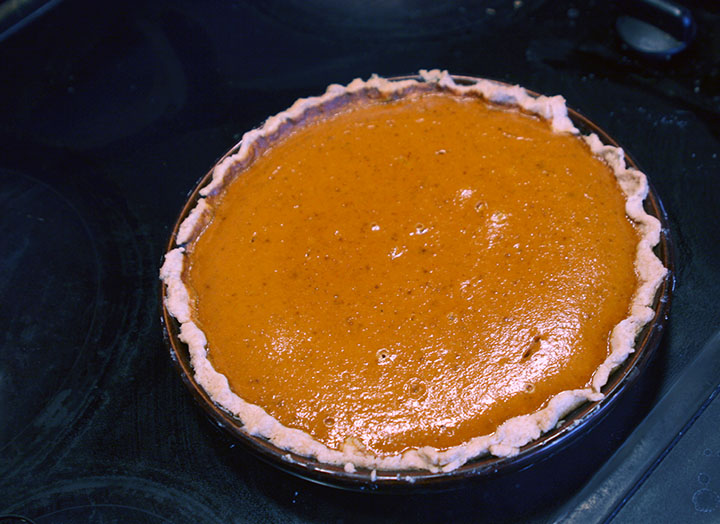
Today I made pie in preparation for the Thanksgiving feast we celebrate here in the USA. But I feel more of a sense of flow when I am cleaning up the mess I made in the kitchen and stopping occasionally to gaze out the window at the falling snow and the sweet little juncos hopping along the porch railing. The actual process of rolling a pie crust involves, in my case, swearing and cussing and patching torn dough. I am positive that my Methodist grandmother never resorted to salty language while pie-making, but I imagine she may have also enjoyed glancing up from her work and appreciating a view, a fellow-creature, something aesthetic or pleasant to behold in the midst of family life.

The activities that keep me actively entranced and purposeful do not include making pies. My re-reading of Mihaly Csikszentmihalyi’s book, however, has reminded me that feeling happy means making meaning in my life and continually seeking out challenges that offer me a sense of building a conscious self and a disciplined, mindful attitude toward life.

Even if I never get really expertly engaged with concocting desserts, I can find some sort of flow throughout my days through reading, art, gardening, writing, tai chi, interactions with friends and family members. And who knows what else? There is so much to learn; that is what I feel most thankful for today.

Not the prettiest pie.

Not the prettiest pie.

Here’s a TED talk by Csikszentmihalyi, if you want to hear more about flow & happiness.

Synthesis & coincidence

&&001“and per se and”

Ah, synthesis! The conjoining and combining of objects, ideas, theories, values and systems, arts, media, experiments, research, disciplines, metaphors, symbols, rhythms, patterns, DNA, et (“&”) cetera.

Synthesis can be planned, hypothesized, purposeful–and it can be spontaneous, unexpected, coincidental. There are times when I feel as though the overlapping and intertwining of experiences seems to have been somehow “planned by the cosmos” (or some higher power); but coincidences occur more often than we think, especially when our consciousness is primed to make connections.

I have primed my own brain, recently, to synthesize thinking about aesthetics, neuroscience, the arts, philosophy and consciousness. So it should not surprise me–though it does!–that the books I have recently been reading connect many threads of my thought, including other recent readings. For example, Martha Reineke’s Intimate Domain: Desire, Trauma, and Mimetic Theory is an exploration of family “romance” in psychoanalytic theory that draws on Freud and Girard; but because Reineke uses Girard’s early writings as her basis, she cites Merleau-Ponty and phenomenology quite often. Furthermore, mirror neurons and the place and operations of consciousness appear in her claims and explorations in this (difficult) text. Mirrors and mimesis, minds and spirits…Gabrielle Starr’s Feeling Beauty, which I’ve mentioned in recent posts, examines the art-body-mind connections in neurological domains and mentions, more than in passing, the phenomenological aspects of the experience we term “art.” Arthur Danto’s The Transfiguration of the Commonplace: A Philosophy of Art (1983, though I read it last month) also wove itself into my thinking as I read Starr’s more current book. In addition (oh, there’s always an “in addition” with synthesis), I am re-reading Csikszentmihalyi’s classic, Flow: The Psychology of Optimal Experience. The states humans experience when we work hard at challenges we enjoy, such as art-making, are deeply connected to our brains and also rooted in our bodies.

So there is a coming-together, a process not unlike chemical bonding, that all of these texts and ideas produce in my mind. This post is one outcome, I suppose. But there will be others.

~

From Carl Sandburg’s “Tentative (First Model) Definitions of Poetry” (1928): “Poetry is the achievement of the synthesis of hyacinths and biscuits.”

387236_10201085579685937_1062169370_n


Change the mind

“The only job of the poet is to destabilize and expand language. This is how poetry changes the world—not by grand ambition or the lauding of critics. It takes the plodding, unending effort of many to alter line by line, phrase by phrase, word by word the way we describe ourselves and everything around us. This is how we change perception. This is how we change the mind.”  —Jaswinder Bolina (in Poetry Foundation: “The Writing Class”  )

Words to mull over. How do we change perception? Is the change of mind correlated with a change in mind–potential alterations of the brain’s structure or synaptic system? If we destabilize language, do we necessarily alter perception?

Although the book is not an easy read, Starr’s Feeling Beauty: The Neuroscience of Aesthetic Experience offers interdisciplinary research into how the brain may be altered by powerful aesthetic experience, or at any rate, how the brain responds to these experiences in ways that lead some researchers to believe the brain can be changed by art. Not just by those who create art, but by those who encounter it.

I encountered Bolina’s essay (see link above) a week or so after I completed reading Starr’s book, and the consilience–to borrow a scientific term–seemed powerful. The ideas have not yet cohered in my own mind, but perhaps in time I will have more to say on this topic.

Meanwhile, I revel in the juicy possibilities of changing mind through art.


Inconvenience

When people need to make decisions about tools or skills or behaviors, they tend to “default” to one of several modes: do what society and/or their peers are doing, do what’s most familiar, or do what’s most convenient. Sometimes the decision modes all point to the same conclusion.

Then there are those of us who are a bit unconventional, or even contrarian.

When I decide not to follow the crowd, I make certain I have a logical reason for bucking the cascade. Herewith, the reason I do not possess a “smart phone.”

~

First, an aside on what initiated this post–the reactions I get from colleagues, students, and friends when they see my cell phone. Said reactions range from astonishment to hilarity to well-meaning advice.

Yes, it is a “clamshell” model. Yes, it has a phone-style dial pad.

No, it is not connected to the internet. It has a camera, but why bother? The jpg files are minuscule, and there is no scrolling function.

This outmoded tool seems inconvenient. Why do I not update my phone?

~

I am a creative writer, even though my everyday life is not particularly structured to enable full concentration on my “art.” Because I already have so many responsibilities to my family, my job, my home, and my community, my responsibility to writing poetry feels squeezed. The way I see it, a mobile device that I carry with me constantly and that I can use to tap into the internet, my email, my Facebook page, or my blog is just one more means of keeping those responsibilities and distractions with me at all times.

Writers such as Gary Shteyngart notwithstanding, that is not generally a method of existing that feels conducive to the writing process (though perhaps the writing process will change as society changes?).

No distractions. (photo credit, click on image)

~

To think, to imagine, to reflect and mull and ruminate, I need time to unplug, disconnect, and disengage from my duties to others. Walking out-of-doors with no beeping or ringing or buzzing in my pocket lets me take in the immediate environment. The birds and the wind offer noises more random and are less insistent reminders of whatever-it-is-that-wants-to-be-urgent.

Indeed, I find it useful to inconvenience myself in this way. When I am not at a web-ready device, I have to turn to a book if I want to find the answer to a question. A dictionary, an encyclopedia, a reference text not only can answer my initial inquiry but may invite me to explore the topic more deeply. I may “get distracted” by another, unexpected entry in the book, read a chapter I hadn’t planned to read, or learn a new word or the etymology of a word that leads to…

…further imaginative exploration and thought (poems!).

Thus, inconveniencing myself is a worthy pursuit.

To be sure, the fact that I turn off my cell device or leave it at home may occasionally inconvenience others–people who expect me to pick up the phone and answer a call or text, on their time. Oh, my beloveds! I do value you and I respect your time; but your time and my time do not always need to coincide. [Truly, the decision on which ice cream to purchase can wait, or be accomplished without my input.]

Why tempt myself into further distraction? My clamshell model’s only good for one or two purposes, so it is easy to forget about it, to turn it off. One less nag. A chance to listen to something else. The last cricket of autumn. The rustle of a buck in the undergrowth. Hens murmuring in the chicken run.

~

Eventually, I may have no choice but to upgrade; but I hope that by that time, my habit of turning off the social networking tool will be firmly in place and my desire to inconvenience myself will trump the advantages of immediate availability a smart phone can offer. This kind of reasoning works for me.

More on poetry & the brain

I remain pretty busy with the October poetry workshop and mid-term evaluations, so I’m going to cheat a bit by adding a link to Poet’s Quarterly, which is featuring in this issue one of my brief essays.

Click on this sentence to take you there. (Probably there is a way to embed the post, but I have not quite figured that out and lack the time today to look into it.)

Dewey & education

I have taken it upon myself to read Dewey after many years’ hiatus from his remarkably clear prose and his fervent support of free, equal, and accessible education for all. The essays in his Philosophy of Education (Problems of Men) were written between 1935 and 1945 and yet in many ways are relevant to 2014: In his era, technology has led to enormous social changes, as have global conflicts; school districts are under pressure to conform to top-down management and are feeling the pinch as politicians cry for school-tax cuts; more young people than ever graduate from high school and college, only to find that jobs are not available for them; an economically-advantaged elite dis-empowers the middle- and working-classes by using class, money, and networking to subvert or gut the democratic system. What is the philosophical, patriotic pragmatist of 1940 to do? Urge people to exert themselves into action, of course.

Dewey’s passion for education and his pragmatism appeal to me even when I do not wholeheartedly agree with his premises, proposals, or–alas–his optimism. Right from the introduction of this series of essays, he sets out such sensible observations about culture, society, and government that it is hard to disagree with him; his works always begin with a straightforward clarity that is refreshing among philosophers. One of the most trenchant observations he makes, over and again, is that the education of the citizenry must change as social developments occur; education must not remain in stasis and, he insists, democracy must also be flexible and living, always moving with the current times:

“I find myself resentful and really feeling sad when, in relation to present social, economic and political problems, people point simply backward as if somewhere in the past there were a model for what we should do today…We have a great and precious heritage from the past, but to be realized, to be translated from an idea and an emotion, this tradition has to be embodied by active effort into social relations…It is because conditions of life change that the problem of maintaining a democracy becomes new, and the burden that is put upon the school, upon the educational system is not that of merely stating the ideas of the men who made this country…but of teaching what a democratic society means under existing conditions.”

My italics in the passage above are there to indicate what I feel is Dewey’s most enduringly important recognition–that social conditions change, and, to stay vital, the foundations of a society need to be resilient enough to be adapted to existing conditions. Tradition has considerable value, but a too-conservative approach to law or education or any other abstract, social construct will fail in time, Dewey says. There is “an inherent, vital and organic relation” between democracy and education that reflects democracy’s recognition of “dignity and the worth of the individual.” As a person who engages in the task of educating others, and who finds she frequently has to change the curriculum to keep up with the technology and the changing mood and environment surrounding her students, I’m glad to be reminded of that organic relationship. It’s important to me that each individual I instruct, advise, and (in turn) learn from feels that he or she embodies dignity and worthiness.

Much as I enjoy reading and thinking about philosophy, it seldom gives me a “warm feeling” the way Dewey’s well-considered, thoughtful words do. He saw the need for balance and for growth–human growth, interpersonal and social growth–which he posited could be achieved through the conscious, considered, informed actions of well-meaning people in community. Educators are, by such lights, among the foremost in the endeavor. Certainly Dewey thought they were.

larch cones by Ann E. Michael


Youthful narcissism

“It’s not all about you.”

zits004(Many thanks to those geniuses of the adolescent mind, Jerry Scott and Jim Borgman, creators of Zits.)

~

…Or is it? Psychologists, neurologists, and even philosophers seem to agree that human beings need to develop through the stage of self-centeredness in order to attain a mature sense of self-in-the-world. We do not recognize the world at large without finding a way to validate or maintain the self or consciousness that we are given.

One method of defining who that self is, what selfhood entails, is through dissent. The two-year-old who shouts “No!” establishes the foundation for the later process of expressing selfhood through making oneself distinct from others–sometimes through disagreement. As I guide my latest freshman class through the understanding of argument as reasoned discourse in an academic environment, one of my purposes is to encourage them to feel free to disagree as long as they can support their reasons for doing so. To accomplish that task, sometimes they have to learn how to “step back” from themselves a bit (see my last post).

~

Yeats: “We make of the quarrel with others, rhetoric, but of the quarrel with ourselves, poetry.”

~

I am aware that most of my students’ dissenting opinions will occur outside of the academic environment, i.e., in “real life.” Real life could benefit from a little more reasoned discussion and fewer overheated, intuition-based gut reactions and ad hoc attacks. Often what people (and students) need is what we desperately try to avoid: difficulties, complexities, challenges. Okay, I’m whistling into the wind…still, I’ve written about the topic briefly here.

~

…and maybe the narcissistic 18-year-olds who come to college subconsciously thinking “it’s all about me” are actually reasonable human beings whose developing conscious awareness of self is ready, (almost), to feel the push-back of the world against the whining ego and recognize that respect and understanding require wide perspectives and differing methods of operating in the world. Maybe they are ready to move beyond mere opinion and into the realm of thinking about thinking, analysis, generosity, compassion…and facts, if we can discern what’s factual.

Maybe they are ready to begin the quarrel with themselves.

~


Introspection & narcissism

In August 2014, New York Times writer David Brooks wrote about the differences, if any, between narcissism and introspection. His opinion column explored whether self-questioning and rumination might lead to self-centeredness rather than self-discovery; he begins the column with the concept of the personal journal or diary and whether that practice has value or not. (Certainly there are other methods of introspection, but for a literate society it is writing that first comes to mind).

Citing research from several psychological studies, Brooks states:

We are better self-perceivers if we can create distance and see the general contours of our emergent system selves — rather than trying to unpack constituent parts.

Interestingly, this suggestion more or less jibes with the multiple-levels-of-self version of consciousness as theorized by Douglas Hofstadter and Daniel Dennett.

Writing as a means to recover from trauma or to “make sense of the world” seems most effective when the writer puts some reflective distance between experience and feeling (see The Writing Cure), although James Pennebaker’s research argues that even immediate expressive writing can help psyches and bodies to heal. Brooks outlines three ways, different from the microscopic introspection of the narcissistic diary-entry, that self-reflection can develop into something other than self-absorption.

One of them is narrative, which makes perfect sense to me–human beings are story-makers. In fact, all three approaches to introspection Brooks mentions find expression in poetry, storytelling, fiction-writing, creative nonfiction, and in good journalism.

Creating our narratives from a reflective “step away” from intense analysis helps human beings to navigate the inner and the outer worlds.

I’m seeing this approach in action with my college freshmen this semester. More on that in a later post.