Enter the philosophy paper…

My “day job” at a small university is part administrative, part teaching, part assessment, and largely tutoring in writing. The last of these requires a peculiar balancing act, because my directive says I must not tutor discipline content; I have to tutor students toward “clear expression” while staying within the areas of grammar, spelling, vocabulary use, assignment interpretation, thesis writing, paper structure, and documentation. As a job description, that all sounds quite clearly delineated and objective enough, but writing well cannot happen when the writer fails to understand content material. Enter the Philosophy paper.

In any discipline, it’s difficult to separate tutoring “clear expression” in terms of grammar and vocabulary without also tutoring content. With philosophy that process is especially challenging, because to a large extent, philosophical understanding (content) relies on grammar (rhetoric). A student can contradict himself simply by neglecting to type the word “not” in a sentence, rendering his attempt at argument void. Or a student may announce she will use one approach to prove her claim and then prove the claim, quite adequately, with a different (and opposite!) approach.

This bust resides in the Louvre, and was found here: http://www.humanjourney.us/greece3.html

This bust resides in the Louvre, and was found here: http://www.humanjourney.us/greece3.html

Cases like these cause me to ponder. How can I coach the writer without offering a content-based answer? Philosophy itself supplies the method: inquiry.

“So, you say here that because Locke believed in Natural Law, he would not apply Natural Law in the case of the social contract. Can you explain that statement? Because it seems as though you are contradicting yourself, unless you accidentally added the word ‘not’ or unless you have more to say after this sentence…maybe, why he would not do so?”

“Here, you do a pretty good job explaining why beauty is in the eye of the beholder, although you need to pay more attention to your use of the comma. But back at your claim in paragraph one, you say you will prove beauty is transcendent–and your definition of transcendent doesn’t work with your argument in paragraph three…do you mean beauty is not transcendent? Did you forget a word, or are you missing a paragraph of explanation?”

When the science students or economics students bring papers to me, it is, I admit, much easier for me to stick to grammar and mechanics. The same sorts of logical structure or argument issues crop up, however. Sometimes, I feel as though I am right on the borderline, and sometimes I think I’ve teetered a bit too far into content tutorial–especially when the students are writing about history, philosophy, literature, or philosophy. Yet would any philosopher disagree that you cannot completely disentangle grammar logic from any other kind of logic? They stem from the same root.
Psychobiology & art

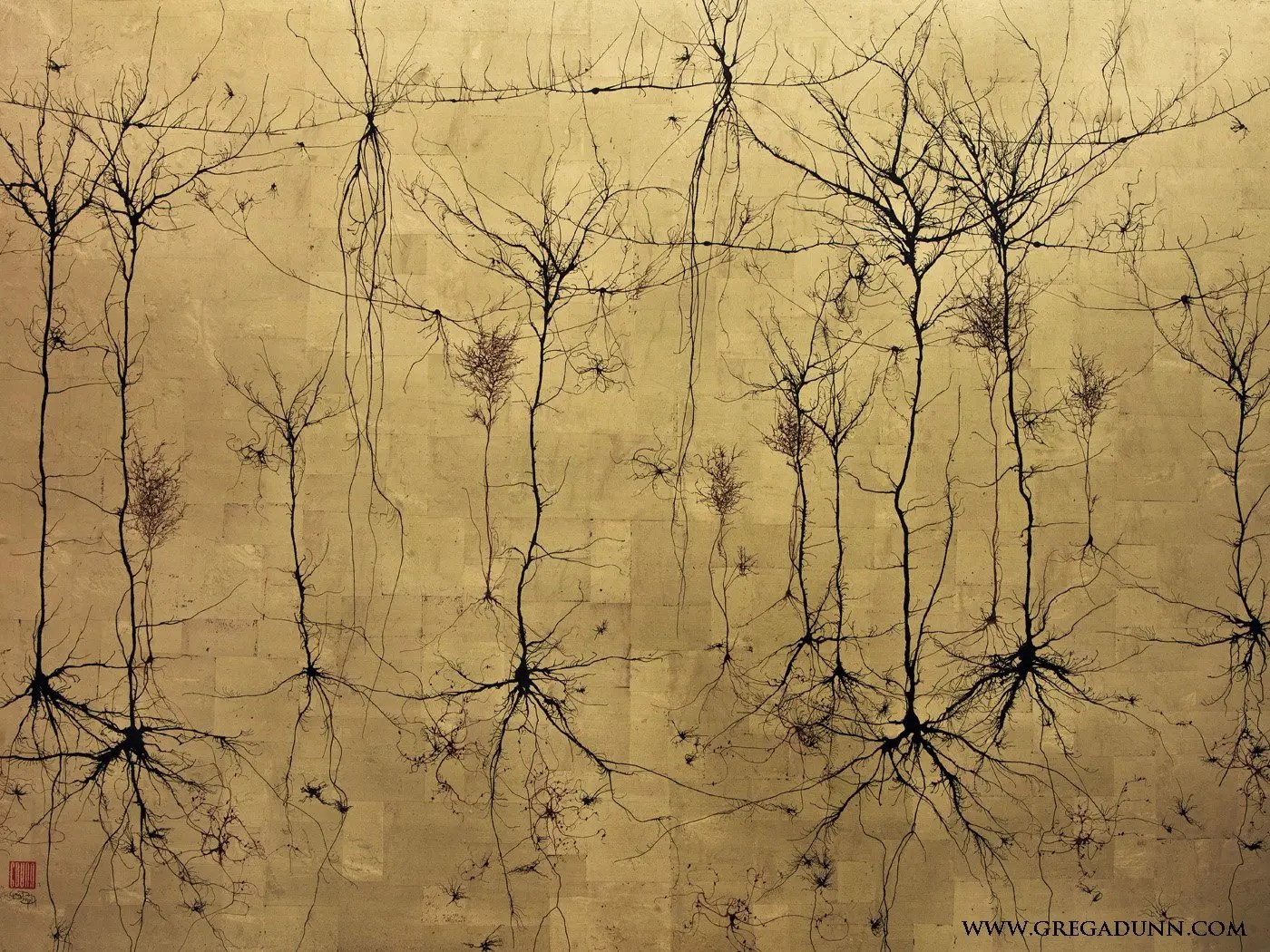
Greg Dunn’s gold-leaf neuroscience art: “Gold Cortex”

~

Howard Gardner once said aesthetics is considered the “dismal branch of philosophy” and that psychobiology, the scientific examination of art, might therefore be called the “dismal psychology.” This view derives from the difficulty of pinning down what qualifies as art, the artistic process, the artistic personality, and the like–especially the challenge of trying to categorize, measure, and in any genuine way evaluate art. Psychobiology as a discipline is new to me; is it merely an earlier form of behavioral neuroscience? How does aesthetics play a role? I went looking.

~

Here is an excerpt from D.E. Berlyne’s abstract of his exploration into stimulus behavior and art (including humor), Conflict, Arousal, and Curiosity, written in 1960:

The highly variegated human activities that are classed as art form a unique testing ground for hypotheses about stimulus selection. They consist of operations through which certain stimulus patterns are made available, and so they must unhesitatingly be placed in the category of exploratory behavior. The creative artist originates these patterns, the performing artist reproduces them, and the spectator, listener, or reader secures access to them and performs the perceptual and intellectual activities that will enable him to experience their full impact.

It’s intriguing to note the different ways a social scientist (Berlyne was a psychobiologist) uses language to write about a generally-considered subjective subject: art. Different in tone and terminology than the language a philosopher or artist would employ, the description characterizes yet another inquiry into the ontology and the exercise of art and the artistic process:

The content of art can range over virtually the whole scope of human communication. It may be used as a source of information about the appearances of objects, the course of historical events, the workings of human nature, as a means of effecting moral improvement, as a vehicle for propagating religious, political, or philosophical ideologies. Art is, however, distinguished from other forms of communication by …the communication of evaluation. While human beings may produce art and expose themselves to it for an endless variety of reasons, collative variables must play their part, as they do in all forms of exploratory behavior. They underlie, in fact, what is commonly called the “formal” or “structural” aspect of art.

The author is interested in whether psychosocial behaviors, culture-building, and communication all derive from exploratory behavior and stimulus-response and what role evaluation plays in the assessment of art, its social or moral value, artistic merit, “timeless” art, and to some extent the very making of art.

The psychology of aesthetics offers intriguing insights–if one can get past the jargon. From the little I have read about it so far, the science seems to share a few points with phenomenology: its task, according to Dr. William Blizer, is to “describe observable phenomena and to note associations and correlations among them which enable such phenomena to be predicted, controlled, and explained.” In psychobiology, the “observable phenomena” are “the behavior of the creative…artist and the appreciator.” Philosophy and psychology are strange bedfellows, though; throw aesthetics into the mix and the entire project begins to seem suspect. I am not at all sure that these inquiries end up explaining–certainly not predicting or controlling–anything about art.

I admit I prefer to read such musings when the makers themselves are doing the exploring. Nonetheless, this little intellectual excursion led to my discovery of Greg Dunn‘s amazing neuroscience designs, one of which appears above. Who knew the brain was so gorgeous?

Consciousness reconsidered

A few months back, I was reading about consciousness (see here and here). This article on “brain tubules” caught my attention, although I admit to considerable skepticism as to how applicable, or even correct, this research will turn out to be. The material seems exciting–quantum vibrations in the brain!–because of the possibilities inherent in a synthesis of chemistry, biology, and physics and how such synthesis could lead to a theory of human consciousness.

The earliest article I could find on this theory dates to 1998 (an abstract is here). I suppose I should now break down and tackle Werner Loewenstein’s Physics in Mind: A Quantum View of the Brain. But I have a huge to-read list at present and no time or concentration to get to those books. Besides, at the moment I find myself more concerned with the less empirical side of consciousness theory. I mean: belief, attitude, faith. Those non-provable abstracts that nevertheless seem so much a part of most human beings’ operating systems…the things that psychology and neurology do not seem able to answer and that keep philosophers continually at work (the only true knowledge being the knowledge that one knows nothing).

~

And maybe, as Daniel Dennett suggests, the very idea of consciousness is an illusion–the brain evolving to fool us through perception.

~

This bust resides in the Louvre, and was found here: http://www.humanjourney.us/greece3.html

This bust resides in the Louvre,
and was found here:
http://www.humanjourney.us
/greece3.html

Do our brains fool us through our perceptions of emotion, too?

~

And how does this affect how we understand, say, literature, or art? Poetry, for example: Is it possible to deconstruct the pleasure I take from a poem into quantum vibrations in connective synapses as a result of the evolutionary process and, if so, where does the knowledge get me?

Would I still love the poem? (I think I would.) Would I consciously love the poem, consciously find pleasure and surprise in it, once I understand fully the process and development of consciousness? (Why not?) Would such knowledge flatten my emotional or aesthetic attraction to the poem? (I doubt it.)

If loving my perception of art, my relationship with it or attachment to it, is “merely” an evolutionary development, that does not cheapen or devalue the way I feel.

~

What brain studies and consciousness studies have to say about faith may perhaps set up more antagonism between science and consciousness-as-non-biological/i.e. religion, spirituality, etc. By faith I mean not necessarily religious faith but any non-provable conjecture, some of which are imaginative and potentially marvelous, not to mention potentially true. Some statements can be disproven but not proven…and there is the apagogical argument…and then there is the definition of faith (or belief) as Wikipedia defines it: “Faith is subjective confidence or trust in a person, thing, deity, or in the doctrines or teachings of a religion, or view (e.g. having strong political faith) without empirical evidence, or as confidence based upon a degree of evidential warrant (as in a Biblical sense).”

That empirical evidence thing is the perpetual stumbling-block, yet–paradoxically–it’s also what makes faith so appealingly…human. Yes, maybe we are fooling ourselves. And maybe that’s what is so marvelously cognitively neurologically fruitful and imaginative about the whole human endeavor.

Clear skies

buddhaedited

(A friend traveling through Thailand took this photo.)

Given that these are the coldest, darkest days of the year, I have felt the need for clarity quite keenly. Today, we had clear skies. When I walked outside this afternoon, I felt as though a note from a singing bowl was vibrating through my body.

{Wake up!}

Entitlement, humility, & self-esteem

Among my academic colleagues in the USA, I hear a refrain of grousing about so-called millennial students who, it is averred, perceive themselves as entitled to good grades, exceptions to rules such as number of absences, timeliness, and response to communication, and other “special treatment.” The general criticism goes along the lines of Kenrick Thompson’s letter to the editors of the Chronicle of Higher Education:

… I grew increasingly weary of all the whining, crying, excuse-making, and general lack of attention to responsibility that appear to characterize most of today’s college and university students. I began to sense a growing atmosphere of entitlement among a majority of my students, who apparently believe that society owes them an education. I even endured several instances of students’ insisting they should pass my course simply because they had paid their fees and purchased the required textual materials.

Thompson lays some of the blame for such behavior at the door of college administrators who care more about admission and retention numbers than about the whole package of education, which includes less-measurable outcomes such as personal responsibility and mature problem-solving. The Chronicle has published other essays on related topics, among them these by Elayne Clift and Frank Donohue.

Other critics have blamed Baby Boomer parents for overdoing positive reinforcement so that their offspring do not have to suffer from low self-esteem. These critics suggest the everybody-gets-a-prize approach has watered down the go-get-’em competitiveness formerly considered a hallmark of the individualist American.

The word “entitlement” pops up in a blog post by Toby Woodlief back in 2007, and certainly appeared in conversations I had with colleagues long before that; but there has been much general buzzing that this sense of entitlement is “a Millennial thing.”

What does entitlement really mean? Webster’s has three main entries, the third of which is: “belief that one is deserving of … certain privileges.”

I can therefore say that I believe I am entitled to something, and I can accuse others of feeling that way; but because the word is based upon the subjective sense (“feeling or believing” that one is “deserving of”), can I say for certain that other persons “believe that society owes them an education”? [Note, Thompson does qualify with “apparently”.] No one can independently ascertain what another person believes or feels. My students do not tell me they feel entitled to things.

Could this be just a problem of perception or point of view, as so much inter-generational sniping is? Certainly my generation received criticism for its youthful irresponsibility, though it was of a slightly different kind (drop out of the rat race, turn on, be free). Did we feel entitled to ignore the paths our parents took?

I wonder if the real reason older people feel so annoyed with Millenials is the perception that there’s so little humility among the young. Many people my age were raised with the Protestant ethic formula that one should be humble, and humility has long been valued by the Catholic church, as well. Humility is closely allied with shame, however–and even guilt, to some degree (original sin and all that)–giving us neuroses along with our humility. It depends, once again, on your sociological and personal outlook; I am not suggesting that humility is bad or good, nor that entitlement is bad or good. These are just extensions of feelings people have, of personal and subjective perceptions.

Blaming the young people, or blaming their parents, or blaming the culture, for that matter…none of it helps us to understand or to respect one another. And as fellow travelers on the planet, are we not entitled to at least an initial moment of respect?

A balance might be nice.

~

I work with 18-year-olds every day, and I enjoy them. This is not to say that I don’t occasionally wish to wring their necks or boot them out of their warm beds in the morning or remind them that I am not here to make them feel good about themselves for no reason other than their uniqueness. It does not dissuade me from doling out Fs when Fs are deserved (or, shall we say, earned) or reminding them, now and again, that most of their annoyances qualify as first-world inconveniences undeserving of hysterical rants.

I try to keep in mind that they are still learning about the world of other human beings.

In time, if they are mindful and observant and lucky, they should discover that the participation trophy for life is life itself–

IMHO   😉

~

Sublime beauty

In his book Survival of the Beautiful, David Rothenberg says perhaps it was the evolution of an abstract aesthetics in art (abstract work as beautiful) that enabled human beings to begin to see natural things as beautiful in themselves–as opposed to the Romantic view that human yearning and elevated sensibility could best be encountered while experiencing Nature or Classicist ideas that found natural things corrupt and irregular, in need of perfection into better-proportioned objectification. In History of Beauty, Eco allows the Romantics their view of the sublime but says that in the late 17th c “the Sublime established itself in an entirely original way, because it concerns the way we feel about nature, and not art.” His text offers the paintings of Caspar David Friedrich as an excellent example, paintings that depict people as observers of the Sublime:

The people are portrayed from behind, in such a way that we must not look at them, but through them, putting ourselves in their place, seeing what they see and sharing their feeling of being negligible elements in the great spectacle of nature…more than portraying nature in a moment of sublimity, the painter has tried to portray (with our collaboration) what we feel on experiencing the Sublime.

I love the idea Eco parenthetically notes here: with the viewer’s collaboration. These paintings permit us to enter into the experience as the great preponderance of the artistic canon did not. Some critics suggest the environmental “movement” (in the USA, at least) owes its lineage to Leopold via Thoreau through Darwin, Wordsworth, and the German Romantics.

Friedrich’s work tends a bit over the top for my personal tastes, but I do think some of his best work (notably The Wanderer above the Mists, Woman on the Beach of Rugen, Moonrise by the Sea) does exemplify a sense I have experienced myself in natural surroundings when I feel myself a “negligible element” amid the remarkable scope of the cosmos and the world.

In the USA, at about the same time as the German Romantics, the paintings of the Hudson River school evoke some of the same sense of nature-as-sublime. (Frankly, I prefer Thomas Cole to Friedrich.)

~

This, too:

“The sense of the Sublime is a mixed emotion. It is composed of a sense of sorrow whose extreme expression is manifested as a shudder, and a feeling of joy that can mount to rapturous enthusiasm…while it is not actually pleasure…”   Friedrich von Schiller, On the Sublime (tr. Alastair McEwen)

~

“Poetry might be defined as the clear expression of mixed feelings.” I am pretty sure W.H. Auden said that. Which, by the way, gets us into the territory of the Sublime as described by Schiller.

~

In Japan, in the 17th century, Matsuo Basho composed haiku, some of which demonstrate the sense of the Sublime (without being Romantic at all)–i.e. that sense of rapture tinged with the shudder of grief or the feeling of awareness of one’s negligibility:

A wild sea-
in the distance over Sado
the Milky Way.

~

paintdaub
I stand on my back porch; I am small and negligible, the sky is large and Sublime.

Tai chi [crane pose]

A memory of my undergraduate days: I was wrestling with indecisiveness, both academic and personal, and consulted a professor who sometimes acted as a sounding board for me. What should I do? Here was one option, here another, no way to decide how best to proceed. I felt mired in uncertainties.

She listened compassionately to my dithering and then replied by telling me about a Buddhist saying: “When leaning left, lean left. When leaning right, lean right. When wobbling, wobble.”

I felt relieved. All my life, I had been criticized for my indecisiveness; here was a person who allowed me to accept it as another way of being. There was also the implication that I would not be wobbly forever. Eventually I would bear enough in one direction to proceed. Meanwhile, I was granted a kind of grace–a moment of compassion for my wobbly state of being–and all I need do was to wobble mindfully.

[Admission: I have never been able to confirm that this actually is a Buddhist saying, or for that matter a Taoist or Confucian saying, and I think perhaps she invented it.]

~

Yin-YangI recovered the memory above while trying a move in my rather new practice of tai chi.

One may infer that I am less than steady on my feet, particularly when required to stand on one foot, as necessary for “crane” stance in the tai chi form I am learning. So, I try to be mindful of breathing while attempting crane. And I wobble, but I try to wobble slowly and mindfully.

I am, however, fairly good at leaning. Standing on both feet while placing my body’s weight on one leg comes naturally to me, whereas the groundedness of the horse stance takes more concentration.

“When leaning, lean.” I can do that.

~

Once again, as per my last post, establishing that middle way–though it is not easy, and it is not hard–doesn’t come naturally, especially when I feel spread a bit thin in other areas of my daily life.

Therefore: “When wobbling, wobble.”

~

From KHHuber’s blog, here’s a lovely photo of (egret? crane? white heron?) steadily elegant on one leg:

kmhubersblog.wordpress.com Photo KM Huber

If only…

The poet & the Good

I have recently finished reading Robert Archambeau‘s collection of essays The Poet Resigns and am mulling over the idea of resigning with him.

It’s not that I necessarily want to give up writing poetry but that, in my reflections about where I can do the most good among the community of sentient beings, my work as tutor and teacher almost certainly has an effect both deeper and broader than my work as poet. This “good” hearkens to the ancient Good of Socrates, Plato, and their ilk but also to the sense of mindful “middle way” of the Tao: a practical path between two values that may be incompatible in many ways.

~

water-rites_coverThe readership for contemporary poetry is small, and my readers number only in the hundreds; among those readers, resonance of any kind–aesthetic, emotional, lyrical–is likely to be limited to a small number of poems. A poem of mine that effects some measure of The Good upon readers represents a minuscule good moving into the world. The net effect, I imagine, hardly registers…not that net effect matters so much. I suppose if a poem of mine moves just one person enough to evince even a small transformation, something has been achieved beyond my individual abilities in the composition of that particular piece.

As a teacher and tutor for the past ten years, my role expands not merely to number of people encountered (few of whom will remember me as an individual) but to the concepts I present to them, most of which will be significant in their lives one way or another–although not immediately, and probably unconsciously. Lately I have been devoting more of my limited energies to this aspect of my life work. Such focus does impede my ability to do creative work of other sorts.

~

This bust resides in the Louvre, and was found here: http://www.humanjourney.us/greece3.html

This bust resides in the Louvre, and was found here: http://www.humanjourney.us/greece3.html

Example: I am reading a little book on philosophy for beginners by Thomas Nagel. The Nagel book is on my table because I have been trying to find simpler ways to talk with students about their philosophy essays. While my main enterprise as writing tutor is to help students to clarify and correct their mechanical weaknesses (sentence and paper structures), it is not always possible to ignore content weaknesses; a student can write correctly about nothing of value–and receive a D or, in the case of Philosophy classes especially, an F.

But understanding philosophy is important.

Now, it is often extremely difficult for beginning writers to express their understanding of philosophical concepts in writing. They are just learning rhetoric and fall into fallacy errors through grammar as often as through thinking. Since I am not supposed to be a content tutor, I have to find ways to tease out what the student understands (or does not understand) and make that idea come through clearly on the page.

Kind of like mind-reading.

[Aside: I have to admit this can take a lot out of me by the end of the day.]

The Nagel book is one of several philosophy primers I have been reviewing to try to find a text to which I can refer my more confused students, the ones who cannot infer the basics from their professors’ lectures or assigned readings. There are academics who might suggest such students do not belong in college in the first place; but I believe in the ideal of an educated populace, and whether or not these students stay in the university through graduation, they can benefit from the discipline of thinking about thinking.

It feels rewarding when, after half an hour of discussion and writing coaching, a young person leaves my office slightly more enlightened. So they tell me, anyway. I know from experience that writing about something helps a person to understand not only the subject but, more importantly, what the writer thinks about the subject.

~

So perhaps my creative energy is better served in the direction of others through tutoring than through poetry; perhaps the former leans more toward the Good. Perhaps I am a better tutor than poet; this is indeed likely, although I have been poet-ing longer than I have been teaching. Then again, not to knock the art of teaching, but writing poetry is much more difficult than the teaching I do. And I get paid to enlighten people through my tutoring.

Not so through poetry. Indeed, Mr. Archambeau–you have gotten me seriously to think about tendering my resignation as a poet, though not without considerably more reflection on the possibility. Writing about the idea has helped me to understand where the Good fits into all of this, and what the middle way might be.

Now, I suppose I could write a poem about the subject…

~

Abstraction, evolution, & sky-beauty

I awakened this morning to a sunrise of surpassing beauty. As I drove to work, I remembered that the first poems I recall ever writing were about the wind and about dawn–perhaps I wrote other poems as a child, but these two are the only ones I remember: poems that celebrated something I found lovely in nature.

After the vivid morning sky, we had a day of rain; and on my commute home, a compelling sunset bookended the working day. I call these skies “beautiful” and would definitely regard my experience of looking at them as aesthetic.

And yet, it’s only the sky, some clouds, the sun, phenomena that science has explained. What makes it beautiful?

photo: Beejay Grob

photo: Beejay Grob (North Carolina coastal sky)

David Rothenberg’s 2011 book Survival of the Beautiful: Art, Science, and Evolution has accompanied me for the past week; I have been reading it when I can find time to read and to cogitate. Rothenberg speaks directly to the question of what makes us experience beauty, whether beauty is a human-only construct, and from where the qualities of aesthetic experience arise. He explores among other things whether beauty (especially in the form of art) evolved along with us, what makes it timeless (if it is indeed timeless), and whether our grounding in nature as earthly beings formed the grounding for what we deem beautiful.

And he considers symmetry and biology and abstract art and math and music. There’s quite a good deal of synthesis and speculation going on in this book.

~

Rothenberg writes that he is interested in whether humans’ developing education in abstractions–concepts and abstract arts–might produce an outcome that increases our appreciation of things in nature and the cosmos. He writes:

It might seem this century has freed us from interest in any kind of constricting form or function in art, but I want to test out a different theory: that abstraction in the arts has made us find more possible beauty in the natural world…as art exalts pure form and shape, the laws of symmetry and chaos found in mathematics and science seem ever more directly inspirational. Aesthetically, we become more prepared to see beauty where before we saw only the clues of beauty, its glimmers or possibilities…our minds are more attentive to an abstract kind of beauty that we can discover but not necessarily build or create.

It takes him several chapters to braid together the many strings of his interdisciplinary inquiries; but the upshot is that while I feel he does not answer the questions he begins with, he does deepen the reader’s thought process about art, beauty, and the evolution of ideas as well as of organisms. He says the interesting discussion lies not with what is or is not art, nor how to evaluate the individual merit of works, but rather “how artistic expression changes how we think in ways only art can accomplish.”

~

In light of Rothenberg’s musings on how natural-feeling abstract art can be, here are some examples: Barlow, Ellis, (contemporary) and Klee (modern).

Rothenberg concludes with some ambiguity about aesthetics and evolution, which suits his book-length and life-long explorations on the interweavings of these ideas; but he adds with certainty that “[b]iology is not here to explain away all that we love in terms of the practical and rational. That is not how nature works. Nor should we shrink from our natural astonishment at the magnificence evolution has produced.”

~

He mentions John Cage’s work and approach to composing, and I think Cage’s main point in so much of his work is getting us to listen, to see, getting us to be attentive. Viz Rothenberg’s words quoted above, maybe an integration of abstraction does open us to be more attentive to the beauty that exists in the world without any artist making it. We could not, in the past, have appreciated the fractal values of river deltas viewed from airplanes; and perhaps only natural (or trained) artists noticed how the twigs of a tree reiterate the shapes, angles, and curves of the branches, boughs, sometimes even bark. Now we know about Mandelbrot sets and fractal geometry, and those abstractions can generate beautiful patterns. Now we know the Fibonacci sequence of numbers–an abstraction–appears in snail shells and sunflower seed-heads.

We do not have to be mathematicians, chemists, art critics, environmental scientists, physicists, sculptors, violinists, composers, dancers, college professors or biologists to recognize patterns and symmetries, or to find that slight variations in the pattern enhance the experience through the kind of surprise and delight that I discover in great poems.

We just have to be attentive.

~

sunset1

Art, story, story, art

Yesterday, I attended a reading by former US Poet Laureate Kay Ryan in a more intimate setting (a luncheon) than I’ve ever been privileged to hear her at in the past. An audience member asked her how she would define art. Alas that I don’t write quickly enough to have taken her words down verbatim, but she offered a lovely answer.

She said that if a person cannot really be happy without doing it, and cannot keep from needing to do it, and if it nourishes or gives back to that person in ways nothing else can–then that “it” is art, in her opinion.

~

I suppose art also ought to speak to others, but I am not sure that is as necessary as art critics think it is.

~

Speaking of critics, and of art, I was impressed with Hilary Mantel’s 1998 novel The Giant, O’Brien for reasons that made a few critics rather lukewarm about it. The author is best known for her amazing historical works, well-researched and full of believably human perspective. O’Brien is a departure in several respects although still historical fiction. I read this book as an ambiguous moral tale, a myth, a story about stories (and art) and a depiction of ways the Enlightenment created significant losses in the midst of its gains. So I was less bothered by the exaggeration of certain personalities or minor plot gaps. O’Brien, a storyteller of the most shamanistic/primitive sort, also possesses a modern (Enlightenment) intellect and an artist’s “intuition.” But he never achieves fame, or the goal of restoring a beloved pub–the place he learned his craft–and dies painfully and slowly, impoverished and nearly abandoned.

As O’Brien nears death, Mantel writes that there comes “a point in fatigue or pain when logic slowly crumbles from the world, where reason’s bricks sieve to crumb. Where content flits from language…and departs.” And her character, the giant–who embodies in his hugeness the epitome of mythical narrative, the kind that sustains us even in dire poverty–eventually comes to the conclusion that the poor among us lose all. Of the poor man, he muses:

Stories cannot save him. When human memory runs out, there is the memory of animals; behind that, the memory of the plants, and behind that the memory of rocks. But the wind and the sea wear the rocks away; and the cell-line runs to its limit, where meaning falls away from it, and it loses knowledge of its own nature. Unless we plead on our knees with history, we are done for, we are lost. We must step sideways, into that country where space plaits and knots, where time folds and twists: where the years pass in a day.

What within us plaits and knots and folds and twists but the brain itself? We pass along our knowledge and, more importantly, our stories. That is done from brain to brain through language and music and art, even as the individual brain comes to the end of its viability and vitality. We step sideways into another person’s brain, just as O’Brien’s listeners memorize his tales, his cadence, his figurative speech. So, in the end, O’Brien is wrong.

~

I attended a funeral today at which the officiant encouraged us to keep the departed alive in our hearts and for the future by telling stories he had told or by relating stories about him to anyone who might listen. I know I have previously written about this idea in conjunction with readings and philosophers and art and literature. The more I encounter it, the truer it seems to me.

The bereaved spouse at this funeral is a person who is losing her own story through senile dementia, though she has some occasional awareness of her memory loss. Her ability to carry on her husband’s narrative is already deeply diminished or perhaps completely gone.

These are among our risks.

~

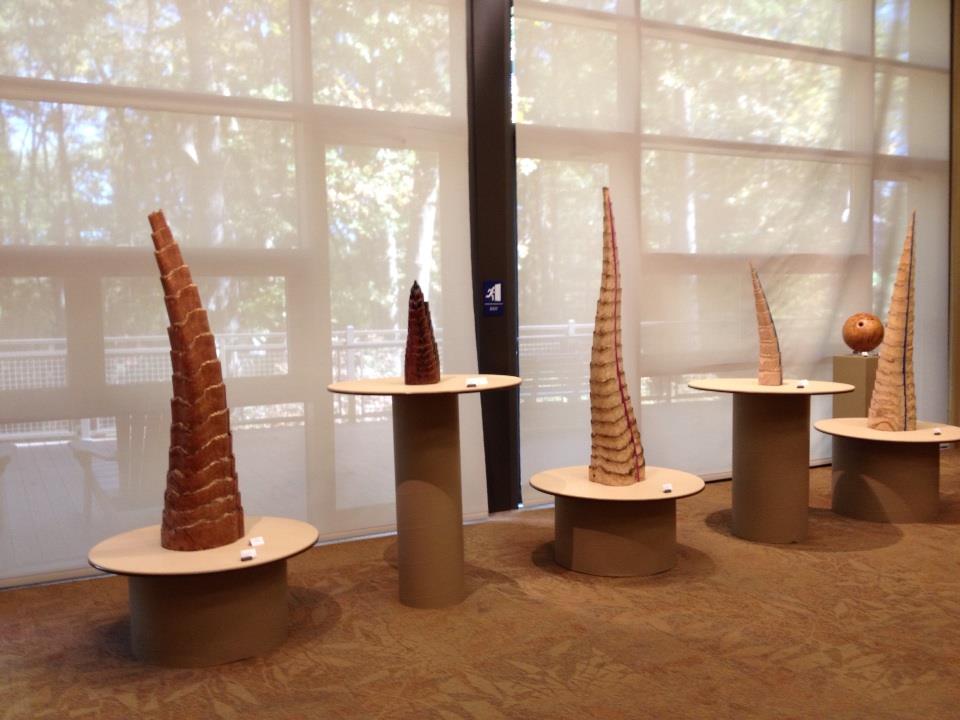
These words brought to mind my long-time friends, the craft-artists David Ellsworth (turned and other wooden forms) and Wendy Ellsworth (beaded forms). This month, for the first time in their many years together, they have a joint exhibit in the gallery space at Jenkins Arboretum (Devon, PA). The photos below are snapshots Wendy took, and their individual work is best viewed in person or on their studio website. [Contact the artists for permissions, photos, information about workshops and talks.]

Wendy Ellsworth's seaforms, and a necklace

Wendy Ellsworth’s seaforms, and a necklace

Wendy's "Sunset" (with David's turned-wood frame/container)

Wendy’s “Sunset” (with David’s turned-wood frame/container)

David Ellsworth's "Emergence" series

David Ellsworth’s “Emergence” series

I have known Wendy and David for over 25 years, and I can testify that the work each of them does fits Kay Ryan’s description of art. They are artists, and their work nourishes both of them–and nourishes us, the beneficiaries, as well.

~

For today, these are my stories.

www.ellworthstudios.com