Collecting & creativity

Somehow or another, I completed a chapbook manuscript. The longer collection is coming together, as well. Yet it feels to me as though I have not spent nearly enough time on my creative work. And when I find myself awake at 3 in the morning, it’s not poetry that runs through my mind. Usually those wee-hour thoughts are work-related. I guess that makes me normal.

The next step, once a writer has completed a manuscript, is to have another writer or two review it; I’ve done that, too. So now? I guess I submit the work and find out whether a publisher agrees the poem collection does the job of poetry.

And I get prepared for rejection. Comes with the territory.

Upon reflection, the reason I feel I haven’t been doing creative work is that I am not generating many new poems right now. Some, but not many. But let’s re-think the process of revision: it’s a process of deciding upon the order poems should appear in a book, and which of the poems ought to be there to speak to one another, to resonate with one another (and with the imagined future reader). Hey, I am using my imagination here, and I am doing creative work. If all I ever do is generate new poems, those poems won’t have a chance to go out into the world and endeavor to speak to other humans.

Figuring out how to make that happen is the creative work of revising, editing, rethinking. Imagining the reader. Striking the tone of each individual poem to see whether it adds harmony, or works with a fugue-like trope, or changes the mood to minor, or unleashes a surprise. The book of poems can have an arc or act as a chorale or zigzag about to keep the reader on her toes.

The collection of poetry, when it is not yet a book, presents problems the writer and editor must solve. Problem-solving requires creative thinking–I tell my students this almost every time I see them in class!

Will the manuscripts find homes? That’s a different “problem.” Meanwhile, more new poems, more revisions, maybe more manuscripts ahead…while I await the first frost, while the leaves turn and fall. All part of the cycle.

Being receptive

When my parents moved to a senior-living campus about 10 years ago, one of the hardest aspects of downsizing was what to do with the books. My dad’s bookshelves were full of texts that he found meaningful, valuable, inspirational, informational, necessary; he loved to read. Choosing which books to give away and which to keep was agonizing for him. And then he faced the task again when he and my mother moved to a smaller, assisted-living apartment. That time, he donated many of his books to the facility’s library, so he could “visit” them if he needed them. There remained one large bookcase. Because you can’t live a happy life without books!

Then he died; and my mother, who also loved to read, developed such aphasia that she could no longer decipher sentences. Now, every time I visit, she gestures at the books and urges me to take some of them. It’s hard to explain the response I have to taking home my dad’s books–a mixture of tenderness and discomfort, nostalgia and pain. Sometimes I end up giving the books away, but usually I read them first. Because they are books and deserve to be read, somehow, just by virtue of existing. No–by virtue of their having been significant to my dad. That is why I feel compelled to read them.

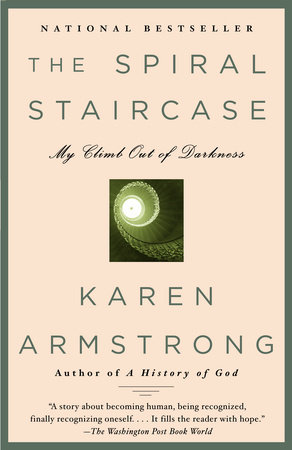
I cannot say I got much inspiration from my father’s 1955 copy of a text on caritas by Martin D’Arcy, The Mind and Heart of Love, although I found suggestions about the philosophy of Christian love that my father would certainly have noted {indeed, his penciled checkmarks in the margins confirm it}. Last time I was at my mother’s, I chose to take Karen Armstrong’s 2004 book The Spiral Staircase, a book I appreciate rather more than I did D’Arcy’s. Much of Armstrong’s memoir deals with the frustration she felt as she struggled to find her place and purpose in the world of work. As it turns out, she is a writer, although it took her awhile to discover and admit it. Part of being a writer involves isolation or solitude, which Armstrong equates with silence: “Without the distraction of constant conversation, the words on the page began to speak to my inner self…I was no longer just grabbing concepts and facts from books…but learning to listen to the deeper meaning that lay quietly and ineffably beyond them. Silence became my teacher.” That passage resonates for me. I can recall times when what I learned, and subsequently, what I wrote or composed, emerged from such silence.

But I like most of all what she says in her next paragraph (p. 284).

This, of course, is how we should approach religious discourse. Theology is–or should be–a species of poetry, which read quickly or encountered in a hubbub of noise makes no sense. You have to open yourself to a poem with a quiet, receptive mind, in the same way as you might listen to a difficult piece of music. It is no good trying to listen to a late Beethoven quartet or read a sonnet by Rilke at a party. You have to give it your full attention, wait patiently upon it, and make an empty space for it in your mind.”

It helps if we can give our hearts to poems and books we read, make space for them in our minds, hear what they have to say before rushing in with our own clever ideas and personal perspectives. When writing, the same approach applies. Often I think I know what I have to say, yet the poem on which I’m working proves me wrong. And it helps to be compassionate to the writerly self, which is another thing Armstrong had to learn, as she was far too hard on herself about her thinking and writing.

Her subsequent books, and her recent work, center around compassion, I notice. I have not read them yet, but I plan to. Another thing I notice is that the copy of The Spiral Staircase I brought home from my dad’s bookshelf is inscribed:

Tom and Bonnie    with best wishes     Karen Armstrong

Practice

When students struggle, I nod as kindly as I can. Do they need to know they’re not alone? Seven billion of us, each with struggles of our own. It takes practice, I tell them, and practice takes time. But persistent patience isn’t common among young folk, who seek strategies, shortcuts, miracles.

They yearn to know what I know so easily, are astonished that words and thoughts can spool smoothly–they think so, bless them–as though there were dictionaries and references in my mind. If they would believe me when I say: it’s possible to learn–

They never realize I haven’t always been old or knowledgeable, that practice continues and, dear students, so does struggle.

We can practice that, too.

~

You noisy jays!
scattering
       the mourning doves

Why don’t you write?

I was an avid letter-writer once, a great correspondent, a reliable pen pal. In return, I received long, descriptive letters from far-flung friends and relished every trip to my mailbox to discover what had arrived that day. A letter from a friend? A poem rejection? A poem acceptance? A postcard from a family member off traveling? Critique and feedback from a poetry-colleague on a series of poems? Junk mail, bills…

These days, my mailbox mostly disgorges junk mail and bills. The few friends who write lengthy correspondence usually do so by email (which I do, truly do, appreciate). My keen interest in other people’s thinking, and my opportunity to acquire perspective into their lives, must now be satisfied by other means. That’s why I follow blogs and other “long-form social media.” (I thought I had coined that term, but apparently it has been in the lexicon awhile.)

Is a letter just a blog written for an audience of one? Is a blog a diary written for an imagined public, or is it a letter to the world? What purpose do private journals serve for those of us who keep them? And what’s behind the urge to keep old correspondence? The discovery of a cache of letters features in many novels and in a host of memoirs and histories, so there’s some kind of human-interest frisson resonating there. Perhaps the simple fact that such writings were intended to be private–that audience of one–piques curiosity.

For me the hardest aspect of letting go of past correspondence is that so many of the people to whom I wrote letters have died. In my attic, there are boxes of letters from these departed friends…suggesting a different meaning for the phrase “dead letter.” In a similar vein, there certainly exist blogs by now-dead writers that remain in the cloud, hanging stuck in the interwebs. Are these memorial pages, or are they digital ghosts, and to whom do they belong?

Photo by Pixabay on Pexels.com

The intersections and overlaps between these related forms of written expression intrigue me. And the nosiness interests me, too. Isn’t that one reason we like to read literature–to get an intimate peek at how other people behave, respond, solve problems, form relationships, think about society and values? To imagine to ourselves what bad behavior feels like and what its consequences can be? Or to find insights as to what generosity and love can accomplish; to gain a sense of empathy, even compassion. Plays, memoirs, novels, and poems operate like that. I’m not sure blogs and diaries work quite the same way with their readerships, but they may do.

Maybe what keeps me following any kind of writing is just the fact that I love to read.

~

Why don’t you write me?
I’m out in the jungle, I’m hungry to hear you
Send me a card
I am waiting so hard to be near you
Why don’t you write?
Something is wrong
And I know I got to be there
Maybe I’m lost
But I can’t make the cost of the airfare
Tell me why (Why, why)
Why don’t you write me?
A letter would brighten my loneliest evening
Mail it today
If it’s only to say that you’re leaving me…

Paul Simon

Moment(s)

Very small pear.

~

It was delicious.

After last year’s complete dearth of pears, this year both trees were laden with fruit so that the boughs drooped, making things easier for the deer, who love to eat them. We were happy to share, as I haven’t got time these days to make pear butter or prep fruit for canning. We gave pears to friends, made pear cobbler, ate pears for breakfast, and enjoyed them immensely. And we liked watching a doe and her twin fawns nibbling around and under the trees at dawn and towards dusk.

The summer heat broke at last after the “remnants” of hurricane Ida crashed over us. If those were just remnants, I have deep respect for the people of Louisiana, who felt the initial force. We got 7″ of rain in less than a day, and the flash floods affected many of our friends. My basement office on campus is drying out during the 3-day weekend–our building’s drainage system was not quite up to the task of directing water away from our doors. Now, the brown crickets are noisier than the katydids, the grasshoppers have grown large, the days are shorter. Tomato harvest has slowed, and gardening consists mostly of pulling up weeds and dead plants. It is as though the downpour swept away summer, despite my knowing that the hot days will return. (September can be steamy here in my valley.)

I’m reading A.E. Stallings‘ collection Like and relishing her new takes on traditional poetry forms as well as her facility with establishing a sense of place in the poems. I appreciate her images and thought-provoking ideas, too. Her work does the things that I think poems are supposed to do.

Finally, I have been drafting a few poems, or at least hoping these drafts will turn into poems. I’ve also begun examining some older work for revision and, maybe, collection into another book. But that’s looking perhaps too far ahead. After a challenging couple of years, maybe just living in the moment serves me better.

The taste of fresh pears. The sticky sweetness of fresh local peaches. The smell of basil.

Lyrical

I may have mentioned in my last post that I am reading Jonathan Culler’s book on the theory of the lyric with the intention of getting back to my own work, revision at very least, writing if at all possible. So I have begun.

Lyric continues to be my main poetry mode, though I do pursue narrative and non-lyrical haiku forms occasionally. I haven’t spent too much time dwelling on how to define lyric as a genre; I just accept it as a sort of catch-all term for a continuum of many kinds of poems that in general are brief, “you” or “I” directed, subjective as to observation, and often patterned rhythmically or patterned using rhyme.

Here are some quotes from the book that I found useful, thought-provoking, or relevant.

~

“Fiction is about what happened next; lyric is about what happens now.”

“Many twentieth-century poems…require sounding or voicing and may juxtapose phrases that evoke various voices…[asking] to be read in relation to the lyric tradition…”

“Poems provide formulations that may explain for you a situation you found incomprehensible.”

“The lyric, by its formal patterning and mode of response, asks to be learned by heart, even if that seldom happens…” (This concept is one he takes from Derrida).

“The lyric aims to be an event, not a representation of an event, and sound is what happens in lyric.”

“Lyric address is usually indirect.” (This, despite the frequent use of apostrophe in lyrical poetry, which Cullers argues is used indirectly most of the time.)

Lyrical apostrophe “posits a third realm, neither human nor natural, that can act and determine our world.”

“If one were to treat lyric as a domain to be mapped, one would need a multidimensional space.”

Jonathan Cullers

~

I especially like that last one. Lyric as Kosmos, as universe (and possibly universal). It jives with Whitman in some ways–resonates, at very least, with his idea of poetry as vast and of himself (as poet) containing multitudes.

Something to aspire to be, to write, to wrap my mind around.

Cycles & theories

The Chinese lunisolar calendar puts us between 立秋 lìqiū, or start of autumn, and 處暑 chùshǔ, or limit of heat. Certainly the heat here lately has felt limiting, but the term more likely refers to the end of the hottest days of the year. My backyard world fills with haiku imagery for waning summer and impending autumn: katydid and annual cicada calls, birds starting to flock, morning glory and goldenrod, ripe pears, apples beginning to redden, hosts of butterflies. I watch as a hummingbird visits sunflowers, cannas, buddleia, corn tassels, and zinnias. Ripe tomatoes and zucchini weigh heavily on their vines.

Yesterday, a doe nibbled pears while her late-born twin fawns wove between her legs and the Queen Anne’s lace beneath the tree. The air hangs so humid, even the monarch butterfly’s wings seem to droop. A sense of waiting.

And I prepare for the fall semester. Cycles continue: that’s a good thing, isn’t it?

~

Therefore, to engage my intellect when my expressive ability with words seems sparse, I’m reading about theory. Specifically, the theory of the lyric in Western poetics, which turns out to be abstract and scholarly (no surprise, really–theory tends to be scholarly). My guide for this outing is Jonathan Culler’s book Theory of the Lyric. This text manages to be relatively readable despite its terminology; and as the terminology for the lyrical poem encompasses a long history of definitions, rhetoric, explanations, subgenres, and antiquated jargon, the going occasionally gets tough. I’m learning a great deal, however, about poetic experimentation over the centuries.

I now recognize that I have subsumed the idea of lyricism as it came down to American writers through Romanticism (see Hegel). It’s just that the concept of subjectivity in the lyric, and inward-turning emotion and the poet as speaker, has been so pervasive in Western poetics and pedagogy that it seemed a basic premise. Yet it was not always thus, and certainly other cultures employ lyricism differently and view it differently. It’s never an easy task to view from outside what is inherent in one’s own culture, but that’s where books like this one enlighten and challenge.

Besides the theory and historicity of poetry and the task of poetics, however esoteric and abstract, theory texts often elicit from me the urge to move to something more concrete, more creative.

I can only hope.

Fallow me

Blogger/poet/bookmaker Ren Powell recently suggested going fallow for awhile “to see what comes of it.” I tend to go through fallow periods quite accidentally. Used to call them writer’s block, but I don’t view them like that anymore. Fallow strikes me as a more accurate term for a number of reasons, some of them etymological. In current agriculture, a fallow field remains uncultivated purposely, to rest and improve the soil’s fertility. That seems more accurate to my current state of mind than “dry” or “blocked.”

Consider the field left fallow: plenty goes on there. Weed seeds germinate and sprout, annelids and arthropods, insects, and beetles, in their various life stages, multiply and move about. Voles, mice, toads go a-hunting. Bacteria do their thing. It’s not a lifeless place, the fallow plot.

But I haven’t been writing.

The publisher of my next book (The Red Queen Hypothesis) says yes, it’s still on her docket and will see the light of day–and print–next year, but that heartening news has not kicked me into gear on the writing front. And yet, by the time that collection comes out, the newest poem in it will be 6 years old. Some of the poems are almost 20 years old; it will not feel like a “new book” to me! Where, then, to put the newer work? What to do with the two half-completed, partially-revised collections of newer compositions that lie next to my desk and languish on my computer’s hard drive? Where is the motivation to finish the work or to start fresh?

I don’t know the answer to that just yet. But here’s an off-the-cuff haiku I dreamed up this morning that reminds me a bit of Issa’s poems.

~

fallow field
even a bird's dropping 
contains a seed 
painting by Jack FIsher

Reading not writing

But the next best thing to writing is reading. Or maybe it’s the other way around; if I had not loved reading, I would never have started writing.

Stacked beside the bed:

A Book of Psalms (Stephen Mitchell)

The Book of Joy (Archbishop Desmond Tutu, Dalai Lama XIV, Douglas Abrams)

The Book (Keith Houston)

The Darker Fall (Rick Barot)

Theory of the Lyric (Jonathan Culler)

Shifting the Silence (Etel Adnan)

Noise (Kahneman, Sibony, & Sunstein)

Haiku 2021 anthology from Moonstone Arts Center

I love how the first three books all have BOOK in their titles. The Adnan and the Mitchell are re-reads that settle my soul while keeping my mind active and inquisitive. The Book of Joy has been surprisingly helpful to me so far (I am reading it a bit at a time while other things are going on).

Anyway, I can garden. We have had plentiful rain and now I have plentiful beans, basil, zucchini, carrots; numerous tomatoes cluster under leaves, so whenever they ripen we’ll have more splendid organic tasty produce. I will continue to pull out the crabgrass, wild mustard, pigweed, smartweed, etc. Culling, cultivating, collecting sunlight through my vegetables and through my skin (yes, I wear sunscreen–and a hat)…there are worse things in life than an inability to compose poems. And I can read, thank heaven. Reading poetry, and reading about poetry, provides plenty of joy.

One of the practices of joy mentioned in the Dalai Lama’s & Desmond Tutu’s book is gratitude. Fortunately, that practice has never been difficult for me.

under clouds /heat rises from soil /beans grow plump


Constricted

I am forcing myself to write despite my sense that the flow, such as it is, has narrowed. I’m keenly aware that there’s a lot of material beyond the blockage and opening the floodgates may be as unmanageable as the “dry period” is unrewarding. Funny thing about balance. Keeping the seesaw level–no easy task. And as my peers and I progress toward aging, the constriction metaphor applies all too well. Many people I know now walk around with plastic or metal tubes inserted in their interiors to keep vital organs ‘flowing.’ My mother’s brain operates through constricted blood vessels, and now she can barely produce an understandable sentence. My lower back’s accumulating calcium deposits that have narrowed the path my spinal cord takes as it does its daily, necessary work.

Sometimes the flow of anything gets constricted. In our bodies. In the earth’s rivers. In our cities and houses: clogging and backups, plumbing and traffic. We implant stents, dig culverts, widen highways, remove the blockage–once we have determined where it is. There’s the challenge. Where is the rub that keeps us from our dreams? (Hamlet couldn’t figure it out, either).

Normally, I read at least a book a week; lately, just magazine articles, or no reading at all. Very strange for me–and I wonder whether my lack of motivation for reading and my current “dry spell” hinge on sorrow. My workplace has been busy lately, lots of scheduling, many meetings and decisions, not much time for personal reflection. It becomes natural, easy, to do the work of routine and ignore the kind of creative effort that grief requires. In my case, there’s also speculative grief: I know my mother’s dying little by little. We who love her spend as much time as we can with her, lifting our own spirits whenever our visits or gifts of chocolate and flowers and dinners out make her happy. What does she love? Fresh strawberries, for example. I bring them from my garden. She savors them. My day is made.

But I come home sad.

vessels, unconstricted

~

I wrote to a friend recently:

My writing practice has suffered a bit during pandemic but feels also as though underlying changes are in process. Just not much by way of results yet.
Somewhat surprised that my father’s death has affected my practice. Or perhaps it is my mother’s aphasia, frailty, and impending death that’s at work here. Or maybe just the stress of trying to maintain my job and relationships with colleagues and students under pandemic protocols, which has not been easy.
My brain’s been stuffed with things like learning new technology and teaching practices, and that leaves less room for wandering and interconnections and daydreaming. And then I have less energy for the creative work, as well. The garden’s been good, though. I’m not discontented, just feeling the currents of interweaving changes.

~
I suppose those interweaving changes may be a bit knotted, if they are threads, or partially dammed, if they are streams. Maybe why that’s the case does not matter much. What matters more is how to proceed when it seems nothing’s forthcoming–patience, force, ritual, practice, or…change.

You can judge your age by the amount of pain you feel when you come in contact with a new idea.

Pearl S. Buck

Wry words from Ms. Buck. Meanwhile, where are those new ideas? Maybe I just don’t feel up to unblocking the flow just yet. A little apprehensive about the pain.