In awe

I know I’m late giving accolades to this Pulitzer-prize-winning book, but I finished reading Tyehimba Jess’ Olio recently and: wow! This 2016 collection goes on my must-keep-&-read-again shelf (okay, that’s not a real shelf in my house, but it should be).

How to describe the experience of reading this book? The poems are mostly lyrical, largely persona pieces, yet the scope of the book as a whole is encompassingly narrative. It takes readers from the mid-19th century through the late 20th century through poems that imagine the voices of slaves, ex-slaves, singers, composers, musicians, performers: all of them real people. It’s part history, part fiction, interspersed with dynamic prose that suggests interviews and letters and song lyrics; furthermore, the sureness of Jess’ use of classic and experimental poetic craft astonishes.
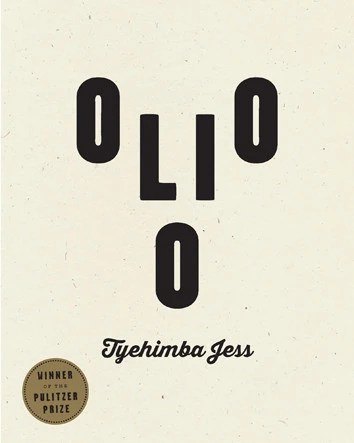
Plus, the stories are just so compelling. Inspirational? Sometimes. Sad? Often. Entertaining? That, too. The title comes from the term that means an amalgam, a mish-mash, and which was used to describe the various acts of minstrel shows. Yet Jess’ book does not feel like that sort of random “show.” It holds together like a carefully-sawn jigsaw puzzle or a masterful collage.

In the midst of the “entertainers” who voice the poems in Olio, there is the unavoidable pain of Black lives in the United States. It’s depicted clearly in the words of the speakers of these poems, and sometimes more subtly, as in the litany of Black churches burned, bombed, or shot up that appears under the choir poems.

Most awe-inspiring for this reader is the section about the conjoined twin girls Millie and Christine McKoy. What Jess does here, besides a spectacular imagining of the characters of the twins (born into slavery and exhibited in “freak shows,” they sang duets!), is to create sonnets that are twinned, star-shaped on the page, syncopated in meter, rhymed and off-rhymed, and–here’s the kicker–that can be read across each line or on each side, (columns or linearly). How did he come up with that form? It’s so suitable to the lyrical aspect of the pieces, which are interwoven into a kind of unexpected crown of sonnets.

If this is hard to imagine, here’s a reading and article that may explain better than I can. Also, if you can locate a copy of the book, you’ll see that the publisher went out of the way to accommodate Jess’ unusual approach: there are fold-outs, illustrations, changes in typeface, and the book’s size is larger than the standard trade book or poetry collection.

Olio doesn’t fit on a shelf as easily as some poetry books; it’s going to stand out. As it should.

~~

Reading poetry can be uncomfortable; some of Jess’ poems are deeply discomfiting and sad. Nonetheless poetry helps me put the world into perspective, perhaps especially when it forces me out of my personal point of view. So I value it immensely. Times like lately, when I am writing only a little and not submitting my work at all, reading the work of fellow writers reminds me of why we bother to create.
Robert Bly

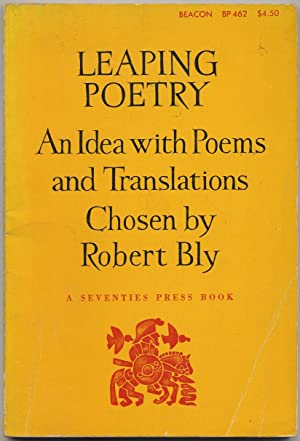
The recent death of poet Robert Bly brought to mind his book Leaping Poetry; I have this edition of the famous little book, which I bought in Grand Rapids Michigan in 1978.

My dear friend Ariel Dawson recommended this book to me. I have read it many times–my copy’s pretty beat up. A 1975 book of his prose poems influenced my thinking about poetry’s many forms, too; I love my copy of The Morning Glory: Prose Poems. The thing I like most about Leaping Poetry is its open-endedness, by which I mean that Bly embraces ambiguity in poems by suggesting readers–and writers–examine the gaps, the leaps, the surprises that encourage curiosity. Free associations into the unknown can lead to obscure and unreadable poetry; but they may also offer a way in to the unconscious, the emotive, the innate–what, in previous decades, was called the “primitive” and associated with non-Western religion and ritual song-poems. When I was first writing poetry more seriously–as a craft, an art–Bly’s little book helped me to reflect on what I was doing. It gave me new direction.

The Morning Glory poems moved me into researching what poems feel like on and off the page and how poets have used forms in different ways through thousands of years. Haibun, for example.

In subsequent years, I have read persuasive criticisms of Bly’s translations and of some of the concepts in Leaping Poetry; certainly there is much one can criticize concerning Bly–because he wrote so prolifically and took a certain joy, I think, in standing out. I made a point of going to his readings and presentations when I could, just to hear what his latest enthusiasms would be. (I must admit I never liked the way he read his own poems, but I often liked the poems themselves.) I am grateful for his work and have been recalling going to hear him and reading his poems over the years, discussing them with friends.

The book itself is an old, dear friend. I think it’s time to read it again. Each time anew.

Minor snow

We had a mild autumn that seemed to stretch longer than usual. Today, a dusting of snow and temperatures not much above freezing, gray sky, a meadow in beige-brown hues and the trees mostly leafless. According to the Chinese lunisolar calendar, the next few weeks are 小雪 xiǎoxuě, or “minor snow;” it is already winter. The jiéqì seasons follow the agriculture of northern China’s plains, and it’s striking to me how closely they resemble the agricultural seasons here in eastern Pennsylvania.

Lately, I feel the seasonal transitions physically. My body responds to the changing weather–not always a good thing, but not necessarily a bad thing, either. It connects me with the environment, reminds me of my necessary relationship with the world and its many beings and aspects: seasons, weather, water, plants, insects, bacteria, trees, other humans…

More than ever, I recognize the value in those relationships and treasure how varied they are. And I am just another part of the things I love and experience.

I also recognize my humanness as being “part of the problem” here. I use energy systems, I drive a gas-powered car, my house pumps water from the aquifer, I cleanse my house with disinfectants, my trash goes to a landfill, my income’s derived from an elite system of higher-education institutions. All that stuff that has materially altered the Earth for the worse and been unequally distributed among people? Responsible for my part in it. Trying to make changes.

I went out, wearing my robe and slippers, to the porch this morning to appreciate the barely-frosted landscape and breathe in the scent of minor snow. Sparrows and finches flitted through the bare shrubs, alive with activity. Tonight is the dark of the moon and soon the solstice will arrive. Times of transition. What will they bring?

Getting through somehow

My mother has vascular dementia, which renders her more and more aphasic, though in her case–so far–her “emotional tone” (as philosopher Arne Naess calls it) has remained intact. I visited my mother on a recent occasion when I wasn’t feeling my best and had had a week of less-than-good health. It was not a matter of duty. The time I spend with my mother is beautiful. But it had been a tough week. Let’s leave it at that.

We sat in her apartment in the assisted-living wing and arranged the flowers I’d brought. Then we spent 20 minutes in a kind of conversation, to which I’ve become accustomed, during which she tries to convey information about something she needs to have done. In this case, after much of the usual (really, rather humorous at times) confusion, I deciphered that she wanted some sweaters taken to the dry cleaner.

Such minutia. And yet, so difficult to get across, across that divide of language and cognition. The incredible concentration and effort it takes her just to dial a phone number to call her ailing sister. To tell the nurse aide that she needs more yogurt. Anything.

Then she surprised me. She pointed to my forehead and then to her own. “This,” she said. “Is wrong. For you. What?”

Was she reading a crease in my brow? I told her I had not been feeling great. She wanted to know, so I told her details, the way one tells one’s mother. Even though I am never sure quite how much gets through.

“Lie down. Take off the peaks.” By which she meant shoes. Why not comply? We both took off our shoes and spent the visit relaxing. We even indulged in a glass of wine because she loves to offer wine to her guests. Never mind it was 11 am. My mother has lost that rigid cognitive sense of time that the rest of us spend our lives obsessing over. There’s something valuable in that loss, though it is a loss.

She’s still teaching me things. Other ways to live with loss (my dad, her “normal” brain, mobility, words…).

~~

The next evening, she called me. She wanted to know how I was feeling. I’m 63 years old and my mother is 88, and she’s still worried about me.

I’m feeling loved.


Love is all you need

Norway’s Philosopher

I first encountered Arne Naess’ work in 2012 (see this post), and I regret that I failed to follow up by reading more of his “ecosophy T” (deep ecology) and philosophy. I am finally getting around to his very late book Life’s Philosophy, and I love how it speaks to me on many levels. His claim that human emotions can and should be components of human reason makes so much sense that I wonder why so few researchers look into it; some folks on the edges of neuroscience and psychology seem to venture there, but few others. The concept of “relationism” resonates for me, too. It reminds me of the Dali Lama’s teachings that all things in the world are intertwined and valuable, even non-sentient beings.

Relationism, as Naess uses it, acknowledges the vast and impossibly infinite complexity of the universe, more strictly life on earth, and–can I use the word “celebrates”?–the interwoven strands of animal, vegetable, mineral, bacterial, cosmological, emotional, rational aspects of a life in the world: ecology on steroids (he would not have phrased it like that). My urge for balance in my own life makes this philosophy relevant: the opportunities for play and for imagination as well as for seriously abstract concepts, for the importance of emotions as felt in the human body and as interpreted or contained in the human intellect; the necessity of listening to even the tiniest sounds, of savoring the small moments, of not needing to be big or grand or successful but to be mature in how one feels with the world.

The incredible difficulty of saying any of this. Which Naess also acknowledges, saying the difficult job of conveying being felt in the world leads to music, to art, to sitting with the natural and sensing beauty. I might add: Poetry. Though poems are made of words, they often operate through images and felt moments rather than intellectual logic.

The wonderful paradoxes of this book delight me, but then, I always have enjoyed paradoxes. Naess was, indeed, a philosopher, a mathematician, a person who valued logic, reason, and analysis, an analysand himself and briefly a psychological researcher, a mountaineer, a teacher. What to do with the inherently analytical side of himself? Treasure and use it to find wonder! That’s what makes him different from so many thinkers. Wonder. He writes, “To me, the ability to analyze the experiences of the moment is a source of wonder: wonder at human creativity and the result of evolution during hundreds of millions of years. That which happens within us–in our minds and hearts–is so complicated that the psychoanalytical instruction to express everything that occurs to one becomes…and exhortation to to the impossible.”

He opposes Cartesian mind-body separation not just within the body itself (as medical science has proven) but in terms of landscape, natural environment, places. He posits that people need deep thinking about values that move us emotionally just as much as we need to think about rational, pragmatic, socially-pressured values that are based on intellect or the empirical. Place matters, and we need to consider our fundamental place, Earth. Naess’ oppositional stances are, however, never a fight. Instead, discourse, compassion, patience with what is complex. A sound life philosophy requires stillness sometimes, and listening, even–especially–to the “tiny, tiny things,” he urges: “The art of living is to be able to work with small things in a big way.”

How do you feel yourself and the world? is the title of one chapter. I read the question with emphasis on different words and began to realize what a complicated and interesting question it is, though it seems (at first) so simple. Naess says that humans have hewed to the idea that there’s a gap between reason and emotion, and that the gap is an artificial one; a change in perspective, and an understanding that the mind and the body live in a physical world where emotions play a huge role in human communication, might help us to enjoy our lives more–and maybe, while we are at it, treat the earth one which we depend with more love and respect. But we have to feel we are not just ourselves but the world: of it, from it, in it.

mapio.net/pic/tvergastein

Physics, poetry, notes

In a discussion among some of my poetry-reading friends, two readers said they feel “stopped” when they encounter unfamiliar words or terms in a poem. They feel poets should avoid writing work that uses specialized knowledge as metaphor, in imagery, or to establish the poem’s context. Their argument is that when a reader feels stopped by anything in the poem–from an unusual line break or stanza structure to an unfamiliar word–a kind of alienation occurs between reader and text, and that when poets choose to employ the unfamiliar they need to explain somehow/somewhere (notes? prose headings?) to guide the reader. But then they added that referring to notes is, in poetry, distracting.

“Some vocabulary and allusions just make me feel inferior,” one friend says. I don’t think they’ve spent much time with Ezra Pound’s later work but imagine this statement by Sam O’Dell applies: “Now, whether or not Ezra Pound intended to make others feel less intelligent while pulling obscure outside references into his poems and essays is up for debate. The guy seems the type who may have enjoyed making sure others knew he was smarter than they were.” (Read the rest here).

Nerdy autodidact that I am, I rather like those stop-the-reader moments in poems–if there’s a payoff. If I learn something new, and if that thing I have learned enriches the poem’s meaning and also enriches me, then I don’t mind feeling surprised or puzzled or even interrupted. Some poems take more work to read than others, and that’s ok. Some novels prove less easy to read than others, and some movies make the audience-experience fraught, unnerving, or strange. For me, the essential work that artistic endeavor does is open new perspectives, present puzzles, invite inquiry. Make me curious!

Example: Recently I re-encountered the work of poet Daniel Tobin, whose collection From Nothing speculatively examines the life–the interior, intellectual, and spiritual life–of the Belgian priest and cosmological physicist Georges Lemaître. In the process, this series of poems covers war, genocide, the atomic bomb, physics. I haven’t read anything by Tobin since his book The Narrows (2005), and the Lemaître poems take considerably more work to comprehend. That work on the part of the reader is rewarded, I should add, especially a reader with more than a passing interest in cosmology and the cosmos itself. A reader who doesn’t mind a bit of theology or physics or history and quite lengthy notes at the end of the book, and who will actually read said notes. And then refer to her books on the expanding universe theory and Hubble Effect and look up more about Lemaître. [That reader would be me; but Tobin has many readers with all kinds of interests and expectations about poetry.]

In Tobin’s lovely poem “(Origin),” I found the word marver, and while looking up the definition learned that when molten glass is poured onto a slab for cooling, the process is called gathering the glass–and I love that use of the word gather. Maybe it will make its way into one of my poems someday. Even if it does not, I feel happier knowing that little fact.

But most of From Nothing contains allusions to cosmology, to Einstein and Planck, to World War II and conflicts of many other kinds, internal as well as external. I kept being wowed by Tobin’s research into Lemaître and by the poet’s imagination as he plumbs his subject’s complicated world of math, motion, and a conceptual physical universe that could also have room for God. I mostly remembered his earlier work that was so tightly crafted, often rhyming (or employing surprising and delightful assonance). In this collection, I didn’t notice the craft aspect until I went back and did some re-reading. I was too caught up in the complexities of physics and the momentum of the subject’s life-as-scientist/life-as-priest. The lines each have six strong beats, the stanzas are tercets, and there are eight stanzas in each poem. There’s more to the craft than that, but what I like is that–unlike some of Tobin’s earlier work–the craft takes a backseat to the narrative (though I think that’s also true in The Narrows, to some extent.)

Maybe this “difficult” book appeals to me because I like difficult books. Maybe it appeals because it reminds me of my father, a person invested in the world of reason and fascinated by science…who yet believed there can be faith, that god exists. Here’s an excerpt of Tobin’s “(Cinema)”:

You, who chose two ways equally at once, circuit 
the conferences, meetings fueled by enigma, mixing 
with the eminent and their sidereal regard,   

your morning Masses before library and lab.

~

My dad was not a Catholic, but the balance between faith and reason was one he wrestled with, too.


Collecting & creativity

Somehow or another, I completed a chapbook manuscript. The longer collection is coming together, as well. Yet it feels to me as though I have not spent nearly enough time on my creative work. And when I find myself awake at 3 in the morning, it’s not poetry that runs through my mind. Usually those wee-hour thoughts are work-related. I guess that makes me normal.

The next step, once a writer has completed a manuscript, is to have another writer or two review it; I’ve done that, too. So now? I guess I submit the work and find out whether a publisher agrees the poem collection does the job of poetry.

And I get prepared for rejection. Comes with the territory.

Upon reflection, the reason I feel I haven’t been doing creative work is that I am not generating many new poems right now. Some, but not many. But let’s re-think the process of revision: it’s a process of deciding upon the order poems should appear in a book, and which of the poems ought to be there to speak to one another, to resonate with one another (and with the imagined future reader). Hey, I am using my imagination here, and I am doing creative work. If all I ever do is generate new poems, those poems won’t have a chance to go out into the world and endeavor to speak to other humans.

Figuring out how to make that happen is the creative work of revising, editing, rethinking. Imagining the reader. Striking the tone of each individual poem to see whether it adds harmony, or works with a fugue-like trope, or changes the mood to minor, or unleashes a surprise. The book of poems can have an arc or act as a chorale or zigzag about to keep the reader on her toes.

The collection of poetry, when it is not yet a book, presents problems the writer and editor must solve. Problem-solving requires creative thinking–I tell my students this almost every time I see them in class!

Will the manuscripts find homes? That’s a different “problem.” Meanwhile, more new poems, more revisions, maybe more manuscripts ahead…while I await the first frost, while the leaves turn and fall. All part of the cycle.

Being receptive

When my parents moved to a senior-living campus about 10 years ago, one of the hardest aspects of downsizing was what to do with the books. My dad’s bookshelves were full of texts that he found meaningful, valuable, inspirational, informational, necessary; he loved to read. Choosing which books to give away and which to keep was agonizing for him. And then he faced the task again when he and my mother moved to a smaller, assisted-living apartment. That time, he donated many of his books to the facility’s library, so he could “visit” them if he needed them. There remained one large bookcase. Because you can’t live a happy life without books!

Then he died; and my mother, who also loved to read, developed such aphasia that she could no longer decipher sentences. Now, every time I visit, she gestures at the books and urges me to take some of them. It’s hard to explain the response I have to taking home my dad’s books–a mixture of tenderness and discomfort, nostalgia and pain. Sometimes I end up giving the books away, but usually I read them first. Because they are books and deserve to be read, somehow, just by virtue of existing. No–by virtue of their having been significant to my dad. That is why I feel compelled to read them.

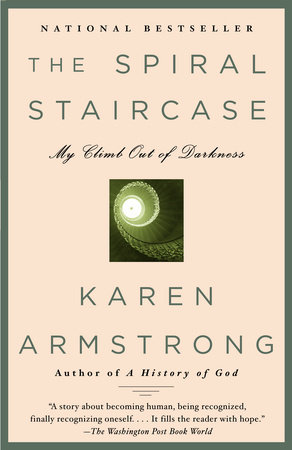
I cannot say I got much inspiration from my father’s 1955 copy of a text on caritas by Martin D’Arcy, The Mind and Heart of Love, although I found suggestions about the philosophy of Christian love that my father would certainly have noted {indeed, his penciled checkmarks in the margins confirm it}. Last time I was at my mother’s, I chose to take Karen Armstrong’s 2004 book The Spiral Staircase, a book I appreciate rather more than I did D’Arcy’s. Much of Armstrong’s memoir deals with the frustration she felt as she struggled to find her place and purpose in the world of work. As it turns out, she is a writer, although it took her awhile to discover and admit it. Part of being a writer involves isolation or solitude, which Armstrong equates with silence: “Without the distraction of constant conversation, the words on the page began to speak to my inner self…I was no longer just grabbing concepts and facts from books…but learning to listen to the deeper meaning that lay quietly and ineffably beyond them. Silence became my teacher.” That passage resonates for me. I can recall times when what I learned, and subsequently, what I wrote or composed, emerged from such silence.

But I like most of all what she says in her next paragraph (p. 284).

This, of course, is how we should approach religious discourse. Theology is–or should be–a species of poetry, which read quickly or encountered in a hubbub of noise makes no sense. You have to open yourself to a poem with a quiet, receptive mind, in the same way as you might listen to a difficult piece of music. It is no good trying to listen to a late Beethoven quartet or read a sonnet by Rilke at a party. You have to give it your full attention, wait patiently upon it, and make an empty space for it in your mind.”

It helps if we can give our hearts to poems and books we read, make space for them in our minds, hear what they have to say before rushing in with our own clever ideas and personal perspectives. When writing, the same approach applies. Often I think I know what I have to say, yet the poem on which I’m working proves me wrong. And it helps to be compassionate to the writerly self, which is another thing Armstrong had to learn, as she was far too hard on herself about her thinking and writing.

Her subsequent books, and her recent work, center around compassion, I notice. I have not read them yet, but I plan to. Another thing I notice is that the copy of The Spiral Staircase I brought home from my dad’s bookshelf is inscribed:

Tom and Bonnie    with best wishes     Karen Armstrong

Practice

When students struggle, I nod as kindly as I can. Do they need to know they’re not alone? Seven billion of us, each with struggles of our own. It takes practice, I tell them, and practice takes time. But persistent patience isn’t common among young folk, who seek strategies, shortcuts, miracles.

They yearn to know what I know so easily, are astonished that words and thoughts can spool smoothly–they think so, bless them–as though there were dictionaries and references in my mind. If they would believe me when I say: it’s possible to learn–

They never realize I haven’t always been old or knowledgeable, that practice continues and, dear students, so does struggle.

We can practice that, too.

~

You noisy jays!
scattering
       the mourning doves

Why don’t you write?

I was an avid letter-writer once, a great correspondent, a reliable pen pal. In return, I received long, descriptive letters from far-flung friends and relished every trip to my mailbox to discover what had arrived that day. A letter from a friend? A poem rejection? A poem acceptance? A postcard from a family member off traveling? Critique and feedback from a poetry-colleague on a series of poems? Junk mail, bills…

These days, my mailbox mostly disgorges junk mail and bills. The few friends who write lengthy correspondence usually do so by email (which I do, truly do, appreciate). My keen interest in other people’s thinking, and my opportunity to acquire perspective into their lives, must now be satisfied by other means. That’s why I follow blogs and other “long-form social media.” (I thought I had coined that term, but apparently it has been in the lexicon awhile.)

Is a letter just a blog written for an audience of one? Is a blog a diary written for an imagined public, or is it a letter to the world? What purpose do private journals serve for those of us who keep them? And what’s behind the urge to keep old correspondence? The discovery of a cache of letters features in many novels and in a host of memoirs and histories, so there’s some kind of human-interest frisson resonating there. Perhaps the simple fact that such writings were intended to be private–that audience of one–piques curiosity.

For me the hardest aspect of letting go of past correspondence is that so many of the people to whom I wrote letters have died. In my attic, there are boxes of letters from these departed friends…suggesting a different meaning for the phrase “dead letter.” In a similar vein, there certainly exist blogs by now-dead writers that remain in the cloud, hanging stuck in the interwebs. Are these memorial pages, or are they digital ghosts, and to whom do they belong?

Photo by Pixabay on Pexels.com

The intersections and overlaps between these related forms of written expression intrigue me. And the nosiness interests me, too. Isn’t that one reason we like to read literature–to get an intimate peek at how other people behave, respond, solve problems, form relationships, think about society and values? To imagine to ourselves what bad behavior feels like and what its consequences can be? Or to find insights as to what generosity and love can accomplish; to gain a sense of empathy, even compassion. Plays, memoirs, novels, and poems operate like that. I’m not sure blogs and diaries work quite the same way with their readerships, but they may do.

Maybe what keeps me following any kind of writing is just the fact that I love to read.

~

Why don’t you write me?
I’m out in the jungle, I’m hungry to hear you
Send me a card
I am waiting so hard to be near you
Why don’t you write?
Something is wrong
And I know I got to be there
Maybe I’m lost
But I can’t make the cost of the airfare
Tell me why (Why, why)
Why don’t you write me?
A letter would brighten my loneliest evening
Mail it today
If it’s only to say that you’re leaving me…

Paul Simon