Epistle as writing practice

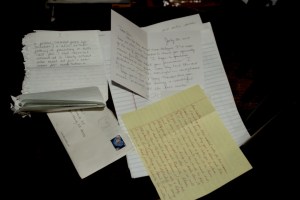
I am often asked by my peers why “young people” do not come to college with exemplary writing skills. Because I feel protective of my students, I wish to defend them–not always an easy task. My first response is that they have not had enough practice in writing to develop adequate fluency, and I generally follow that by admitting that many of my students have never really read books for leisure or out of passionate interest and that they are quite adept at other forms of communication (social media, looking at you!). Last year, I decided to spend one class period on epistolary writing. I recognized that one way I developed confidence in expressive writing was by writing letters. Lots of them. Every week to my parents, almost as often to my sister, to my best friends, to sweethearts, grandparents, anyone I cared about. Probably 30 years of letters, which later morphed into lengthy emails as the technology developed. Letters. Who writes them any more? Certainly not today’s college freshmen, if my students offer any objective measurement of their generation. The epistolary mode offers students a chance to exercise the use of second-person as a governing pronoun, a style that formal academic writing shies away from except in certain forms of persuasive writing–the opinion column, for example. Teaching my students NOT to employ “you” is such a constant effort that I thought letting them write letters would give them a much-needed break from prescribed academic conventions and allow them to loosen up their sentences a bit. Before I assigned in-class letter-writing, I asked whether any of them ever writes letters. Not one hand went up. I withdrew from my tote bag a clutch of old correspondence (yes, of course I would be that person who keeps the letters people write to me). After flourishing an envelope–with a 29-cent stamp–I disclosed the contents, a ten-page, handwritten letter from a dear friend. The students audibly gasped. “How long did that take to write?” “Did you read all of that?” Sure! When long-distance phone calls were expensive, letters were social media. We couldn’t just snapchat a photo of ourselves standing on a pile of snow and caption it “Snow!” We’d have to send a photo. Or we’d have to describe without the visual–and this is a practice my students have almost never had to employ. Lack of informal writing practice translates into lack of writing practice, period. I even read passages from three letters aloud, and the students were impressed with the vivid writing…writing by “non-writers.” “You could write like this, too,” I told them. “You just haven’t needed to do it, and therefore you think you can’t do it.” Then I asked them to think of a person, a specific person, and come up with a reason or purpose to write to that person, and then just write. The response was amazing. Some of these students wrote more in 15 minutes than they ever have for an in-class assignment. Most of them enjoyed it! One student even said that “this old style of long form texting intrigues me” and plans to start writing letters to a sibling once a week. Success! ~ Letter Writers Alliance is an informal site promoting the hand-written, postal-mail delivered epistolary correspondence. Members can sign up to find a pen pal or just browse the site for stationery, pens, letter-writing tips, etc.

Keeping the minutes on violence, with Lucille Clifton

Wow. I found this post by Lesley Wheeler worth re-blogging. It hurts my heart that she found so many of her students had experienced this kind of fear and violence in their schools. But it makes me pleased to be a writer if I can be in the company of people like Lesley and her students, facing what is horrible and difficult and discussing and writing about it. And reading, too–reading poems that face the “dark” in human beings can be as liberating and enlightening as reading poems that offer “hope” or balance. The heart does need rest now and then; thoughtful reflection offers more rest than many folks realize. Thank you, Lesley, for being a teacher.

Lesley Wheeler's avatarLESLEY WHEELER

For a workshop on Tuesday, Election Day, one of my undergraduates submitted a poem based on the day he hid in a closet during a middle school shooting. A different student said there had been a shooting in her school, too; another described an active shooter just last week in the high school her sister attended; a fourth said a friend had died in the Parkland massacre. Stunned, I responded with something like, “Are you telling me that four out of the fifteen of you have had a near miss with a school shooting?” Then two more raised their hands. Six.

Gun violence in the US is insanely, horrifyingly prevalent; every new mass shooting refreshes the horror and also increases the number of Americans directly affected. A good friend’s father’s retirement center was recently in lockdown because of an active shooter. And when I described the workshop discussion to a…

View original post 696 more words

Post traumatic stress

Shell shock. Combat fatigue. Delayed hysteria. Contemporary psychology and medicine have another name for it now, post-traumatic stress disorder, and have extended the concept of delayed stress response to victims of trauma other than combat: abuse and catastrophe victims, anyone who has survived a traumatizing experience, of which the world offers many options.

The mental and physiological symptoms that interrupt the rest of the afflicted person’s life? Those are nothing new. Indeed, perhaps the rage of Achilles was a kind of post-traumatic stress response. Maybe whole cultures reflect collective past traumas, responses delayed by decades, even centuries.

Think of it: most modern nations were born of war, boundaries drawn after bloodshed, famine, oppression through colonization, purges and expulsions. Trauma.

We can never escape suffering, although most people seem equipped to repress painful experiences. The human challenge is to remember without demanding revenge, to employ both reason and compassion in the entire community of human beings. Not, for any of us, an easy task.

Lately, I feel a bit as though the country in which I live–the citizens, popular culture, government and also the environment itself, geological, ecological, biological–has exhibited PTSD responses. Probably, now that I think about it, that’s been true for a long time. So I find myself contemplating the long view (see the Clock of the Long Now for a theoretical 10,000-year perspective!)

As an individual, I do not have a long reach nor a significant number of years to dwell on the planet. That need not keep me from using the long-view perspective; indeed, I sense that the type of curating that I have begun in terms of compiling another manuscript and thinking about the life of work I have contributed over the years through child-raising, landscaping, gardening, teaching, helping young people in university, assisting family members, and whatever other small drops one person can add to the ocean of existence, suggests my comfort level with the long now has deepened.

Likewise, I accept that suffering just pretty much covers the human condition from beginning to end, and without it we would never recognize how amazing the earth and its diverse communities are nor appreciate our joy nearly as much. Despite the difficulty involved in recalling trauma, we may need to face it, with the compassionate support of other humans, in order to more fully live our ordinary lives and understand the long view.

~

A handsome red fox just scampered across our back yard. Beautiful in the mid-autumn sunlight, a flash of joy.


Manuscripting

Something I’ve been thinking about lately: how to organize a collection of poems into a manuscript? I have done it before; after all, I have managed to get several chapbooks and a long collection into the world already.

This slideshow requires JavaScript.


And yet. The difficulty never departs, so I have once again been seeking inspiration and practical advice. The interwebs disclose a bounty of information from experts. There are hundreds of articles and blogs concerning this particular challenge, a challenge that seems unique to poets, though I suppose short story writers may encounter similar concerns when choosing how to organize and what to include in a book. If you find yourself wrestling with this task, encouragement and guidance abound. Here are a few articles to check out:

~

Chicago Review of Books posted this article, asking four poets how they went about the task (and by the way, all four of these books contain wonderful work–definitely worth reading).

Marilyn McCabe’s “megablog” on the process is here.

In 2011, Jeffrey Levine of Tupelo Press posted a lengthy how-to on the Tupelo blog.

For the more scholarly reader on this topic, a lovely in-depth article by Natasha Sajé in The Iowa Review.

Poet & publisher Diane Lockward’s book The Practicing Poet includes not only prompts and craft suggestions but chapters on manuscript organization and getting published.

~

Now I need to take these generous people’s advice.

Murmurings

IMG_5681

Center Valley, PA, USA

On a crisp, abundantly clear day (for a change!), I opened the car windows to listen to the corn stalks rattling in the breeze. After an unusually wet year, the fields have been too wet to bring out heavy farm equipment, like gleaners. They would get stuck in mud. So the corn stands and, finally, dries in the rapidly-cooling air.

And rustles and swishes, and produces the susurration associated with tree foliage, only louder, harsher. The November sun heightens the contrast between the grassy-looking stalks and the crowd of shadows below the strap-shaped leaves. Zea mays: one of the incredibly numerous poaceae monocots. Field corn, in this case. It surrounds two sides of the campus where I work. On windy days, I can hear it murmuring. It has a wistful sound to it, each plant crackling softly against its many neighbors.

IMG_5680

Ascribing human emotions to non-human things is something poets often do and for which they have been occasionally excoriated (see the pathetic fallacy). It is really I, not the field corn, who’s feeling wistful. There’s no reason not to occasionally explore things such as the pathetic fallacy, anthropomorphism, or clichés in poems, though. Poems can be places for play, puns, irony, and over-the-top expressiveness…where else but in art do we have so much possibility for free rein and experiment?

With that in mind, what came to mind is a decade-old poem I played with long ago. I thought of it, located it in my files, and realized how well it suits this year’s rainy weather. It has never seen print, so this is its first public “share” to the small world of readers. Just to be wistful, and to listen to murmurings.

Fallacy Pathétique

Awful, the sobbing breast of the nearby hill
draped in funereal rain,
moping trees with bedraggled leaves
under dolorous skies.

How coarse and crass the indigent crows
mocking day’s solemnity
over pleading calls for mercy, compassion
from the myriad finches.

Do not quench sorrow but be drenched in it,
small streamlets fast-running
down ratty embankments dull with mud.
O, morning, mourning,

lease your grief to field and gravel and
the huddled owl’s
damp-pinioned back hunched in sleep.
Be terrible and bleak,

stained with the nouns and adjectives of despair,
run down the mountain
with a mouse carcass on your swift spine,
meet the road in a reeking ditch.

Composition

Forgive me, readers–whoever you are–this weekend I am composing poems instead of a blog post, revising the work (see this post) and creating new stuff from dribs, drabs, sketches, notes, and the windy day outside with its sky full of variable, intermittent, strangely-colored clouds.


In print

I have been lucky in print this year. Two literary journals that I’ve long admired, Bellevue Literary Review and Prairie Schooner, published my poems, and so did the newer journal Naugatuck River Review. This is “a big deal” to me, because it is always exciting to be admitted into the pages of a magazine I like and because, despite the advantages of online/cloud-based literary journals, I love print!

There’s something inexpressibly marvelous about holding a book in my hands, turning the pages, and having a physical object–paper, binding, print–to carry with me.

Online magazines, theoretically at least, have a longer reach and can capture more readers (“hits”) than print. Literature requires audience, and the interwebs offer potentially millions of visitors to the poem online; but the operating word here is potential. What’s possible isn’t what generally happens. The readers of online literature, those people who stay on the poem long enough to read it–and then read the next poem, and the next, on-site–are not as legion as we poets might wish.

Through moderate use of social media, I do publicize my own work when it appears online (see links to the right on this page!). I welcomed the appearance of literature on the internet because one of my purposes for writing is to communicate with people. Readers matter to me. Getting my words into the public domain is the only way to begin that process of communication, and though online journals seem like the most ephemeral form of ephemera, they do make it easier for me to “share” (thanks to Facebook, I am beginning to despise that word) the poems or essays I’ve crafted.

schooner&scooter

Print journals, like books, lack the immediacy of the online publication. They are not interactive in the way some online journals can be (see my recent audiofile and poem in The Maynard as an example), although some print journals are pretty experimental and interactive in quite innovative ways, such as Ninth Letter.

I encourage anyone who reads my blog to check out other bloggers on literature and poetry, and a good place to start is with Dave Bonta’s Poet Bloggers Digest. Searching the internet will open up a world of excellent poetry in carefully edited and curated literary journals.

The internet platform permits poets to read their own work, in podcasts and on YouTube, and to launch videopoems into the world. It has been a boon for poets to find audiences of all kinds, not just people who read poetry journals.

However, my cat will never circle and then settle on an online literary journal. So there’s that…

~

[I tried to snap his photo when he sat on Prairie Schooner, but he jumped up and moved on.]


Neglecting the work

It seemed to me to have been a long time since I devoted serious focus to my creative work–I mean in terms of organizing, keeping track, revising, submitting to journals, compiling a draft manuscript of newer work…the so-called business of poetry. I resolved therefore to spend a weekend at the task. Alas. The weekend revealed to me the extent of my benign neglect: ten years of not-really-being-on-the-ball.

inflating-clipart-beach-ball-6

I do not consider myself a particularly prolific poet, but I found myself faced with well over a ream of poetry pages, many poems only in their second or third draft and far from “finished.” Maybe an average of 70 poems a year for ten years. Do the math: this is not a weekend’s work. [le sigh]

Where to begin? There is no beginning. After an hour or so of trying to prioritize the various components of the job, I gave up and just started at whatever had become the top of the pile. Analysis: which drafts had any glimmer of possibility? Some erstwhile poems could easily be culled into the “dead poems file” I keep under the cabinet with the dust bunnies. Others required considerable revision.

Fascinating process, despite aspects of tedium. I encountered poems I forgot I’d composed. I looked at the dates I began and revised them, tried to discern where my thoughts and feelings were at the time. Somehow, going through poems in no way resembles looking at old photographs–it’s not that sort of memory jog. Indeed, the poems are not involved with the memory part of my brain but with the creative part.

And that is exactly what I have been neglecting: the creative, imaginative, intuitively analytical side of myself.

In the process, I found a chapbook manuscript to submit–I had completely neglected it–and several worthwhile poems. I have no idea yet how much further I can get into the pages of past poems, and whether I might fashion another manuscript from the lot. But I’ve decided the work should not be neglected.

And I have a lot of catching up to do!


Vocation, avocation

Somewhere recently–was it the Sunday New York Times?–I read an opinion essay about how recent surveys of US citizens indicate that we have fewer hobbies than we have had in years past. The columnist wondered whether that lack is due to a zeal to be the best at whatever we engage in–the best jogger we can be, the most avid cyclist, the best collector, knitter, paper-crafter, woodworker, violinist, what-have-you. She suggested we’ve somehow lost the joys of being hobbyists: amateurs who do or create something because it is fun or relaxing, or because trying to learn a new skill makes us feel good. A true hobby is something we don’t have to be perfect at, because that is not the point.

As my students wrestle with the tasks of college and their concerns about their futures, the concept of vocation arises often. What to do with a life? Earn enough money to live reasonably comfortably, even if the job is not a passion? What if it’s not even satisfying? Should people choose a bearable career and find enjoyment in avocations? Or persist at what they love even if society doesn’t always reward the path they’ve chosen? Or–the options are legion.

~

I believe in vocation as passion, and I also practice hobbies. My career is in higher education, and I enjoy and learn from my job. My vocation is writing, particularly writing poetry; my passion lies in that direction more than any other, but poetry has not been a career path in my case.

~

My hobbies have evolved over the years. For decades, gardening has kept me happily occupied out of doors–but I have no need to become a Master Gardener, and my gardens are often minor failures in one respect or another. The garden, however, soothes me, distracts me from anxieties, helps me to become a better observer, teaches me much. When learning about plants, I got interested in botany and wild flower identification, so I am a more informed hiker and nature-saunterer than I used to be.

IMG_5633

garden photo: pepper, sassafras leaf © 2018 by Ann E. Michael


Photography’s also a hobby I pursue, an interest of mine since my late teen years (back before digital). The view through the frame has always intrigued me, as well as the opportunities that different lens lengths offer the photographer as to framing and focus. I especially enjoy macro lenses. It’s fun to zoom in closely on insects, flowers, and small areas of everyday objects. Photography encourages different types of observation.

The earliest interest I can recall having is art: painting and drawing in particular. From the time I was tiny, even before I entered kindergarten, I loved to draw and paint and to look at art in books and museums. During my teen years, I studied art at Fleisher Art Memorial in Philadelphia and headed to college thinking I would minor in the fine arts. My talent did not match my aspirations, and a thorough self-analysis at around age 20 led me to recognize I could be creative more successfully in other ways…by that time, I was writing more seriously than I was painting.

But now? I have taken up painting in acrylics. Mostly sketches of clouds. There’s no pressure on me to do well; I can paint many mediocre pictures of clouds and feel relaxed in the process, meditative, observant, a casual learner.

cloudsketch

mediocre acrylic sketch of clouds, by Ann E. Michael

~

As I wrap up this post, I realize that my career and my hobbies have encouraged observation from multiple and new perspectives. And my vocation? Poetry practically relies upon the writer’s ability to switch into creative and imagined points of view, as well as to have the opportunity for closely-observed objects and experiences.

Vocation, avocation, passion, career. I count myself lucky.

Seen from above

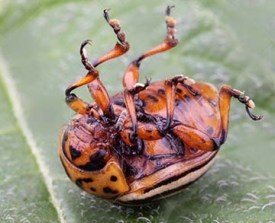
Wislawa Szymborska’s poems are in my head today, prompted by finding a dead beetle on my porch. Novice entomologist identifies dead bug, then thinks of poems.

~

Seen from Above

Translated by Stanislaw Baranczak and Clare Cavanagh

A dead beetle lies on the path through the field.
Three pairs of legs folded neatly on its belly.
Instead of death’s confusion, tidiness and order.
The horror of this sight is moderate,
its scope is strictly local, from the wheat grass to the mint.
The grief is quarantined. The sky is blue.

To preserve our peace of mind, animals die
more shallowly: they aren’t deceased, they’re dead.
They leave behind, we’d like to think, less feeling and less world,
departing, we suppose, from a stage less tragic.
Their meek souls never haunt us in the dark,
they know their place,
they show respect.

And so the dead beetle on the path
lies unmourned and shining in the sun.
One glance at it will do for meditation —
clearly nothing much has happened to it.
Important matters are reserved for us,
for our life and our death, a death
that always claims the right of way.

~

In Joanna Trzeciak‘s translation, the second stanza begins:

For our peace of mind, animals do not pass away,
but die a seemingly shallower death

…a phrasing that evokes more clearly (to me) how humans use a sort of euphemistic, possibly spiritual phrase for being dead. And in this translation, the last stanza reads:

So here it is: the dead beetle in the road
gleams unlamented at the sun.
A glance would be as good as a thought:
it seems that nothing happened here.
Important supposedly applies only to us.
Only to our life, only to our death,
a death which enjoys a forced right of way.

Both translations are lovely, but I think I prefer the Trzeciak version, though I would be hard-pressed to say why; and I certainly cannot compare either to the original, since I do not know Polish.

What I love about this poem is its perspective, as reflected in the stances of title and stanzas. Literally, the speaker is above–looking down at a beetle husk. Tidiness in an insect’s demise–as opposed to our own. Then the point of view shifts, suggesting we humans are “above” the animals, their deaths less upsetting to the cosmos. But we are the cosmos, in our egotistical narcissism; and then, at last, death reminds us how unimportant we are…no matter how we think of ourselves.

20775536-dead-colorado-potato-beetle-belly-up