A different kind of difficult book

Elie Wiesel’s Night.

Jerzy Kosinski’s The Painted Bird.

André Schwartz-Bart’s The Last of the Just.

Dominique Lapierre’s City of Joy.

Dorothy Allison’s Bastard Out of Carolina.

I’ve been posting about books that I love in spite of–or because of–their challenging material in terms of philosophical thinking or complex scientific explanations. It occurs to me there are other forms of “difficult,” and that topic is yet another challenge for the reader to encounter. These are books I found hard to read because of subject matter, events, descriptions of things I cannot imagine, or maybe can imagine, facing.

Sometimes a book seems difficult for me on these terms because of where I am in my life; it might not be difficult to read at another time. An example of this sort of book is Franzen’s The Corrections, which features among other characters a family patriarch in serious physical and mental decline. My family is experiencing something similar right now, and I cannot quite bring myself to open the book lying on the nightstand.

On the other hand, reading can help me get through tough situations. Maybe I’ll get to The Corrections soon after all if I recall how fiction and poetry–especially the latter–have often been tools for coping or “processing.” It was immensely difficult to read Marie Howe’s What the Living Do close on the deaths (by AIDS) of three friends, but I felt understood when I read her work; I can’t explain it any other way. This exchange is almost magical to me: I do not necessarily feel I understand the writer, but I feel the writer has understood me. Without knowing me. Without knowing a person like me would ever stumble upon and read the pages…yet the text makes me feel understood.

I love that feeling, even though the rational side of me cries “Magical thinking! Coincidence! Self-delusion!”

So that’s art.

Some tough books to read: Gray Jacobik’s Little Boy Blue, Chana Bloch’s Mrs. Dumpty, Donald Hall’s Without, Heidi Ann Smith’s The Carol Ann Burns Story, Selah Saterstrom’s The Meat & Spirit Plan, Allen Ginsberg’s Kaddish, Gregory Orr’s Gathering the Bones Together…and these books, mostly poetry, do not include the more traditional memoirs and non-fiction accounts of difficult events that are available to the reader. You could spend your entire life reading about the Holocaust, and some readers do just that.

Why would I willingly subject myself to disturbing reading? I kind of wonder about that myself; it’s not the same impulse that makes me want to read a thriller or mystery novel. In those cases, there is a promise of entertainment in a voyeuristic form and the outcome usually promises a kind of satisfaction that these other books do not always offer (read: hope, redemption, solutions…)

But I will hearken again to something I heard Marilynne Robinson talk about (see my previous post on AWP). She suggested that literature teaches us compassion. Good art of any kind opens up a new kind of perspective, one that thrusts us out of our own comfortable, individual points of view and therefore allows us–in the safety of our own homes, secure in the knowledge that this is only a book and is not happening to us–to engage with the “other.” When we feel empathy for a problematic character, when we feel we understand another person’s plight, even a fictional person, we move away from narcissistic isolation and into engagement with other beings. And that is compassion.

And that is also art.

AWP conference

I got back from Chicago on Monday and have been trying to catch up ever since. Chicago hosted the 2012 Associated Writing Programs conference, where nearly 10,000 writers, aspiring writers, teachers, publishers, and students (often these categories overlap) converge to interact, interface, synthesize, network, inform themselves, and idol-worship.

For an introverted, reflective, crowd-shy person, the event can be overwhelming. I speak from experience.

Nevertheless, the conference generally provides me with tremendous food for thought in the form of books to read, authors to discover, concepts to familiarize myself with, pedagogies to explore, and considerable re-assessment of why I do what I do. Also, I meet people.

At a wonderful presentation called “Literature and Evil,” for example, I was seated next to poet James McKean. We had an amiable discussion about teaching composition prep to freshmen before I figured out who he was. Here is one of his poems: “Bindweed” up at The Poetry Foundation site. For poetry people, that’s big-time. The thing is, I hadn’t read any of his books; it would have been really weird to say, “Oh, I recognize your name. I don’t know your work at all, though. Sorry.” So we chatted about an area of common ground: teaching.

I tracked down McKean’s books via Iowa’s Writing Program and did a bit of internet sleuthing for samples of his poetry. Turns out I really like his work. So I’m going to be reading James McKean’s poems and meanwhile be thinking, what a nice man he is! Such a devoted teacher, down-to-earth. He shared some of his classroom approaches and I shared my teaching experiences with similar students. We talked about the differences between community college adult students and 18-year-old freshmen. We didn’t talk about teaching creative writing, but we did talk about the low-residency MFA and his current crop of students. He is much younger than my dad, but he reminded me of my father, a midwesterner and professor interested in what Marilynne Robinson, Ha Jin, and Paul Harding had to say about evil and literature.

They had lovely and compassionate and interesting things to say, in my opinion. I suggest you read their books. And, while you are at it, pick up a collection of James McKean’s poems. He’s a terrific poet–and a very nice man.

More difficult books

photo by Ann E. Michael

Some weeks back, I posted about reading “difficult books.” It occurs to me that there are different kinds of difficult books, and perhaps different kinds of motivation for reading them.

In my previous post, I addressed why I read philosophy. I also read books on subjects like string theory, fractals, physics, economics, psychology, and other topics that might be considered difficult, especially for a person who is not a scholar in any of those areas. One example is the book I’m reading now, Daniel Kahneman’s best-seller Thinking, Fast and Slow. Kahneman is a psychologist who won a Nobel Prize in Economics, and this book explores how human beings make decisions, are rational or irrational depending on circumstances and how information is presented, make judgments, develop intuition and biases, and learn or fail to learn from mistakes. He’s a fairly good writer for the layperson, staying away from jargon and taking pains to explain his work clearly for the non-psychologist, non-economist, and non-mathematician. Nonetheless, this book–while wonderful!–is not easy material to read. One reason is that the text is about thinking, so (like philosophy) the endeavor is entirely metacognitive. Also, Kahneman’s findings directly challenge many of the things we think we know about ourselves. That sort of book is inherently difficult.

Another book written in lively anecdotes avoiding too much technical language but that I found difficult all the same is Stuart Kauffman’s At Home in the Universe. Kauffman explains Boolean logic in a way that helped me to understand not just the basic premise but how Boolean operates in terms of randomness and the development of algorithms. His book, however, takes for its subject complexity theory. You can tell by the name of the theory that this material’s a little challenging. Furthermore, he begins by writing about chemistry, a science in which I have almost no foundational understanding. I learned much from his work about self-organization of things like molecules and stellar systems, and this book enabled me to read his more theoretical text on “reinventing the sacred” with deeper understanding (and even a bit of skepticism). But easy to understand? No.

Joao Magueijo introduced me to the research and theories of young cosmological physicists through his book Faster than the Speed of Light, a book that is laugh-out-loud funny in places and written with the casual tone of having a conversation with an enthusiastic and possibly jerky scientist while at a university-neighborhood pub (there were more than a few asides in his narrative, most of which dealt with university or science politics). I know more physics than chemistry, but I can’t do the math. I had to re-read some of the pages in Magueijo’s book to figure out where he was going with his potential discoveries. I read the book years ago, yet it stuck with me; recent news about possible faster-than-light particle movement reminded me instantly of the work this team was doing in the late 90s.

Science and philosophy are difficult; and while books that involve the relationship between the disciplines (such as Hofstadter’s now-classic Gödel, Escher, Bach and Kauffman’s Reinventing the Sacred, to name only two) are not necessarily twice as difficult, they cannot be categorized as easy-to-read, even when the author is a marvelous writer. True “System 2 thinking” (see Kahneman) means constant engagement with the text, and our brains simply get tired. But they also get exercise and plasticity from the enjoyable work of reading what is hard, a workout I find exhilarating.

Kindred spirits

Kin=One’s family and relations. [Merriam-Webster]

My parents bred, bore, and raised me. That’s true for many of us human beings.

When I ask people about their parents, inevitably I learn that parents are people who are admired, influential, heroic, role models, (or sometimes, the opposite of these ‘ideals’).

My parents are, I have decided, kindred spirits. Kindred in the physical and specific sense, but also kindred in the more metaphorical, spiritual sense.

My dad’s my intellectual kindred spirit, my mother acts more as my artistic and intuitive kindred spirit. Not to put too dualistic a point on it…

The influence they’ve had is behind us now–many years have passed since I relied on them for sustenance and a roof over my head, for discipline and social or academic guidance, or for artistic or other taste.

I admire them for their qualities but have long ceased putting either of them on a pedestal; they are realistic in admitting their failings and flaws–and often accurate because they are wise and smart and reflective and aware. (And so am I, within my specific limits.)

As we age, I cannot help but think of these things more often: what the meaning if inheritance is, really, in terms of the physical (DNA), the cultural, spiritual, intellectual, psychological, and emotional realms. Not to mention the philosophical, which is where my dad comes in, though my mother has her own form of philosophy I will probably never be able to explain adequately.

Kindred. A lovely word rich with metaphorical possibilities. And spirit…well, that’s another day’s work to explore.

Hope & meaning

Hope. Meaning. Zen?

I have been thinking about hope lately for a number of reasons, due in part to a conversation with a person of my acquaintance who feels very strongly that humans have destroyed the planet irreparably, that civilization is past the tipping point, and that what many people term Armageddon or apocalypse is not merely inevitable but near. One might say she has no hope for the future.

This woman is generous, creative, happy; she is a lively activist who advocates for artistic and social justice causes–even though she has no hope for the future. Why does she bother? She might serve as a real-life example for a philosopher’s thought experiment or dilemma on the self-interest theory.

She seems quite sane. I think she illustrates how hope and meaning differ.

Hope leans inevitably toward the future. It signals a desire for a circumstance we do not have and may never attain. Even when stated in the present tense, it indicates a temporal shift, an implicit recognition of a future: “I hope things stay exactly as they are” implies there is a risk of change.

Hope is related to faith, unprovable yet deeply felt, something in which we believe (against all rational proofs).

Meaning, however, has more substance. We do not believe in meaning, we discover it. Meaning is a found thing which acts upon us by allowing us to take action…meaningful action. Meaning is temporal in the sense that it takes place in time as we understand it. It possesses an unusual characteristic in that it needs no outcome even as it operates in real time in our lives. Meaningful existence keeps us moving, and when we lose life-meaning we are likely to feel even more devastated than when we lose hope.

My acquaintance lives her life in a meaningful way, doing things that nurture a sense of meaning in her life even though she is fairly certain the outcome of her actions will be negligible. Her purpose is to share with or add meaning to the lives of others, knowing she cannot rescue everyone or steer the earth’s denizens toward utopia.

She is one of the more contented and least-anxious people I know.

After mulling these ideas over, I found myself returning to an overly-familiar Dickinson poem on this topic, the one in which she calls hope “the thing with feathers”:

Hope by Dickinson.

Consider her metaphor. Hope flies; it can escape us. I have held birds and know from experience they are not easy to catch nor to maintain a hold upon. Hope flies into its future without us even while it blesses us with its singing. What have we got then, earthbound beings that we are? A wordless tune, something that comforts without asking for anything in return–if we accept the tune as comfort enough (and we may not).

Perhaps what keeps us going, really, is not hope but the dailiness of our small but meaningful pursuits. Dickinson writing even when no one was reading. Each of us accomplishing whatever seems necessary, art or baking, advocacy or gardening, regardless of result.

Chop wood, carry water.


Multi-booking

Ah, the pile of books at my bedside. And the ones on my desk at work. And the one I left by the living room sofa.

When I was a younger bookworm, I was resolute about reading, or devouring, one book at a time—often one book at a sitting, in those less-busy days. I cannot indulge myself in that sort of approach to reading anymore, however; I have learned to multi-book.

Some books lend themselves to multi-booking more than others. I do not think I could re-read The Brothers Karamazov while reading other texts. In fact, novels are the one form of reading that I still try to read with my former one-book-at-a-time method. Various forms of non-fiction, though, are terrific for book meshing. It’s amazing how sometimes a synthesis occurs in my mind while reading multiple, randomly-unrelated texts: a book on typography, a philosophy book, a brief treatise on tree-pruning, the biography of a writer or artist.

I can also read poetry collections severally and simultaneously. Diversity of style or subject matter doesn’t matter much; I read poems more or less individually, anyway, and then go back and re-read for a sense of the collection as a whole. The first read is one I can pick and choose from to get a sense of the style, craft, strategies, and tone of the poems. The second read I may approach more wholly, to get a sense of the poet. But first, I like to read the poems.

Something I can do while reading other poets’ work, as I would in a literary journal.

The diversity, the styles, the differing contexts…the books, the poems, the subjects seem to begin a discourse with one another that is often inspirational. Taking a walk after reading both Nabokov’s Lectures on Literature and a few chapters of an entomology textbook resulted in my poem “Luminaries.”

Might I be interested in hearing a conversation between Whitman and Heaney? Sappho and Gregory Orr? Lorca and Kim Addonizio? Reading poetry puts them in touch with one another through their work and my imagination.

Sometimes, I still feel dismayed at how rarely I get the chance to curl up in a hammock or chair and allow myself the opportunity to plow through a book uninterrupted, undistracted. I have learned to adapt to other reading strategies, however, and have therefore never managed to stop gorging on books.

Which is all to the good.

Snow scene

photo Ann E. Michael

winterhazel

Temperate regions in zones 5 and 6 benefit from snow cover, which moistens soil as it melts and insulates the living things that depend upon soil–a cold “open” winter is particularly hard on plants. Except for an unusual late-autumn blizzard, this season has been mild; so I welcome today’s snow even as signs of spring become visible: a few blooms on the hazel boughs, some snowdrops, reddening stems in the hedgerow shrubs.

phot Ann E. Michael

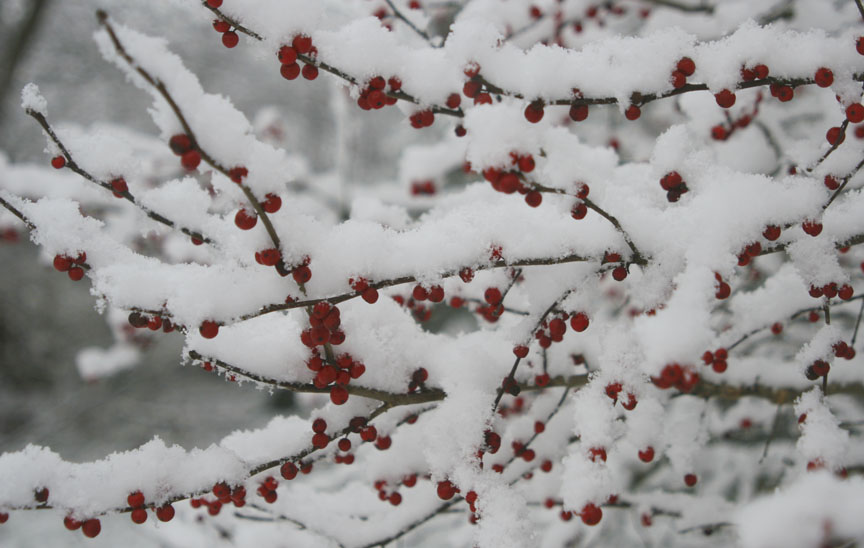
winterberries

Winterberries are beginning to shrivel, and soon bluebirds and the earliest robins will pick them off for sustenance before the grubs and insects are plentiful. Today, as winter gently asserts itself, there are revelations in the outlines of white against shadow. The squirrel dreys are visible, loaded with dollops of snow, amid treetops. The deer paths and deer beds are more obvious because those areas are flattened by use and thus blanketed more evenly than the surrounding grassy spots.

Meadow’s stalks droop in criss-crossed patterns. If I look closely enough, I can identify the species, dry and broken, tangled together and covered in snow: solidago, eupatoria, aster, clematis, ryegrass, penstemon, milkweed. The snow’s ephemeral, yet I find myself thinking of Steve Tobin’s Earth Bronzes.

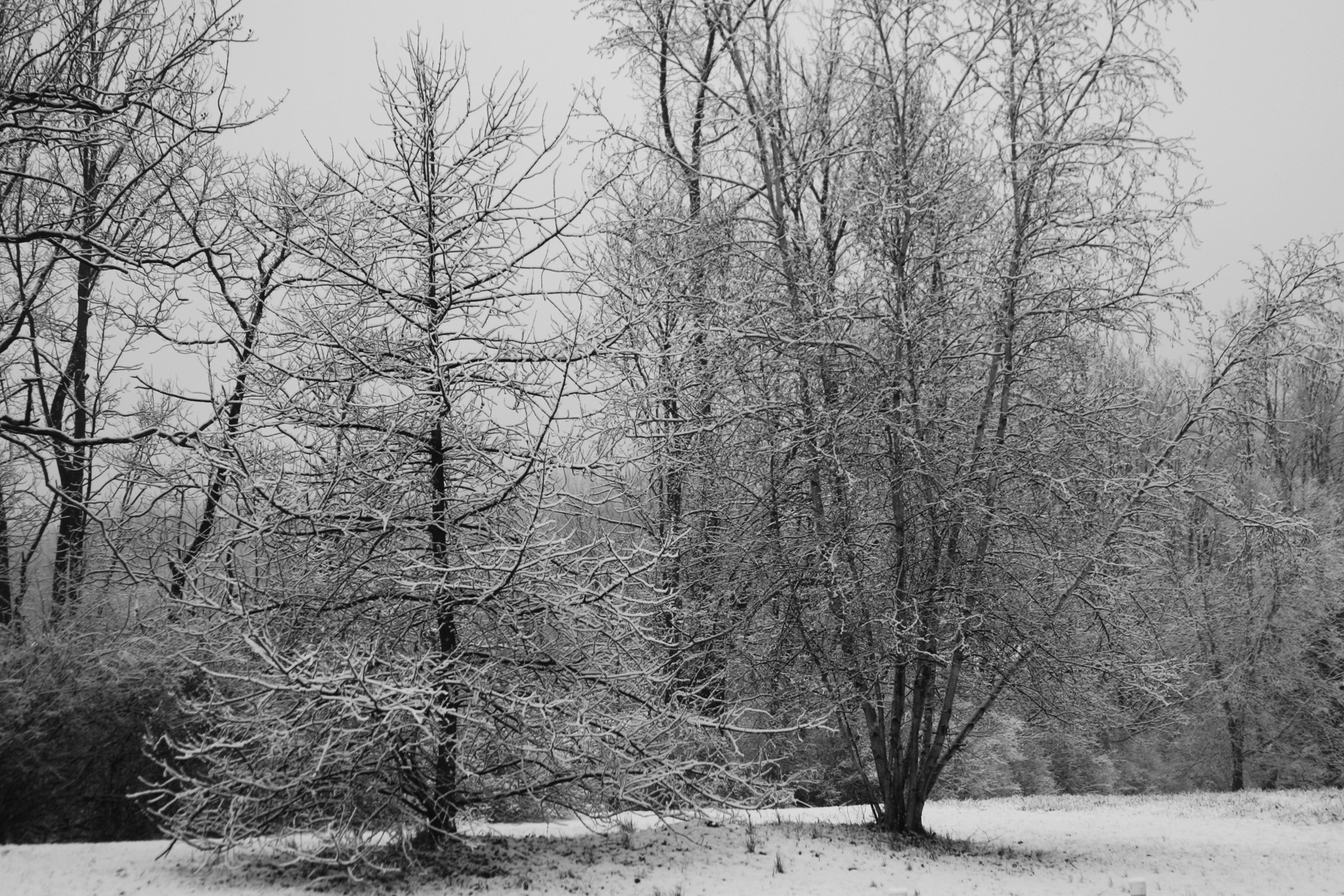
The ways shrubs and trees collect snow fascinate me, too; I love the fractal sketching of dogwood and Japanese maple, the calligraphic hatchwork of long-needled pines and the way thorns embrace little cups of ice along vine-y stems. I love the larch and birch that create the perfect image of lacework when a light snow coats their branches:

photo by Ann E. Michael

larch and birch

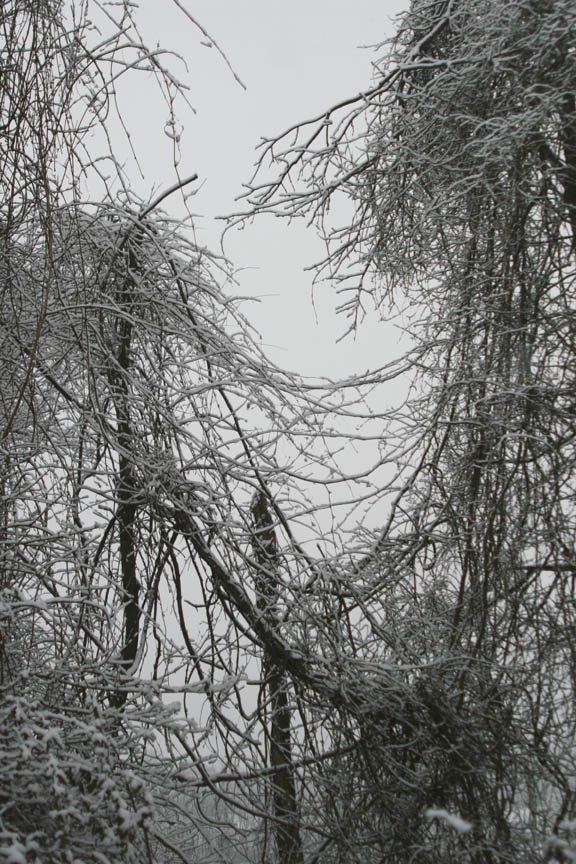
Overhead, vines rope trees together, creepers that take on a creepy mien, ghostly and dripping, when snow-covered. Vines have become a hazard in our region, with both native varieties (poinon ivy, wild grape) and non-natives (too many to name!) choking wooded areas, killing off tree crowns, usurping the niches of native plants, and adding to the hazards of storm damage.

Maybe that is why the ice-draped vines appear sinister to me.

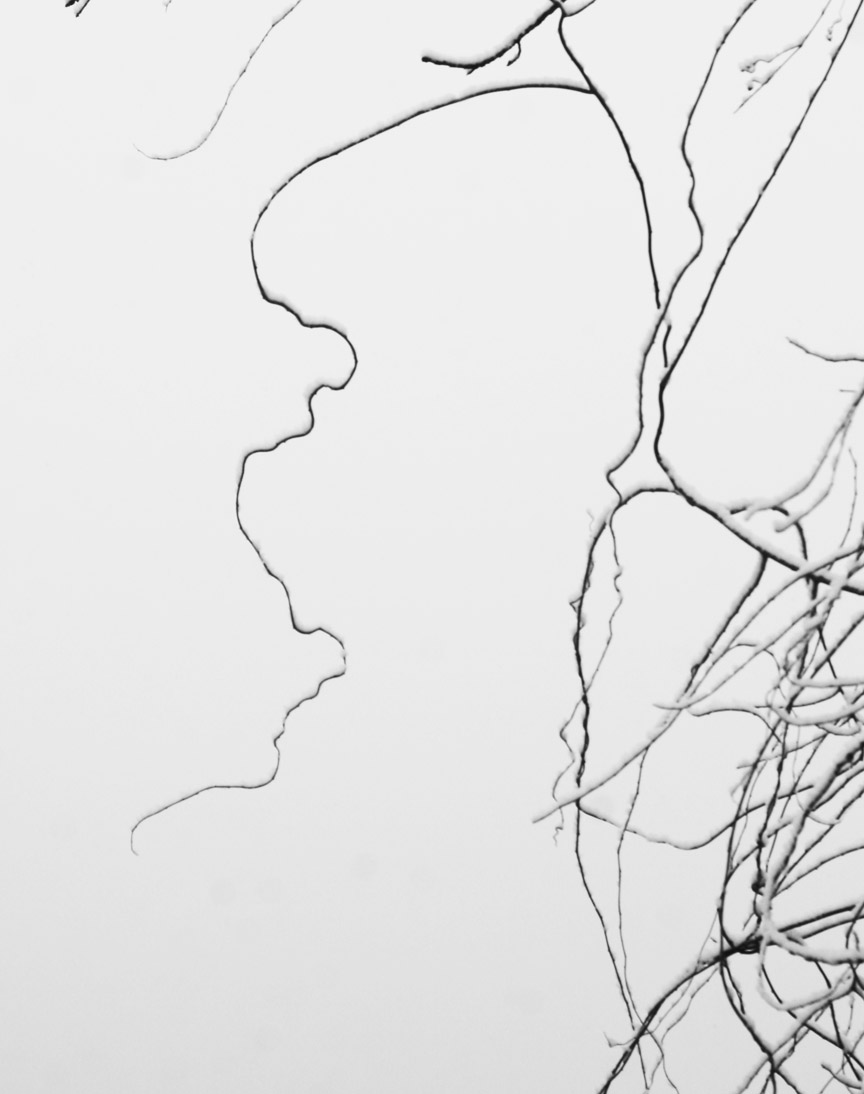
And yet. A plant is neutral, alive, neither good nor bad, possesses no conscience, cannot be evil, plays its role in the environment–and can serve as inspiration. One woody tendril sways high above the ground, a line drawn against the featureless sky. Using a stick, I copy its shape in the snow at my feet. It might be part of an alphabet I do not know, an ideogram I have yet to decipher, the course of a river. Imagination steers from that point on: I take up my pen and write.

Inspiration

The word “inspiration” is from the Latin inspiratio: to blow into, to inflame. I began musing on inspiration today while on a walk with Spouse and Dog, during which the idea of muse came up in conversation (with Spouse; Dog kept her own silent counsel). He observed that he had never had a muse and asked if I had ever had one. I said I cannot think of ever having a person serve as my muse, but perhaps other things have played that role.

“Isn’t a muse a person?” he asked. We discussed, then, the difference—as each of us saw it—between a muse and a mentor. He has had mentors at various stages of his life; I think most of us encounter someone along the way who serves as a sage, a guide, a teacher, or as a role model. That person certainly offers a kind of inspiration. A muse, however, seems to connote inspiration of a different character or quality from mentorship. The muse acts as trigger, someone or something whose mere presence elicits a creative urge. The muse inflames, blows on the spark of creativity and ignites it.

Richard Hugo’s book The Triggering Town is justifiably famous among creative writers, particularly poets, for its author’s sensitive explanation of a source for the creative process and his description of how inspiration percolates into the creative act. He uses the example of American towns that act as triggers for memories or conjure of specific details of place and personhood. The town becomes muse. In a similar way, works of ekphrastic poetry may employ art as muse (though not always). For other creative people, music provides that initial flicker of inspiration—which seems especially fitting, given the word “music” originates from the word for the Greek muses themselves: mousike techne “art of the muses” from mousa, “muse.”

Mousa itself derives from the ancient proto-indo-european linguistic base *mon-men-mn, most closely associated with the meaning “to think, to remember.” Inspiration, though we feel it emotionally, psychologically, even physically at times, takes us into our minds, where the creativity takes place and can be formulated into art.

Much of my inspiration over the years has come from what people tend to term “the natural world”—as if we humans were not a part of that. But other things spur my creativity, including art and things I read. Having finally completed Parfit’s Reasons and Persons, I am now consuming more easily-digestible fare and finding much to inflame my interests in Alberto Manguel’s 1995 book A History of Reading, which I highly recommend.

Perhaps I will later find time to discuss the joys and pitfalls of reading several books at once. Meanwhile, I plan to spend the last light of a late winter afternoon observing hawks and woodpeckers.

Kalliope or Calliope, Athenian-style, the muse of epic poetry.

Non-sense

Let me pick up from my brief post of yesterday, which concerned in part the value of asking the nonsensical rather than (or in addition to) the rational question. What led me to that topic is the recent death, at age 101, of artist Dorothea Tanning, whose work–both visual and textual–is often considered surrealistic.

Surrealism goes in and out of fashion, and I am not planning to comment critically on its aesthetic value; but I will say that I have admired and been influenced by artists working in the surrealist oeuvre and that I enjoy the way “nonsense” and  “non-sense” can lead to juxtapositions of ideas and images that have proven fruitful for my own creative work process.

The nonsensical question may follow along the lines of:

How does the sunflower feel when a bird feeds on it?

Non-rational, because the sunflower does not–as far as we know, in the rational/sentient way–feel anything emotionally; the jury may be out on whether there are tactile receptors in a sunflower that can feel anything physically. To answer the nonsensical question in this case requires a kind of metaphor or animation of the inanimate. (We could also argue the inanimate status of a sunflower seed-head.)

Further nonsensical inquiry could lead us to “What does the goldfinch say to the sunflower?” or, more nonsensical still, “What would a sunflower say to an electric guitar?”

Non-rational prompts can provoke interesting results in the process of creative thinking.

Back to Tanning. Her life itself was a creative process. Check out the biographies of her that are popping up online in response to her death. While I am not a fan of all of her work in her various media, I love her vivid and exciting explorations. Here’s one of her early, less-experimental works that appeals to me because of its imagery. I identify with this painting.

“What would it feel like to wear a nest on one’s head?”
As a poet, she was strongest in the area of visual figures (no surprise there). I’m running out of time now, so I will close with an excerpt from one of Tanning’s poems:
There was a time
of middle distance, unforgettable,
a sort of lace-cut
flame-green filament
to ravish my
skin-tight eyes.
I take that back—
it was forgettable but not
entirely if you
consider my
heavenly bodies . . .
I loved them so.
Heaven’s motes sift
to salt-white—paint is ground
to silence; and I,
I am bound, unquiet,
a shade of blue
in the studio.
(The entire poem, “Sequestrienne,” is here.)
For another surrealist whose poetry is not always classically surreal, see my posts on Eluard .

Ratiocinatio

What ought I to be doing? Where do I really want to be? How shall I best spend my waking hours? Am I contributing to society? Do I want to? Does self-expression even matter? Is art important? If so, to whom, and why? What actions should I take? Can I ever justify my faith? Is there such a thing as hope? Is there a reason I’m not doing more with my time? Is there something valuable I am missing in my life? What do I want to do with myself from this moment on?

Is that all there is, my friend?

Discovering truths through a series of questions is supposed to be a rational, perhaps the most rational, way to approach the Big Questions. The rational truth-seeker ought not to stop at answers, even when the answers seem sufficient (logical).

The term for this method is, in rhetoric, ratiocinatio. Basically, it’s Socrates’ approach: keep asking. However, ratiocinatio as I understand the term does require more than just asking. It implies finding rational answers—or at least responses—to the questions. It also operates under the premise that the questions be rational…an idea against which the contrarian creative side of myself sometimes rebels. “Go ahead,” it urges, “Ask the nonsensical question!”

I invite you to ask the nonsensical question. It might be interesting to discover where this approach leads. Maybe even to…truth?