Some awe

In 2015 (I think), I posted about the University of Berkeley’s professor Dacher Keltner‘s studies examining the experience and emotion of awe. Now he has a book, Awe: The New Science of Everyday Wonder and How It Can Transform Your Life. The subtitle’s unwieldy and promises a little much–I’m sensing a publisher’s or publicist’s input there. Keltner’s a psychologist, not a popular self-help author, but whatever…

The ways scientists attempt to study human emotions amaze me with their inventiveness. How does one conduct empirical experiments on anything so wildly subjective? (And honestly, I question whether empiricism is always as objective and reliable as scientists believe it is–though we haven’t developed a better method yet.) This book answers some of my questions about the “how” of studying emotion, which includes a good deal of physiology; after all, human emotions are based in human bodies. Qing Li’s book on forest bathing touches on some of these methods of study as well. Blood pressure, heart rate, breath rate: those can be measured, and there’s exhaustive research that shows how such aspects of our physiology connect with feelings of well-being, even before looking at the roles hormones and neurotransmitters play.
But what about awe? Isn’t that usually a feeling that takes your breath away? That might raise the pulse, that might be fear as easily as joy? Keltner writes about the line between fearful shivers of the Halloween-night kind and goosebumps that appear when humans feel awed. Also our tears–of joy, grief, physical pain, and those tears that we feel when we are “moved” by an act, a place, a work of art. He cites Rose-Lynn Fisher’s photos of tears, which I was happy to see mentioned because I love her work (a poem about those photos appears in my book The Red Queen Hypothesis). He cites Ross Gay’s poems and prose poems/essays of joy and gratitude, in books I happen to love. And Keltner offers an anecdote about poet laureate Robert Hass and the “whoa moment” that arises in “myriad cultural forms.”

Among those forms is poetry, and here’s where this text got me considering what I love in reading poetry and what I may be aiming for when writing it: the term he uses is everyday awe.

Deep awe–I’m not enough of a genius with words to create a sense of deep awe with a poem, though I admire the geniuses who have been capable of such art. But everyday awe? That’s a feeling with which I’ve been familiar since my childhood and which I have never lost sight of. For me, it arises from my favorite pastime: observation. The fog-mantled tent-spider web in tall grass, the sparrows sipping from city-street potholes, the toddler showering his baby sister with dandelion flowers, the smell of honeysuckle early in June, or campfires or cinnamon. Sea spray in my face. Sand in my shoes. The way my mother’s 90-year-old skin stretches and smooths when I stroke her arm. Skunk cabbage unfurling with the morning sun behind it. These things I can write about; the words are everyday words, and this is my everyday world. That, for me, is where the art of poetry and the experience of living intersect.

Astronomy

As a freshman in college, seeking to expand my limited science knowledge, I enrolled in a Physical Astronomy course, an introductory seminar class that taught students how physicists study the cosmos. At any rate, it introduced us to how that was done in the early 1970s. Thanks to computer tech and so many rapid changes in the field (we were using slide rules!!), the discipline has changed in some respects. I was terrible at the math, never having gotten beyond Algebra II in high school, but I had a terrific professor and loved the material. As may be obvious to readers of this blog, the cosmos and all that is in it provides me with endless opportunities for learning, speculation, and reflection.

Rebecca Elson, whose book A Responsibility to Awe I just finished reading, keenly reminds me of how fascinating the study of the universe can be and how little we know of it. Each decade the science and the theories take immense leaps in measurement and exploration, and each leap reveals how many more questions we have yet to ask, let alone answer. Not just inquiries into the galaxies, but also biological and ecological worlds to explore: salmon, eels, oceans, mountains, our own histories and our own mortality. Elson’s area of study centered on galaxy formation–the chemical evolution of stars, and globular clusters. But she started out collecting rocks with her geologist father who was doing fieldwork in Canada, then studied biology. It wasn’t easy to be a young woman studying the sciences in the 1970s, and she felt she was drifting a bit; writing, however, she felt more sure of. In the essay that ends this collection, she states that the atmosphere at Princeton during her post-doctoral study was “a stronghold not just of men, but of theoreticians” who looked down on work which involved “mere” observation, which is what she had painstakingly been doing in her research in Australia and Cambridge. At Princeton, though, she met a group of poets who encouraged her work and who made her stay at the university more comfortable. Good observation skills make a terrific foundation for poets.

~

If the ocean is like the universe
Then waves are stars.

If space is like the ocean
Then matter is the waves
Dictating the rise and fall
of floating things...
  --from "Some Thoughts about the Ocean and the Universe"

She was diagnosed with non-Hodgkins lymphoma when she was 29, died ten years later, and this book is the only example I’ve been able to find of her poetry. But it is revelatory what Elson does with simple language and deep, theoretical concepts as metaphor, topic, or theme. Some of the poems are so brief, yet I find myself thinking about them again and again. Like good haiku, they are not aphoristic–but they linger. Her sense of awe is palpable in these poems; I think that’s what I like most about her poetry.

Evolution

We are survivors of immeasurable events,
Flung upon some reach of land,
Small, wet miracles without instructions,
Only the imperative of change.

~
Salmon Running

Who isn't driven
Up the estuaries
Of another's flesh,
Up rivers of blood,
To spawn close to the heart?

~

A poem titled “OncoMouse, Kitchen Mouse” thanks the laboratory mice whose lives led to the cancer treatments that, for a time, prolonged her life; “Antidotes to Fear of Death” finds her eating the stars, or stirring herself into a young universe. While one late poem is bleak (“There is no poetry to cancer/To the body betraying itself”), another–the last entry in her notebook–observes the flourishing of spring. Much to learn here. Enough admiration that I wish, selfishly, she’d had more time on earth so I could enjoy more of her poems.

~

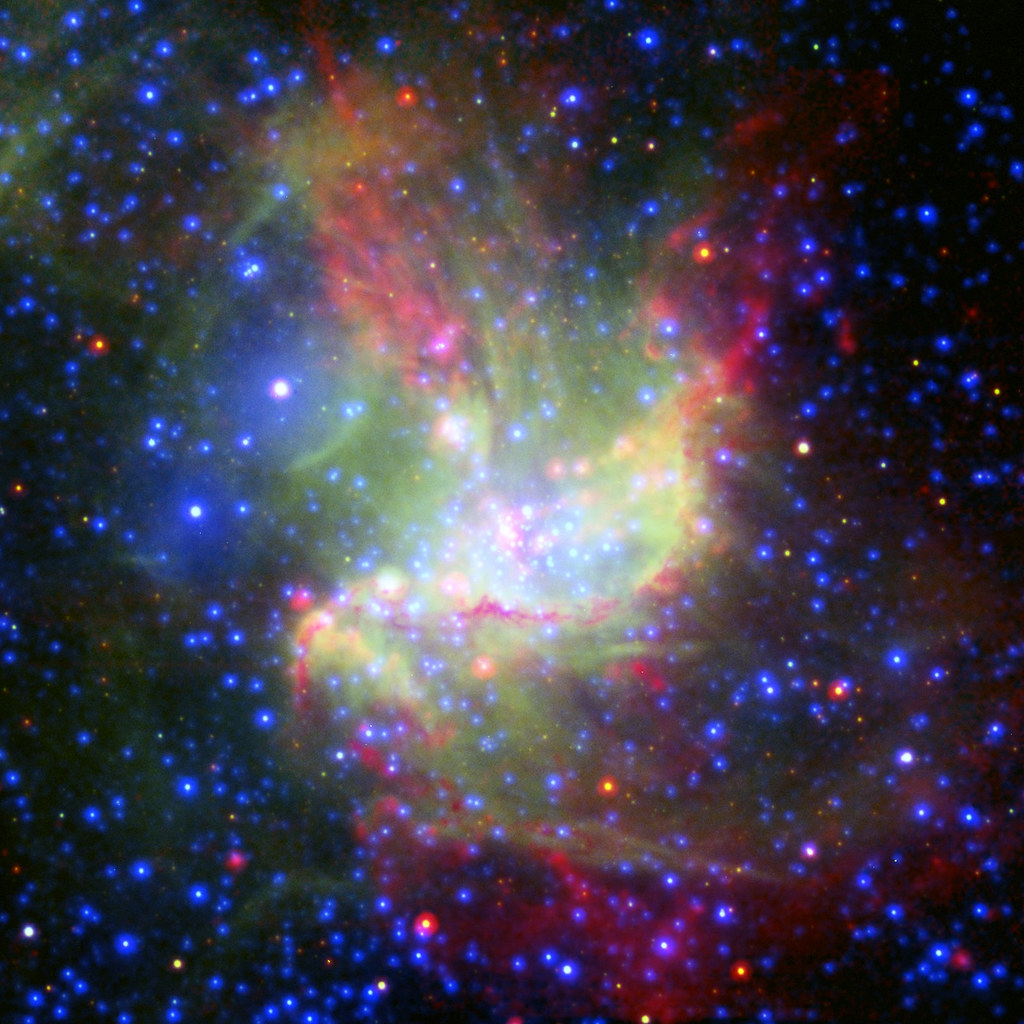
Fledgling Stars in Stellar Nursery by NASA Goddard Photo and Video is licensed under CC-BY 2.0

Poetry, awe

Welcome, National Poetry Month. This year’s poster was designed by one of my favorite cartoonists, author/artist Roz Chast. She illustrates Mark Strand’s famous poem. Click the link to order a copy! You can donate to Poets.org while you’re at it.

~

Apropos of my last post (here), it turns out that Berkeley Social Interaction laboratory (BSI) has done studies on…awe. Awe might be what Ehrenreich experienced in a fashion more ecstatic or charged than the more garden-variety awe that BSI’s Dacher Keltner writes about in this essay in Slate. Some of the early findings from social research suggest that awe, even more than compassion and joy, contributes to a sense of personal well-being and counteracts depression.

Possibly more surprising is the indication from respondents that awe is not as uncommon as we think:

[A] study from our Berkeley lab speaks to the promise of daily awe. Amie Gordon gathered people’s daily reports of awe for two weeks and found that it is surprisingly common in everyday living. Every third day, people feel that they are in the presence of something vast that they do not immediately comprehend. For example, seeing gold and red autumn leaves pirouette to the ground in a light wind; being moved by someone who stands up to injustice; and hearing music on a street corner at 2 AM all elicited such an experience. Intriguingly, each burst of daily awe predicted greater well-being and curiosity weeks later.

When I reflect on my own daily life, I realize that’s true–this sort of experience grounds me many days when I feel I am losing purpose or overwhelmed or simply sad. It might be the sight of a raptor in an amazing dive toward prey, or the shimmer of light on a bird’s feathers, or a particularly stunning sunrise. It might be a story a student tells me, something moving or courageous.

Every once in a rare while, awe is larger, encompasses more, displaces my sense of self, flames into ecstasy. That kind of experience exhausts, whereas “everyday awe” invigorates, calms, balances life toward the bearable. And often, reading a poem pushes me into the state of awe. For Poetry Month, I will grant myself the daily possibility of awe by reading poetry.


Familiarity & awe

The region I live in is not known for dramatic landscapes–no big sky, no ragged peaks or ocean shoreline, no palms, grand flora, impressive architecture. Nonetheless, there are days such as this one when my familiar commute fairly glows with beauty. In the long slant of mid-autumn morning sun, the half-harvested soybean fields shimmer under frost: beige never looked so glorious. Even the big agricultural gleaner glimmers with ice crystals. The sky’s washed with upswept cirrus clouds, and backlit dogwood leaves cling like maroon pennants to silhouetted branches.

Perhaps my aesthetic appreciation of the view is due to a neural release of dopamine responding to images processed through my eyes’ rods and cones; that understanding, if true, in no way lessens my awe.

As I head toward the campus building, the clamorous urgency of wild geese momentarily catches me by surprise. Welcome.

Beauty & awe–briefly

I have been reading lately (currently Leonard Shlain’s Art & Physics and Donald Revell’s The Art of Attention: A Poet’s Eye), but not much inspired to write. Instead, I work in the garden or sit on the porch and listen to birdsong.

I muse upon beauty. Partly such musing falls under the pursuit of aesthetics: the world of my garden becomes especially beautiful in spring. The sounds birds make seem beautiful to my ears. Water droplets on emerging leaves appear beautiful in the morning light.

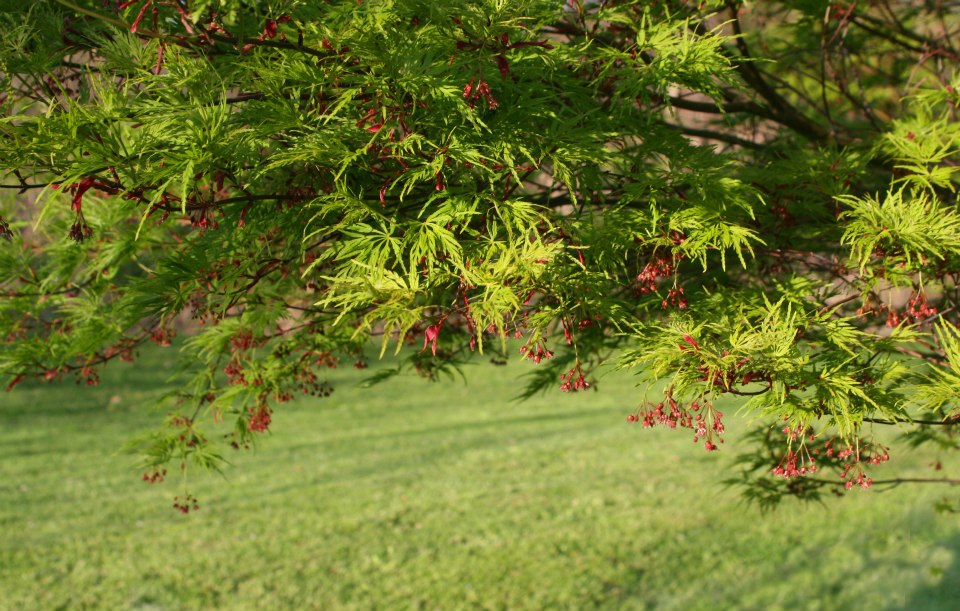
japanese mapleThese are phenomena. The world of things I can take in with my senses, process through my body and brain, and create–out of whatever “mind” may be–a concept of the beautiful. The phenomena are not physically affected by my categorization. It is I who am changed, I suppose, by virtue of my aesthetic appreciation of the beautiful.

I am reminded of Kierkegaard:

“Love does not alter the beloved, it alters itself.”

Aesthetic appreciation does not alter the thing-in-itself, it alters the person who finds beauty in the thing-in-itself. If this is so, I am altered by my love of what I deem beautiful.

~

While I was searching the web to find the quote above–I couldn’t quite recall it exactly–I found the Kierkegaard quote on the blog of pastor Jonathan Martin, whose theology I can’t completely get my mind around but whose words (below) reminded me of the Bhagavad Gita:

The most beautiful thing a person will ever see may well also be the most terrifying.

Is this not the nature of true beauty? To not just be soft and delicate, but to be so powerful, so overwhelming, so altogether other from ourselves as to threaten? Beauty does not intimidate, but it can overpower. Beauty is a coup to our senses. It holds an unruly power over us. Beauty can move us, haunt us, carry us, compel us. To feel ourselves beholden to the raw power of something beautiful is to be upended, not just inspired but assaulted.

On the lines of such thinking, we might find beauty in a tsunami, hurricane, earthquake, meteor strike the same way Arjuna feels paralyzed by the awesome beauty of the revealed godhead Krishna.

Perhaps that is why we often find ourselves fascinated by photos of natural disasters. Having lived for a couple of years along the northern end of Tornado Alley in the USA, I fear tornadoes. But they possess a kind of beauty in their awesomeness, if we can remove ourselves from the anguish we feel for people whose livelihoods, homes, and lives are destroyed by the big winds.

I wonder if human beings can ever bear that kind of awe; Martin says it transfigures us, Kierkegaard implies something similar, the Mahabharata and other sacred literature suggest that our bodies and our minds can withstand such revelation but cannot describe or truly comprehend it. It seems to me a kind of spiritual post-traumatic stress disorder! This is the “fear and trembling” of the psyche, whether the mind decides the experience is physical, mental, spiritual, or religious.

And that manner of beauty is not aesthetic.

Martin later writes, “Objectively speaking, the beauty of God is already present in our beloved, whether we recognize it or not. Rather, when we encounter beauty in another person, we are changed–we are transfigured…[those we love] do not become beautiful because we recognize their beauty; rather their beauty makes us beautiful.”

Is this experience awesome or aesthetic? Does the beauty of the azalea, the lilac, make me beautiful because I recognize it as such? Am I altered, fundamentally, in my admiration for an artist’s work, a poet’s words?

~