While I await the eventual drying-out of the garden soil so I can plant a few early veggies and herbs, it seems a good time to ready a few more poems. I’m revising, drafting, but not sending out work. That feels comfortable at the moment; anyway, I much prefer writing to submitting poems.
I’ve also reserved myself some quiet hours to read books of poetry and a novel or two. Jessica Cuello’s Yours, Creature just arrived in my mailbox, and I’m on an Isabel Allende kick at the moment, so I definitely need some time to devote to reading. My husband, who tends to do his reading in the evenings, recently forwarded a Washington Post column by Stephanie Shapiro about why so few people read for pleasure during the day. Its title is “Why Does Daylight Reading Feel So Wrong?” She writes, “Although I am retired, I find it hard to allow myself an afternoon with a book or a long magazine article. Just the thought of settling onto the sofa in daylight hours, especially on weekdays, smacks of laziness and stirs up guilt. If I must sit at all, it should be at a desk or a countertop to do something ‘useful’— answer an email, write a grocery list, look up a recipe, what have you.”
I’m sure this is a common feeling, but it isn’t one I acquired, probably because my dad was ALWAYS sitting around reading a book, newspaper, or magazine–day or night. Reading during the day seemed normal to me. It still does, I’m happy to say.
I drew the night with a number 2 pencil I'd sharpened with a Girl Scout penknife. It was 1969. Night needed blurred edges so I smudged at it with two fingers of my right hand. And then night left its prints on my thumbs and palms, somehow, on the yellow print blouse and blue jeans I wore.
I sketched shadows the way I saw them under beds and outside windows, how they deepened the early hours when Grandmother wakened by gaslight to start her chores-- in darkness which I learned to draw with a pencil and which stayed on my skin the whole day.
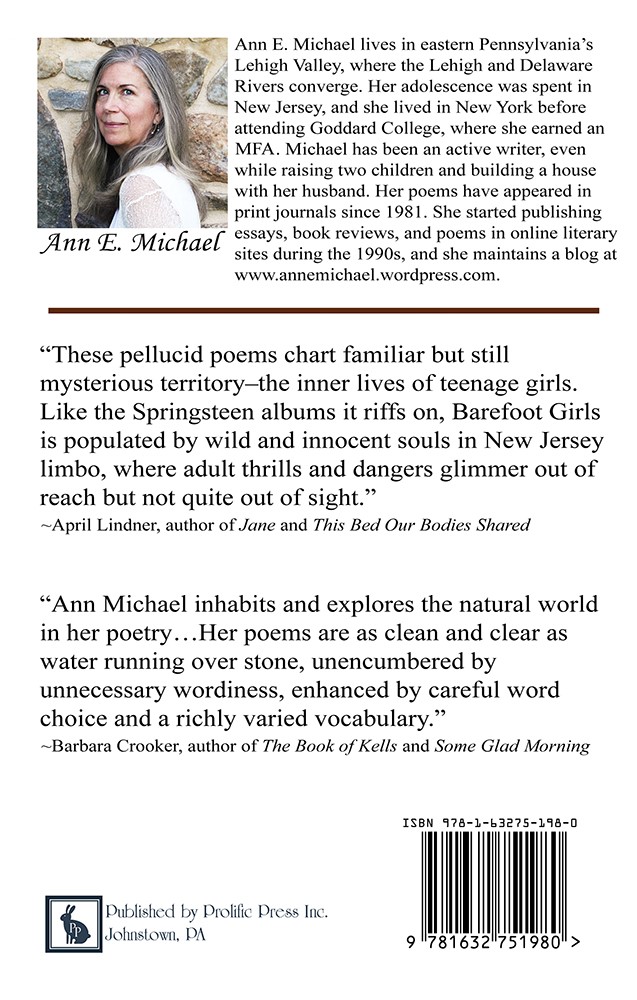
Although poems can be anything–philosophies, arguments, histories, internal monologues, passions, information, invention, dreamscapes, jokes, narratives, parodies, you name it–poems sometimes parallel a writer’s individual experiences in the world in a way that would, in prose, be termed memoir. When readers think of poems that are “from the heart,” they usually mean work that authentically describes what appears to be personal acquaintance with environments and behaviors: something autobiographical, or “true.” I have tussled with this perception in some of my own work, for example, my chapbook Barefoot Girls, in which the poems describe fictional experiences that in many cases were not my own but those I heard as a teen; and yet, some of them are memoir-ish.
How to decide what categorizes memoir-ish poetry collections? On the one hand, maybe everything ever written by any poet, since connecting the personal with the so-called universal has long been considered the job of poetry. Even narrative and heroic epics, when they are lasting and successful in their aims, contain some aspects we might call personal (motives and emotional responses to a situation, for example), though the writer’s life and its events may be obscured by centuries.
But memoir is not autobiography; readers should keep that in mind. Maybe it’s Vivian Gornick who said that autobiography is what happened and memoir is how it felt–I’m sure I am misremembering, so don’t quote me on that. In a past interview in the New York Times,Sharon Olds derided her own poems as narratives–even personal narratives–but sidestepped the term autobiography; she still refers to the first-person in her own work as “the speaker.”
…even though her poems have been called diaries, “I don’t think of it as personal,” she said. “These are not messages in a bottle about me,” said Ms. Olds.
“The Examined Life, Without Punctuation” by Dinitia Smith, 1999 (New York Times)
Where does that leave us as readers? I don’t know–and I think it’s okay not to know. That said, I have recently read a number of poetry collections that fall decidedly on the memoir side of the continuum and found them interesting, informative, well-written, at times beautiful and also at times hard to read (i.e., profoundly sad). If you, my reader, are intrigued by the challenge of what is or is not memoir in poetic form and are open to experiencing the circumstances and knowledge of other lives and perspectives that such work offers, here are a few books you might investigate. There are many, many more–this list is just from my more recent perusals. Not one of them is anything like the others.
We had some mild, sunny days around the equinox, days that lured me to the yard and garden. The neighbors’ pussywillow pushed its fuzzy catkins out in the warmth, and the sight of daffodil and hyacinth leaves making their way upward was cheering. A rather sluggish field vole ran out from under some mulch, much to my annoyance–the voles have really torn up the ornamental beds and the lawn under the cover of the snow. There’s a large meadow behind my house; why don’t the voles stay out there? At any rate, I wanted this one away from the garden. I figured I could catch it and let it go in the hedgerow where the grasses are dry and thick.
Field Vole (Microtus agrestis) from Warren Photographic
I was wearing garden gloves and the vole was a bit startled by sunlight but too fast for me. Because I had a hose in my right hand, I aimed it at the vole. I figured the wetting would confuse it enough that I could sweep down fast and scoop it up with some thatch, then release it. Or really, I wasn’t thinking much. But it did work: the vole, suddenly damp, froze for a moment. I snatched it and cradled it in my gloved hands (they bite!) and let it go along the edge of the meadow.
My compassionate spouse admonished me, though. He said it was cruel to spritz the vole. I realized he was correct. In the moment, I was considering my good intentions to remove the creature to a “better” place to forage; but that in itself was not a very kind thing–it was my wish, certainly not the vole’s! And I am positive I frightened it terribly.
The episode made me reflect on how often we privilege our own desires as being motivated by good intentions. We reason our way out of thoughtless behavior by saying “But I didn’t mean…” I have done so far too often. I think this is what props up microagressions and passive acceptance of egregious social behaviors like racism. Today I stumbled across an article by Shayla Love that suggests our much-vaunted concept of our true moral selves is illusion. She cites an article by psychologists that concludes that “[t]he true self is posited rather than observed. It is a hopeful phantasm.” Strominger, Knobe, & Newman’s article on the true self is here.
So I am celebrating in a very small way, hooray for the little things! For the fact that my 88 year old mother has had her vaccine, and so have I, and now we can visit in person and appreciate little joys like cranberry, raisin, almond, and dark chocolate trail mix, floral bouquets, slow walks through the garden starting to green up and–soon–bloom. Maybe I will even be able to take her out for a beer (at an outdoor restaurant) in a month or two. I can read her some of the poems I’ve written about my dad. We can just sit and watch the birds.
For the fact that my students are slogging away, enduringly hopeful that by the time they graduate the USA will somehow be better. Maybe it will. With their help.
For the fact that my siblings and I have friendly relationships with one another–and honest ones.
Hooray for my spouse, mowing the meadow with his 1947 John Deere Model M tractor! For a new manuscript of old poems that I’m finally spending some genuine, careful, critical time revising.
Last night, first time I heard the tree crickets’ din blossoming in darkness; cicadas’ daytime clatter began last week, and the lantern fly nymphs are in their last stage before morphing into winged tree-pests. The heat’s oppressive, which seems to suit the general mood. I have not been writing poems, but this morning wakened early to surrounding birdsong and felt a moment of beauty amidst the tension.
As usual, my garden has offered respite. I harvest beans in evening’s humid warmth, pulling pods from the resilient stems. I marvel at the squash blossoms–bright bells amid enormous green leaves–and gather cucumbers and zucchini, and wait for tomatoes to ripen as I tie up the vines heavy with green globes. The scent of lemon basil pervades dusk as the last fireflies start to wink. Yes, there are disappointments and bugs and there will be yet more weeding and work. It is, however, labor of the body for the nurture of the body. A body in the world.
~
Twenty-odd years ago, we planted an American beech and a stellata magnolia 15 feet apart in the yard. For years, the magnolia–an understory tree (more of a shrub)–grew taller than the beech. Beeches are slow growers in their early years, but it caught up. Now the magnolia flourishes happily under the spreading beech, and in the space between them there’s a mossy, shady refuge where I sometimes sit to escape the heat or the stress and worry of life. I’m not the only one who seeks the protective room beneath the spreading trees, as that’s where the snapping turtle buried her eggs, and there’s a sandy spot in the mosses where another creature has made a place to lie.
I sought the place last evening after watering the garden. Wandered there over the brittle grass and spent clover blossoms of our meadowy yard. Felt the things of the earth beneath my feet. Still a barefoot girl. Still in need, now and then, of refuge.
~
Oh yes–my book of poems, Barefoot Girls, is still available. It is a limited run, though. $8.95 from Prolific Press. Reading poetry: another type of refuge.
While we are self-isolating, how about reading books? As it happens, I have a short chapbook of poems that’s being released just in time for National Poetry Month. Here are some thoughts.
~
I enjoy reading memoirs–a well-written memoir reads like fiction or poetry, with interesting perspective and description revolving around not an entire life but one event or series of events that has a dramatic arc the way fiction does–and, often, some of the same ambiguities. Now that my chapbook on adolescent New Jersey girls in the 1970s is coming out (March 26, Prolific Press), however, I realize that readers are likely to interpret these poems as memoir. After all, I was indeed a teenager in south Jersey in the 1970s. That being the case, I might go only so far as to call these lyrical narrative poems memoir-ish.
What people who read poems often forget is that the poem does not necessarily reflect the poet’s experience, only her interpretation, only the potential or the possible–the imagined. Poets choose personas as narrators when we endeavor to imagine other people’s insights, points of view, or experiences. Or even other beings’ or objects’ “points of view.” But of course, we can only imagine–we cannot really know anyone else’s lived experience. That gives poets and fiction writers and dramatists room to speculate, pretend, imagine: “What must it be like?”
This booklet tries to evoke various voices from a collective past but, I hope, will feel familiar to anyone who has ever been an adolescent. These poems emerged from Bruce Springsteen songs, from memories, from rumors, from attending a class reunion, from experiences my 21st-c students had, and from my imagination. I filled in some gaps and created perspectives that would certainly not have been my own when I was a teen. And yet, any writer’s disingenuous if she claims her characters or narrators have nothing to do with her own perspective, that everything she writes is completely made up; if that were true, readers would feel left out. There would be nothing in the poem to relate to, nothing from which to derive personal meaning or insights. No “Aha!”
Any poem that can be called lyrical takes up the close point of view. Any narrative poem tells a story of some kind. An example is Patricia Smith’s book Blood Dazzler.Readers find it easy to believe that Smith resided in New Orleans, was there when Hurricane Katrina hit, because the poems are so authentic and personal–fierce, believable voices describing the devastation and its particular toll on elderly and non-white citizens. But Smith did not live in New Orleans, and it doesn’t matter. It is an excellent and shattering work all the same.
Here’s one of Ren Powell’s posts on the unreliable narrator of our own lives. What we writers work with, often, is evoking the emotional memory, which isn’t the same as other ways humans recall events.


 ann e michael