Changes & alterations

We built our house here about three decades ago. At the time, I was young and excited about landscaping the place; although I had been growing our own vegetables for years by then, I was fairly new to ornamental gardening. I made mistakes; I underestimated the speed at which shrubs and trees grow; I thought I could keep a handle on invasive species; the world of various bark beetles and aggressive vines was new to me; and I had no idea how hard it would be to manage almost seven acres without, say, a team of landscapers.

Or how rapidly an environment alters when the climate changes, and when cornfields and early-growth wooded areas become housing developments, parking lots, and streets. I have learned a great deal and much looks different now than thirty years ago, but the swallows still return to my garden between April 26 and May 6. My land contains fewer efts in May than it used to, but the gray frogs, spring peepers, wood frogs, and toads make their usual frenzied chorus at mating time each spring.

~

Recent changes have come from the emerald ash borer, which has decimated, or worse, the green ash native to this valley. The huge trees have come crashing down during the past 10 years, making hard work for us even if it does provide a bit of firewood. Cutting, splitting, stacking hardwood isn’t a task I’m much good at anymore. Thirty years ago, maybe…and there does not seem to be any good that comes of this tree loss, which I’ve been mourning each year as we have less and less of a woodlot treeline above the hedgerow and see more and more of the neighboring subdivision.

But on my damp, early-morning walk today, I perceived some changes that I should have expected and that offer a glimmer of hope for native trees and shrubs–despite the proliferation of Russian olive, multiflora rose, Amur honeysuckle, mugwort, wintercreeper, Asiatic bittersweet, mile-a-minute weed, and more colonizing invaders than I can tick off in one blog post. There, beside the tractor path, along the edges of the hedgerow (for edges are where things happen most quickly), I observed more tree saplings than in past years. With the vase-shaped, leafy arcs of green ash absent, sun reaches further through the thickets. And there I spot horse chestnuts starting to push up, tiny walnut trees, oak trees of differing species, “baby” hickories and maple varieties, along with understory’s smaller shrubs and trees like amelanchier, ironwood, redbud, buckeyes.

Granted, most of them won’t survive to maturity, but some of them will–gradually re-making the woodlot unless other disturbances undo the renewal.

I won’t be here in another 30 years to find out, but I find hope in these saplings. I’m also happy to see that the little woodland and field wildflowers such as false Solomon’s seal, jack-in-the-pulpit, wild violets, and mayapples remain. And though I find myself swearing inwardly at the way the Russian olives grow massive along the property line and the invasive bittersweet sends thick tendrils coiling up into the trees, it’s not the fault of the plants that they got here. Humans brought them to North America, and the plants–like European colonists–became a bit too successful in their new homes, pushing out what was here before their arrival. Am I any different, really, than the dandelion or the honeybee? My ancestors came to these shores not so long after those species were imported with earlier “settlers.”

~

The rain we’ve been getting means I haven’t been out weeding in the vegetable garden. After I take my walks, I come inside to dry off and do household chores, or make soup, or work a little on my poetry. I feel excited by a little writing project I have recently given myself, and I’ve also been playing around with drafting prose poems. Next week, I head to the high desert again for further inspiration and a chance to travel with a good friend, visit museums, and spend some time with my daughter. When I return in mid-May, the gardens, the meadow, and the woods will already be much changed.

Verdancy

This report was posted almost a week ago, and the rainless weeks continue; today, fires are climbing their way along Pennsylvania’s forests beside the Delaware River, which looks almost as low as the Rio Grande in Albuquerque when I was there last month. Okay, I exaggerate a bit–but my alarm’s genuine. “No measurable precipitation” here, whereas Valencia, Spain gets a year’s rain in one day and western North Carolina receives 30 inches in two days. This stuff worries me even more than the upcoming election.

I’m not an alarmist, I’m a gardener. When do people start to admit to, and take action about, climate change? (Sorry, rhetorical question.)

~

One theme of the writing workshop I took with Anita Skeen and Cindy Hunter Morgan, as I blogged about here, was color–color as prompt, color as image, color in ekphrastic work, color as inspiration. One prompt was to write about a color you can imagine hating, or a color that you love. It was autumn, and I was in the desert; so I decided to be difficult and write about loving green. Not typically considered an autumn or desert tone, though in fact the high deserts have more green, and in more shades thereof, than most people expect.

Here’s my draft. I used to hate showing unfinished work around, but now I don’t mind doing it. I find the practice of posting/sharing early drafts instructive (and it keeps me mighty humble).

~

Love Is Verdant

Listen, if I were to fall in love again,
it would be with a color: green.
So many variations and hues
ever-changing, surprising me with wilderness,
forest and pine, sage, olive, and moss,
the craziness of chartreuse,
glossy feathers of the teal.
Green as rushes in swamplands, bamboo
on mountains, diverse as rainforests
and summer tundra lichen, yellow-green
of maple leaves early in autumn,
the pitchy green of piñons high up the mesas.
Sure, there have been times I sought for
love that is constant, but now I know better,
for the only constant is change—and green
can accomplish that with as little as breeze
and sunlight, which are likewise things I love.

~

Photo by Pixabay on Pexels.com

Drought, again

The temperatures here in this eastern Pennsylvania valley have been mild, even warm, which isn’t that unusual for October, anymore. What’s different is the lack of rain. Northern New Mexico had more rain the past three weeks than our region did. Now that is unusual, and a bit worrisome. Our local trees have been enduring numerous stresses in recent years: irregular rainfall, invasive insects, road construction and housing developments, run-off, and viruses. Droughty autumns and winters do not make for resilient, happy trees and other perennials, unless they are desert varieties.

I love the desert, but the Lehigh Valley (where I live) is not primed to be a desert. We need the temperate moisture of rivers flowing down to sea level and 50″ of rain each year. It would be interesting to learn xeriscaping and how to garden in low-moisture regions, but only if I were living in one. I’ve been concerned for a long time about the climate changes I see occurring around me, noted the differences year by year in my gardening journal, tried to limit my own water use even in this temperate, damp-ish area. But. On my own, I cannot conserve enough water to keep the 70-foot-tall tulip trees and large oaks and colorful maples healthy. Nor the soil and its microorganisms, fungi, understory plants, and useful arthropods.

True, sometimes the long days of rain and overcast skies we get in autumn, winter, and spring feel oppressive; and they make my joint pains flare. But I count for little, whereas the earth counts for a lot. I’d gladly trade some low-barometer aches for a vibrant, healthy local climate.

~

The frosts, though light and few, are arriving now. Maybe we will get rain by Election Day? I have too many hopes for next week. Best not to speculate; I can wait.

In the meantime, I have just finished reading Cindy Hunter Morgan’s very beautiful new collection, Far Company, and I recommend it, especially if you like poetry with an environmental resonance and poems of memoir and recalled experience. Purchase it from Wayne State, not Amazon, if you can. To frustrate a certain billionaire, not that he will notice.

We do the small things, right?

Northern stars

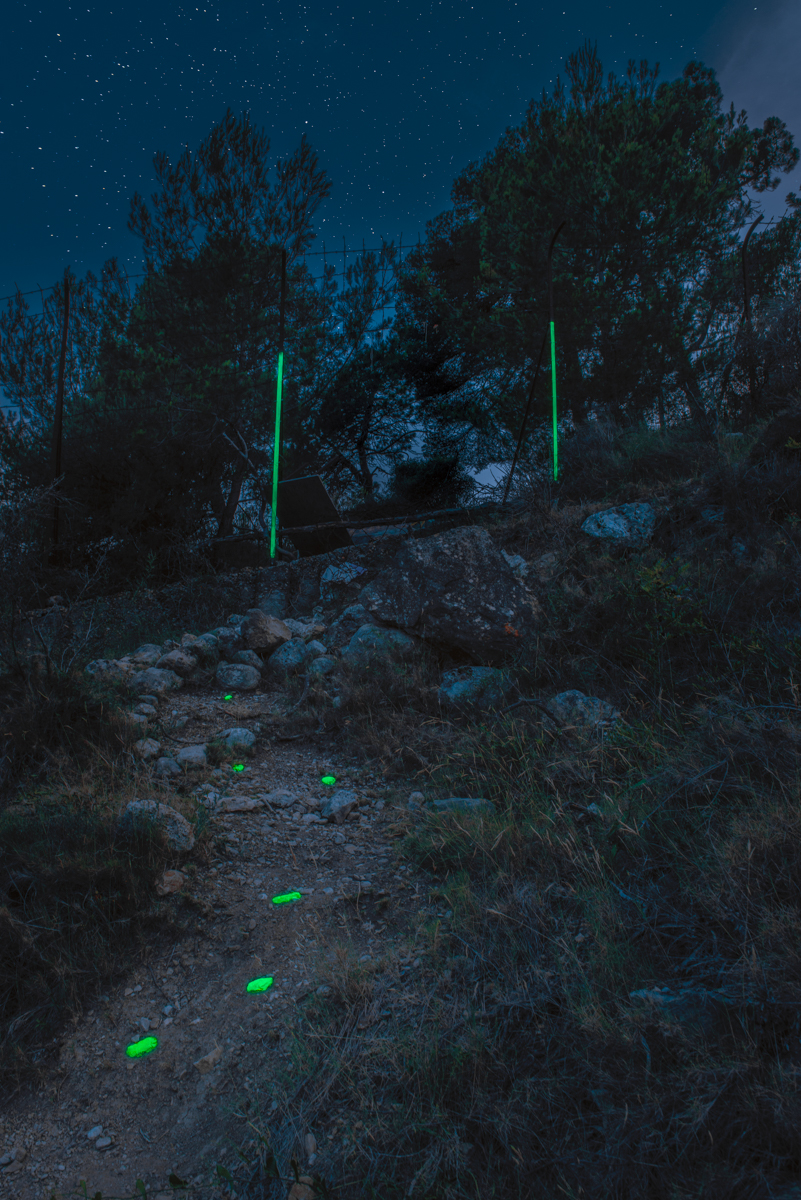
Northern Stars (2023) Celestino Marco Cavalli

~

A phosphorescent path
connecting Italy and France
through glowing stones
that look like stars.
A poetic and political action.

~

https://www.celestinomarcocavalli.xyz/work.html

The installation shown here was created by one of the artists I met while at Joya, Celestino Marco Cavalli. The link above will take you to a description of his project. In brief, it is a series of fluorescent-painted stones that follow a trail refugees travel on their way from the Mediterranean, through Italy, and into France. The website does not include the many photographs Celestino took during his 5-month visit there to document the conditions under which emigrants travel–the trash they leave as they abandon belongings, the graffiti and the notes to others they leave in caves and hollows, the prayers they write, the places they shelter from the sun or rain or cold weather. Do the refugees litter the mountain paths? Yes. Do they do so out of desperation? Also yes.

This installation is innovative, compassionate, and political–also problematic; as always, borders between nations are fraught with concerns about each country’s boundaries, laws, rules and regulations. These days, most immigrants taking this trail (through Italy) have come from the global south, where the climate damage wrought by industrial nations has made living in poverty even harder and fostered political unrest. And the immigrants take huge risks–with no guarantees that they won’t be deported, or preyed upon by criminals who exploit their vulnerable status.

I’ve never been a refugee, an exile, an immigrant. I have met quite a few, though–often very young people, students I encountered at the college where I worked, students from Haiti, Dominican Republic, Turkey, Syria, Lebanon, Mexico, Venezuela, Pakistan, Eritrea, Viet Nam, Kenya…and my husband’s stepmother, who arrived at Ellis Island from Austria between the wars. And a colleague who was stranded at college in the USA when the Ayatollah took power in Iran, and a fellow employee from Cambodia, who lost her entire family except for one brother to the Khmer Rouge. Whenever I hear about the politics of immigration (which is often), I think of them: how hard they work, what they sacrificed to get here, how hopeful they are, how challenging their lives have been and continue to be. And their grief.

The following is a persona poem--"A persona poem is a poem in which the poet speaks through an assumed voice" (Academy of American Poets). Celestino's Northern Stars is my "prompt."

~

Refugees

Because we must hide by day
and travel at night, darkness hinders.
The narrow stony trail offers options:
turned ankles, torn skin, or a precipice
that takes us sliding down the mountain,
an avalanche of self, death’s prospect.
No one arrives eager for exile;
we’re just trying to save ourselves,
our families, a few belongings
we used to think were precious.

The way we take may be steep—
everyone knows that metaphor—
what we never expect is how much
it is an unburdening of all
we thought was necessary,
an education in physical need.
Shoes, for instance, more critical
than underwear. Ancestors emigrated
on callused feet without watches
or water bottles. The least cut could
go septic, a child’s wail could betray us
to predators or enemies. Still true.

One by one we let things go, abandoned
in shallow caves with other people’s
remnants, plastic bags and t-shirts,
books, candlesticks, so much trash after all—
even our skins can barely hold what
we need anymore. We arrive shriven,
numb as feldspar, having walked so long.
May we have water? May we rest, with our
children in our laps, and sing the songs
our parents taught us not so long ago.

Sweltering

I do not much care for air conditioning, and I believe it is bad for the environment; yet I admit I’m grateful for it lately, as I reside in one of the many regions of the USA that’s been enduring dangerously high temperatures for more than a week straight. I feel lucky that we’re not struggling with the heat wave–that we can shut up the windows and turn on the AC. We’re also in an earlier-than-usual drought situation though the air feels muggy and humidity has been as high as 98%.

My garden needs water every day; I generally water in the evenings because that is when the garden is in shade. The barn swallows swoop around me as I make sure the tomato and cucumber plants’ roots are getting a deep soaking. While I water, I watch for insects–fireflies, moths, dragonflies. And for bats, which have returned but aren’t as numerous as they once were. It’s pleasant for me that there are fewer mosquitoes and gnats, but I’m concerned about a drop in the number of junebugs and moths, and even (yes) mosquitoes. The heat and drought have taken a toll on all kinds of wildlife.

This morning, a pair of finches dive-bombed a squirrel that was up in the pear tree, chasing it far into the hedgerow. It may have been after the unripe pears, but squirrels also sometimes eat songbird eggs or chicks, especially when the squirrels are nursing kits or when there’s a lack of other food. The deer are so thirsty and desperate for greens that they’ve eaten every last hosta in my landscape, including the ones right up at the house foundation. They are consuming plants they have overlooked before, but I can’t blame them. Since it has been so miserable outside, I haven’t picked black raspberries this year; I’m sure the deer are happy about that. But I do wish they’d eat the poison ivy, wintercreeper, oriental bittersweet, and honeysuckle vines…that would make my landscaping tasks easier!

I’ve kept a garden journal for 30 years. If you have a garden, you don’t need to be an environmental scientist to recognize that the climate is undergoing changes. This is not a political statement but a fact. Everything right now is stressed–including the gardener! The stress enters into my consciousness and, I suppose, into my creative life. My poem drafts of the past week have been a bit on the bleak side.

Here’s a draft of one of the 7-line poems I was working on last week. Suits the weather, I guess.

~


Sweltering

A description accurate for the days past solstice
when even the wind lies sweating in a hammock
unable to rise for a brief turn around the block.
Blackbirds slow their trills, robins shelter in shade,
all the tasks we should tend to we leave undone.
Hours of lethargy seep into skin and set up house,
keeping us damp, achy, sunburned with the blues.

~


The Birdcatcher*

So many “heat bubbles” world-wide this summer. We happen to be in one of them–high temperatures, even at night, and barely any rain in the past three weeks. No rain in the forecast for days ahead. Drought. Temperatures in the 90s. It’s not even as humid here as it usually is in summer. But humid enough. I dislike air conditioning as a rule, but boy am I grateful for it and privileged to have it.

The sunflowers in my garden grew taller than average this year yet are now drooping from high temperatures and lack of water. Young deer show up outside of their usual territories while trying to find forage that isn’t crispy. They (and the birds) gobbled up the wild berries so quickly that I managed to pick only a pint or so of wineberries. The drought hit after blackberry season, though, so we did get a nice harvest of those.

Curled petals of a very dry sunflower.

It’s not just the deer behaving differently because of the weather. I notice that squirrels and some birds have altered their usual patterns as well. This evening, I got a panicked call from a friend who lives in a nearby city–a bird had found its way into her son’s attic room through a poorly-installed window air conditioner, and all the windows up there were stuck shut due to the humidity. The poor bird was fluttering crazily, and she had no idea how to free it. I’m guessing the bird (it appeared to be a juvenile catbird) was seeking shade and shelter, and saw the gap between the wall and the unit as a safe space as the sun began to go down.

I have not had a lot of experience rescuing caught birds, but this is the second time in a week I was summoned to assist a frightened avian. On Monday, one of our summer library assistants asked for help with a fledgling robin that was unable to clear the brick wall of our entry ramp in order to join its parents, who were chirping from a nearby shrub. That task was easier than rescuing an attic-trapped bird, but I succeeded in both cases.

I shall rename myself Papagena!

Meanwhile, we have finally taken steps to remove house sparrow nests from our damaged cedar siding, an eviction over which we have no regrets. The layers of nesting material in former woodpecker holes (which the house sparrows enlarged and populated) make an interesting study in avian biology; they also make a mess. More about the problematic house sparrow at this post. Suffice it to say, there’s a ton of work involved, including lift boom rental, that we must manage under lousy-hot conditions.

Bird-catcher, bird-rescuer, and bird-evictor. Here I am, keeping things in balance.

~

*The Birdcatcher is the title of a wonderful collection of poems by Marie Ponsot. I recommend finding a copy and reveling in her work.

Change

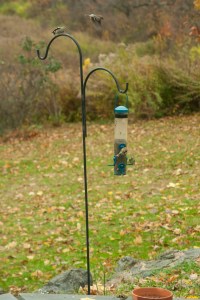
finches-fall1

Goldfinches in winter attire

Two kinds of chickadees (black-capped and Carolina). White-breasted nuthatches. A tufted titmouse, bluejays, goldfinches in their brown-ish phase. The winter birds have arrived; despite a strangely warm November, the birds molt into dull plumage or migrate on schedule. I try to remember that when I feel worried about climate change: some forms of life are adaptable, change is normal, anxiety accomplishes nothing, and right action is possible.

I do not mean that we ought to ignore changes, especially those for which we have been responsible. When human beings get concerned enough to act, there’s a great deal of harm we can undo.

In the late 1960s and early 1970s, people in the USA became anxious about pollution. I am old enough to recall when New York City’s famous skyline was obscured by a yellowish-gray haze almost every day. Days we could see the Empire State Building shining in sunlight without smog were rare.The problems Chinese cities today are having with polluted air were happening for the citizens of Los Angeles and New York fifty years ago, but we took action–surprisingly enough–and eventually state and federal regulations required that technology be implemented to ease the problems technology had created.

This process was not speedy or easy, but it worked. I visit New York fairly frequently, and the sky is almost always smog-free. My now-grown children have never seen the skyline hidden under layers of air pollution.

Things changed.

Can humans undo the damages we have wrought to our oceans, air, rain forests, mountains, deserts, rivers, planet and its climate? Probably not–not all of it, certainly–and I doubt there is much we can do to stave off the “sixth extinction.” We have to accept we are part of the change, for good or ill, and to find ways to do less harm in whatever time remains to us–to activate compassion.

~

Meanwhile, I await the juncos. They usually arrive around the first week of December.