Happy places

The past few days, I have been in one of my happy places: the Sandia Mountains of New Mexico, where one of my Dear Ones lives. Cibola National Forest offers alpine grasslands and mostly-pine forests (juniper, pinyon, ponderosa, Douglas fir, white firs, aspen, oaks) and trails ranging from easy walks to steep climbs. Also horse trails. I stuck with the easier walks, but after just a couple days I adjusted to the altitude. Spring is just beginning up in the mountains, but lower down–at 5,500 feet–there were flowering trees and early “ephemerals” and even, in downtown Albuquerque, hollyhocks starting to bloom.
Ft. Union

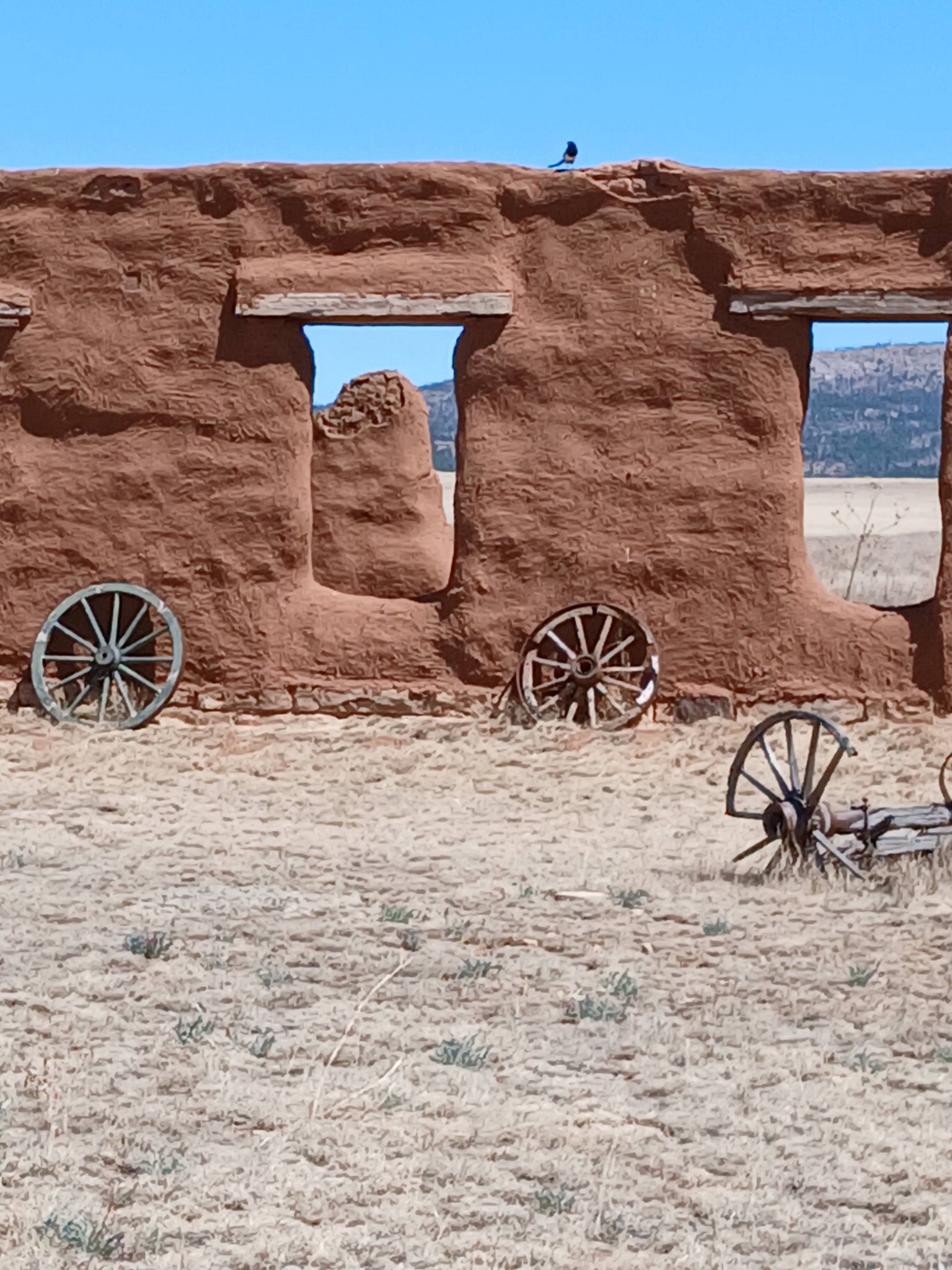
This trip, we flew in to Denver to see as many Colorado friends as we could fit into 4 days (such fun!), drove I25 south alongside the Rockies, and entered NM through the high grasslands, where we saw pronghorn antelopes and wagon-wheel ruts, still evident from the days when the Santa Fe trail led travelers to bustling Fort Union. Now the place is quite empty; it’s even a Dark Skies park, but we were there in the daylight hours. I spied a nesting pair of western meadowlarks and enjoyed listening to their songs. The mountains make their own weather, and the clouds were constantly shifting and remarkable to behold as we drove down the highway. We were lucky to have timed our departure so as to miss most of the truly awful Denver-area traffic. Indeed, our drive southward on Easter Saturday was almost zen-like in its big-sky peacefulness. It helped that we had decided not to listen to the news media…

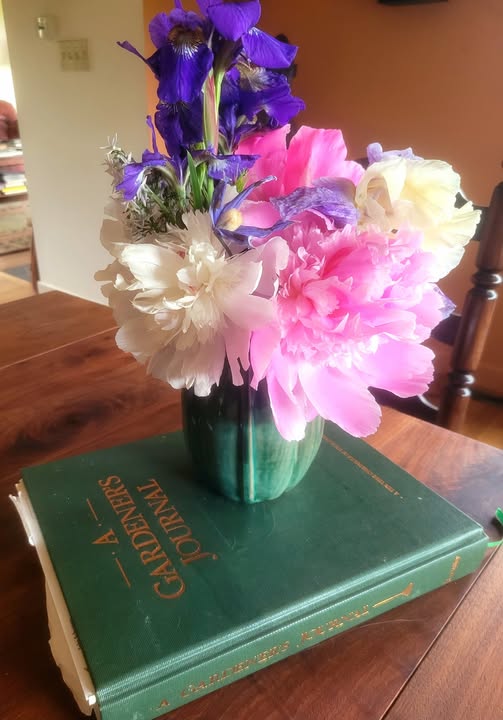
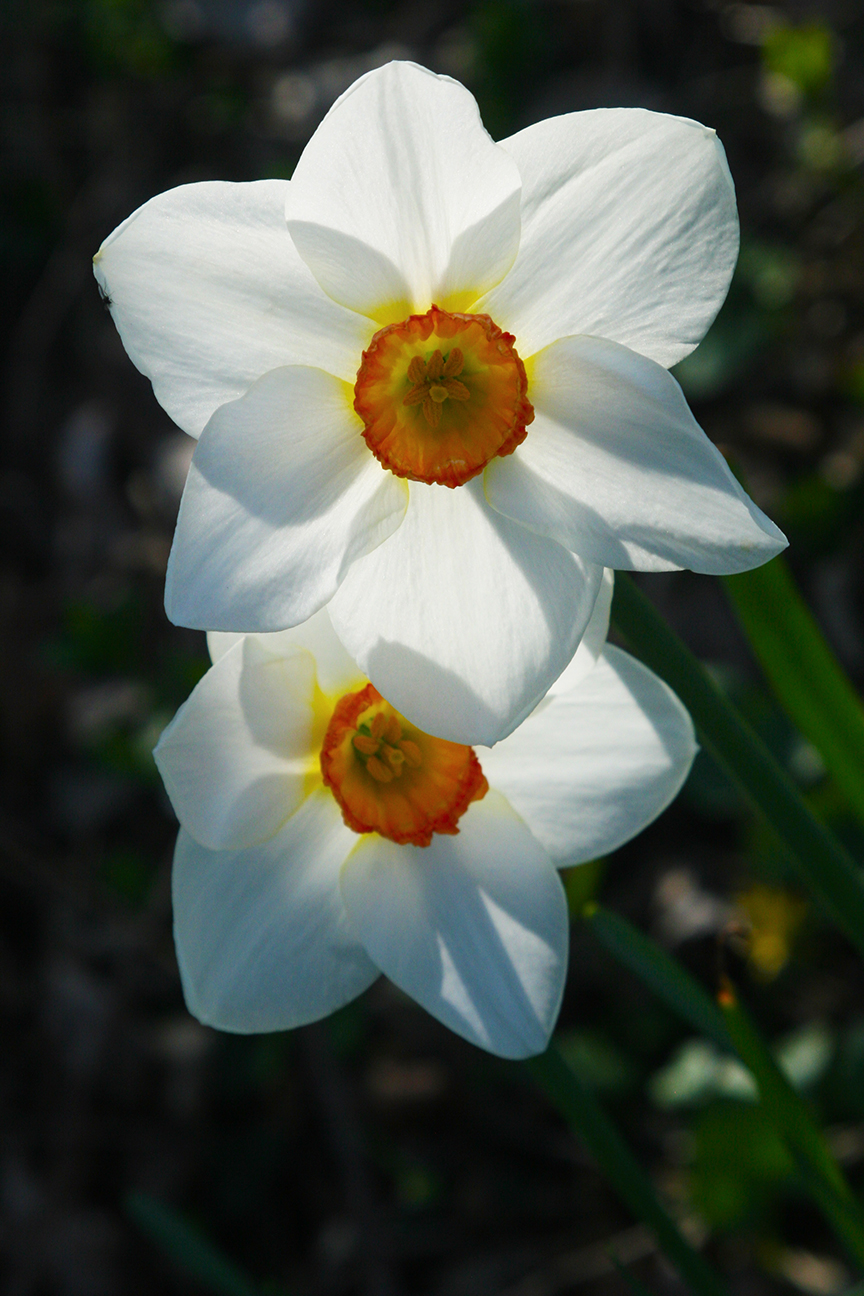
What is it about this high, dry region that has appealed to me from the first time I visited Abiquiu at age ten? As a child, it seemed the place possessed a soulful magic. I was fascinated by the mesas, hogans, adobe dwellings, twisting rivers, desert fauna. But as an adult, I’m a gardener–this is not an easy place to garden. The soft, rainy days of spring and autumn, the summer downpours I grew up with…these are not New Mexican phenomena. If I were to move to the Southwest, I’m sure I’d miss fog and mist and even drizzle, at least sometimes. I’d miss the deep, fertile soil I’ve enriched for 25 years in my truck patch (which I am currently sowing, slightly late, with spinach, lettuce, carrots, etc). Yet even though I have spent the past two days prepping and catching up on my garden, making bouquets of narcissus and hyacinth, and hearing the familiar birds of home, I recognize that this happy place is not my only happy place.

I thought recently of a letter I read written by, of all people, Martha Washington (to her friend Mercy Otis Warren), in which she says, “the greater part of our happiness or misery depends upon our dispositions, and not upon our circumstances. We carry the seeds of the one or the other about with us, in our minds, wherever we go.” She was leaving her Virginia plantation, where her grandchildren were, to go to the Capitol with her newly-elected husband.1

I don’t know that I necessarily have a cheerful disposition, but I appreciate her metaphor of the seeds we carry with us whatever our circumstances. It’s spring in eastern Pennsylvania, and there is much here to appreciate.
~

  1. Found in American Historical Curiosities, John Hay Smith, 1860 https://www.gutenberg.org/files/7912/7912-h/7912-h.htm

A little green

Summer arrived rather suddenly here in the valley. After a rainy May that was a bit cooler than average, June has slapped us with 80° days and sunshine. Not that I am complaining, but it does throw a curve at the vegetable garden’s usual progression.

And all that rain burgeoned into so much verdancy–my eyes almost ache from all the green! We’ve needed the rain (the wettest May on record) to make up for the driest October on record (2024). Nature appears to be doing its best with balancing things out in the face of all we humans have been doing to unbalance it.

Quite a switch from the spring greenery in the mountains of New Mexico, greens that are far less chartreuse in hue, the kind of green you have to be looking for amid the deep jades of pines and the brownish-green cholla. Prickly pears are a bright shade of green but don’t evoke any sensation of lushness. The little-leaf oaks start out with a fresh hue but become very dark, nearly black, as the season progresses.

I was thinking about the hues of the high desert because of our visit to the Georgia O’Keeffe Museum in Santa Fe. One of the galleries there is a display of the artist’s pastel chalks, brushes, and color chips she created for herself to get the palette she felt best represented the landscape she knew. Many shades of ochre, browns, dull oranges, sandy yellow, and that famous turquoise blue of the New Mexico skies–but also the green of cottonwoods in spring, the green of pinyon and ponderosa, the sage green so common among low-growing plants like sage and rabbitbrush.

Try defining the word green.

A little Joni Mitchell to accompany that request:

Back in PA

Last year at this time, I had covid and was languishing in bed, unable to tend to the garden. A regional drought meant I really should have been watering the new plants; and it also kept the weeds firmly rooted, fighting for dominance in the vegetable patch. This year, I timed a trip to New Mexico just when I ought to have been harvesting spinach and planting out tomatoes, beans, and squash. Oops. And then it rained buckets the whole time I was away (much-needed rain, but…). Therefore, the garden situation was not ideal. But garden situations seldom are ideal because Nature does its own thing regardless of my plans.

At any rate, eastern Pennsylvania finally moderated its weather enough that I got the weeds and the seeds and transplants more or less under control this past week–“control” being a general term subject to, well, Nature. The peonies bloomed gorgeously on schedule, as did the nefarious multiflora roses and Russian olives that plague the hedgerow. The catbirds and Eastern kingbirds are back; the robins’ first brood has hatched; the orioles are insistent in the walnut trees and brilliant in the garden, chasing the barn swallows. I’m not doing much writing, though I drafted one or two beginnings of poems. Outdoors takes precedence–not that I can’t write out of doors, I often do so. But poems can wait in a way the garden cannot.

And, speaking of poems (and Pennsylvania), I returned from my trip to find this Keystone Poetry anthology awaiting: https://www.psupress.org/books/titles/978-0-271-09990-3.html–the followup to 2005’s Common Wealth anthology, also edited by Marjorie Maddox and Jerry Wemple.

The new anthology, 20 years after the initial one, has poems by about 180 poets–yes, I am one of them–covering the corners and the center of the Keystone State. I like it even better than the first collection, and it is clear the editors learned much from the experience of curating poems and creating a cohesive “experience” of the regions. Granted, since I know both of the editors personally and appreciate their poetry and their visions, I may be biased. But that’s okay. Objectively, I truly get how huge an undertaking this was and how well it has turned out. For educators, there is a section at the close of the anthology full of suggestions for reading, writing critically, and writing creatively based on this anthology, and even in comparison with the previous one. As both editors are college professors who teach creative writing and critical writing, these appendices are well-thought out and worthwhile.

I miss the aridity of New Mexico, which seems to benefit my overall health. And I miss my daughter immensely. But springtime in eastern PA has many compensations, not the least of which are blooming even as I write.

Plan B (reading)

While I was traveling the high-altitude desert regions, my home valley got its much-needed rain. And the rain continues. And continues. My plan was to get to work on my gardens as soon as I came back, to weed and plant out seedlings. Well, it’s a bit too wet for that. Also chilly and humid and sea-level, and therefore my physical adjustment has been a bit …bumpy. So, Plan B.

The Plan B default for me usually entails spending “down time” reading, writing, or housekeeping, though visiting the library and meeting friends for coffee fall under Plan B, too. Today, since I feel lousy and have a spate of brain fog, reading has been the choice. I still have a few books on the bedside pile that I haven’t gotten to–mostly poetry collections I bought at AWP at the end of March. But also there is Ocean Vuong‘s heartbreaking and beautiful novel-that-reads-like-memoir, On Earth We’re Briefly Gorgeous, that I finally got around to reading, and a back issue of Rattle Poetry a friend gave me–one that was largely devoted to haiku and related forms–that featured a fascinating interview with Richard Gilbert (thank you, Lesley S!). On the poetry-only book list, I read January Gill O’Neil’s Glitter Road, Julie Kane’s Naked Ladies, and Ross Gay’s first collection, Against Which. All quite useful to me in times when I feel bleak and physically frail–there’s humor, sorrow, and bravery in all of these writers’ poems. Though I’m too foggy-headed to write mini-reviews at the moment, I encourage my readers to check these poets out.

Perhaps my next post will be about the lovely time my friend and I had in northern New Mexico, visiting my daughter and Santa Fe, including my opportunity to see Bandelier National Monument again and ponder its environments and history. A trip like that takes some time for me to “digest.” But it was wondrous. And so is a day at home to recuperate in my favorite way: reading.

Drought, again

The temperatures here in this eastern Pennsylvania valley have been mild, even warm, which isn’t that unusual for October, anymore. What’s different is the lack of rain. Northern New Mexico had more rain the past three weeks than our region did. Now that is unusual, and a bit worrisome. Our local trees have been enduring numerous stresses in recent years: irregular rainfall, invasive insects, road construction and housing developments, run-off, and viruses. Droughty autumns and winters do not make for resilient, happy trees and other perennials, unless they are desert varieties.

I love the desert, but the Lehigh Valley (where I live) is not primed to be a desert. We need the temperate moisture of rivers flowing down to sea level and 50″ of rain each year. It would be interesting to learn xeriscaping and how to garden in low-moisture regions, but only if I were living in one. I’ve been concerned for a long time about the climate changes I see occurring around me, noted the differences year by year in my gardening journal, tried to limit my own water use even in this temperate, damp-ish area. But. On my own, I cannot conserve enough water to keep the 70-foot-tall tulip trees and large oaks and colorful maples healthy. Nor the soil and its microorganisms, fungi, understory plants, and useful arthropods.

True, sometimes the long days of rain and overcast skies we get in autumn, winter, and spring feel oppressive; and they make my joint pains flare. But I count for little, whereas the earth counts for a lot. I’d gladly trade some low-barometer aches for a vibrant, healthy local climate.

~

The frosts, though light and few, are arriving now. Maybe we will get rain by Election Day? I have too many hopes for next week. Best not to speculate; I can wait.

In the meantime, I have just finished reading Cindy Hunter Morgan’s very beautiful new collection, Far Company, and I recommend it, especially if you like poetry with an environmental resonance and poems of memoir and recalled experience. Purchase it from Wayne State, not Amazon, if you can. To frustrate a certain billionaire, not that he will notice.

We do the small things, right?

Two falls

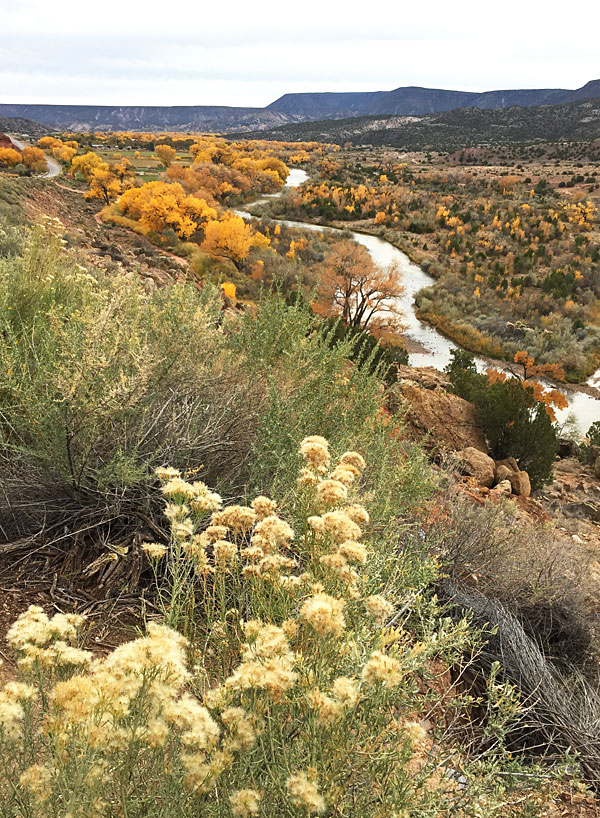
I have experienced two autumns this October: one in New Mexico, one in Pennsylvania. In the American Southwest, high up in the world, the cottonwood trees that hug every available water source were going a brilliant gold while I was there. Any view above a creek or river revealed a winding path of yellow–along the Chama, along the Rio Grande. The tiny-leaved oaks were turning brown-leaved and dropping scads of acorns along the paths. The oranges and reds are mostly there year-round, on the mesas and in the canyons.

It was wonderful to experience a poetry workshop with Anita Skeen and Cindy Hunter Morgan and to learn how books are made by hand, wonderful to draft some poems using color imagery and ekphrasis, wonderful to meet some fascinating people with whom I enjoyed pushing past my/our comfort zones and into art forms we may have been a bit less comfortable with. These are reasons to attend an instructor-led workshop, seminar, or residency. I spent part of last September in New Mexico, but it wasn’t the most spectacular time for autumn coloration–whereas October certainly gleams in northern NM!

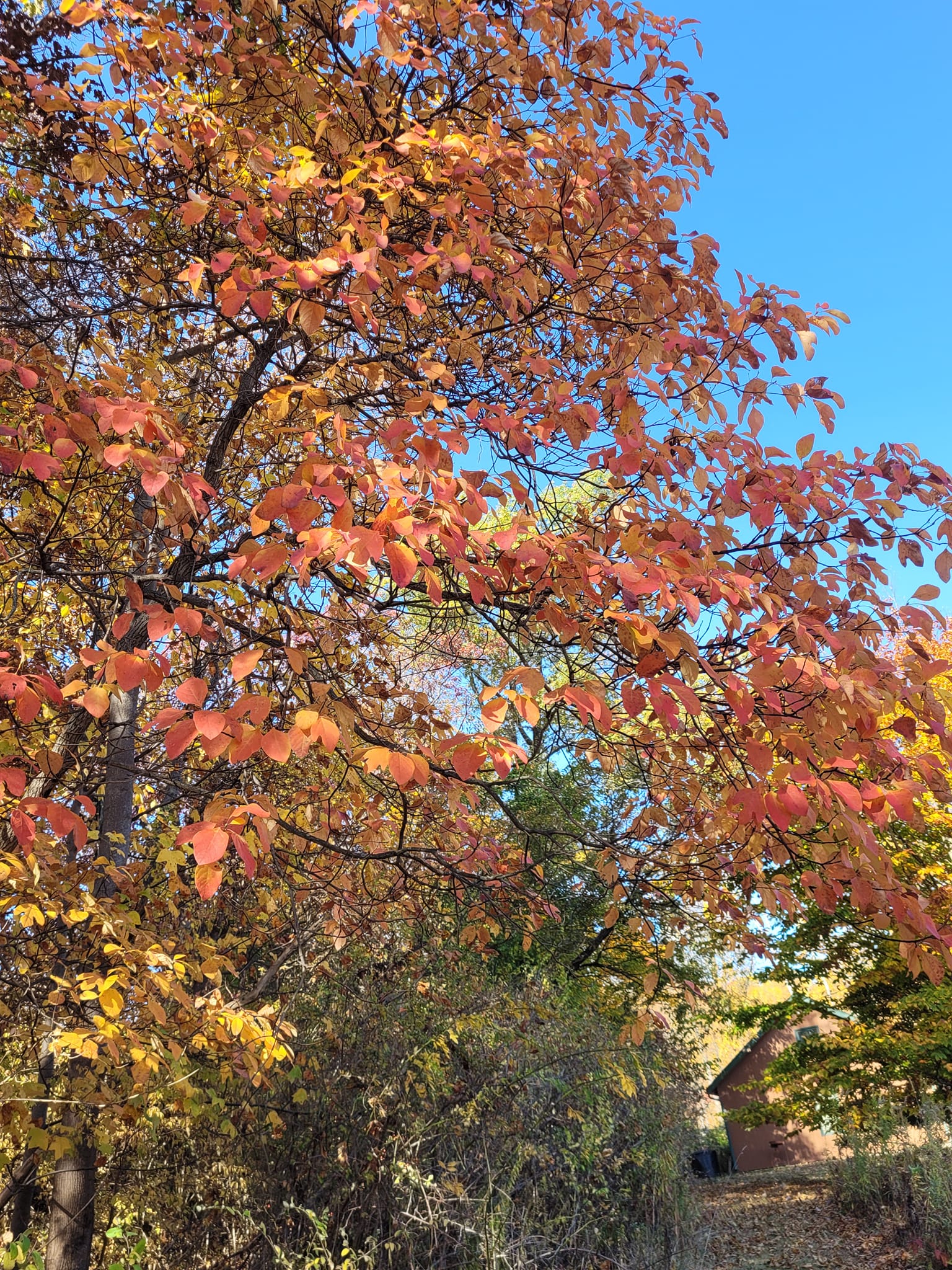
When I returned home, I had missed “peak season” for color in Pennsylvania; my husband said that came a bit early this year because of drought. But it’s still very bright here. The maple leaves haven’t all fallen, most of the tulip trees are still yellow, the hickories haven’t reached peak gold yet, and many of the sassafras are that warm coral color I love so well. The burning bushes? Ours hasn’t dropped its bright fuchsia-maroon leaves. It’s a vivid presence at the corner of the house.

~

Therefore, I have two autumns this year, one sea-level Mid-Altlantic East, and one high-altitude Southwest.

Which strikes me as an abundance of beauty and color. So I am continuing the theme of last week’s workshop. Here’s a new draft of a new poem just for the joy of it. [This fall, those of us in the USA could use a bit of joy.]


I don’t have a title for it yet. Maybe you can help me think of one.

~


The difference between orange leaf color
and orange rock color.
Between the greens of grass and juniper,
the pale dun of meadow’s die-back
and beige sand stretching westward
to the mountains.
Even the clear sky’s blueness
on fair, mild mornings
differs by an almost measurable degree.
Something to do with altitude
and aridity, the science of which
I don’t really understand.
Life’s variations and hues—
striated like cliffs, buttes, mesas,
like hills of maple and hickory in fall—
beautiful and strange.
Even when I close my eyes, color-
memories, all those shades
I can’t define, sift through my skin.
Into blood. Into bone.

There & back again, with weeding

I have traveled to the American Southwest and back again, over a fortnight away from the humid valley where my gardens languished toward autumn, pounded by rain, while we were gone. For two weeks, we lived among the terpene-scented (pinene, not cannabis…though we did notice cannabis when in downtown Albuquerque…) environment of the Sandia Mountains, where humidity is “not a thing.” I embraced my beloved family members, not quite often enough to make up for the distance between us, but enough to feel contented for awhile. And we explored some of the northwestern/north-central parts of the state that we haven’t seen before and were awed. I have not yet tired of the geology there. It’s easy to imagine New Mexico as the benthic floor of an ancient sea!

En route home, we encountered flight cancellations and re-routing, which is practically to be expected (our checked bag arrived 20 hours after our arrival in Albuquerque, also not an unsurprising development). I hear many complaints about air travel these days. I may even have added to said complaints. While it may feel almost as inconvenient, unreliable, and uncomfortable as traveling by Conestoga wagon, you must admit it’s much faster–even if it doesn’t seem that way while you’re waiting for the bus to the economy long-term parking lot at 11 pm. If my beloveds had taken Horace Greeley’s advice in the 1850s, I might never have seen them again. So, I am grateful. Even to American Airlines.

~

Upon a (slightly delayed) return, I found that the valley in which we live had experienced considerable rain but mild temperatures; as I expected, the garden weeds were thriving. Some of that is fine with me: annual weeds can go crazy in October and I don’t mind. But the perennial vines, little shrubs, and weedy biennials and perennials? I dig those out in fall, along with the tomato vines, sunflower and corn stalks, and amaranth plants. That has been my job upon my return; and the cooler weather, with soil moist from all the rain, has been a boon. I have to admit that adjusting to the lower elevation and the higher humidity has put some strain on my ol’ body. But we did a good bit of hiking and walking in the Sandias and Bandolier and Jemez, so I was somewhat prepared for the workout.

My beloved doesn’t understand my enthusiasm for “putting the gardens to bed for winter.” It seems like boring, hard work. Yet I don’t clean everything up–I always leave cover for bees and other creatures that need leaf litter and old stems in order to winter over. However, taking down the stalks and cutting back the peonies (etc) feels satisfying to me. I work in the cooler weather and sense the difference in the air. I recognize the annuals are dying and the perennials are going dormant, the trees let go of their coloring leaves; walnuts, oaks, and hickories seem to fling their mast upon the earth with every gust of wind. There’s nothing sad or somber about the changing of seasons. Winter must arrive in order for spring to do its thing. I like to think of daffodils, muscari, and irises huddled quietly in soil and taking much-required rest before the warmth unthaws the earth. I feel the same.

Topophilia

In a past post, from 2013, I mentioned some neologisms describing feelings about place.

dusk GR

Toponesia suggests nostalgia but adds to it a sense of loss for what has been erased, eroded, or developed to the point it is no longer familiar. When you return to your old neighborhood, for example, and discover that your house no longer exists and there’s a mall there instead, or discover that your old school has become a condominium. Many of us know this feeling: memory conflicting with current reality.

A sweeter emotion–if you can call these emotions (they may indicate self-reflection and consciousness as much as emotion)–is that of topophilia. An article by Hakon Heimer in Environmental Health Perspectives says

The term topophilia was coined by the geographer Yi-Fu Tuan of the University of Wisconsin and is defined as the affective bond with one’s environment—a person’s mental, emotional, and cognitive ties to a place.

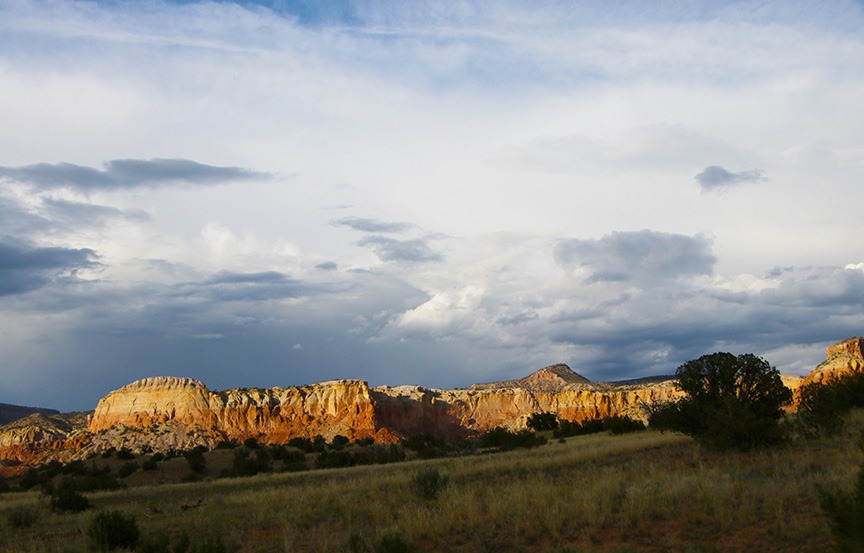
This feeling arose in me recently on a trip to New Mexico. The place in mind and heart is Ghost Ranch, which most people associate with the artist Georgia O’Keeffe–her house and studio are there (and are now a museum). But my association began before I knew of O’Keeffe; I was eleven years old, and the ranch was journey’s end of a long family road trip west.

GR19

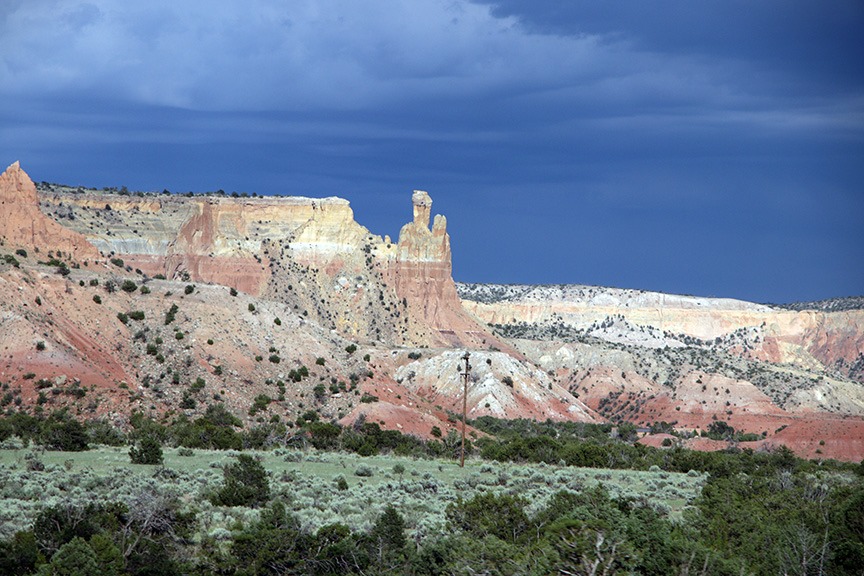
Chimney Rock, Ghost Ranch, Abiquiu, MN


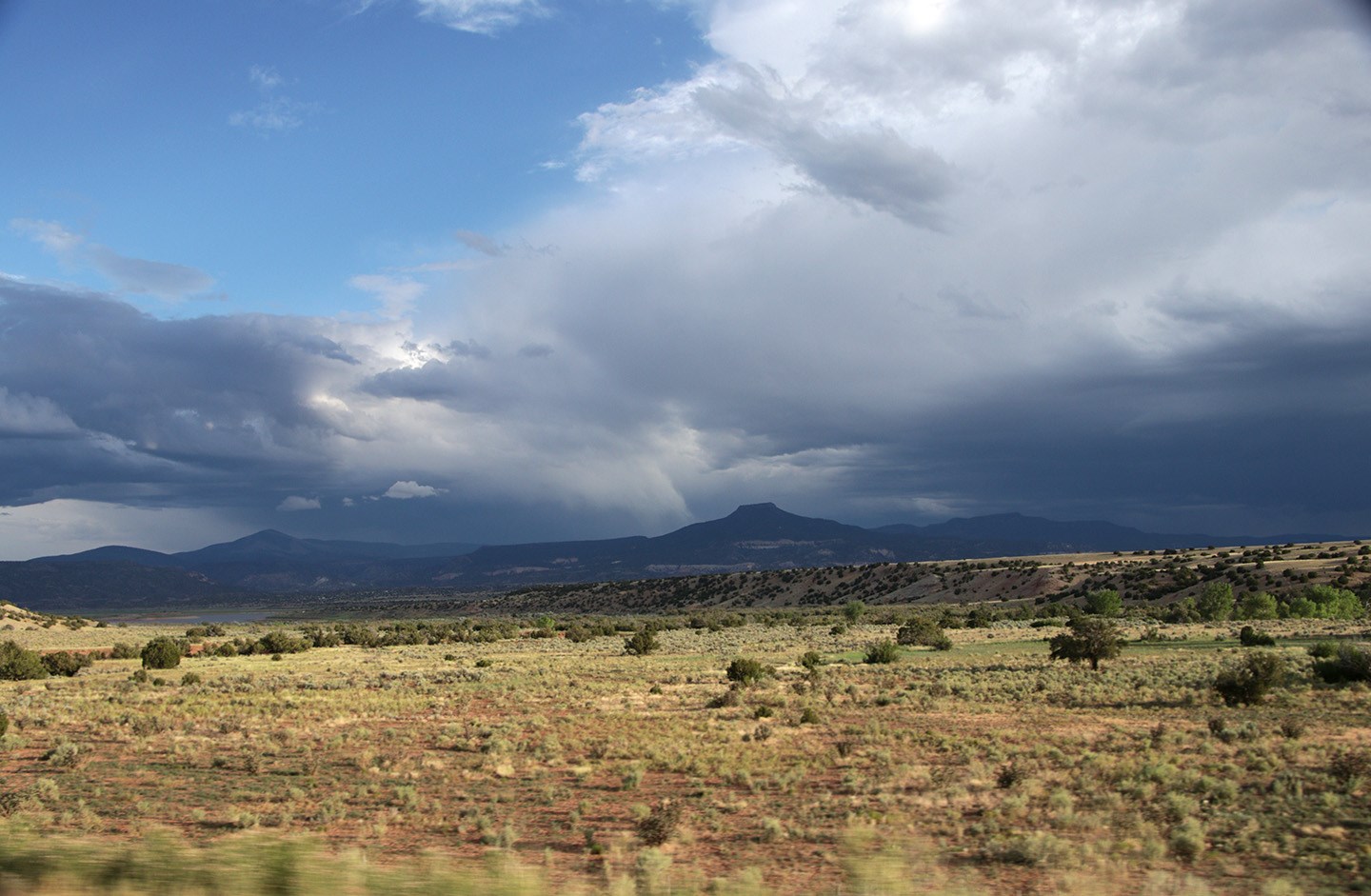
The summer days I spent there somehow lodged inside me with a sense of place–and space–that felt secure and comforting, despite the strangeness of the high desert environment to a child whose summers generally featured fireflies, long grass, cornfields, and leafy suburban streets. Ghost Ranch embraced me with its mesas curving around the flat, open scrubby meadow where the corral block houses sat. Chimney Rock watched over me. Pedernal loomed mysteriously in the deep, blue-purple distance. I still cannot explain why the place felt, and still feels, like a second home to me. If I believed in the existence of past lives, I would say I had lived there before. Topophilia.

pedernal storm