Slightly less difficult books

photo ann e. michaelI recently read Paul Bloom’s book Descartes’ Baby while simultaneously reading Daniel Dennett’s Content & Consciousness. Of these two, the latter falls a bit under the “difficult books” category, but it is not too hard to follow as philosophy goes. Dennett’s book is his first–the ideas that evolved as his PhD thesis–and in these arguments it is easy to see his trademark humor and his deep interest in the ways neurology and psychology have aspects useful to philosophy. Bloom’s book, a somewhat easier read, suggests that the mind-body problem evolved naturally from human development: young children are “essentialists” for whom dualism is innate; Descartes simply managed to write particularly well about the evolutionary project (with which, I should note, Bloom disagrees; as a cognitive psychologist, he maintains a more materialist stance).

It turns out that because I have read widely if shallowly in the areas of philosophy, cognitive psychology, evolution, art, aesthetics, and story-making, I find myself able to recognize the sources and allusions in texts such as these. Quine, Popper, Darwin, Pinker, and Wittgenstein; Schubert, Kant, Keats, Dostoevsky, Rilke…years of learning what to read next based on what I am currently reading have prepared me for potentially difficult books. [Next up, Gilbert Ryle and possibly Berkeley.] I don’t know why I feel so surprised and happy about this. It’s as though I finally realized I am a grownup!

And I am glad to discover I am not yet too old to learn new things, young enough to remember things I know, and intellectually flexible enough to apply the information to other topic areas. Synthesis! Building upon previously-laid foundations! Maslow’s theory of humanistic education! Bloom’s taxonomy! The autodidact at work in her solitary effort at a personal pedagogy.

If I ever really discover what consciousness is, I’ll let you know.


Dozens of views

No one has ever found the traces of memory in a brain cell. Nor are your imagination, your desires, your intentions in a brain cell. Nothing that makes us human is there.

Deeprak Chopra

Chopra is not my favorite writer on consciousness, but he does an adequate job of explaining complicated concepts to people who are just getting accustomed to questioning experience and who are beginning to be open-minded about the mind, the body, and beyond. So often, we have been raised not to doubt, told what God is and is not, and trained into beliefs about the truth. This, in spite of the common human trait of curiosity that asks: who and where are we in the world? What makes me me? What happens when I die? Chopra, with his medical background and his experience spanning several major cultures, can offer both a great deal of information and pose provocative questions to his readers.

In our technologically-obsessed culture, it is easy to turn to science as foremost authority; I happen to be fascinated by neurology and neuropsychology when it comes to consciousness, for example, but I never rule out so-called spiritual insights. Chopra’s writing often falls into the fallacy of stating “there are two views,” when in fact there are dozens of views, even among scientists. My guess (it is but a guess) is that the either/or form of presenting perspective is simpler for the “average reader”–as defined by his editor–to understand. Yet it seems to me a slight to the average reader to narrow these big questions down to “two views.”

Here’s an example, just one of many in his writing:

There are two views about consciousness in science today. One is that consciousness is an emergent property of the brain and. therefore, also an emergent property of evolution. That’s the materialist, reductionist view. There’s another view…[that] holds that consciousness is not an emergent property but inherent in the universe.

Now, I genuinely prefer what Chopra calls the “mind first” argument in which consciousness is a kind of field effect. I would not, however, suggest that matter first and mind first are the only two views today’s scientists hold; and neither would anyone else who has read a number of the elegantly-argued, well-researched, thoughtful, passionate blogs of today’s science researchers. The majority of them are atheists, but some are agnostics and some are inclined toward non-theist teachings such as Zen. Even among the ranks of non-believers (in terms of an anchoring eternal presence or god), the question of consciousness leads to intriguing inquiries.

The philosophers of today cannot ignore scientific advances any more than Maimonides could in the 12th century. Physics is a thing! as my students might put it. For the ways in which this relates to the science of neurology, I return to the framework on consciousness proposed by Douglas Hofstadter in his book I Am a Strange Loop.

What is the world but consciousness? Or illusion, in Hindu and Buddhist teachings (Maya) and, in a slightly different but related way, in Plato. And how many perspectives are there on that consciousness?

Chopra would probably say that each of us has to experience a state of awareness and interaction with whatever deep potential “god” or the creating principle offers for us. Which basically admits of not merely dozens but billions of unique interactions or perspectives…if we even agree to the schema.

goldenrod (solidago) going to seed

goldenrod (solidago) going to seed

Painfully conscious

I’ve just finished reading Melanie Thernstrom’s 2011 book The Pain Chronicles, a journalist’s inquiry into the concepts that “define” pain and the medical discoveries concerning chronic pain, in addition to a bit of memoir as a narrative device. Although I have experience with chronic pain myself, the part of the text that most interested me comes in her concluding chapters, in which she gathers the variously-disciplined evidence of her enterprise to suggest that pain is the ultimate test of the mind-body problem (thank you, René Descartes). The experts Thernstrom interviews disagree on how much we do know or can know about the human brain and how it processes anything, let alone such a complicated psycho-physiological event as pain. Some of them believe human beings will make enormous technological discoveries to unlock our brains’ workings, but the majority seem to have learned from research that each “a-ha!” leads only to further complications. Discussing the outlook for future fMRI scanning in brain research, Dr. John Keltner tells the author:

[N]obody has come up with a rich and complicated enough model to analyze the complexity of the distributed patterns of neural  networks and deduce anything like underlying rules…We’re literally grappling with the fundamental aspects of human beings. We naively believed that pain is simple–it hurts or it doesn’t hurt–so there should be a single brain state we could see every time someone is in pain. But what we’ve stumbled into is the discovery that there’s a relative universe of hurt–that hurting is an immense, rich, and varied human experience associated with an unknown number of possible brain states.

I find some of these analogies, and some of this language, appealing–I can think of poems that express “a universe of hurt.” I embrace the idea that hurting is immense, rich, varied, and human–we are aware (conscious) that we hurt, that others hurt, that hurt can be painful even when it is not caused by a toothache but through loss of a friend or lover…the beloved other, the pain in ourselves. Isn’t compassion born of this awareness? Does art have a place here, too? I wonder.

Thernstrom concludes with the agreement of several expert researchers: “pain and suffering are properties of the mind” [my italics]. That means pain is, at least in part, a property of that elusive thing we generally call consciousness. Scott Fishman of UC Davis explains that “[t]he mind is like a virtual organ–it doesn’t  have a physical address that we know of.” Consciousness, these researchers imply, is not merely the sum of firing neurons, a process that can be considered on some level mechanical. Thernstrom asks, “Do we need to understand consciousness itself in order to understand pain?”

If so, that is a tall order, one the author posits is analogous to understanding aesthetics (what is beauty?). But though the task appears daunting, the discoveries en route make the trek valuable.

Even if we never understand the answer.

neural matrix fiber topography, Johns Hopkins University

neural matrix fiber topography, Johns Hopkins University

Buddhism, philosophy, consciousness (poetry)

IMG_1440~

Sometimes, a startling morning.

A few minutes that feel time-free, when the phrase “Be here now” inheres in the body, the air, the mind, the moment.

Free to recognize consciousness as a grounding, not as an end-in-itself. Part of the world, part of the cosmos.

~

Reflecting, I realize another thing: poetry does that for me, hands me a moment. When I listen to or read a poem, it moves me into a moment suspended in “now-ness.” I am with Seamus Heaney’s father, digging; I watch the horses in Maxine Kumin’s field. The poems that move me do so by allowing me, the reader, to enter that moment or that consciousness, that perspective, which I may or may not relate to, and may or may not layer through perspectives of my own. Yet there I am, in a real way.

~excerpt from “Digging” (see this link for the whole poem, and audio)~

Under my window, a clean rasping sound
When the spade sinks into gravelly ground:
My father, digging. I look down


Till his straining rump among the flowerbeds
Bends low, comes up twenty years away
Stooping in rhythm through potato drills
Where he was digging.


The coarse boot nestled on the lug, the shaft
Against the inside knee was levered firmly.
He rooted out tall tops, buried the bright edge deep
To scatter new potatoes that we picked,
Loving their cool hardness in our hands.


By God, the old man could handle a spade.
Just like his old man.

objects, stories

contemplation

~

Sometimes the momentary sense of time-free, liberated unity occurs on its own, smacks me by surprise. Or it may arise from mediation, contemplation, or during “mindless” work–such as digging.

Philosophy and criticism tend not to evoke that sort of free consciousness. They require the brain to operate in a different way, a distancing from one-ness; but I like that sort of brain-work because the intelligent and inquisitive people who write, or write about, philosophy, neurology, psychology, and criticism of all kinds offer insights I would not likely find on my own. They ask the interesting questions (it doesn’t matter to me if they do not have the answers).

~

So there’s a balance, right?

~

Poets also ask the interesting questions. Through reading a good poem, I am there in the poet’s moment, curious and uncertain. It is a kind of contemplative practice to read, with an open mind and an open heart, poetry.

(The criticism and the analysis come later. Let them wait!)


Noesis

noesis~

  1. Cognition; perception.
    2. The exercise of reason.

Interesting that definition number two is dependent upon definition number one. Lately I have been thinking about the difference between consciousness and conscience; the latter seems to me to be specifically human, I guess, because isn’t conscience a sort of cultural or judgmental entity based upon rules? Yes, I am talking about morality, a term I tend not to use much when I consider cognition, consciousness, narrative, being.

I recently perused Patricia Churchland’s Braintrust and found myself intrigued about where and in what ways morality and consciousness or sentience mesh. Churchland is a moral philosopher, but this book relies largely on arguments premised on neurology, biology, evolution, and animal studies. Her critics pose interesting rebuttals, too. I found her book readable and often convincing–and it’s the kind of book that leads me to other writers and scientists; I love that in a book!

braintrust~

The phenomenology of consciousness–the carbon body brain-based “real world” idea of the word–involves intentionality, sentience, qualia, and first-person perspective. We can identify qualities based upon our first-person consciousness and respond to them. This process has led Western thinkers toward the concept of reason or rational thinking. The exercise of reason derives from perception.

This does not mean that phenomenology is the sole form of consciousness or even that it is necessarily human-only, but it seems to me to be the easiest one for human beings to wrap their minds around. Yet the earlier philosophers were not phenomenologists. Their speculations about what consciousness originated in and what morality inhered in were quite abstract.

For a good sum-up of how contemporary scholars define and discuss consciousness, go to Stanford’s site here.

~

Being cognizant or conscious does not necessarily lead to moral behavior or reason…or does it? Here we have an idea that has been debated for centuries. In her book, Churchland often returns to Hume, who wrote about morality from what, eventually, became known as the utilitarian stance (though I would argue Hume is not really utilitarian). Stanford offers an overview of morality as defined by philosophers over the years; The Internet Encyclopedia of Philosophy says this of Hume:

In epistemology, he questioned common notions of personal identity, and argued that there is no permanent “self” that continues over time. He dismissed standard accounts of causality and argued that our conceptions of cause-effect relations are grounded in habits of thinking, rather than in the perception of causal forces in the external world itself. He defended the skeptical position that human reason is inherently contradictory, and it is only through naturally-instilled beliefs that we can navigate our way through common life.

These concepts should feel modern to most of us thanks to cultural anthropology, sociology, and psychology, among other disciplines. Hume’s position conflicts with much religious dogma, but his ideas were not out of line with many of his fellow Enlightenment-Era thinkers. During the Enlightenment, intellectuals were enamored of the exercise of reason (noesis).

~

So: consciousness and conscience. First we have the one–however it arises within us*–and the other develops (or evolves?) thanks to the need for social beings to navigate common life. And thanks, perhaps, to brain evolution adapting to social common life (see Churchland for more on this).

Much to mull over during my brief summer break.

~

Jiminy Cricket copyright Walt Disney Co.

Jiminy Cricket copyright Walt Disney Co.

*See my numerous previous posts on consciousness!

⇐ “And always let your conscience be your guide!”


Unknowable

While reading up on some recent theories on evolution and reading for the first time (other than in excerpts) The Descent of Man, and Selection in Relation to Sex by Charles Darwin, I have returned to mulling over the problem of consciousness. What fascinates me is how this topic (consciousness) overlaps with philosophy, physiology, evolution–how and why we developed the brains we have with their attendant egos, theory of self, what-have-you–and with human constructs such as art and religion and morality, which I value for complicated reasons.

And out of curiosity, I took up Barbara Ehrenreich’s Living with a Wild God, which seemed to me a departure from her books until I realized that I was unfamiliar with her earlier work.

Ehrenreich’s book stems from her inquiry into a period of her own late adolescence when she experienced a kind of awakening that defied expression. For another sort of person, this might have been a spiritual encounter; but she was a self-described solipsist atheist who wanted explanations. The why of the world mattered to her–she was headed toward an education in science at Reed and Columbia University, though she did not know that yet when she had her ecstatic sensation. Reading Living with a Wild God reminded me of watching an animal tear and tear and worry at a carcass, not quite able to let go. The author fumes at her younger self for being so unforthcoming with details and suggests she may have been having a dissociative event, a small psychological break. Yet there were no symptoms of such a problem in her diary or in her memory.

She writes a bit about psychology, human consciousness, adolescent daydreaming, rational thinking versus imaginative beliefs, systematic or otherwise. After considerable wrestling and intriguing memoir, she admits that all she can do is speculate about what she felt:

There were no visions, no prophetic voices or visits by totemic animals, just this blazing everywhere. Something poured into me and I poured out into it. This was not the passive, beatific merger with “the All” as described by the Eastern mystics. It was a furious encounter with a living substance that was coming at me through all things at once, and one reason for the terrible wordlessness of the experience is that you cannot observe a fire really closely without becoming part of it…you will be recruited into the flame and made indistinguishable from the rest of the blaze…the only condition was overflow. ‘Ecstasy’ would be the word for this, but only if you are willing to acknowledge that ecstasy does not occupy the same spectrum as happiness or euphoria, that it participates in the anguish of loss and can resemble an outbreak of violence.

In the Bhagavad-gita, when Arjuna sees Krishna-manifest-as-All, the experience is not beatific, any more than Moses’ encounter with God as the burning bush relates an enmeshing with the One; the sense of merger with the energetic being remains absent–there is awe and a sensation that the human consciousness has been irrevocably rattled, altered, changed, but not that the human consciousness melds with that unknowable and indescribable Other.

What drew me to this book is that I had similar, though briefer, experiences when I was young. They tended to occur in flashes, and I associate them now with daydreaming and with a “losing of self”–I really have no words for it, though Ehrenreich’s “overflow” seems about right…one reason Bachelard’s writings on childhood and reverie resonate with me. It’s heartening to find another person, a well-known author, who also has found the experience impossible to formulate in language. I especially appreciate her suggesting “that ecstasy does not occupy the same spectrum as happiness or euphoria, that it participates in the anguish of loss and can resemble an outbreak of violence.” I identify deeply.

Some meditative practices aim to erase, temporarily, the boundaries that keep us from being truly in the world. Some religious practices aim to make the faithful “one with” the deity. Ehrenreich does not possess the kind of mind or personality that seeks answers in those ways. She’s frighteningly intelligent, well-educated, worldly, scholarly, sensible, socially and culturally aware, fiercely atheistic. Yet she cannot quite believe that what she felt, saw, knew, in her body and in her mind, was “simply” something her brain invented. After 50 years, she continues to wonder. I sense she is still tearing obsessively at the unresolved.

Maybe that is enough, to wonder. At any rate, wondering may be as far toward why as any of us human beings will ever get.

Awareness, openness, & … magic mushrooms?

In a recent New Yorker article about potential medical uses for psilocybin (“The Trip Treatment”), science, culture, and food writer Michael Pollan interviewed researchers in neuroscience, medicine, and psychology. The medical potential of psychedelic drugs is not something I can comment on from reading just one article; what intrigued me most about this piece is how these drug studies overlap with studies on cognition, metacognition, consciousness, and spirituality. The medically-controlled “tripping” that volunteers have undergone overwhelmingly resulted in some form of what we term mystical or spiritual (for lack of a scientific term) feeling.

It’s almost impossible to consider these realms of experience without questioning concepts such as “soul” or “self-awareness.” Pollan writes:

Roland Griffiths is willing to consider the challenge that the mystical experience poses to the prevailing scientific paradigm. He conceded that “authenticity is a scientific question not yet answered” and that all that scientists have to go by is what people tell them about their experiences. But he pointed out that the same is true for much more familiar mental phenomena.

“What about the miracle that we are conscious? Just think about that for a second, that we are aware we’re aware!”

A man after my own heart. It is amazing, a kind of miracle. And we get consciousness and metacognition without any drug intervention at all. It just springs into our beings at some point, as we create ourselves from lived events and construct speculative worlds and an understanding (though often flawed) of other minds.

Here is another fascinating result from the psilocybin studies that may make us revise our ideas of interpersonal relationships, personhood, and creating a self. Pollan writes:

A follow-up study by Katherine MacLean, a psychologist in Griffiths’s lab, found that the psilocybin experience also had a positive and lasting effect on the personality of most participants. This is a striking result, since the conventional wisdom in psychology holds that personality is usually fixed by age thirty and thereafter is unlikely to substantially change. But more than a year after their psilocybin sessions volunteers who had had the most complete mystical experiences showed significant increases in their “openness,” one of the five domains that psychologists look at in assessing personality traits. (The others are conscientiousness, extroversion, agreeableness, and neuroticism.) Openness, which encompasses aesthetic appreciation, imagination, and tolerance of others’ viewpoints, is a good predictor of creativity.   [italics mine]

Openness, aesthetic appreciation, imagination, tolerance, creativity…and one researcher in neuropsychopharmacology suggests that this sort of un-boundaried openness signifies a temporary regression to an infantile state, very much as Freud hypothesized. I thought instead of Bachelard and the childhood reverie state.

Intriguing, that pharmacological work of this sort makes neuroscientists resort to citing William James and Sigmund Freud on mystical experience and the subconscious!

[Robin] Carhart-Harris believes that people suffering from other mental disorders characterized by excessively rigid patterns of thinking, such as addiction and obsessive-compulsive disorder, could benefit from psychedelics, which “disrupt stereotyped patterns of thought and behavior.” In his view, all these disorders are, in a sense, ailments of the ego. He also thinks that this disruption could promote more creative thinking. It may be that some brains could benefit from a little less order.    [italics mine]

I wonder if the aesthetic experience itself, when wholly engaged, can sometimes act like a drug on the art-viewer’s or art-maker’s being. When one reads the poem that rearranges one’s world, doesn’t it disrupt stereotyped, familiar, habitual patterns of thought? That’s what happens for me when I encounter great art of any kind. It is close to mystical.

~


Consciousness as story

Some recent questions to myself:

Reading philosophy and psychology for so many years, was I looking all along for an explanation of consciousness?

Through neurological and evolutionary science, and more philosophy and more psychology and, in addition, some anthropology, some history. And fiction. And rhetoric. Trying, perhaps, to understand the self? Through criticism, through art, through literature?

Looking carefully at art, reading literature closely: were those also endeavors to comprehend what mind is? Other minds? My own mind? Through the creative act, perhaps?

Is the ars poetica a kind of manifesto of human consciousness from an individual perspective, yet open to interpretation by other human minds? And the beautiful–what is it that even makes beauty a significant concept? Where did that come from? Evolution and the sexual drive (see Dutton riffing on Darwin)? Society? Synthesis? Ego? Inspiration? Angels?

Is every story a scaffold to consciousness? A hedge against oblivion? (Self-oblivion, the hardest navigation act there is: depression, hopelessness, loss of self-knowledge, coma).

I wonder if the stories we tell to others and to ourselves, employing memory selectively whether or not we realize it, act as a kind of (modern-day, metaphorical) Chain of Being through which we develop Theory of Mind and, beyond that, a sense not just of ego but of neurological consciousness. If stories are what make us human.

~

The chain of being, from Charles Bonnet, Œuvres d'histoire naturelle et de philosophie, 1779-83

The chain of being, from Charles Bonnet, Œuvres d’histoire naturelle et de philosophie, 1779-83

[Note: I do not hold the medieval concept of a hierarchy in which Man, angels, and God stand above all other things; the stone and the plankton have as much value–likely more–than I do in the workings of the cosmos, as far as I am concerned. I post this Enlightenment-Era engraving here for metaphorical and aesthetic reasons because I take pleasure in the delightful monkey.]

~

Stories have tremendous value to human beings in ways we are still discovering; see my previous posts here, here, here, and here (among others). I keep coming across claims for the significance of story in surprising places–most recently in Dutton’s The Art Instinct and in Atul Gawande’s latest book, Being Mortal. Widely different texts, similar observations.

How is it we know who it is we are?

Possibly, in the process of inventing the story of ourselves, we become human. Perhaps the story of ourselves is fundamental to conscious “human” minds.

Speculation. But I love recalling that my children, when they were very very young, consistently made one particular demand of me: “Mama, tell me a story!”

~

A good start. Possibly.

My most recent reading material is The Feeling of What Happens: Body and Emotion in the Making of Consciousness, by Antonio Damasio. Damasio is convincingly on the neurological/evolutionary trail to recognizing how consciousness operates and why we have developed it, though he allows for mysteries we do not yet and may never understand.

Damasio is clearly not a dualist who thinks the consciousness can exist separately from the body (one of his previous books is aptly titled Descartes’ Error). He doesn’t address the “soul” in The Feeling of What Happens, but argues that reason requires feeling in order to operate effectively, that feeling is a more “conscious” form of emotion, which is “unknowing” in the sense we call consciousness and is founded upon core consciousness, which is reliant upon the physical organism…a vastly complex array of cells, nerves, you name it, generally self-regulating and not by nature in particular need of a conscious mind.

So next time someone tries to explain why a situation happened and just says, “It’s complicated,” maybe you ought to accept that. Because, apparently, it’s really really really complicated!

http://www.isys.ucl.ac.be/descartes/images/Descartes.gifThat does not keep people like Damasio from trying to track down what goes on in the minds of sentient beings.

Having just read Flow, I immediately thought of what Csikszentmihalyi says about the way true flow experiences depend upon deepening levels of complexity–that’s how we keep from becoming bored by routinization of a task. Dennett suggests that consciousness consists of layers: “multiple drafts,” and Damasio calls the human brain, and the brain-body unit, a series of “systems within systems.” But there is no little self, no metaphorical or actual homunculus, at the very bottom of the system, or at the very top. There are only more and varied connections, he asserts–with profound respect and amazement at what biology has wrought.

I also thought about Csikszentmihalyi’s idea of a life project. Some years ago, I began a journal devoted to exploring my poetic project and learned that I do not really think about my writing as a project per se, at least not in the formal sense of poetics. [Here’s Dorothea Lasky harping on the whole concept of a poetic project, in a bit of refutation aimed at poetry critic David Orr.]

What I think I was doing, in fact, was trying to figure out my life project, in the way Csikszentmihalyi defines that concept. What is my life’s philosophy in terms of guiding tasks, principles, goals, projects, challenges? Is teaching part of the package? Motherhood? Gardening? Writing? Human relationships? Learning? Speaking of human consciousness, do I have a conscious path or goal?

Maybe my goal is to keep on amid the complexity and to relish it as much as possible, since it is unavoidable. And perhaps by accepting the complications, I will find my life becomes simpler. That could be a possible outcome–right?

I think of Reineke writing on Marcel Proust’s narrator and his struggle with status, jealousy, conformity, and desire. I read the Proust novel(s) when I was in my early 20s and found his narrator frustratingly neurotic but also a little too familiar, as my life experiences in many ways mirrored his. Eventually, he learns that the way to cure the pain of desire is to discipline himself to let go of desire itself; (and no, neither Proust nor his narrator were Buddhist).

And what happens when he gains this recognition is that he can write the novel. He develops flow, and a life project.

I am past 50, a good time to establish more consciously what my life project is. I know it involves relentlessly and joyously learning new things. I think it will include poetry in some way. And discipline of some kind, conscious effort. For now, those things constitute a good start.


Flow & dough

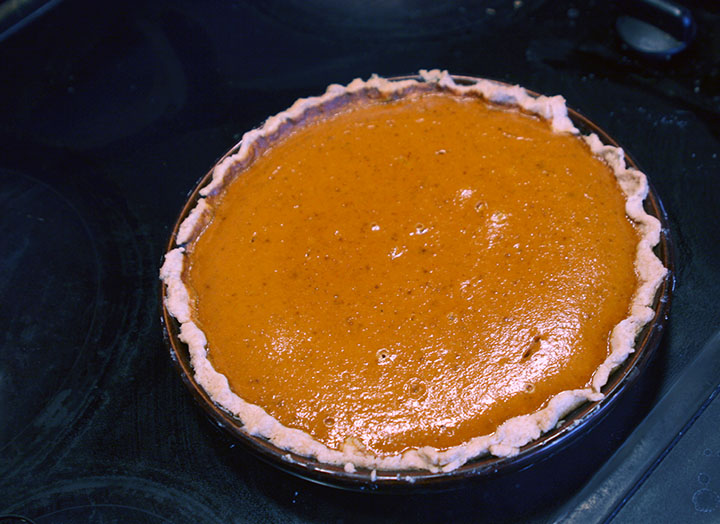
I have no doubt that, for some people, making pies is a flow experience. I’m reasonably certain that my grandmothers, and sometimes my mother, felt a sense of flow when pie-making: fully engaged in the process, challenged, immersed, and enjoying the fulfillment of a task as it evolves. Making pies can be intrinsically rewarding, but–alas–for me, it is a bit too much of a challenge and the purpose is generally extrinsic (though a good pie is surely worth the effort).

Today I made pie in preparation for the Thanksgiving feast we celebrate here in the USA. But I feel more of a sense of flow when I am cleaning up the mess I made in the kitchen and stopping occasionally to gaze out the window at the falling snow and the sweet little juncos hopping along the porch railing. The actual process of rolling a pie crust involves, in my case, swearing and cussing and patching torn dough. I am positive that my Methodist grandmother never resorted to salty language while pie-making, but I imagine she may have also enjoyed glancing up from her work and appreciating a view, a fellow-creature, something aesthetic or pleasant to behold in the midst of family life.

The activities that keep me actively entranced and purposeful do not include making pies. My re-reading of Mihaly Csikszentmihalyi’s book, however, has reminded me that feeling happy means making meaning in my life and continually seeking out challenges that offer me a sense of building a conscious self and a disciplined, mindful attitude toward life.

Even if I never get really expertly engaged with concocting desserts, I can find some sort of flow throughout my days through reading, art, gardening, writing, tai chi, interactions with friends and family members. And who knows what else? There is so much to learn; that is what I feel most thankful for today.

Not the prettiest pie.

Not the prettiest pie.

Here’s a TED talk by Csikszentmihalyi, if you want to hear more about flow & happiness.