Energy & stamina

I have been thinking about energy and stamina, and the difference between the two, and how they relate to creative practice. The word “energy” conjures up, for me, vigor and forcefulness, vitality, strength–a sort of bustling intensity, the kind my son exhibited when he was five years old, for example. I have never considered myself a particularly high-energy person.

Think of the cat. A cat is capable of intense bursts of energy but will also husband that energy until the moment it’s needed. The cat will also sleep most of the day, storing up energy for the necessary predatory expenditures of strength. The feline form of energy use does not suit me very well, though I am partial to naps.

Stamina, however–stamina I have possessed. Stamina is also strength, also energy, but it is of a different nature. Plodding sometimes, headlong other times, but steady in the main. The sort of focus and determination a person needs to get through the long haul strikes me as stamina. Stamina is the energy to endure.
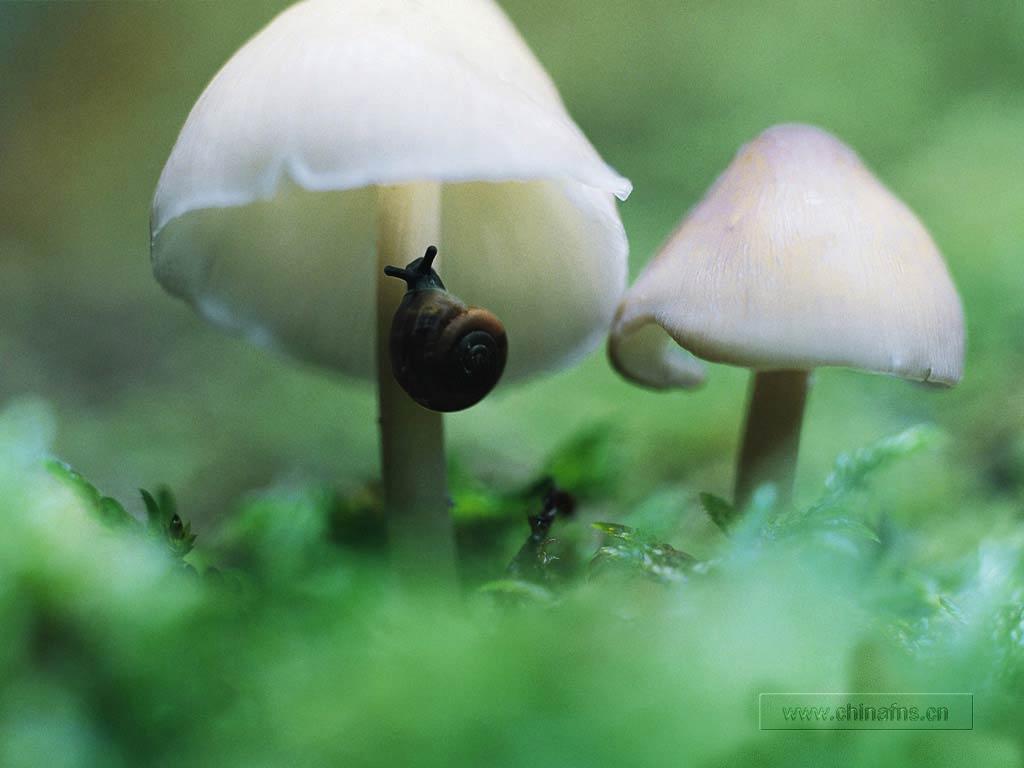
free kewlwallpaperWe have the mayfly and the bee, always buzzing actively, bursting with lively energy. Or the cat, conserving and then pulsing with strength and force. And we have the snail, constant and enduring, slowly edging its way toward its object.

My writing practice requires endurance, because I only occasionally get flashes of inspiration or insight and rarely feel surges of creative energy. Nonetheless, I have been told I am a “prolific” writer (by whose standards, I always wonder; compared to Georges Simenon and Alexandre Dumas, I am a piker). I think the reason is that I keep on. Everyone experiences setbacks, rejection, dry spells, discouragement, dull days. How we choose to deal with those situations becomes part of our practice of the discipline of art, and many approaches “work.” Whenever I read biographies of artists of any kind, or interviews with poets and writers and choreographers and composers, I recognize that (despite post-modernist critique) the life, in terms of personality and approach, does to some degree influence the art.

But the results are impossible to stereotype. A talkative, energetic artist may produce quiescent, meditative art. A dour personality can produce hopeful poetry, a still and soft-spoken person may create fierce, kinetic work.

A highly energetic person like Rimbaud can “burn out” on a major art form rapidly (though his busily-spinning, adventurous life kept going). And then there are the energetic sorts who just keep making work with boundless, apparently inexhaustible fire (see Simenon). One method or personality is not better nor more suited to art than another.

~

This is my minuscule revelation for the day: The one time I visited a shaman, I was told that my totem animal is the snail. The idea gave me a moment’s pause, but then seemed somehow very apt.

Except I was a little queasy about the slime trail.

~

I decided I can reframe the fact of slime once I recognize its purpose. It is not merely a lubricant, helping the gastropod to glide along, but also a glue that enables the creature to climb difficult surfaces, walls, and even ceilings. The layer of mucous also acts to protect the snail from dehydrating.

There must be a metaphor there somewhere. Poetry as…snail slime?

~

Time to keep plugging away, I  think.
Not a dry spell

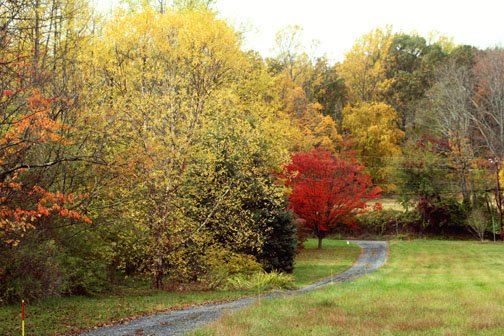
October arrived in a remarkably ordinary way, considering how inconsistent the weather in my valley has been during the past year. There were a few clear days of brilliant sky, some heavy breezes with leaves beginning to drift into the lawn, a couple of glorious autumn days–mild and crisp–followed by a spate of rain and humid air (and toadstools and mushrooms cropping up everywhere), a further yellowing and reddening of foliage, and then, chilly rain.

This is “normal” weather for our area in early- to mid-October. Although the heavy skies and damp chill are not always welcomed by residents, including me, the gardener in me feels relieved. We need the rain and the coming dormancy. The birds relish the late, large insects that frequent gutters and fields, ponds and puddles, providing proteins for a trip south or for winter ahead. Seeds need the watering-in and the cooling-down. Trees need reminders to store their nutrients deep inside when the cold air really sets in.

And pretty soon, I will have bulbs to plant. I want the soil to be moist enough to dig up and the ground temperature cool enough to keep the daffodils still and quiet for several months.

Some years, I write prolifically in autumn; it’s as though the change in season effects a kind of transition within me, and creativity abounds. Other years, not so much. I do notice that when I spend a good deal of time out in the garden, I write more. This fall has not been that kind of season. I have been busy with writing tasks that do not exercise the philosophical or metaphysical side of myself–though I have been writing, most of the work has been reviews, proposals, pedagogy.  I will be posting links to the reviews and essays on the sidebar to the right, adding to the list…

Should fortune–and the Muse–smile upon me, there may be a few new links to poems, as well, in the coming weeks. In November, I’ll be giving a few readings locally. In January, I’ll be teaching Introduction to Poetry again, and I’m eager to try new texts for my students.

Perhaps the post-equinox period will have a creative harvest after all.

Ambition & failure

Some of my non-writer friends are surprised to learn that I am in the process of trying to get a new book into print. After all, Water-Rites just came out! So shouldn’t I be concentrating on selling that book and resting on my laurels awhile? To be sure this collection is a “success” before continuing on?

Those who write poetry or literary fiction, however, recognize that by the time a book finally gets published, the work in it is “old.” We are already well into new projects, working on new ideas, using new styles to express ourselves, addressing different topics. If I were to wait to write new poetry until after my book got into print, I’d probably never write another collection. The economics of the poetry world are too close to what Lewis Hyde calls the “gift economy” to imagine we can stop writing, sell a book, live off of the income and then write another one. Even many best-selling authors cannot do that. Poets are lucky to sell 500 copies of a book. We write for other reasons. Need. Love. Ambitions of a non-monetary kind.

Like all artists, poets take risks. Sometimes the changes we make in our work are not well-received. Sometimes they aren’t any good. Failure, however, can be a most excellent instructor. Sometimes, to shake myself up when the writing seems stuck, I attempt a completely different activity. Gardening clears my mind, and gardening offers many chances to fail at what I do. I’ve also tried watercolor painting, sumi ink calligraphy, modeling clay, embroidery, dancing, piano, and many other endeavors. I cannot claim to be remotely good at any of them yet each of these pursuits has taught me much…often through my lousiness.

janis ian

Janis Ian, 2012. Photo by David Sloan.

Recently, Janis Ian–singer, songwriter, science fiction author, and philanthropist–offered the commencement address at Warren Wilson College in Asheville, NC. In her speech, Ian talked about being self-taught; being a self-taught success. And she had important things to say about failing, as well. She said, “We are rarely asked what success really represents to us, or why failure is so demeaning.” Then, she admitted that she herself had always avoided failure but that at a point in her life when she felt unhappy with everything she was producing, “I had to learn to fail before I could find my way again.”

Her approach was to take ballet lessons! At age 33. And she was awful at it, but she enjoyed doing it. Then she attempted other things at which she was terrible, and she learned to overcome some of her fear of failing.

An autodidact myself, even though I do have academic degrees, I found I could easily relate to Ian’s experiences. The part of her speech that spoke to me most was this section:

“You see, I am an artist. I believe that art saves. I believe it is often the only thing that stands between us and chaos. I have faith that while the world is crumbling, art survives. So to feel like my work was a mockery of what I could do, that I was not living up to my talent…well, it was killing me.”

Art requires us to do our best, to be ambitious and strong, to take risks and –occasionally– to fail. To fail spectacularly perhaps, or just to produce a bunch of small, humiliating, stupid failures…like dancing badly in your own room where no one can see you.

But dancing can feel so wonderful, so freeing, so different from writing! It’s worth doing badly. Sometimes when we have less at stake, we find new methods of expression and new ways to keep our fears, including the fear of failure, at bay.

~~

The full speech is available on Warren Wilson’s site here.

Creative reading

“There is then creative reading as well as creative writing. When the mind is braced by labor and invention, the page of whatever book we read becomes luminous with manifold allusion.” —Ralph Waldo Emerson

~

There’s a difference between simple literacy and genuine reading; that difference is partly discovery, partly imagination, partly hard work, and largely enthusiasm.

“To have great poets, there must be great audiences too,” said Walt Whitman.

Yes, I know I have covered this ground in previous posts. What interests me, though, is the way working on my writing has made me a more active and imaginative reader than I once was. Which may seem an odd thing for a lifelong bookworm to say, but as Stephen King has observed, “If you don’t have time to read, you don’t have the time (or the tools) to write.” The implication here suggests these skills–or crafts, or tools, or processes–are conspecific. Conspecific is a science term meaning belonging to the same species, and I think it’s an apt word to describe what I am trying to say here. We can have stories without writing, but we cannot have writing without context, whether it is grocery lists or epic narratives; in the literate world, our texts provide us with practically boundless context if we use our imaginations to proceed beyond our physical, past, or immediate experiences into hitherto unknown worlds. When writing imaginatively, we have to engage with what we’ve learned through reading. The writer must be a reader.

Perhaps there are other forms of reading: listening, observation. But we are basically still within the taxa of story. My latest reading material is Brain Boyd’s immense and intriguing volume On the Origin of Stories. This book and Bachelard’s The Poetics of Reverie are producing quite an intellectual and creative mash-up in my mind and firing up some slower synapses that tend to lead to writing of one kind or another. I think there will be poems…sprung from luminous manifold allusions…because these authors have forced my mind into working while I explore the depths of their invention.

O, let us labor over our books with joy! For one never knows what will result.

Snow scene

photo Ann E. Michael

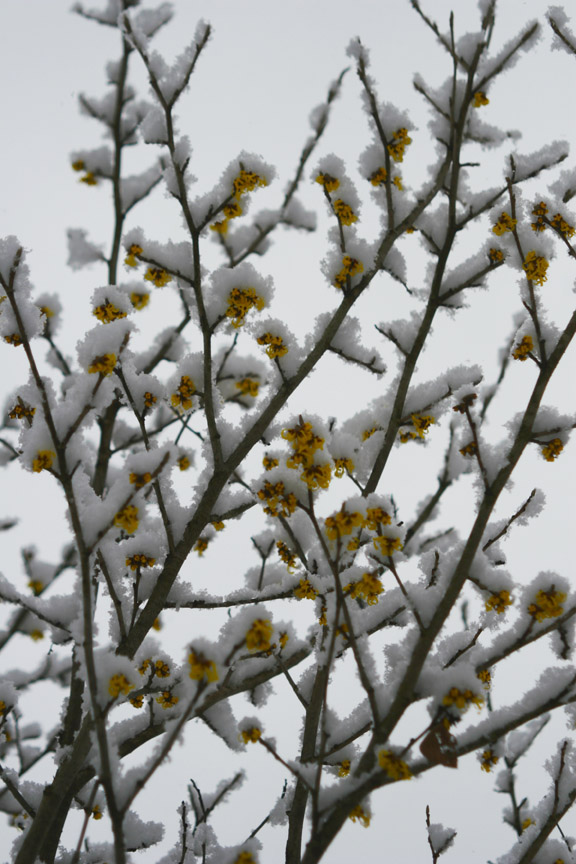
winterhazel

Temperate regions in zones 5 and 6 benefit from snow cover, which moistens soil as it melts and insulates the living things that depend upon soil–a cold “open” winter is particularly hard on plants. Except for an unusual late-autumn blizzard, this season has been mild; so I welcome today’s snow even as signs of spring become visible: a few blooms on the hazel boughs, some snowdrops, reddening stems in the hedgerow shrubs.

phot Ann E. Michael

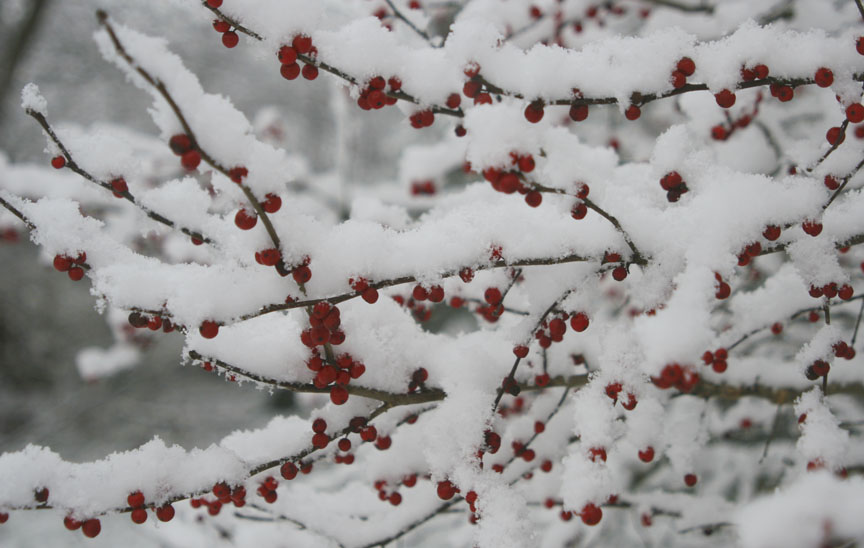
winterberries

Winterberries are beginning to shrivel, and soon bluebirds and the earliest robins will pick them off for sustenance before the grubs and insects are plentiful. Today, as winter gently asserts itself, there are revelations in the outlines of white against shadow. The squirrel dreys are visible, loaded with dollops of snow, amid treetops. The deer paths and deer beds are more obvious because those areas are flattened by use and thus blanketed more evenly than the surrounding grassy spots.

Meadow’s stalks droop in criss-crossed patterns. If I look closely enough, I can identify the species, dry and broken, tangled together and covered in snow: solidago, eupatoria, aster, clematis, ryegrass, penstemon, milkweed. The snow’s ephemeral, yet I find myself thinking of Steve Tobin’s Earth Bronzes.

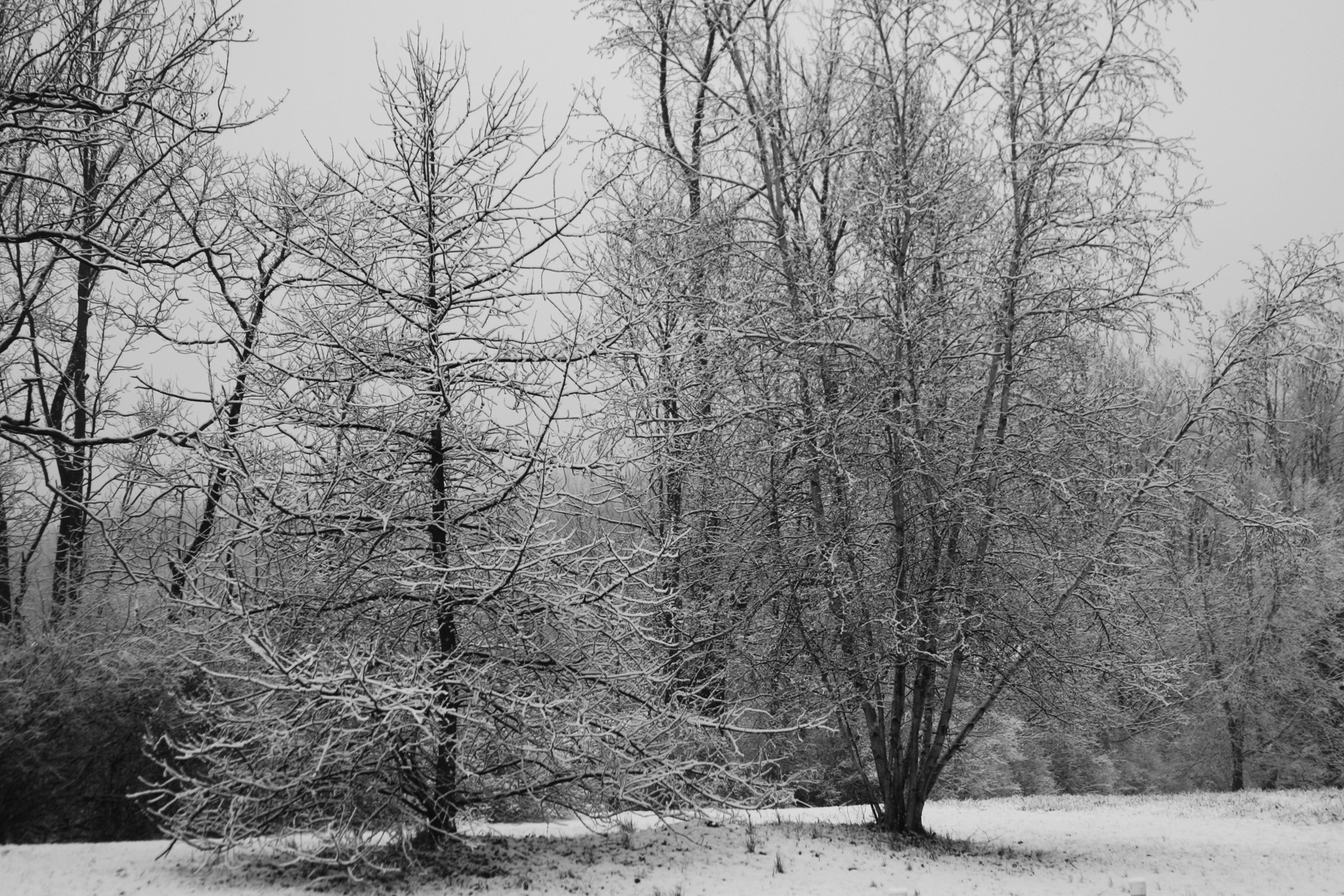
The ways shrubs and trees collect snow fascinate me, too; I love the fractal sketching of dogwood and Japanese maple, the calligraphic hatchwork of long-needled pines and the way thorns embrace little cups of ice along vine-y stems. I love the larch and birch that create the perfect image of lacework when a light snow coats their branches:

photo by Ann E. Michael

larch and birch

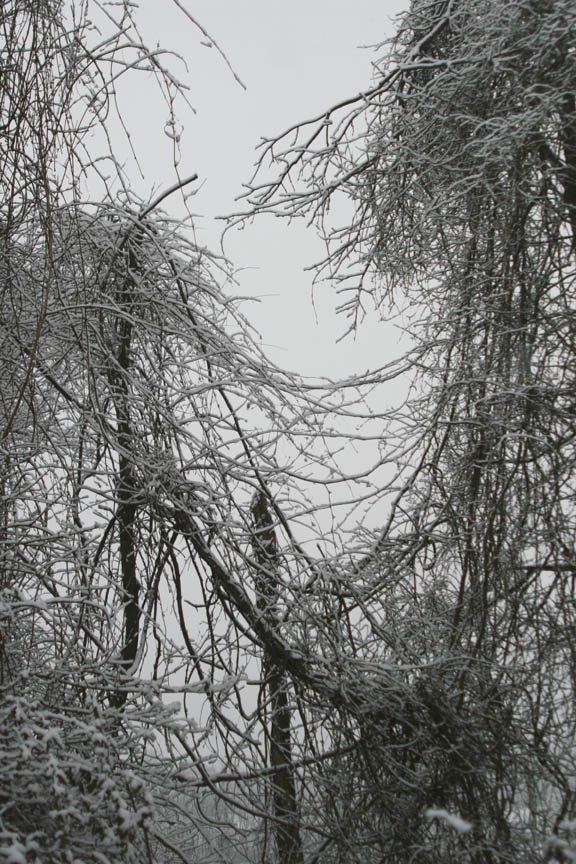
Overhead, vines rope trees together, creepers that take on a creepy mien, ghostly and dripping, when snow-covered. Vines have become a hazard in our region, with both native varieties (poinon ivy, wild grape) and non-natives (too many to name!) choking wooded areas, killing off tree crowns, usurping the niches of native plants, and adding to the hazards of storm damage.

Maybe that is why the ice-draped vines appear sinister to me.

And yet. A plant is neutral, alive, neither good nor bad, possesses no conscience, cannot be evil, plays its role in the environment–and can serve as inspiration. One woody tendril sways high above the ground, a line drawn against the featureless sky. Using a stick, I copy its shape in the snow at my feet. It might be part of an alphabet I do not know, an ideogram I have yet to decipher, the course of a river. Imagination steers from that point on: I take up my pen and write.

Inspiration

The word “inspiration” is from the Latin inspiratio: to blow into, to inflame. I began musing on inspiration today while on a walk with Spouse and Dog, during which the idea of muse came up in conversation (with Spouse; Dog kept her own silent counsel). He observed that he had never had a muse and asked if I had ever had one. I said I cannot think of ever having a person serve as my muse, but perhaps other things have played that role.

“Isn’t a muse a person?” he asked. We discussed, then, the difference—as each of us saw it—between a muse and a mentor. He has had mentors at various stages of his life; I think most of us encounter someone along the way who serves as a sage, a guide, a teacher, or as a role model. That person certainly offers a kind of inspiration. A muse, however, seems to connote inspiration of a different character or quality from mentorship. The muse acts as trigger, someone or something whose mere presence elicits a creative urge. The muse inflames, blows on the spark of creativity and ignites it.

Richard Hugo’s book The Triggering Town is justifiably famous among creative writers, particularly poets, for its author’s sensitive explanation of a source for the creative process and his description of how inspiration percolates into the creative act. He uses the example of American towns that act as triggers for memories or conjure of specific details of place and personhood. The town becomes muse. In a similar way, works of ekphrastic poetry may employ art as muse (though not always). For other creative people, music provides that initial flicker of inspiration—which seems especially fitting, given the word “music” originates from the word for the Greek muses themselves: mousike techne “art of the muses” from mousa, “muse.”

Mousa itself derives from the ancient proto-indo-european linguistic base *mon-men-mn, most closely associated with the meaning “to think, to remember.” Inspiration, though we feel it emotionally, psychologically, even physically at times, takes us into our minds, where the creativity takes place and can be formulated into art.

Much of my inspiration over the years has come from what people tend to term “the natural world”—as if we humans were not a part of that. But other things spur my creativity, including art and things I read. Having finally completed Parfit’s Reasons and Persons, I am now consuming more easily-digestible fare and finding much to inflame my interests in Alberto Manguel’s 1995 book A History of Reading, which I highly recommend.

Perhaps I will later find time to discuss the joys and pitfalls of reading several books at once. Meanwhile, I plan to spend the last light of a late winter afternoon observing hawks and woodpeckers.

Kalliope or Calliope, Athenian-style, the muse of epic poetry.

Non-sense

Let me pick up from my brief post of yesterday, which concerned in part the value of asking the nonsensical rather than (or in addition to) the rational question. What led me to that topic is the recent death, at age 101, of artist Dorothea Tanning, whose work–both visual and textual–is often considered surrealistic.

Surrealism goes in and out of fashion, and I am not planning to comment critically on its aesthetic value; but I will say that I have admired and been influenced by artists working in the surrealist oeuvre and that I enjoy the way “nonsense” and  “non-sense” can lead to juxtapositions of ideas and images that have proven fruitful for my own creative work process.

The nonsensical question may follow along the lines of:

How does the sunflower feel when a bird feeds on it?

Non-rational, because the sunflower does not–as far as we know, in the rational/sentient way–feel anything emotionally; the jury may be out on whether there are tactile receptors in a sunflower that can feel anything physically. To answer the nonsensical question in this case requires a kind of metaphor or animation of the inanimate. (We could also argue the inanimate status of a sunflower seed-head.)

Further nonsensical inquiry could lead us to “What does the goldfinch say to the sunflower?” or, more nonsensical still, “What would a sunflower say to an electric guitar?”

Non-rational prompts can provoke interesting results in the process of creative thinking.

Back to Tanning. Her life itself was a creative process. Check out the biographies of her that are popping up online in response to her death. While I am not a fan of all of her work in her various media, I love her vivid and exciting explorations. Here’s one of her early, less-experimental works that appeals to me because of its imagery. I identify with this painting.

“What would it feel like to wear a nest on one’s head?”
As a poet, she was strongest in the area of visual figures (no surprise there). I’m running out of time now, so I will close with an excerpt from one of Tanning’s poems:
There was a time
of middle distance, unforgettable,
a sort of lace-cut
flame-green filament
to ravish my
skin-tight eyes.
I take that back—
it was forgettable but not
entirely if you
consider my
heavenly bodies . . .
I loved them so.
Heaven’s motes sift
to salt-white—paint is ground
to silence; and I,
I am bound, unquiet,
a shade of blue
in the studio.
(The entire poem, “Sequestrienne,” is here.)
For another surrealist whose poetry is not always classically surreal, see my posts on Eluard .