& more difficult books…

Difficult books” ends up being one of my most-blogged-about topics. I like to challenge my brain with concepts that rattle the typical, with texts that force me to slow down and puzzle through my tangled thoughts. Right now, I am slowly reading two difficult but extremely rewarding books: Ann Lauterbach‘s The Night Sky: Writings on the Poetics of Experience and Elaine Scarry‘s The Body in Pain.

Both of these writers use plenty of source material that synthesizes (or sometimes argues with) their concepts and explorations. In many cases, these are books new to me, but Lauterbach also quotes from and is inspired by some of my own favorites: Whitman, Emerson, Dickinson, William James. Lauterbach combines what my students would call a geeky interest in theory (literary and social) with anecdote, musings, and a collaged or transgressive approach to the argument or critique. This is to say I admit I do not always know where she is going with her essays, even at the close of them. And yet–her interweavings fascinate, her choices surprise. She’s a master of the pithy definition (“Poetry is…”), but she allows for many perspectives, many definitions.

brad-hammonds-flikr-books

Brad Hammonds/Flickr Creative Commons

Scarry’s text covers a different domain, though theory certainly has a place in her book. The Body in Pain examines what pain is–semiotically, physically, its interiority, its defining characteristics, the portrayal of pain in art and literature and what that tells us about the body, the Self, and the shared understanding but individual experience of pain. I have not gotten much beyond the second chapter of her book, but I already feel myself inquisitive about aspects of human pain that I had never even considered before; who thinks about pain except when feeling, or anticipating feeling, pain? Of course we know what pain is–until we try to describe our experience of it to another person.

I’ve had that frustrating experience numerous times (here’s Ally Brosch of Hyperbole & a Half with the best solution to pain charts), but I have not devoted much time to exploring why pain is so individual despite our universal recognition of its existence; also, it had not occurred to me why we so often doubt others’ pain. Scarry says we have developed no particular understanding of the phenomenon, one reason she undertook the writing of this book.

Meanwhile, the semester continues apace and my students are interested in argument after all, it appears; and the bounty of late tomatoes has arrived with much processing to do before they all rot. My time spent blogging will be brief in the coming weeks. 🙂

 

On absence

I have experienced a felt absence lately, a sense of missing.

Maybe the world is too much with me. I have responses to the Stanford rape case, responses to the Syrian refugee crisis, to the US presidential campaign, to the mass murder at a gay nightclub in Orlando; responses to some personal challenges, as well–health: my own and loved ones’, among other concerns.

Responding represents the equal and opposite reaction to any action, in a Newtonian metaphor. And what my body and my mind these days are saying to me is “step back, reflect.”

Humans love immediacy–the rapid Twitter argument, the comments on opinion posts, the punch in the gut. Animals need rapid responses in order to negotiate a world of predator and prey; humans, however, (and, more than most of us realize, many other animals) also possess the ability to reflect on what the feelings are. What they may mean. How that meaning may alter our responding mechanisms. We can–if we pause to do so–put ourselves in the place of the Other, imagine different perspectives that may color our responses.

Sometimes, we may need to absent ourselves awhile. To put some distance between our feelings and the conflicts we engage in. We need feelings and we need thoughts, we need responses and we need observation from other viewpoints.

~

It occurs to me that poetry is the conversation between the rational, languaged mind and the mind of feeling and imagery. This effort involves the same mind at work on two or more fronts, the human brain constructed as it is to handle multiple levels of feedback, feedforward, and association.

Poetry isn’t “about emotions.” It’s an art that employs language to represent the tension between the rational and the feeling, the mind’s mighty efforts to engage with the difficult and the heart-stirring.

This is how reading about neuroscience enhances my interpretation and understanding of what poets do. I read difficult books and eschew spending time on the internet. I sit on my back porch and ponder. A buzzard swings to and fro above, gliding on the updrafts. I try to heal myself. I cannot heal the world.


IMG_2288


The morbid book group

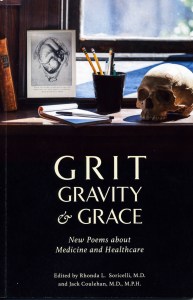
[FYI, readers, I have a poem in this anthology, which relates to this post.]

~

A little over a year ago, I was invited to participate in a book discussion group that  focuses on texts that offer varying perspectives concerning health, surviving cancer, different cultural views of aging, and dying; books on “dying well,” hospice and palliative care, and on hope and healing; books on chronic pain and on neurology and the medical establishment, on birth traditions, on the history of medicine. We have also read The Tibetan Book of Living and Dying by Sogyal Rinpoche, Still Here by Ram Dass, and discussed books that have topics such as placebo effects, psychology, alternative medicines, the pharmaceutical industry, hospitals, the training and practice of doctors, and the death & dying ‘industries,’ including works by authors with personal and moral perspectives on how to live (and how to die). The people involved have included a pediatric palliative care expert, a NICU nurse, a hospice team spiritual counselor, a minister, a former nurse and massage therapist who’s a tai chi instructor, and others–most of us “of a certain age,” by which euphemism I mean we have been living through the experience of having parents in extreme old age and of having long-time friends who now contend with chronic or potentially fatal illnesses. At least one of us has survived cancer.

For a perspective on how most Americans view a serious study of such topics, I offer my husband’s assessment. He calls this “the morbid book group.”

In fact whenever I mention that I participate in a book group (a popular American activity), people ask me if the group has a theme; I tell them, “The theme is medicine, and wellness, and how we die.” And there’s inevitably a pause, and usually my friend asks, “Isn’t that kind of depressing?”

No. It has not been depressing, in fact. I have gained more than I can say from these books and from our small group discussions: information, perspective, philosophy, insight, dare I say wisdom? Not to mention freedom to talk about those things we tend to evade in polite conversation, the space in which to say “This really sucks” or “This saddens me deeply” or to ask, “What can we do?” The book selections have led to great discussions–and have helped me to forge some new friendships as well as to confront and accept different points of view on controversial issues surrounding health care. And death, yes (hello morbid books!), and grief, and–most of all–compassion.

Difficult books? Challenging reading? Have I ever shied from it? I relish exploring this kind of non-fiction-fact-science-ethics-cultural criticism. Participating in this book group is one of the highlights of my current life experience; it’s up there with my long-running poetry critique group and my MFA years in terms of transformational engagement and exchange of ideas.

Below, a list of some of the books we have read and talked about. Just in case any of my readers wish to begin a morbid book group of their own.

~

Radical Remissions, Kelly A. Turner

Knocking on Heaven’s Door, Katy Butler

Buddha’s Brain, Rick Hanson

Death’s Door, Sandra Gilbert

Living with a Wild God, Barbara Ehrenreich

Still Here, Ram Dass

Being Mortal, Atul Gawande

The Anatomy of Hope, Jerome Groopman

The Tibetan Book of Living and Dying, Sogyal Rinpoche

Birth, Tina Cassidy

The Empathy Exams, Leslie Jamison

Counterclockwise, Ellen Langer

The Pain Chronicles, Melanie Thernstrom

Choosing Civility, P.M. Forni

Healing Spaces, Esther M. Sternberg

Die Wise, Stephen Jenkinson

…& more ahead, as we plumb consciousness, placebos, the medical hierarchy, and compassionate ways of living in the world. By the way, readers–suggestions for further readings are welcome!


Rest & reading

It’s been a busy week, and I am exhausted mentally and physically; I am taking the three-day weekend as relaxation time–which means: reading, mostly. Currently, my “difficult books” concentration is Maimonides’ Guide for the Perplexed, though I am not finding it as challenging as I expected, because Maimonides is a good teacher! I am not among his target audience, however, as I am a woman. He was quite forward-thinking for a 12th century Talmudic scholar with an Aristotelian bent, but women were not considered qualified to study the deep mysteries of metaphysics. [Alas, I read without repentance for my heresy.]

My reading also means catching up with blogs I follow. Here’s the link to Theodora Goss’s latest musings on aesthetics and beauty–a lovely blog-essay. I hope you will read it.

ann e michael


Spaces

Ah, the traditional New Year’s blog post! 🙂 I have spent time away from the computer to tend to other things, among them, my own “space” for being less busy. Finding that space has not been easy, but it is the sort of discipline we human beings ought to practice in this Age of Information. Without a little inner space, it is far too easy to become anxious and overwhelmed.

So I think of Bachelard’s quiet exhortation to cultivate the creative or childhood space, which I contemplated in 2013 at about this time of year (in this post). And I think of Jon Kabat-Zinn and other writers–often classed as spiritual self-help authors but whose writings need not be considered spiritual at all (Kabat-Zinn, in particular, avoids using the term)–who remind us to be attentive, aware, mindful, compassionate even to ourselves, and willing to take ourselves away to inner stillness now and again.

I am particularly drawn to the notion that contemporary human beings can come to mindfulness through actions rather than through withdrawal from the body and the world. Really, we hardly have any other choice. Although I enjoy solitude more than most people do, I am ill-constituted to be a hermit or a renunciate. My temperament precludes noisy advocacy against injustice or for specific good causes; but I could certainly do more helping, more of the kind gesture, more listening, and more giving of the type that lets not my left hand know what my right hand doeth (Matt. 6:3).

There were difficulties this past year, and aggravations, and sufferings both personal and social. So be it; we can learn from failure and adversity. The best way to learn to problem-solve is by being faced with problems!

In his 2000 book about aging and dying, Ram Dass wrote: “My guru once said to a visitor complaining about her suffering, ‘I love suffering. It brings me so close to God.’” Well, that is another way of looking at things; and perspective matters. Creative thinking involves full analysis (even when the analysis seems intuitive, immediate) and often employs a total restructuring of the problem at hand–a widening or narrowing of scope, a different point of view, a new set of tools or skills for puzzle-solving, or quiet cogitation while the thinker digests the whole situation…which may be, for some folks, prayer.

Or poetry. When I am not writing poetry, I am always reading it. Other writers’ words open me to a sense of communal understanding, a sense that we are not alone, not a single one of us, who can hear or read or remember a poem or a word of love or praise. Even when those poems depict sorrow or suffering, for then we know we are not the only ones who feel troubled.

“And our problems will crumble apart, the soul
blow through like a wind, and here where we live
will all be clean again, with fresh bread on the table.”

Pablo Neruda, 100 Love Sonnets

Let the wind make space for fresh bread on your table in 2015 and always.


bread

bread

Continuing the discussion

The semester is almost over, and my students and I have spent a few weeks doing writing that relates to Cass Sunstein’s book Why Societies Need Dissent. As it turns out, this semester coincides with considerable current-event attention on protest, conformity, stereotyping, and other issues Sunstein explores in that text. Social media pushes the herd mentality, the “troll” mentality, and the ease of using shortcuts in thinking: justification through bad analogies, irrational responses, barely-considered ideas, culturally-entrenched concepts, knee-jerk reactions.

In other words, the gamut of human social psychology in 140 characters or thereabouts, with links, memes, and dudgeon.

A case in point that appeared on social media last week is a photo of a black man holding a sign that reads, “No mother should have to fear for her son’s life every time he robs a store.”

That was a photoshopped “joke” in which someone altered the last line of the protester’s poster. The intent was to assert that Michael Brown had robbed a store before walking down the middle of a Ferguson street, and the intent was clearly meant to suggest that Brown deserved to be shot by police–or, at any rate, to suggest that he was not “innocent.” I agree with the poster even in its altered state because I propose that none of us are innocent, and that none of us deserves to be killed. A suspected robber should be tried by jury and should be considered innocent until proven guilty because that is the way US law reads.

I do not claim that “It’s that simple.” Indeed, the situation is far from simple, which is why it feels so fraught and inflames such exertions of logic, law, and character defamation, and so many conflicting opinions–not to mention Facebook “purges” and irate newspaper columns and public protests. These are reasons that discussion can be useful. We need to continue the discussion, even though it is awfully difficult to do so.

~

If only we could listen to other perspectives. If only we could engage in discussion. I listened to two of my male students talking about being stereotyped. One claimed he was seldom troubled by harassment and not really bothered when people tried to stereotype him. “You’re not black,” his friend responded, “You’re Latino, or whatever.” The first man held up his arm: “Hey, man, I’m darker than you. What makes you black and me not?”

“Neighborhood. Money.”

“Look at you, bro! You’re wearing $185 shoes and new jeans. Dollars to donuts your family has more money than mine.”

They continued in this fashion awhile, sometimes asking me what I thought. If it was history that made them different, couldn’t the black man put it behind him? And he didn’t even really know much about “his” history, it turns out. If it wasn’t skin color that made one man feel less sure of himself on the street, warier, even in a “good” neighborhood, to what could it be ascribed? Was it just a personal issue? A neurosis? Was the Latino man clueless, or oblivious? Or just lucky up to now? Are these issues of confidence, self-esteem, bravado, or fear? Social issues or private ones? All of the foregoing?

And how does all of this relate to how young people of any background, religion, or color comport themselves in the world, deal with society and its assumptions, codes, expectations?

~

I teach writing. My job consists in instructing students in the perhaps arcane code that clear, concise, informational, and persuasive writing requires if they are to succeed in writing for academia and, later, the world of business information. I tell them: “This is what you should expect others/authorities to expect of you. It’s your choice to follow the conventions or not to follow the conventions, but you need to at least know what the conventions are.”

Meanwhile, I hope they recognize that they should follow the conventions of the rule of law; and if they choose to oppose the law, they should do so with forethought and initially, at least, within the structure of the law. But bad laws do need to be changed, and bad protocols need to be changed, and unarmed people should not be killed for brooking authority; and stereotyping–a very natural and automatic human behavior though it is–should be consciously questioned, even though yes, that can make the discussion difficult.

Synthesis & coincidence

&&001“and per se and”

Ah, synthesis! The conjoining and combining of objects, ideas, theories, values and systems, arts, media, experiments, research, disciplines, metaphors, symbols, rhythms, patterns, DNA, et (“&”) cetera.

Synthesis can be planned, hypothesized, purposeful–and it can be spontaneous, unexpected, coincidental. There are times when I feel as though the overlapping and intertwining of experiences seems to have been somehow “planned by the cosmos” (or some higher power); but coincidences occur more often than we think, especially when our consciousness is primed to make connections.

I have primed my own brain, recently, to synthesize thinking about aesthetics, neuroscience, the arts, philosophy and consciousness. So it should not surprise me–though it does!–that the books I have recently been reading connect many threads of my thought, including other recent readings. For example, Martha Reineke’s Intimate Domain: Desire, Trauma, and Mimetic Theory is an exploration of family “romance” in psychoanalytic theory that draws on Freud and Girard; but because Reineke uses Girard’s early writings as her basis, she cites Merleau-Ponty and phenomenology quite often. Furthermore, mirror neurons and the place and operations of consciousness appear in her claims and explorations in this (difficult) text. Mirrors and mimesis, minds and spirits…Gabrielle Starr’s Feeling Beauty, which I’ve mentioned in recent posts, examines the art-body-mind connections in neurological domains and mentions, more than in passing, the phenomenological aspects of the experience we term “art.” Arthur Danto’s The Transfiguration of the Commonplace: A Philosophy of Art (1983, though I read it last month) also wove itself into my thinking as I read Starr’s more current book. In addition (oh, there’s always an “in addition” with synthesis), I am re-reading Csikszentmihalyi’s classic, Flow: The Psychology of Optimal Experience. The states humans experience when we work hard at challenges we enjoy, such as art-making, are deeply connected to our brains and also rooted in our bodies.

So there is a coming-together, a process not unlike chemical bonding, that all of these texts and ideas produce in my mind. This post is one outcome, I suppose. But there will be others.

~

From Carl Sandburg’s “Tentative (First Model) Definitions of Poetry” (1928): “Poetry is the achievement of the synthesis of hyacinths and biscuits.”

387236_10201085579685937_1062169370_n


Change the mind

“The only job of the poet is to destabilize and expand language. This is how poetry changes the world—not by grand ambition or the lauding of critics. It takes the plodding, unending effort of many to alter line by line, phrase by phrase, word by word the way we describe ourselves and everything around us. This is how we change perception. This is how we change the mind.”  —Jaswinder Bolina (in Poetry Foundation: “The Writing Class”  )

Words to mull over. How do we change perception? Is the change of mind correlated with a change in mind–potential alterations of the brain’s structure or synaptic system? If we destabilize language, do we necessarily alter perception?

Although the book is not an easy read, Starr’s Feeling Beauty: The Neuroscience of Aesthetic Experience offers interdisciplinary research into how the brain may be altered by powerful aesthetic experience, or at any rate, how the brain responds to these experiences in ways that lead some researchers to believe the brain can be changed by art. Not just by those who create art, but by those who encounter it.

I encountered Bolina’s essay (see link above) a week or so after I completed reading Starr’s book, and the consilience–to borrow a scientific term–seemed powerful. The ideas have not yet cohered in my own mind, but perhaps in time I will have more to say on this topic.

Meanwhile, I revel in the juicy possibilities of changing mind through art.


Difficult writing?

Here’s Will Buckingham on writing and difficulty. Worth a read! I don’t know how to embed the blog into my post, so here’s the link.

http://willbuckingham.com/the-pleasure-and-difficulty-of-writing/

Writing can indeed be a pleasure–most of the time! There are periods of difficulty when I feel frustrated, but those periods make for puzzles and challenges; and I enjoy puzzles and challenges. They push me, force me to stretch a bit, engage with what’s not so simple or superficial, change my perspective, alter my expectations and assumptions, discover something new. I learn from these experiences. I would not want life to be easy all the time, nor would I want creative writing to be easy all the time. Although it’s pleasing to lie in a hammock on a mid day and sip a cold drink and listen to the birds and read a book…pleasure also encompasses inventive challenges. Motivation. Inspiration. Different forms of joy.

Buckingham mentions a biography of the writer and artist Tove Jansson, best known in the USA for her Moomintroll series but clearly a creative artist of the first rank. I’d put this book on my reading list, but it is at present only available in Finnish! Marina Popova at Brainpickings has posted some of Jansson’s vivid illustrations of Alice in Wonderland here.

On the pleasures of difficult reading, please see my past posts here, here, and here.

Why read difficult books?

Poetry can be difficult, but I love to read it. Poetry is not the only form of ‘hard reading’ I do, though. Reading a text that’s challenging takes more time and more effort on my part, and for a person who is often pressed for time the question presents itself:

Why do I read hard books?

Bachelard. de Bolla. Girard. Kuhn. I’m immersed in Quiddities by W. V. Quine at the moment. Slow going, though I enjoy his sense of humor, because I’m not as comfortable with philosophical terms as I once was. Next up: Derek Parfit.

Philosophy, poetics, aesthetics…not as easy nor, I suppose, as entertaining as popular fiction. I admit I enjoy how novels erase the boundaries between my life and the characters’ lives, their times and places (historical? imaginary? far from Emmaus, Pennsylvania?); it is easy to feel wrapped up in a novel, and I appreciate being taken elsewhere.  I’m a fan of short fiction, too. It’s easy to love fiction.

That’s not always the effect I seek from reading, however. I read non-fiction to become informed, and I especially treasure information that is delivered in a beautiful, literary fashion. John McPhee, James Prosek, Annie Dillard, Phillip Lopate, Terry Tempest Williams, to name a few. Writers such as these make reading science and politics and biology and culture and other informational material a joy.

I read difficult texts such as philosophy and physics because I love to think. Thinking deeply has always resulted—for me—in new forms of perspective, in inspiration, and in poetry.

Poetry is sometimes difficult to read, as well. Think of the many ways the word “difficult” can mean in this poetic context: Marie Howe is difficult in a different way than Jorie Graham, or Lyn Hejinian, or Ezra Pound, Gray Jacobik, or Gregory Orr’s early collection Gathering the Bones Together.

Stuff that is hard to read can be extremely rewarding. And, when I am puzzled (which I often am), I feel inspired to question and to observe…which leads to writing. Much of what we call “art” is a response to difficulty.

Oh, how I relish the difficult!