Circumstances being what they are, too numerous to mention here, I continue amid distraction and creative malaise. To counter the mood, and to educate myself, I turn to poetry. Often I buy or borrow books that are new to me for excitement or inspiration; this month, I’ve decided to do some re-reading. Since I’m not writing much myself these days, and not too thrilled with what little I have been drafting, it seems time to re-examine poetry that I really admire. Maybe I can learn a few things.

I’ve long been a fan of Elaine Terranova, whom I met many years ago in Philadelphia. I have all of her books but the latest (and will get to that one soon), but the one I’m re-reading is Not To, New and Selected Poems, which came out in 2006 and which contains selections from The Dog’s Heart, Damages, The Cult of the Right Hand, and from her early chapbook called Toward Morning/Swimmers –as well as about 80 pages of what were then new poems.
I don’t want to do a book review here, nor am I interested in poetry analysis right now. The reason I’m re-reading these poems with care and interest is to endeavor to understand why I appreciate her work so deeply. For one thing, Terranova consistently surprises me, but with quiet surprises. The turns in her poems are seldom the powerful, swift changes of mood, direction, or language that I like in many writers’ work…but they are there, and their subtleties and reflective twists engage me in ways perhaps more lasting. Because I have to think about where the poem chose to go, and how it got there. It’s not merely ambiguity, though sometimes the closure’s ambiguous, it’s because the last lines of Terranova’s poems feel so right to me. They don’t always circle back to an image or idea in the opening–sometimes, they travel quite a distance away. And I love her observations and the occasional aside that seems to break the fourth wall:
...Once a squirrel
dropped through the chimney into the whole
ruined civilization of the basement. Here,
I'm taking the squirrel's viewpoint.
That’s from “Small Hours.” How terrific is that–the ruined civilization of basements? And the little comment that suggests indeed, the squirrel has a viewpoint. This poem ends 8 or 9 lines later with the sense of “being swept up/and contained in my bed” but the image she chooses is that of a child on a bicycle, which (to this reader) evokes memory and those hours we find ourselves in the somewhere-else of sleep and remembrance. No statement. No whole-poem metaphor. How did she come to those closing lines? Why do they work so well?
I want to learn that.
~
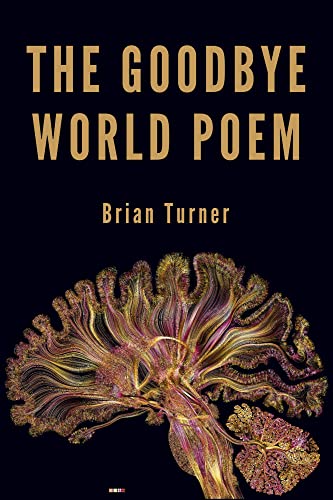
Brian Turner’s book The Goodbye World Poem is another re-read and feels utterly appropriate for a time of personal losses and deep reflection. And thankfully, it’s also a reminder of joy. These poems were written after the deaths of Turner’s wife (poet Ilyse Kusnetz), his father, and his best friend–truly, how does one find the means to say anything at such times? Yet somehow, Turner produced a trilogy of poetry books: The Wild Delight of Wild Things, The Goodbye World Poem, and The Dead Peasant’s Handbook, all published in one year (2023). Exploring what grief feels like has a long history among poets, and Turner’s work reminds me, in topic, of such collections as Donald Hall’s books Without and The Painted Bed, among others; Turner’s poetry is quite different from Hall’s, but the pain of loss and the gratitude for memories of the loved one are similar. And his work differs a lot from Terranova’s.
What do I want to learn from Turner’s poems, what is it he can do in these works that I would like to learn how to do? I love that I learn things in his work, information about whales, jellyfish, swamps, science. His work is usually narrative, doesn’t pretend to be anything but personal and memoir-based. Use of the first-person in poems doesn’t necessarily mean the poem is the writer’s experience or even her own memory/story, but it’s difficult to imagine Turner’s poems as being a stand-in persona. The imagery may offer metaphor but sure feels like “I saw this, I observed that.” Real stuff. Real life. That can get old in poems–but Turner keeps these observations new. Again, there’s reflection in the work that takes us past the surface words, tries to get the reader to find a way in to this grief, this loss, this mix of human feelings.
I think what I like in this work is how Turner acknowledges and presents the mix of human emotions and the movement toward compassion for the sufferer, whether the person suffering is a dying loved one or one’s own distraught and agonized self, whether the sufferer is an animal or a place (environment, region, biosphere). His poem “Fallen Giants” just gets to me each time I read it. It can be read almost as non-fiction prose, though it is lineated–long lines–and uses rhythm and repetition carefully. But, in fact, the poet is describing what whale fall might be like as the huge carcass descends through the silent ocean. And knows that whales are intelligent and can grieve:
...They fall into a hunger they cannot imagine,
with the sound of loved ones in their ears, calling to them, sonorous
and mournful, the pathos undeniable, and mournful because called out
for love's sake, the fluid world a conduit for the voices of these giants,
who sound themselves across the globe, across generations, speaking
to their loved ones...
This poem closes with the image of whales’ huge lungs, how they hold their breaths until they ascend “to the surface/ with a terrific blast of exhalation, a kind of announcement to the universe/that they were here, on planet Earth, a presence in this world, alive.” Compassion for whales that feels like compassion for human beings, for the earth, for the universe. I want my poems to acknowledge and evoke compassion in readers, remind them that the world is complex, beautiful, though often sad. And that it is good to be alive in the world, if only for awhile.
~
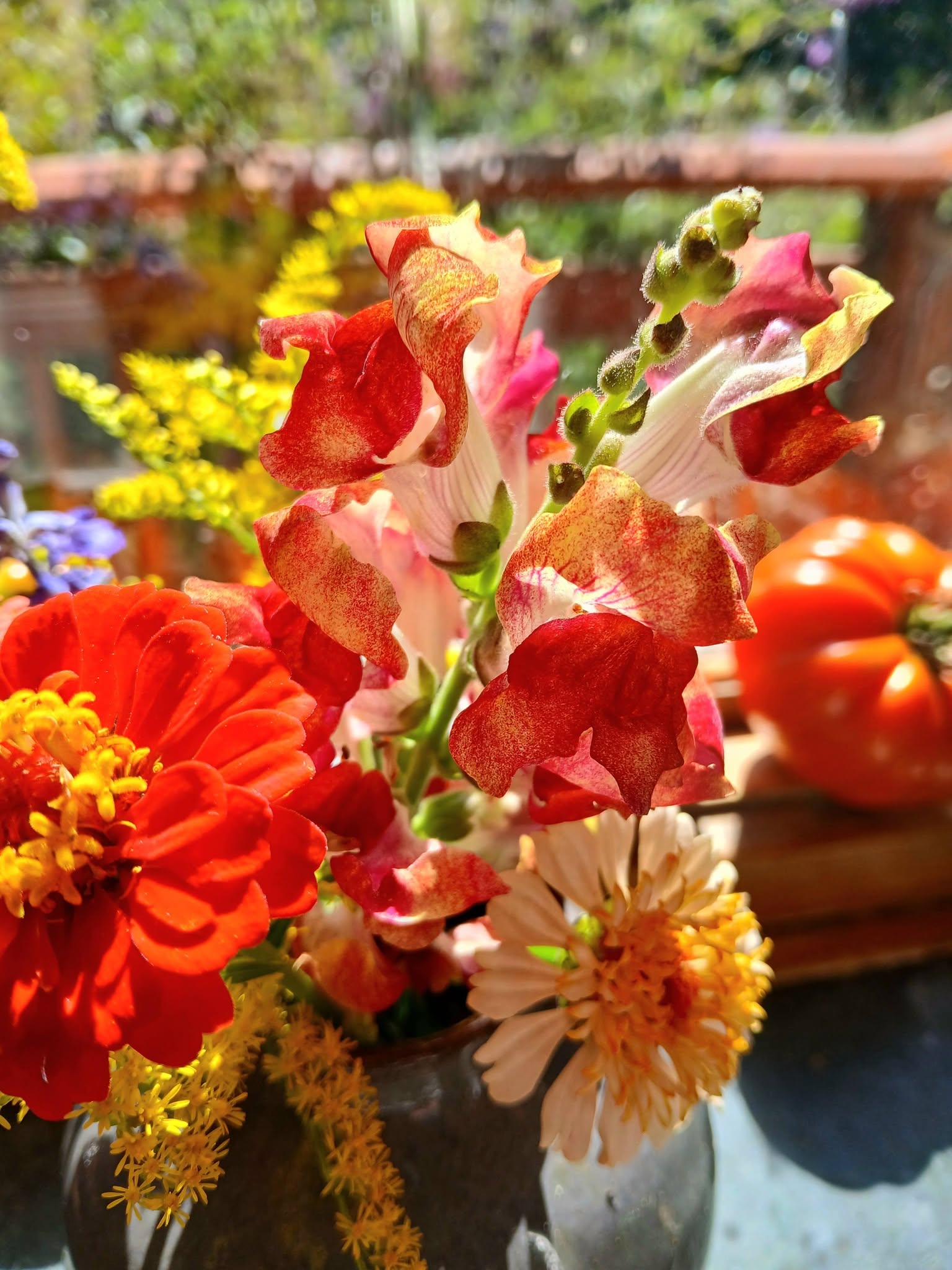
From the late summer/early autumn garden, several beautiful reminders of what life on Earth can offer. I recognize very clearly that not everyone has the good fortune to have a life that gives them bright flowers and ripe tomatoes. So I will be grateful today.