A little green

Summer arrived rather suddenly here in the valley. After a rainy May that was a bit cooler than average, June has slapped us with 80° days and sunshine. Not that I am complaining, but it does throw a curve at the vegetable garden’s usual progression.

And all that rain burgeoned into so much verdancy–my eyes almost ache from all the green! We’ve needed the rain (the wettest May on record) to make up for the driest October on record (2024). Nature appears to be doing its best with balancing things out in the face of all we humans have been doing to unbalance it.

Quite a switch from the spring greenery in the mountains of New Mexico, greens that are far less chartreuse in hue, the kind of green you have to be looking for amid the deep jades of pines and the brownish-green cholla. Prickly pears are a bright shade of green but don’t evoke any sensation of lushness. The little-leaf oaks start out with a fresh hue but become very dark, nearly black, as the season progresses.

I was thinking about the hues of the high desert because of our visit to the Georgia O’Keeffe Museum in Santa Fe. One of the galleries there is a display of the artist’s pastel chalks, brushes, and color chips she created for herself to get the palette she felt best represented the landscape she knew. Many shades of ochre, browns, dull oranges, sandy yellow, and that famous turquoise blue of the New Mexico skies–but also the green of cottonwoods in spring, the green of pinyon and ponderosa, the sage green so common among low-growing plants like sage and rabbitbrush.

Try defining the word green.

A little Joni Mitchell to accompany that request:
Topophilia

In a past post, from 2013, I mentioned some neologisms describing feelings about place.

dusk GR

Toponesia suggests nostalgia but adds to it a sense of loss for what has been erased, eroded, or developed to the point it is no longer familiar. When you return to your old neighborhood, for example, and discover that your house no longer exists and there’s a mall there instead, or discover that your old school has become a condominium. Many of us know this feeling: memory conflicting with current reality.

A sweeter emotion–if you can call these emotions (they may indicate self-reflection and consciousness as much as emotion)–is that of topophilia. An article by Hakon Heimer in Environmental Health Perspectives says

The term topophilia was coined by the geographer Yi-Fu Tuan of the University of Wisconsin and is defined as the affective bond with one’s environment—a person’s mental, emotional, and cognitive ties to a place.

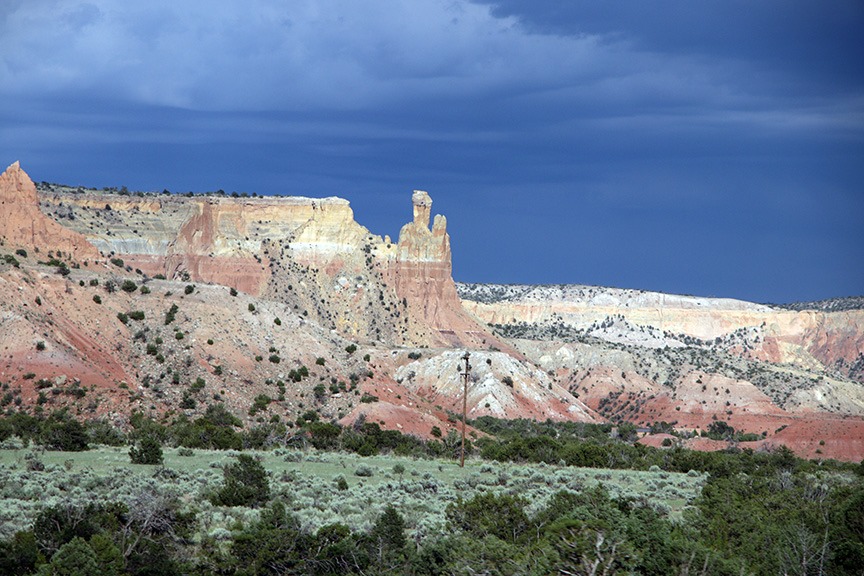
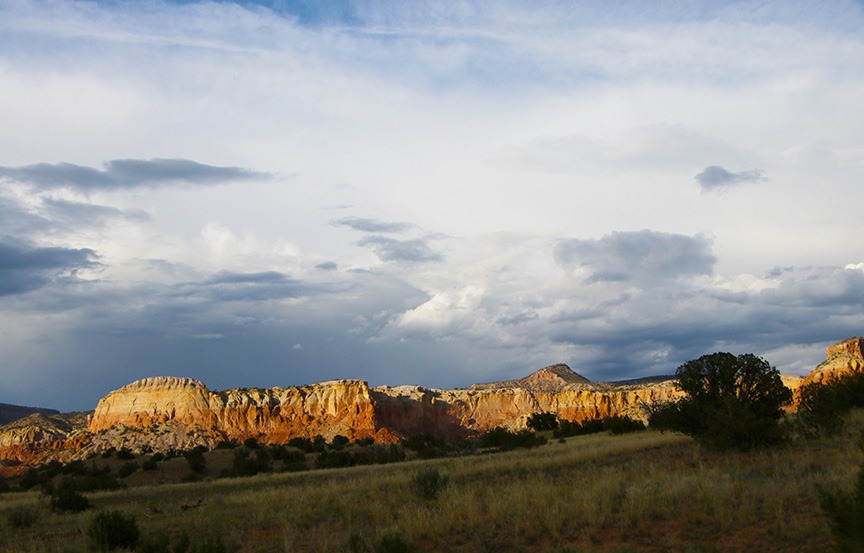
This feeling arose in me recently on a trip to New Mexico. The place in mind and heart is Ghost Ranch, which most people associate with the artist Georgia O’Keeffe–her house and studio are there (and are now a museum). But my association began before I knew of O’Keeffe; I was eleven years old, and the ranch was journey’s end of a long family road trip west.

GR19

Chimney Rock, Ghost Ranch, Abiquiu, MN


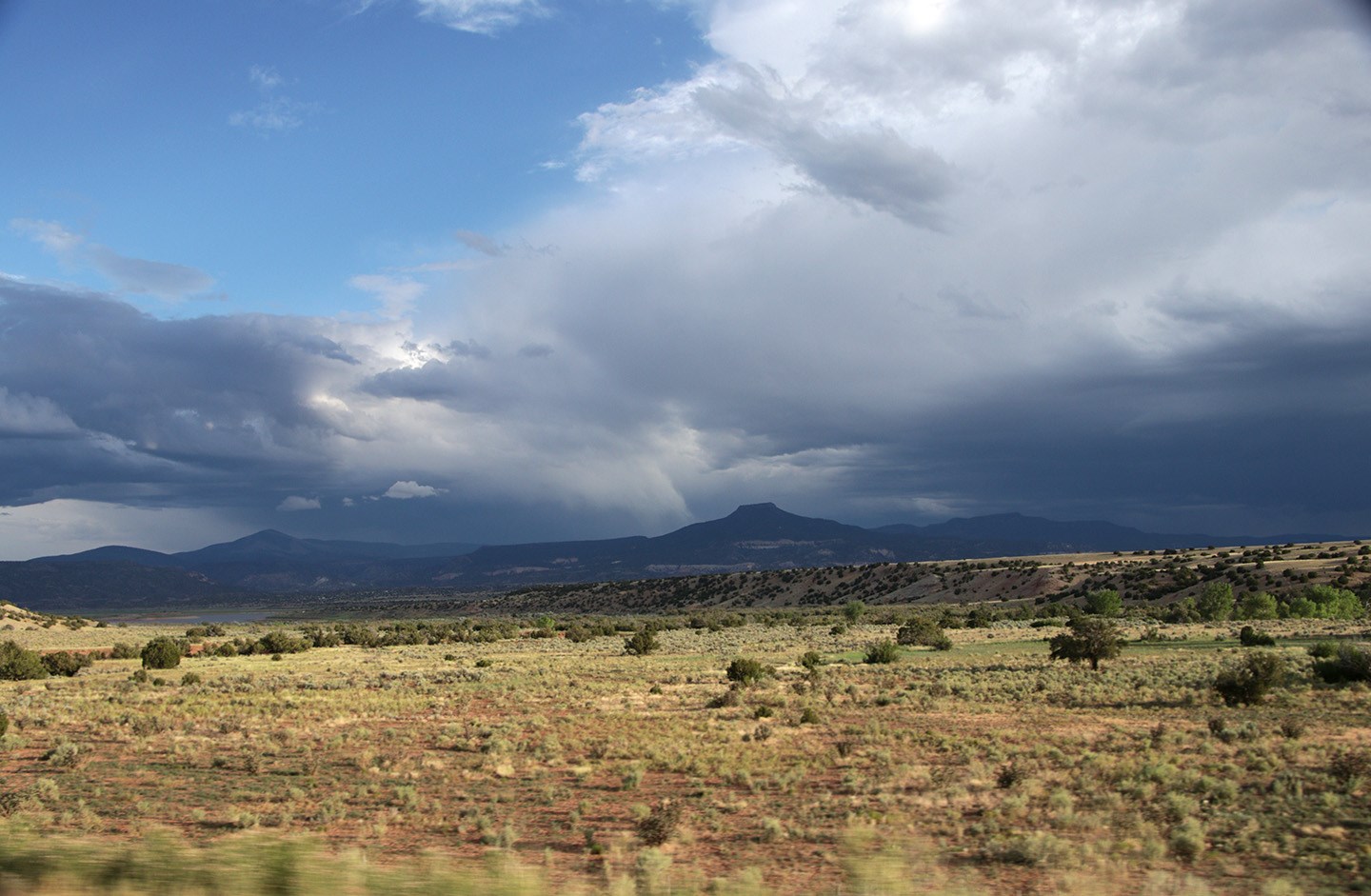
The summer days I spent there somehow lodged inside me with a sense of place–and space–that felt secure and comforting, despite the strangeness of the high desert environment to a child whose summers generally featured fireflies, long grass, cornfields, and leafy suburban streets. Ghost Ranch embraced me with its mesas curving around the flat, open scrubby meadow where the corral block houses sat. Chimney Rock watched over me. Pedernal loomed mysteriously in the deep, blue-purple distance. I still cannot explain why the place felt, and still feels, like a second home to me. If I believed in the existence of past lives, I would say I had lived there before. Topophilia.

pedernal storm