Poets, horses

My local public library’s poetry section is on the sparse side. However, after renewing my card today, I felt determined to borrow a poetry book. I considered taking out one of Louise Glück’s collections, but I already own copies of the two on the library’s shelves (Wild Iris and Meadowlands). I chose Maxine Kumin’s 1992 book Looking for Luck instead. When I returned home, I learned that Glück has died (age 80). There will be time to return to her books and to seek out her most recent collection, which I have not read; but hers is a voice readers of poetry will miss.

One thing that her poems do is to face, without shying away from, sorrow or grief. They seldom offer sociably-conventional consolations. The consolation is in the spare beauty of her observation, her control of language. That is difficult to do. When I write from despair or deep grief, I find I want to bring some kind of–call it hope?–into the last few lines. I wonder whether I’ve a tendency to want to comfort; maybe my readers, maybe myself.

I haven’t gotten very far into the Kumin book yet, but it’s clear that this collection includes numerous poems featuring horses, one of Kumin’s lifelong joys (she and her husband raised quarterhorses in New Hampshire). Her poems have taken me back in time, so to speak, to when my daughter was learning to ride. I have had a sensible regard for horses’ size, prey instincts, teeth, and hooves from early childhood–not quite a fear of horses, but pretty close–so when my then-tiny nine-year-old expressed an unwavering and stubborn interest in riding lessons, I held off until persuaded to let her “just try it.” Of course she knew what she was interested in, and of course she loved riding, despite frustrations and beasts who didn’t want to cooperate and being pitched off and stepped on while I watched and encouraged and soothed, swallowing my fears for her safety.

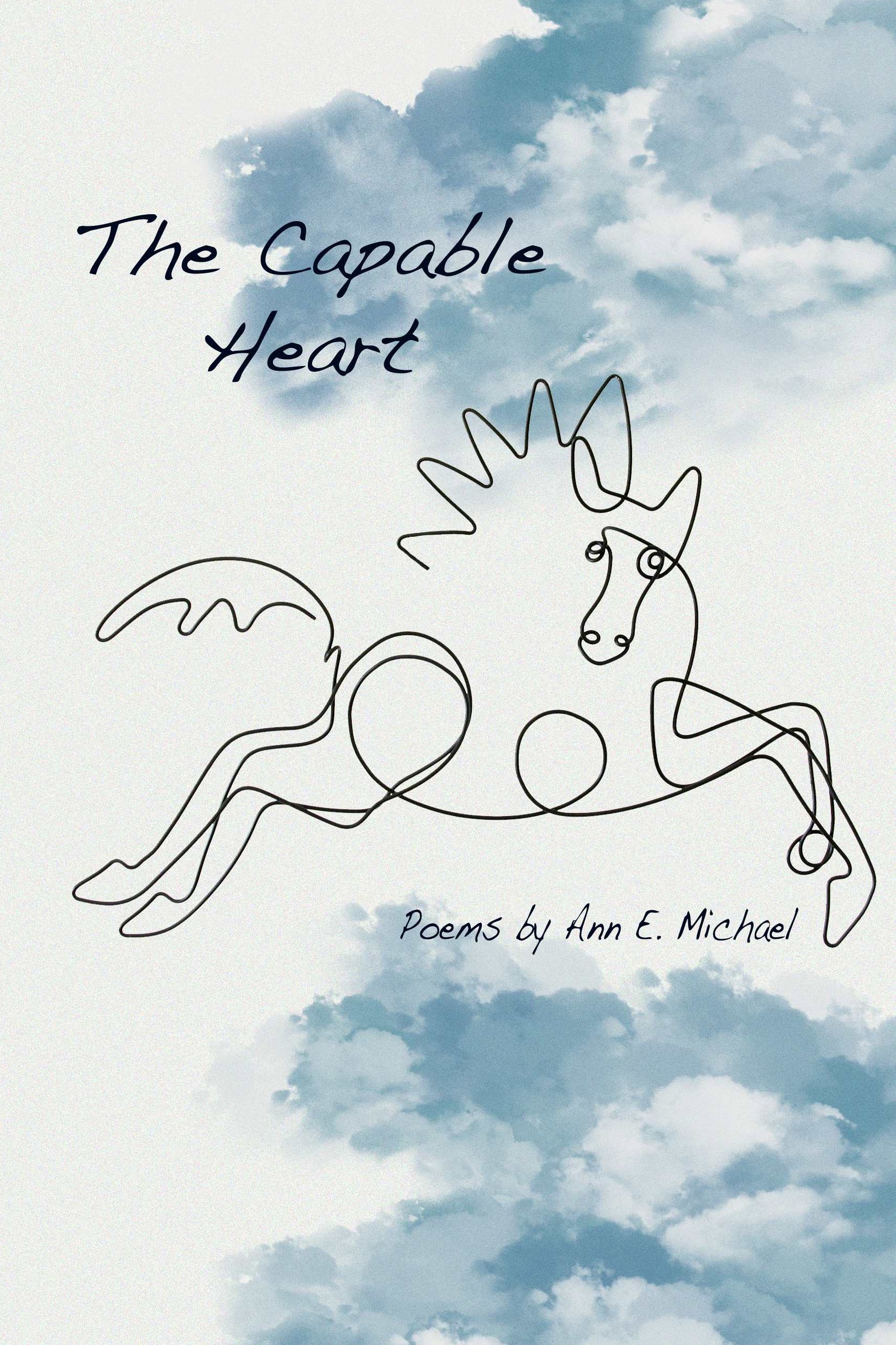
Equine grace, strength, personality did not quite win me over; I’ll never be much of a rider myself. But contending with horses and learning to love and commune with them was good for my child, and reading Kumin’s poems brings back how human animals can have relationships with other animals. I never quite got over horses being an “Other” for me, but observing how my daughter loved being with them inspired me to write quite a few poems of my own [see my chapbook The Capable Heart]. Reading Kumin’s work takes me to a familiar and important place in my own life.
Winnowing books

My adult daughter began her clearing out of the childhood bedroom last week. After some fairly easy culling of bits of craft projects, 6th-grade ceramics efforts, broken sea shells, pencil stubs, dried-up bright-colored shaped erasers and outgrown clothing, the bookshelves had to be tackled.

She had no idea how many books she really had. We found them overflowing the shelves, under the bed, on the bedstand, in the toy box and in the closet. Reviewing the stacks was a journey back to her childhood, from YA paperbacks to Goodnight Moon; no fewer than ten oversized books claiming to be The Complete Guide to Horses, the Horse, Horsemanship, Care and Treatment of the Horse…not to mention similar books on dogs, cats, and guinea pigs. All of the Harry Potters and two sets of Chronicles of Narnia, the Time Garden books by Edward Eager, Rumer Godden’s Doll stories and Dover reprints of classic E. Nesbitt books, picture books for toddlers and collections of short stories and poems for children of all ages. Black Stallion novels and Marguerite Henry’s works and the animal novels by Felix Salten.

This experience was a physical and emotional and, I suppose, intellectual transition for her as she begins to look at what her life ahead may be and what texts she will want to keep as guides and as talismans.

A battered copy of The Phantom Tollbooth. Yes. The Runaway Bunny. Yes. Centered Riding. Yes. All of Laurie R. King’s mystery and adventure novels. Yes.

We moved about a third of her books into the give-away pile. Wrenching! Yet of course, what she saved still overflows the available shelf space.

What is the old saying about apples not falling far from the tree?

On Tolerance

Tolerance, as defined in the OED, means endurance, as of pain or treatments; it is also the tiny allowance of imperfection in coining or machinery, the acceptable out-of-round. But the term has become popular recently under its third definition, “freedom of bigotry or undue judgment upon the actions or behaviors of others.” It has indirectly become the target of people who complain about over-use of “politically-correct language.”

Tolerance is not one of the Virtues, but it tends to have a slightly virtuous connotation, sometimes with an irritating hint of self-righteousness. An acquaintance of mine said once, “Quakers! They’re so damned tolerant,” as if it were an attribute to be avoided by sparkling, sexy people who are analytical and quick to judge. I have known some mightily opinionated Quakers in my time and will attest that tolerant folks can hold strong opinions. The connotation of tolerance to mean somehow wishy-washy or evasive is an unfortunate one. And it’s wrong.

My parents taught tolerance. This was a necessary trait in a family full of passionate, witty, highly-opinionated and creative people. I learned that I could disagree with my sister completely and still love her and accept her point of view, even if I could never in a million years adopt her perspective. My father marched on Birmingham and Washington in the 1960s, and we learned that people who do not look like us are no less like us than our neighbors—and we learned to be polite to our neighbors, some of whose values and opinions we didn’t particularly care for, but whom we tolerated as members of the community. Tolerance is a component of empathy in two directions: empathy inspires in us the ability to practice tolerance of others, and the practice of tolerance itself enables us to feel empathy with others.

Without empathy, no altruism; without altruism, no society. Tolerance has an important place in human nature. The simplistic slogan “Teach tolerance” has value only if we can remove the negative slap-dash judgment of tolerance as some sort of liberal-PC value rather than as what it is, a practical behavior necessary for social interaction. Good manners, for one thing. And yes, that means that sometimes we must endure the psychic pain of listening to a person we desperately want to judge negatively, or bear with the person who is slightly “out of round.”

Practicing tolerance doesn’t mean giving up our own values, it merely forces us to withhold judgment a little longer than usual and to endeavor to discern, and acknowledge, another person’s perspective. Can we argue? Can we disagree? Certainly. Will we respect that perspective? Maybe not. But we can learn a great deal from the exercise.

Here is a poem from my collection The Capable Heart. Tolerance and an attempt to understand another perspective are not just for human beings. This poem looks at my daughter’s point of view, my own, and the horse’s. More broadly, the piece is about all of the things I’ve mentioned in this post—if that’s how my reader would like to interpret it. (Of course, I am ready to acknowledge other interpretations and perspectives!)

WAYS WE ARE ALIKE

I wanted a way to embrace
my daughter’s fascination.

To overcome my own fear, with carrots,
with a lead rope and a soft brush.

I touched the withers and the
warm, broad chest;

I held the lead. Let pulsing lips
explore my hands, my jacket.

The narrow nose stretched
under my fingers and

I rubbed the strong, shallow bone
above curious, sensing nostrils.

My daughter tells me the many ways
horses and I are alike.

They are beautiful, and
they understand fear.

Orri. Photo by Ann E. Michael