Changes & alterations

We built our house here about three decades ago. At the time, I was young and excited about landscaping the place; although I had been growing our own vegetables for years by then, I was fairly new to ornamental gardening. I made mistakes; I underestimated the speed at which shrubs and trees grow; I thought I could keep a handle on invasive species; the world of various bark beetles and aggressive vines was new to me; and I had no idea how hard it would be to manage almost seven acres without, say, a team of landscapers.

Or how rapidly an environment alters when the climate changes, and when cornfields and early-growth wooded areas become housing developments, parking lots, and streets. I have learned a great deal and much looks different now than thirty years ago, but the swallows still return to my garden between April 26 and May 6. My land contains fewer efts in May than it used to, but the gray frogs, spring peepers, wood frogs, and toads make their usual frenzied chorus at mating time each spring.

~

Recent changes have come from the emerald ash borer, which has decimated, or worse, the green ash native to this valley. The huge trees have come crashing down during the past 10 years, making hard work for us even if it does provide a bit of firewood. Cutting, splitting, stacking hardwood isn’t a task I’m much good at anymore. Thirty years ago, maybe…and there does not seem to be any good that comes of this tree loss, which I’ve been mourning each year as we have less and less of a woodlot treeline above the hedgerow and see more and more of the neighboring subdivision.

But on my damp, early-morning walk today, I perceived some changes that I should have expected and that offer a glimmer of hope for native trees and shrubs–despite the proliferation of Russian olive, multiflora rose, Amur honeysuckle, mugwort, wintercreeper, Asiatic bittersweet, mile-a-minute weed, and more colonizing invaders than I can tick off in one blog post. There, beside the tractor path, along the edges of the hedgerow (for edges are where things happen most quickly), I observed more tree saplings than in past years. With the vase-shaped, leafy arcs of green ash absent, sun reaches further through the thickets. And there I spot horse chestnuts starting to push up, tiny walnut trees, oak trees of differing species, “baby” hickories and maple varieties, along with understory’s smaller shrubs and trees like amelanchier, ironwood, redbud, buckeyes.

Granted, most of them won’t survive to maturity, but some of them will–gradually re-making the woodlot unless other disturbances undo the renewal.

I won’t be here in another 30 years to find out, but I find hope in these saplings. I’m also happy to see that the little woodland and field wildflowers such as false Solomon’s seal, jack-in-the-pulpit, wild violets, and mayapples remain. And though I find myself swearing inwardly at the way the Russian olives grow massive along the property line and the invasive bittersweet sends thick tendrils coiling up into the trees, it’s not the fault of the plants that they got here. Humans brought them to North America, and the plants–like European colonists–became a bit too successful in their new homes, pushing out what was here before their arrival. Am I any different, really, than the dandelion or the honeybee? My ancestors came to these shores not so long after those species were imported with earlier “settlers.”

~

The rain we’ve been getting means I haven’t been out weeding in the vegetable garden. After I take my walks, I come inside to dry off and do household chores, or make soup, or work a little on my poetry. I feel excited by a little writing project I have recently given myself, and I’ve also been playing around with drafting prose poems. Next week, I head to the high desert again for further inspiration and a chance to travel with a good friend, visit museums, and spend some time with my daughter. When I return in mid-May, the gardens, the meadow, and the woods will already be much changed.

Alien

Last week I attended a local book festival that offered a day of independent and small press books (Easton Book Festival) and came away with Lanternfly August by Robin Gow. The poems fascinate me on a number of levels, especially as I love poetry that interconnects with science–biology in particular–and with the diverse experiences that make up a human life.

But first, some context or references. Gow hails from eastern PA, from a rural area north of me, and now lives in Allentown. This region of Pennsylvania was port-of-entry for the spotted lanternfly, a recent scourge for gardeners and landscapers, that made its way from Asia–where it feeds on Ailanthus altissima (tree of heaven). Well, in fact, it did not “make its way” here; it was brought here, inadvertently I assume, through global trade and human intervention. It isn’t the lanternfly’s fault that it is an invasive species. It is human beings’ fault. What if we were to view the lanternfly from other perspectives? What metaphors might it offer us, particularly about being alien, the Other? This is one way to read Gow’s collection.

Gow, who is not yet 30, identifies as an “autistic bisexual genderqueer person” but says they didn’t come out until college. Life in rural Pennsylvania as a person with autism and a sense of being different in terms of mind and gender? There have to be feelings of alienation, or of feeling like an alien. Gow also writes for YA readers, where compassionate understanding of how it feels to be part of, or left out of, peer groups matters; in the lanternfly poems, readers get a sense of empathy even for this damaging leafhopper. That amazes me, and I appreciate it deeply.

When the bugs first appeared, I read as much as I could about how to discourage them from our trees, how to trap them and what their various stages (egg masses, instars) looked like. Mostly I was bent on eradication, with a bit of resignation in the mix–see this post from 2018. After we got them reasonably under control here, they began to move north and west, just as the brown marmorated stinkbugs did shortly after their arrival in 1998. Both insects feed on sap or fruit. They are foreign to our shores but find much to suck upon here and have damaged fruit crops and trees. Although some people find them beautiful–they are much prettier in flight than at rest, brightly translucent red with the sun behind their wings, and their second instar stage resembles ladybugs–they have gained the reputation of being a Bad Bug. Gow writes:

When I called you “host” I meant,
“I love you in a ruinous way.”

That’s from the poem “Third Instar.” In the poem “First Instar,” the speaker wonders how long before “this becomes wreckage? I don’t even know yet what I am.” The creature could be some type of cryptid, developing into something no one can explain or understand. Society offers solutions that don’t necessarily work–ways to eradicate the insect demonstrated on TikTok, laid out on government websites, posted on Pennsylvania Department of Agriculture’s pages. Also the inquiry, in “Home Remedies,” of totally re-imagining one’s body: “Have you tried becoming a different species? Have you really given mammals a try yet?” Wry humor, of a bleak but wildly intelligent sort, pervades many of these pieces. In “Stop the Spread” (pandemic/plague allusion definitely intended):

...I cannot stop myself
from lanterflying: verb meaning to exist ardently
despite not belonging. How did I become so contagious?
Spores, like fireworks, floated from my gills.

I’m not really writing a review here, just sharing my enthusiasm; otherwise I’d have written about the varieties of form/text/layout Gow employs and the structure of the collection, and much more. Anyway, this is the reason I love going to conferences, seminars, readings, small press, and literary events–always something new to me to explore and learn from. Gow’s poems have helped me to develop a kind of compassion for “alien invasives.” The parallels to how society treats its Others–those aliens and distraught foreigners (not colonizers) arrive almost inescapably from the collection. That those who do not fit in nonetheless have value and need appreciation and respect comes through as given. There’s deep heart in these poems.

A bit of awe from me to this poet. (I happen to be reading about awe right now, which may figure in my next post). To find out more about Robin Gow: They have a website with a daily poetry blog at https://robingow.com/dailypoetry/, definitely worth checking out, and their books are listed there.

Parallels

I’m reading Margaret Renkl’s book of brief essays, Late Migrations, which evokes in me a revival of memories not too dissimilar from hers. We are near in age, and though she writes from Tennessee and Alabama, her unsupervised childhood running barefooted through peanut fields and along creek banks at her grandparents’ house feels parallel to my unsupervised childhood running barefoot along creek banks surrounded by small towns and cornfields. I too slept on the screen porch at my great-grandmother’s house, fan running, insects humming, heat lightning brightening the humid summer nights.

Renkl writes about watching Walter Cronkite on television and seeing the Viet Nam War, vivid to us in spite of the screen’s small size and black and white images. As teenagers in the mid-1970s, Renkl and I benefited from fairly liberal sex education classes in high school. I also benefited from a brief era of integrated junior highs and high schools, however; not the case in Birmingham, Alabama. Like hers, my parents scraped by in suburbs close to the city in houses with cement stoops and no porch. Though they eventually made their way into the solid middle class, my folks attained financial stability long after I had left home.

The essays note the change in climate, both cultural and natural, that has occurred over the past six decades. Renkl observes the increasing brevity of Southern winters and wonders how the temperature will affect the migratory birds–will they wait too long to head south? Will their food sources also change, or will the migrants find less to eat to sustain them, especially on the return trip north when they need to power up their bodies for mating and nesting? How will the birds navigate an increasingly human-altered globe-scape, a world of all-night lights and glass towers, wind turbines and redirected rivers? And will native birds survive the aggression or overpopulation of invading species?

I see that last concern in my Pennsylvania back yard, where the number of European house sparrows has probably quadrupled in the past three or four years. A passionate birder friend of mine has told me, flatly, “Kill them.” That seems harsh; in Renkl’s book, she gets the same advice about squirrels in her attic! There are, however, compelling reasons to find a way to discourage these aggressive and noisy little birds (see Todd Holden’s article here). My spouse and I have not yet gotten the heart to destroy birds, though they are enlarging woodpecker holes made in our cedar siding corner-boards and then nesting in the openings. We have had no bluebirds, except the occasional one just passing through, for four or five years. A coincidence? I think not!

The memoir aspects of Late Migrations resonate with me, and so do the essays in which she reflects on what we are losing (on earth and among our Beloveds). The author decides to let the chipmunks continue to reside in tunnels under her house and to leave the squirrels in her attic in peace. I’ve come to terms with our hungry, marauding whitetail deer population, our groundhogs, and the Asian stinkbugs, among other creatures. The house sparrows, though, are as bad as the mugwort, knotweed, and wintercreeper in our perennial gardens and hedgerows. I may have to take more meticulous precautionary steps before next spring arrives.

Meanwhile, I use Cornell University’s Merlin app early in the morning and late in the evening (when the house wrens are less vocal) in an effort to determine which birds are hanging out in our little ecosystem–the birds I can’t see, or that I can’t identify by sight (like the blackpoll warbler). Two evenings ago: a bluebird.

But it was just passing through.

Passer domesticus, male. Image from https://www.rspb.org.uk

Wild places

I’ve been reading Robert Macfarlane’s book The Wild Places slowly, chapter by chapter and pausing between, enjoying his sentences immensely and feeling quite the milquetoast in comparison with an author who climbs snowy peaks by moonlight and sleeps outdoors, like John Muir, in scooped-gravel beds in seaside cliffs. I do not require luxury, but I get chilly easily and my hips and back are seldom forgiving when I sleep on the ground.

Still–I might put up with a considerable amount of misery to see the stars or the northern lights above Stornoway on a clear night (admittedly, a clear night is rare up there). And not by cruise ship. Given current circumstances, however, I am not going anywhere, which gets a bit tedious. Macfarlane’s last few chapters begin to focus on specific ways to view and consider wildness–finding wildness closer to home, in the flora and fauna and earth, rocks, topography even of regions that are tamed, farmed, suburban. One’s backyard walk might reveal wildness, though in miniature.

98106636_10223440949236204_1636631536210018304_o

terrarium-sized wildness cultivating human-made cinderblock

There lies inspiration; I can do that–walk in my yard. Look for wildness. Indeed, I have often proceeded that way, slowly and quietly looking about, creeping low to see the small things, overturning old logs, crouching beside vernal pools and driveway puddles, listening for rustlings in the hedge, noting hawk- or vulture-shaped shadows on the path and raising my eyes to find the birds in flight. What are these things but wild? Just because I am familiar with them, I tend to forget their inherent wildness.

~

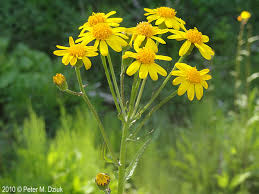
I took a walk in and through the meadow, which has  not yet grown tall with grasses and milkweed and solidago. I took notice of the perennials starting to emerge. Also of the quantity and variety of nutsedge-like plants.  I had not realized there are so many kinds. Amid the low-lying, pale purple violets, the milkweed and eupatorium shoots are emerging. And I found golden ragwort in the field–never had seen it before.

packera aurea

packera aurea, golden ragwort

This time of year, the does give birth; I have found fawns lying still among the grasses before and ambled the field perimeter slowly in hopes of such an encounter again. So far, not yet. But yesterday morning, a doe grazed along the edge of the tractor path, her spindly, spotted newborn scampering around her legs. So I know the wild ones are present and going on about their usual spring business.

Of course, the avian realm of wildness gets active in April and May. We found an eastern kingbird nest perched on the flat of a canoe paddle that rests on rafters in winter, under our outbuilding. Discovering the nest meant we had to put off our intended initial canoe float in May.

Recently I learned about bumblebee nests, too, and found an abandoned one under an oak tree in the hedgerow while I was looking at jack-in-the-pulpit, mayapples, fungi, and solomon’s seal. Thrashers, ovenbirds, numerous sparrows, and a noisily-protesting red squirrel raked about under wild black raspberry canes.

ann e michael

waiting for mama

There with the native plants, and aggressively overtaking the undergrowth, are amer honeysucke, asiatic rose, barberries, wintercreeper, japanese knotweed, mugwort, ragweed, burdock, thistle, garlic mustard, and whole hosts of plantains and creeper vines. One part of me abhors them. But I admire their tenacity and their ability to adapt to new circumstances. They’ll probably be thriving long after humankind has departed the planet.

As, perhaps, will the whitetail deer–a century ago, become scarce in the wilderness, considered almost “hunted out”–they managed to recover their numbers through adaptation to suburbia, where they are now “pests.” They graze on front lawns, nibble at ornamentals, gobble the leaves and bark of decorative trees, and gather at street-side puddles to drink, leaving heart-shaped prints in the mud and grass. But on my walk yesterday, I observed a doe lying amid the brambles; and she observed me. With the eyes of the wild, darkly liquid, meeting my gaze with her own. I did not move. Nor did she. I made no sound. We watched one another until, with a fluid motion and almost soundlessly, she leapt to her feet, twisted in the air, and fled in an instant. A brief rustle of trampled branches in her wake.


Bittersweet

IMG_6549.JPG

These berry-laden vines are called oriental bittersweet–aptly named for this aggressive plant. Sweet because indeed, they are beautiful; but their introduction to the Americas has nearly wiped out American bittersweet and threatens trees because the vines are adept girdlers. They squeeze trunks as trees grow, sometimes killing the tree.

I should remove them from my hedgerows, but I haven’t the energy. Look at this link for the challenges involved. My lack of intervention probably falls under the category of deferred maintenance, and has led to a sense of plaintiveness, perhaps, and to these drafts of tanka poems on this late November day.

~

the leafless hedgerow
studded with red berries
each wintry morning
my walk’s accompanied
by bittersweet

~
how dull gold husks
open to red fruit
how such slender vines
grow to strangle trees
–bittersweet

~

an old cliché
take the bitter with the sweet
older now myself
I try balancing
life’s flavors


Reverie, with interruption

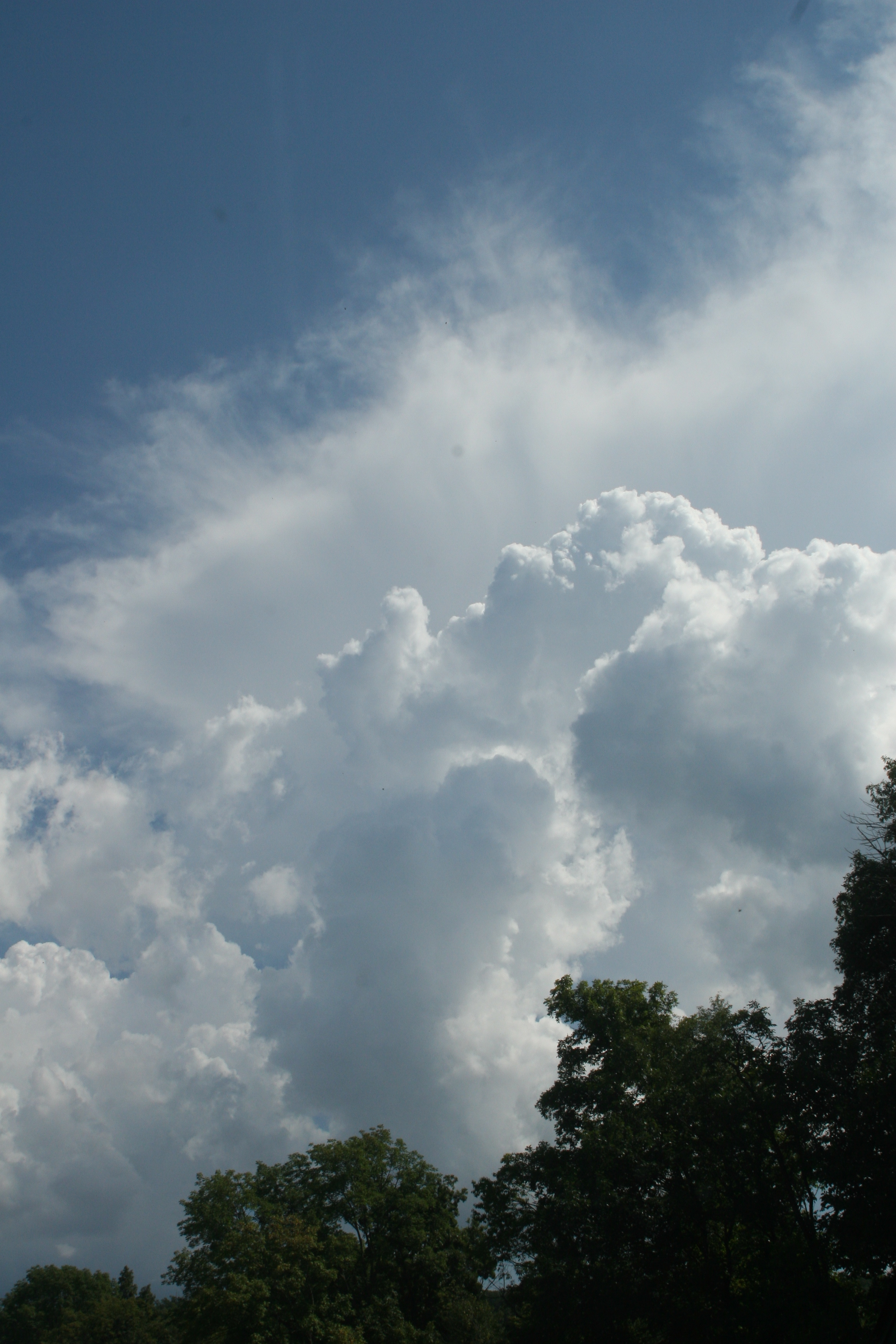
On the first warm, sunny, not-horribly-humid day in a long time, to reward myself for marking up a pile of student essays, I lay in the hammock and looked up at the clouds. The clouds are amazing today, shifting, fast-moving, likely thanks to Hurricane Florence far to the south.

I wanted reverie, but I got spotted lanternflies instead, which interfered with my admiration for the clouds. Dozens of the creatures were aloft on this mild afternoon.

IMG_5605

They are a recent invasive species to our region; their appearance causes concern because they use fruit trees, mast trees, grapes, and hardwoods as host plants when they cannot find their traditional host, ailanthus. We have no ailanthus on our property, but we do have oaks, hickories, maples, beeches, and many scraggly cherry, walnut, and mulberry trees along the hedgerow and into the woodlot. Development in the valley–housing developments, business plazas, parking lots–coupled with stress from climate weirding, has been hard on trees. We already have diseases that have damaged the Pennsylvania ash, hemlocks (PA’s state tree), and dogwoods. I notice weakened bark on many trees. The droughts and the too-much-rain cycles, and unusual, high winds with storm fronts, plus road-widening, contribute to considerable loss of trees.

I lay in my hammock under the trees and worried about the lanternflies. Which accomplished nothing (I think of a James Wright poem at this point…).

What was there not to despair about? So much anxiety surrounds me. Even the damned bugs. If only starlings were to take a liking to spotted lanternflies, I mused.

A butterfly went past. I looked down at the zinnias blossoming their stems off in the garden and felt pleased to count four monarchs there. It has been a good year for monarch butterflies in my yard, and green darners and other dragonflies, and hummingbirds–which used to be quite uncommon visitors here. The little brown bats are returning each dusk, recovering slowly from the decimation of white-nose virus.

The balance may seem off in many ways. But there are restorative moments.

Even if “I have wasted my life.”

monarch.ann e michael

Monarch on tithonia blossom


Devil-bush

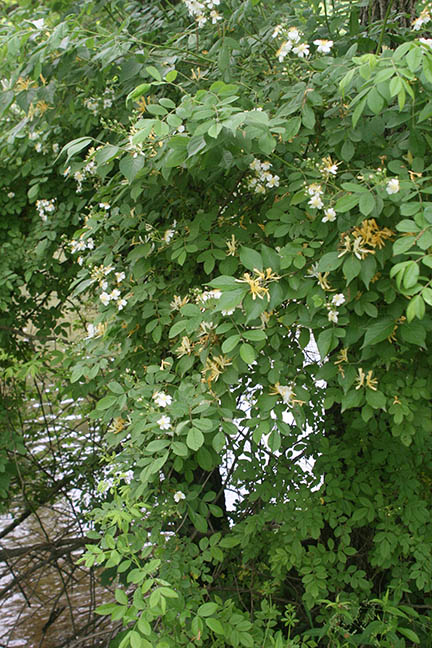
asian rose-amerMultiflora rose: Rosa multiflora Thunbergia ex Murr, is banned in 13 US states, including my own, where it thrives at the expense of native species of many kinds.

Here (at left) it mingles with another invader–Amur honeysuckle (lonicera maackii) along the Tulpehocken Creek in Berks County, Pennsylvania. Amur honeysuckle has not yet made the “illegal plant” list. Both shrubs spread easily because they do not mind disturbed soil and they have attractive berries that birds consume, thus sowing the bushes widely.

I do not know how a plant can be illegal if the birds are our planting culprits; but I do know how hard it is to eradicate multiflora rose, which flourishes in our hedgerow among the sassafras, tulip trees, green ash, white ash, honey locust, wild cherry, walnut, oaks, and maples.

The shrubs are wickedly hard to pull out, as they are stemmy and prickly and have deep roots. We’ve hacked them out of the rocks and pulled them out by chain with our tractor and weed-whacked them and used a machete in the thickets. We have often enlisted our son in our efforts to limit their number along our property line. He refers to the rose as “devil-bush,” having been scourged by its thorns numerous times while endeavoring to cut back or pull out the shrubs. I, too, have shed my blood over its white flowers–not to mention erupted in rashes, because poison ivy frequently entwines itself around the stems of multiflora rose.

Well. They are in bloom now (end of May). And so far, the roses are winning.

~~

The USDA has a page devoted to information on multiflora rose, a “noxious plant.”