Dissent, controversy, & opinion

It may be obvious that, in this blog, the writer tends to shy away from highly controversial contemporary issues–with the possible exception of my occasional strong views on education–even though philosophical and critical arguments are part of my job and integral to my life interests. One possible explanation is that I am, as Charles Schultz memorably popularized, “wishy-washy.” (This strip is from 1952, © Charles Schultz):

Peanuts

And a little destructive criticism from 1959….

~~

Indeed, my students sometimes get annoyed with me because I do not take sides during class discussions of controversial topics. “Don’t you have an opinion?” they ask.

Why, yes, I do. It is not my job to share my opinions with students, however, as much as it is my job to make them think more than once about their own opinions. It is also my job to help them navigate the complexities of critical thought, weighing “both sides” (and pointing out that many controversies have many more than two sides), and learning that perspective can deepen understanding and sometimes even alter opinions. This approach is far from wishy-washy; it is courageous. It can be risky to analyze rationales and points of view that differ from your own, and risk takes courage.

~~

A good book that explores the courage it takes to analyze and, often, to dissent from the normative view is Cass Sunstein’s Why Societies Need Dissent. Sunstein argues that truly free societies need to permit dissenters room for expression and criticism; he provides evidence that without dissent, societies fail to thrive through change. Because growth is a change process, societies that resist change too rigidly fall apart.

This year, my class and I will be exploring Sunstein’s text in an effort to recognize the kind of thinking and evidence needed before one writes an essay. I hope they apply these ideas in their freshman Philosophy course.

I hope they apply these ideas in my course, for starters…

~~

Argument has a negative connotation in American English, so many critics substitute the word discourse. I have no problem with such a substitution: the term discourse seems to connote politeness and respect, behaviors necessary for useful dissent and analysis of alternative perspectives. The philosophical argument, whether taking place in philosophy class, conference hall, or koan, operates most productively and insightfully when predicated upon mutual respect for differences.

Dissent as discourse may not be the most natural behavior for human beings, but it is something we can demonstrate and coach in the university classroom.

With any luck, both students and teachers may be able to apply the techniques to other areas of our lives. Along that vein, here’s an easy-to-interpret Buddhist explanation from New Lotus on how to approach argument in the Buddhist way.

GFS2


Mere philosophical speculation

I have been reading more of Daniel Dennett. One of his earlier books, Brainstorms, consists of essays and talks and thus, being available to read in short bursts, has served as my intellectual entertainment in between the busy social events of this particular June.

I liked three of his essays better than the others. The first one in the book describes, explains, and argues for “intentional systems;” the author also does a fairly good job of asserting that philosophers and psychologists ought to study computer models of intelligence as a means of leaning more about human intelligence. He does not make lots of mechanistic claims, however–he does not suggest human beings are mere soft machines, and he gives a good argument in Chapter 11 as to why we cannot make a computer that feels pain. But he does separate, by degrees, the differences between basic consciousness states and consciousness that exhibits intentionality, and he separates basic consciousness from simple instinct–something that confuses many people when they are posed difficult questions about non-human animal “minds”.

His essay “How to Change Your Mind” offers terrific, logical insights about human “feelings,” “intuitions,” and opinions. Dennett shifts the perspective on the psychological question of why it is so difficult for human beings to “change their minds” and to give genuinely rational (or mechanistic) reasons for doing so.

The book’s final chapter, “Where Am I?” is available as a PDF at this link, and here Dennett offers a much more entertaining and readable philosophical thought experiment on personhood (and consciousness/mind) than Derek Parfit posits in his book Reasons and Persons. Those readers who are interested in how a thought experiment can argue for the existence of a person-as-consciousness-state without embodiment-in-carbon-based-materiality, without the usually-required religious or spiritual crutch, but also without the dense counterarguments of Parfit’s approach, may wish to check out this chapter.

Granted, I understand that many people feel thought experiments are a monumental waste of time, tantamount to navel-gazing; others feel sure that teleportation out of fleshly bodies is the stuff of science fiction (emphasis on the fiction). But as our inventions permit us to test out theories that once were “mere philosophical speculation,” all kinds of surprises may await us. Quantum physics was an imagined idea, for example, that scientists have been able to revise and explore in a more machine-based way…Thomas Kuhn’s The Structure of Scientific Revolutions does, often, operate historically as he envisioned the process. The recent excitement over teleportation of coded data provides an example of mechanical testing of theories (here is a good basic article on the experiment for the layperson, with graphics and a Star Trek image, and here is the scientist-written article).

All of which is fascinating, yet none of which decreases my enjoyment of a run of perfect June summer days. Incarnate, I attempt meditation. There is honeysuckle on the breeze. Insects whir and buzz around me; sun warms my left shoulder. Time for consciousness. Time to be here, among the things of this world.


IMG_0787

Consciousness as multiple drafts

Daniel C. Dennett’s 1991 book, Consciousness Explained, has kept me entertained and interested for a couple of days now. How could I refuse a book with that title? And Dennett–whose conversational writing style appears to toss off one idea after another in quick succession–actually stays mostly true to classic philosophical reasoning in his arguments as he endeavors to make claims for what consciousness is. He begins with phenomenology as one way to initiate the concatenation of empirical science (physics, biology, neurological research) with logic. He dispenses with Husserl and the early Phenomenologists but invents his own form–hyperphenomenology–breaking phenomena into three divisions and exploring each until he arrives at a way to destroy the long-held concept of the mind, hence consciousness, as “Cartesian Theatre,” and replace that model with a construction more biologically sound.

The book is far too complex to summarize, but the concept he develops that most appeals to me is what he calls the multiple drafts theory of consciousness. Dennett draws upon neurological and psychological research as well as past and current philosophical thinking to propose that what we term consciousness may consist of multiple narratives created through physical input, memory processing, and other processes that result in fraction-of-a-second “revisions” in thinking. Narratives! Revisions! As a writer, I can certainly relate to this idea. The theory of multiple drafts consciousness would explain many phenomena, such as the unreliability of eyewitnesses, the repression and re-constructing of traumatic experiences, the embellishment of stories (as Dennett puts it, “What I should have said at the party becomes what I said at the party”)…and it has examples in the way we “tell” fiction, movies, and family stories.

Currently, I am engaged in the work of revising dozens and dozens of poems. Many drafts. Many narratives, many layers. Subtle shifts in perspective or story or language or style–which version is the real me? All of them, across a continuum.

Derek Parfit’s Reasons & Persons suggests some of the same conclusions through a more traditional philosophical approach (harder to read than Dennett’s often-humorous prose which is geared more toward the non-philosopher and which employs considerable neurological and psychological research as part of its rational evidence).

Although these texts intrigue, and are convincing, they remain speculative. For me, the science aspects of the inquiry remove none of the mystery or delight I experience in terms of my own consciousness. Nor do they negate my sense of myself as individual, unique as to perspective, or whole in myself and in the cosmos. I know that many people resist the idea that consciousness is not soul, who feel that scientific research somehow diminishes human beings into–what? Fancy hardware for intelligent software? Automatons with the illusion of free will? Purposeless life forms? Robotic zombies with no moral bearings?

continuum

A continuum version of tao

Apparently, we desire awe; but knowledge doesn’t have to kill awe.

I find myself fascinated with the ideas posed by Douglas Hofstadter wherein he theorizes consciousness-as-continuum (see this post). People love to default to a black & white way of analysis, thinking, and judging, but everything in nature contradicts that concept. No doubt our brains, wired to make quick decisions using the simplest shortcuts, sieve out a great deal of content and then justify later (Daniel Kahneman’s book Thinking Fast and Slow covers this process in fascinating depth). It’s simply easier to think of balance as tao, perfectly harmonious black and white, or to sort people or objects or ideas into yes-or-no categories. But the distinctions are seldom so clear–there’s a continuum that stretches from the black to the white, as in the spectrum, as in the fringes of a forest or a meadow, as in the so-called races of human beings, as in places where societies and cultures meet and often intermingle, as in the coastline of the sea or a riparian environment. And all of those things are awesome, even miraculous.

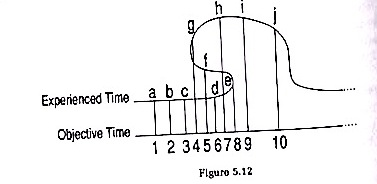
In Dennett’s Chapter Five, “Multiple Drafts vs. the Cartesian Theater,” he offers this diagram:

~

dennett003It’s a proposed version of what happens when we think.

You will have to read the book to decipher this illustration; but I recognize in it the way I tell a story, think about a story, remember an event, record an experience, and the narrative method of the many kinds of stories (many genres, many media) that I love.

One thing it is not is straightforward. We have all those revisions to make, to layer our experiences with, to explore along the fringes of, and to find deeply miraculously awesome. Wading among my drafts now, I feel revitalized. These reflections and revisions are part of my Self as a conscious being in a physical and wonderful world.


Reading as drug

“…Let us admit that reading with us is just a drug we cannot do without–who of this band does not know the restlessness that attacks him when he has been severed from reading too long, the apprehension and irritability, and the sigh of relief which the sight of a printed page extracts from him?–and so let us be no more vainglorious than the poor slaves of the hypodermic needle or the pint-pot.”  ~ W. Somerset Maugham, “The Book-Bag”

azaleas by Ann E. Michael

In June and July, my situation lets up enough that I am not in my office 40 hours a week and can, for a time, attend to the garden or the hiking trail or avail myself of more time to read. Yesterday, I browsed through the campus library and came away with seven or eight books. How I loved that feeling when I was a child: walking through the stacks, thumbing through card catalogues, picking and choosing, now with deliberation, now with impulse, until I had reached the borrowing limit!

It is, in a way, a kind of addiction, though for the past three decades I have been a bit more studied and less compulsive in my reading habits. A bit. Plants and animals, and the workings and seasons of the garden, are my alternate texts when the printed page is unavailable or my eyes feel tired. Certainly I read on-screen quite often, but that process is not nearly as fulfilling. I have downloaded a book by Deleuze (Difference and Repetition) as a kind of experiment; I’m not at all sure that philosophy will be comfortable to read on screen, but I suspect I might prefer reading philosophy on a computer than reading a novel on a computer.

For me, the worst thing about onscreen reading, as I possess neither laptop nor tablet computer, is the inability to stretch on a lounge chair or curl up on a sofa (or, best of all, in a hammock) while reading. And the pleasant experience of leaf-shadows gently caressing the off-white pages of a paper book, the tone of the paper shifting ever slightly as the light changes, the sensation of dozing off with a book over one’s face when the sun gets hot…book addicts find these aspects as enjoyable as the intellectual response to the material, the words themselves.

Several significant events & celebrations appear on this summer’s horizon, but with any luck I can employ my library cards to good purpose a few more times before the fall semester arrives.


Mimesis

Mimesis: “Imitation, in particular. 1.1 Representation or imitation of the real world in art and literature”… “a figure of speech, whereby the words or actions of another are imitated” … “the deliberate imitation of the behavior of one group of people by another as a factor in social change” (OED).

“Nature creates similarities. One need only think of mimicry. The highest capacity for producing similarities, however, is man’s. His gift of seeing resemblances is nothing other than a rudiment of the powerful compulsion in former times to become and behave like something else. Perhaps there is none of his higher functions in which his mimetic faculty does not play a decisive role.” —Walter Benjamin (“On the Mimetic Faculty,” 1933)

~

From time to time, I mull over mimesis and its role in human learning. Research on animal behavior since Benjamin was writing has somewhat undermined his assertion that the “highest capacity for producing similarities” belongs to human beings, but the concept remains generally accurate. What I notice among my students, however, is the human ability to perceive differences. My students much prefer to focus on what makes things different than on what makes them similar, but perhaps the reason is that similarities seem so obvious (due to our capacity for “producing similarities”) that we take them for granted. I introduce poetry to my students as an ancient art derived from exactly what, no one is certain, but likely from invocation or ritual or song or the human desire for narrative–and I tell them that it has been carried along through history by, among other compelling things, mimesis–that mimetic faculty we possess that makes us want to repeat or copy, in order to learn, to love, to pass along, to entertain, to communicate, to enjoy. We can look in the mirror and see another human’s face, or our own faces slightly changed through the process of copying another.

The mimetic urge has a long history among those people who intellectualize. Theories of Media (Univ. of Chicago: W. J. T. Mitchell) glossary offers a concise but comprehensive “mimesis” entry authored by Michele Puetz–the article in which I found the Benjamin quote above. (By the way, the Theories of Media glossary project is a great resource!) As I looked through my go-to philosophy resources, though, I was left with the distinct impression that the concept of mimesis has moved from the realm of the philosophical–Plato and Aristotle are our main thinkers on mimesis in the philosophical arena, so that’s pretty far back–and into the realms of sciences, both social and biological. Mimetic response has been researched, and speculated upon, by psychologists, cultural anthropologists, and neurologists (see the initial excitement about “mirror neurons” in this 2006 New York Times article). The term has found considerable employment in the writings of Rene Girard, whose writings span cultural anthropology, literary criticism, psychology, theology, and philosophy.

Writes Gabriel Andrade, in the Internet Encyclopedia of Philosophy:

“Girard believes that the great modern novelists (such as Stendhal, Flaubert, Proust and Dostoevsky) have understood human psychology better than the modern field of Psychology does. And, as a complement of his literary criticism, he has developed a psychology in which the concept of ‘mimetic desire’ is central. Inasmuch as human beings constantly seek to imitate others, and most desires are in fact borrowed from other people, Girard believes that it is crucial to study how personality relates to others.”

Clearly, human psychology and biology cannot be simplified to mere reflection and copying, but it is equally clear that the metaphor of mirroring can be fruitful as we explore the complexities of mind and consciousness, culture and art. Sometimes I take on the role of educator; and when I do so, I recognize the need for student learners to imitate, to hear information repeated, and to attempt to create their own “similarities.” Sometimes I take on the role of poet; and when I do that, I am clothed in centuries of form, rhythms, sounds, similes, stylings and borrowings and references: copies and reflections, altered through time.
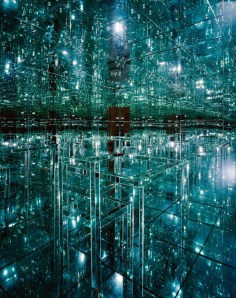
Mirrored Room by Lucas Samaras

Mirrored Room by Lucas Samaras Photo: © Albright-Knox Art Gallery/CORBIS

~
A brief aside: When I was eight or nine years old, I went with my parents to an art museum–it may have been the Chicago Art Institute–and there was an installation of Lucas Samaras’ piece “Mirrored Room.” [See the photo at left.] I was deeply impressed by the mirrored room, partly because it was inside this artwork that I finally understood, metaphorically, the concept of infinity. I was awed by the many diminishing selves I could see, the way a single “I” could change (in size), and by the tricks of light and how easily one could get lost in such a small space.

The mirrors copied me.

Mimesis implies something active, a borrowing, a taking–a kind of theft, on the one hand, and a kind of tribute or ritual motion on the other. It is also inherently continuous. The behavior does not stop at the first copy; it is carried on, perhaps through generations, like DNA.

Here is the brilliant Anne Carson:

“[It’s] what the ancients mean by imitation. When they talk about poetry, they talk about mimesis as the action that the poem has, in reality, on the reader. Some people think that means the poet takes a snapshot of an event and on the page you have a perfect record. But I don’t think that’s right; I think a poem, when it works, is an action of the mind captured on a page, and the reader, when he engages it, has to enter into that action. And so his mind repeats that action and travels again through the action, but it is a movement of yourself through a thought, through an activity of thinking, so by the time you get to the end you’re different than you were at the beginning and you feel that difference.”

~

Carson describes how I feel when I’ve read a poem or novel that moves me deeply. For that matter, it is how I feel when I find a work of visual art, or a play or dance, that seems to speak with immediacy to my own sense of experience, which arouses my passion, compassion, or emotion and alters my entire psyche for awhile– “by the time you get to the end you’re different than you were at the beginning and you feel that difference.”

Sometimes I even manage to compose a poem that gives me that sense of feeling different than I was at the beginning. On those rare times, I may look at myself in the mirror and see a changed face.


 

Enter the philosophy paper…

My “day job” at a small university is part administrative, part teaching, part assessment, and largely tutoring in writing. The last of these requires a peculiar balancing act, because my directive says I must not tutor discipline content; I have to tutor students toward “clear expression” while staying within the areas of grammar, spelling, vocabulary use, assignment interpretation, thesis writing, paper structure, and documentation. As a job description, that all sounds quite clearly delineated and objective enough, but writing well cannot happen when the writer fails to understand content material. Enter the Philosophy paper.

In any discipline, it’s difficult to separate tutoring “clear expression” in terms of grammar and vocabulary without also tutoring content. With philosophy that process is especially challenging, because to a large extent, philosophical understanding (content) relies on grammar (rhetoric). A student can contradict himself simply by neglecting to type the word “not” in a sentence, rendering his attempt at argument void. Or a student may announce she will use one approach to prove her claim and then prove the claim, quite adequately, with a different (and opposite!) approach.

This bust resides in the Louvre, and was found here: http://www.humanjourney.us/greece3.html

This bust resides in the Louvre, and was found here: http://www.humanjourney.us/greece3.html

Cases like these cause me to ponder. How can I coach the writer without offering a content-based answer? Philosophy itself supplies the method: inquiry.

“So, you say here that because Locke believed in Natural Law, he would not apply Natural Law in the case of the social contract. Can you explain that statement? Because it seems as though you are contradicting yourself, unless you accidentally added the word ‘not’ or unless you have more to say after this sentence…maybe, why he would not do so?”

“Here, you do a pretty good job explaining why beauty is in the eye of the beholder, although you need to pay more attention to your use of the comma. But back at your claim in paragraph one, you say you will prove beauty is transcendent–and your definition of transcendent doesn’t work with your argument in paragraph three…do you mean beauty is not transcendent? Did you forget a word, or are you missing a paragraph of explanation?”

When the science students or economics students bring papers to me, it is, I admit, much easier for me to stick to grammar and mechanics. The same sorts of logical structure or argument issues crop up, however. Sometimes, I feel as though I am right on the borderline, and sometimes I think I’ve teetered a bit too far into content tutorial–especially when the students are writing about history, philosophy, literature, or philosophy. Yet would any philosopher disagree that you cannot completely disentangle grammar logic from any other kind of logic? They stem from the same root.

Psychobiology & art

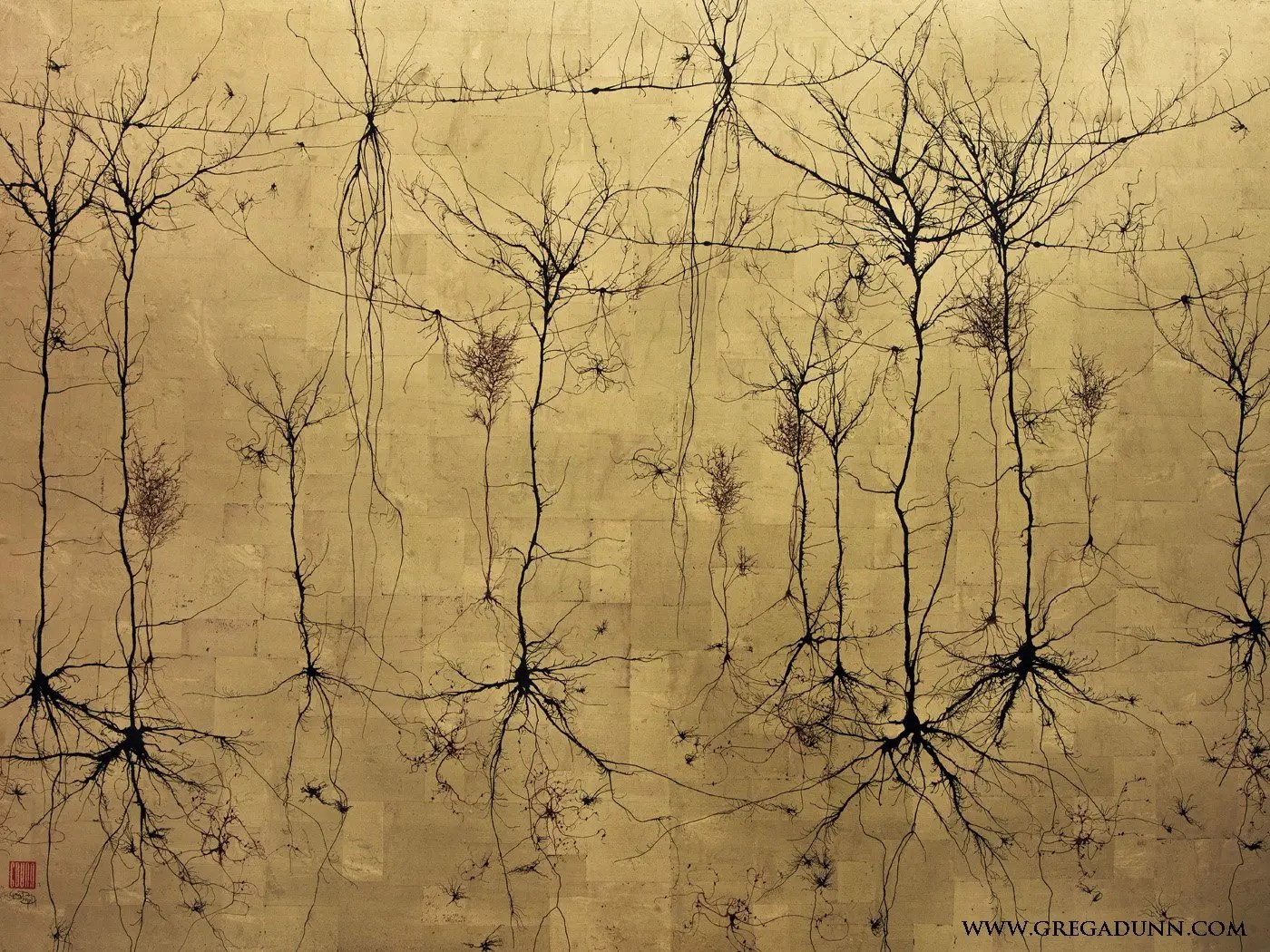
Greg Dunn’s gold-leaf neuroscience art: “Gold Cortex”

~

Howard Gardner once said aesthetics is considered the “dismal branch of philosophy” and that psychobiology, the scientific examination of art, might therefore be called the “dismal psychology.” This view derives from the difficulty of pinning down what qualifies as art, the artistic process, the artistic personality, and the like–especially the challenge of trying to categorize, measure, and in any genuine way evaluate art. Psychobiology as a discipline is new to me; is it merely an earlier form of behavioral neuroscience? How does aesthetics play a role? I went looking.

~

Here is an excerpt from D.E. Berlyne’s abstract of his exploration into stimulus behavior and art (including humor), Conflict, Arousal, and Curiosity, written in 1960:

The highly variegated human activities that are classed as art form a unique testing ground for hypotheses about stimulus selection. They consist of operations through which certain stimulus patterns are made available, and so they must unhesitatingly be placed in the category of exploratory behavior. The creative artist originates these patterns, the performing artist reproduces them, and the spectator, listener, or reader secures access to them and performs the perceptual and intellectual activities that will enable him to experience their full impact.

It’s intriguing to note the different ways a social scientist (Berlyne was a psychobiologist) uses language to write about a generally-considered subjective subject: art. Different in tone and terminology than the language a philosopher or artist would employ, the description characterizes yet another inquiry into the ontology and the exercise of art and the artistic process:

The content of art can range over virtually the whole scope of human communication. It may be used as a source of information about the appearances of objects, the course of historical events, the workings of human nature, as a means of effecting moral improvement, as a vehicle for propagating religious, political, or philosophical ideologies. Art is, however, distinguished from other forms of communication by …the communication of evaluation. While human beings may produce art and expose themselves to it for an endless variety of reasons, collative variables must play their part, as they do in all forms of exploratory behavior. They underlie, in fact, what is commonly called the “formal” or “structural” aspect of art.

The author is interested in whether psychosocial behaviors, culture-building, and communication all derive from exploratory behavior and stimulus-response and what role evaluation plays in the assessment of art, its social or moral value, artistic merit, “timeless” art, and to some extent the very making of art.

The psychology of aesthetics offers intriguing insights–if one can get past the jargon. From the little I have read about it so far, the science seems to share a few points with phenomenology: its task, according to Dr. William Blizer, is to “describe observable phenomena and to note associations and correlations among them which enable such phenomena to be predicted, controlled, and explained.” In psychobiology, the “observable phenomena” are “the behavior of the creative…artist and the appreciator.” Philosophy and psychology are strange bedfellows, though; throw aesthetics into the mix and the entire project begins to seem suspect. I am not at all sure that these inquiries end up explaining–certainly not predicting or controlling–anything about art.

I admit I prefer to read such musings when the makers themselves are doing the exploring. Nonetheless, this little intellectual excursion led to my discovery of Greg Dunn‘s amazing neuroscience designs, one of which appears above. Who knew the brain was so gorgeous?

Consciousness reconsidered

A few months back, I was reading about consciousness (see here and here). This article on “brain tubules” caught my attention, although I admit to considerable skepticism as to how applicable, or even correct, this research will turn out to be. The material seems exciting–quantum vibrations in the brain!–because of the possibilities inherent in a synthesis of chemistry, biology, and physics and how such synthesis could lead to a theory of human consciousness.

The earliest article I could find on this theory dates to 1998 (an abstract is here). I suppose I should now break down and tackle Werner Loewenstein’s Physics in Mind: A Quantum View of the Brain. But I have a huge to-read list at present and no time or concentration to get to those books. Besides, at the moment I find myself more concerned with the less empirical side of consciousness theory. I mean: belief, attitude, faith. Those non-provable abstracts that nevertheless seem so much a part of most human beings’ operating systems…the things that psychology and neurology do not seem able to answer and that keep philosophers continually at work (the only true knowledge being the knowledge that one knows nothing).

~

And maybe, as Daniel Dennett suggests, the very idea of consciousness is an illusion–the brain evolving to fool us through perception.

~

This bust resides in the Louvre, and was found here: http://www.humanjourney.us/greece3.html

This bust resides in the Louvre,
and was found here:
http://www.humanjourney.us
/greece3.html

Do our brains fool us through our perceptions of emotion, too?

~

And how does this affect how we understand, say, literature, or art? Poetry, for example: Is it possible to deconstruct the pleasure I take from a poem into quantum vibrations in connective synapses as a result of the evolutionary process and, if so, where does the knowledge get me?

Would I still love the poem? (I think I would.) Would I consciously love the poem, consciously find pleasure and surprise in it, once I understand fully the process and development of consciousness? (Why not?) Would such knowledge flatten my emotional or aesthetic attraction to the poem? (I doubt it.)

If loving my perception of art, my relationship with it or attachment to it, is “merely” an evolutionary development, that does not cheapen or devalue the way I feel.

~

What brain studies and consciousness studies have to say about faith may perhaps set up more antagonism between science and consciousness-as-non-biological/i.e. religion, spirituality, etc. By faith I mean not necessarily religious faith but any non-provable conjecture, some of which are imaginative and potentially marvelous, not to mention potentially true. Some statements can be disproven but not proven…and there is the apagogical argument…and then there is the definition of faith (or belief) as Wikipedia defines it: “Faith is subjective confidence or trust in a person, thing, deity, or in the doctrines or teachings of a religion, or view (e.g. having strong political faith) without empirical evidence, or as confidence based upon a degree of evidential warrant (as in a Biblical sense).”

That empirical evidence thing is the perpetual stumbling-block, yet–paradoxically–it’s also what makes faith so appealingly…human. Yes, maybe we are fooling ourselves. And maybe that’s what is so marvelously cognitively neurologically fruitful and imaginative about the whole human endeavor.

The poet & the Good

I have recently finished reading Robert Archambeau‘s collection of essays The Poet Resigns and am mulling over the idea of resigning with him.

It’s not that I necessarily want to give up writing poetry but that, in my reflections about where I can do the most good among the community of sentient beings, my work as tutor and teacher almost certainly has an effect both deeper and broader than my work as poet. This “good” hearkens to the ancient Good of Socrates, Plato, and their ilk but also to the sense of mindful “middle way” of the Tao: a practical path between two values that may be incompatible in many ways.

~

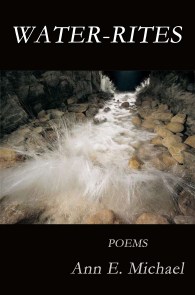
water-rites_coverThe readership for contemporary poetry is small, and my readers number only in the hundreds; among those readers, resonance of any kind–aesthetic, emotional, lyrical–is likely to be limited to a small number of poems. A poem of mine that effects some measure of The Good upon readers represents a minuscule good moving into the world. The net effect, I imagine, hardly registers…not that net effect matters so much. I suppose if a poem of mine moves just one person enough to evince even a small transformation, something has been achieved beyond my individual abilities in the composition of that particular piece.

As a teacher and tutor for the past ten years, my role expands not merely to number of people encountered (few of whom will remember me as an individual) but to the concepts I present to them, most of which will be significant in their lives one way or another–although not immediately, and probably unconsciously. Lately I have been devoting more of my limited energies to this aspect of my life work. Such focus does impede my ability to do creative work of other sorts.

~

This bust resides in the Louvre, and was found here: http://www.humanjourney.us/greece3.html

This bust resides in the Louvre, and was found here: http://www.humanjourney.us/greece3.html

Example: I am reading a little book on philosophy for beginners by Thomas Nagel. The Nagel book is on my table because I have been trying to find simpler ways to talk with students about their philosophy essays. While my main enterprise as writing tutor is to help students to clarify and correct their mechanical weaknesses (sentence and paper structures), it is not always possible to ignore content weaknesses; a student can write correctly about nothing of value–and receive a D or, in the case of Philosophy classes especially, an F.

But understanding philosophy is important.

Now, it is often extremely difficult for beginning writers to express their understanding of philosophical concepts in writing. They are just learning rhetoric and fall into fallacy errors through grammar as often as through thinking. Since I am not supposed to be a content tutor, I have to find ways to tease out what the student understands (or does not understand) and make that idea come through clearly on the page.

Kind of like mind-reading.

[Aside: I have to admit this can take a lot out of me by the end of the day.]

The Nagel book is one of several philosophy primers I have been reviewing to try to find a text to which I can refer my more confused students, the ones who cannot infer the basics from their professors’ lectures or assigned readings. There are academics who might suggest such students do not belong in college in the first place; but I believe in the ideal of an educated populace, and whether or not these students stay in the university through graduation, they can benefit from the discipline of thinking about thinking.

It feels rewarding when, after half an hour of discussion and writing coaching, a young person leaves my office slightly more enlightened. So they tell me, anyway. I know from experience that writing about something helps a person to understand not only the subject but, more importantly, what the writer thinks about the subject.

~

So perhaps my creative energy is better served in the direction of others through tutoring than through poetry; perhaps the former leans more toward the Good. Perhaps I am a better tutor than poet; this is indeed likely, although I have been poet-ing longer than I have been teaching. Then again, not to knock the art of teaching, but writing poetry is much more difficult than the teaching I do. And I get paid to enlighten people through my tutoring.

Not so through poetry. Indeed, Mr. Archambeau–you have gotten me seriously to think about tendering my resignation as a poet, though not without considerably more reflection on the possibility. Writing about the idea has helped me to understand where the Good fits into all of this, and what the middle way might be.

Now, I suppose I could write a poem about the subject…

~

Abstraction, evolution, & sky-beauty

I awakened this morning to a sunrise of surpassing beauty. As I drove to work, I remembered that the first poems I recall ever writing were about the wind and about dawn–perhaps I wrote other poems as a child, but these two are the only ones I remember: poems that celebrated something I found lovely in nature.

After the vivid morning sky, we had a day of rain; and on my commute home, a compelling sunset bookended the working day. I call these skies “beautiful” and would definitely regard my experience of looking at them as aesthetic.

And yet, it’s only the sky, some clouds, the sun, phenomena that science has explained. What makes it beautiful?

photo: Beejay Grob

photo: Beejay Grob (North Carolina coastal sky)

David Rothenberg’s 2011 book Survival of the Beautiful: Art, Science, and Evolution has accompanied me for the past week; I have been reading it when I can find time to read and to cogitate. Rothenberg speaks directly to the question of what makes us experience beauty, whether beauty is a human-only construct, and from where the qualities of aesthetic experience arise. He explores among other things whether beauty (especially in the form of art) evolved along with us, what makes it timeless (if it is indeed timeless), and whether our grounding in nature as earthly beings formed the grounding for what we deem beautiful.

And he considers symmetry and biology and abstract art and math and music. There’s quite a good deal of synthesis and speculation going on in this book.

~

Rothenberg writes that he is interested in whether humans’ developing education in abstractions–concepts and abstract arts–might produce an outcome that increases our appreciation of things in nature and the cosmos. He writes:

It might seem this century has freed us from interest in any kind of constricting form or function in art, but I want to test out a different theory: that abstraction in the arts has made us find more possible beauty in the natural world…as art exalts pure form and shape, the laws of symmetry and chaos found in mathematics and science seem ever more directly inspirational. Aesthetically, we become more prepared to see beauty where before we saw only the clues of beauty, its glimmers or possibilities…our minds are more attentive to an abstract kind of beauty that we can discover but not necessarily build or create.

It takes him several chapters to braid together the many strings of his interdisciplinary inquiries; but the upshot is that while I feel he does not answer the questions he begins with, he does deepen the reader’s thought process about art, beauty, and the evolution of ideas as well as of organisms. He says the interesting discussion lies not with what is or is not art, nor how to evaluate the individual merit of works, but rather “how artistic expression changes how we think in ways only art can accomplish.”

~

In light of Rothenberg’s musings on how natural-feeling abstract art can be, here are some examples: Barlow, Ellis, (contemporary) and Klee (modern).

Rothenberg concludes with some ambiguity about aesthetics and evolution, which suits his book-length and life-long explorations on the interweavings of these ideas; but he adds with certainty that “[b]iology is not here to explain away all that we love in terms of the practical and rational. That is not how nature works. Nor should we shrink from our natural astonishment at the magnificence evolution has produced.”

~

He mentions John Cage’s work and approach to composing, and I think Cage’s main point in so much of his work is getting us to listen, to see, getting us to be attentive. Viz Rothenberg’s words quoted above, maybe an integration of abstraction does open us to be more attentive to the beauty that exists in the world without any artist making it. We could not, in the past, have appreciated the fractal values of river deltas viewed from airplanes; and perhaps only natural (or trained) artists noticed how the twigs of a tree reiterate the shapes, angles, and curves of the branches, boughs, sometimes even bark. Now we know about Mandelbrot sets and fractal geometry, and those abstractions can generate beautiful patterns. Now we know the Fibonacci sequence of numbers–an abstraction–appears in snail shells and sunflower seed-heads.

We do not have to be mathematicians, chemists, art critics, environmental scientists, physicists, sculptors, violinists, composers, dancers, college professors or biologists to recognize patterns and symmetries, or to find that slight variations in the pattern enhance the experience through the kind of surprise and delight that I discover in great poems.

We just have to be attentive.

~

sunset1