Play’s the thing

My freshman humanities professor, the brilliant, late Larry Fuchsberg, assigned Johan Huizinga‘s The Waning of the Middle Ages as one of the texts for our course…an unusual choice for American teens in 1975, as was another of our books, Burckhardt’s The Civilization of the Renaissance in Italy. At 17, I found Burckhardt rather slow going stylistically (it was published in 1860, after all); by comparison, Huizinga (circa 1919) was refreshingly clear. I really enjoyed it and learned a great deal. I kept meaning to read his 1938 book Homo Ludens, but for awhile it was difficult to find in libraries or bookstores. Also, I lacked the time to track it down or read it. The premise interested me, though–that we humans evolved our culture from the “pointless, imaginative” urge to play, and that play is fundamental to our learning and our social structures. Also, we are not mechanical beings–the messy frolicsome-ness of people is as necessary for our survival as food, water, and shelter.

“Animals play, so they must be more than merely mechanical things. We play and know that we play, so we must be more than merely rational beings, for play is irrational.” 
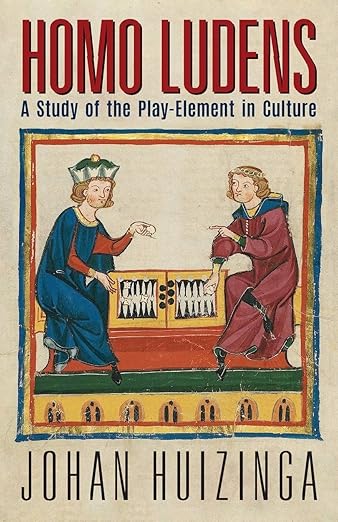
Finally, I’ve begun to read Homo Ludens, and it’s even on Amazon now; also I discovered that it exists online here thanks to Yale University. Fifty years after my initial encounter with the author, I find his thinking just as interesting as I did in college, and just as difficult. As in his other books, Huizinga uses etymology as one of his methods of examining the meaning and culture of play. He was writing for an audience that he assumed was well-educated in the classics, so there are passages in Greek, Latin, and French that neither he nor the English translator bothers to translate for less linguistically-adept readers like me. Fortunately, such passages are brief and are used as sources for his argument, and I’m not reading to find fault with his material. I’m interested in his argument and insights as a whole, and intrigued by his thinking. He apologizes for his lack of sources (ha! There are hundreds of them) because he was “working in haste.” He composed this book in the Netherlands as Germany began to be a serious threat to Europe, and he wanted to get his ideas in print before he was silenced. In fact, his last few years were difficult. He had used his standing as a well-known cultural historian to criticize the Nazis and was arrested in 1942, basically house arrest; he died in 1945 just before the war was over.

I’m only on Chapter 4 but am finding, in the etymological tracings of the words that intersect in meaning(s) for play–game, contest, gambol, gamble, dallying, tournament, match, riddle, performance, frolic, pretending, folly, fun, sport, etc.–fruitful stuff for poetry, for thinking about poems and about how poems work as craft, as poems, and as works of art and imagination. And also, what roles poems may play in culture today, and whether that differs at all from the role poetry played in ancient times. Huizinga writes:

“In the making of speech and language the spirit is continually ‘sparking’ between matter and mind, as it were, playing with this wondrous nominative faculty. Behind every abstract expression there lie the boldest of metaphors, and every metaphor is a play upon words. Thus in giving expression to life man creates second, poetic world alongside the world of nature.”

Language may not be necessary for play but can easily be incorporated into it, and language can become play. Or playful. I don’t know much about Wittgenstein, but I find myself thinking of his theory about words having “family resemblances” that often connect, overlap, shade meanings. So we get jokes, puns, flirting, mocking, and new “rules” for our language use that culture constantly shifts in all kinds of directions. Language is a game-changer, and poets make use of that.

I thank Larry Fuchsberg, musicologist, book-lover, and educator, for introducing me to Johan H. Teachers, you never know how much you may have influenced a student’s life, even decades later.
Prose/poetry

In the first weeks of this year, I participated in a virtual poetry workshop with Anita Skeen. It was so useful to me that I signed up for another workshop, this one on writing the prose poem, with mixed-media artist and poet Lorette Luzajic. She is the editor of an online prose-poetry lit journal, The Mackinaw.

In this workshop, I’m returning to a form I learned early in my writing practice. My friend and mentor David Dunn may have introduced me to prose poems, I cannot recall anymore; but I do know he was writing them in 1980 and that some of the poems in our collaborative chapbook The Swan King are either prose poems or on the verge of being prose poems. Prose poetry was then considered a “new” form and was (& in some quarters, remains) controversial among poets and critics. It sounds self-conflicting: if it is prose, how can it be poetry?

In the decades since I was very new to poetry, reading everything I could find of contemporary work and experimenting all over the place, the prose poem has been much written-about in literary forums and academia and is–mostly–on pretty sturdy footing as a “form” of poetry. I never completely stopped writing prose poems, and a few appear in most of my books. I’ve been writing so many sad lyrical-narrative poems since 2018, however, that I haven’t spent much time really playing with poetry, and play is a huge part of creative thinking. So Lorette Luzajic’s workshop, which gives us a chance to experiment and play, appealed to me.

The workshop has got me thinking about versions and expansions of the form, turned up some exciting new poets to read, and offered amusing prompts that have moved me into ekphrastic, surrealistic, dream-based, and pop-culture themed poems. I have found some surprises in my own work, which is always a reviving feeling.

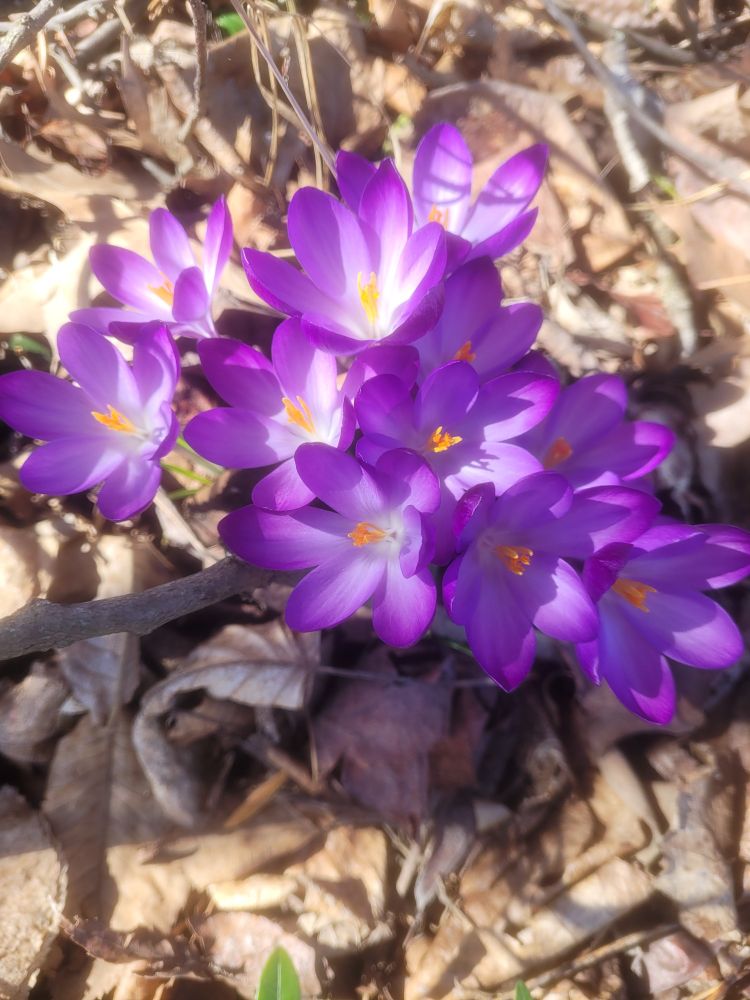
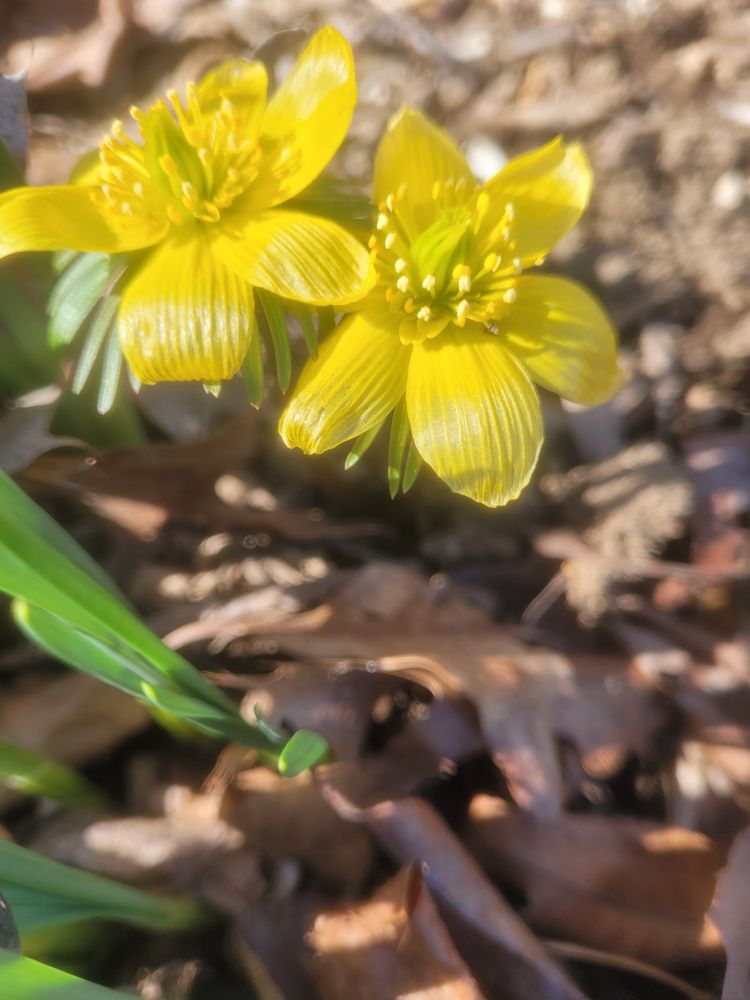
Also, we are almost at the vernal equinox. My environment is brightening in small ways, which tends to help with enduring the tough stuff.

Playing

Sometimes a “skinny” poem’s fun to play with. And breaking up the expected in a rather ornery mood.
~

airplane on sky during golden hour

Aviatrix

I get off on
it, scoff at
ground
walkers
down be
lo & be
hold—
sky waves
a big hello.
Nobody drags
me under
no beast nor
man can
tether me
to lack
luster earth.
Wind, cloud
I am a
light o, how
I hate
going back.

~

Photo by Azim Islam on Pexels.com

Cosmogenic questioning & play

“We may note in passing that the cosmogenic question as to how the world came about is one of the prime pre-occupations of the human mind…a large part of the questions put by a six-year-old are actually of a cosmogenic nature, as for instance: What makes water run? Where does the wind come from? What is dead?” (Johan Huizinga, Homo Ludens, p. 107)

We have, for many such questions, science-as-answer; but scientific answers do not always satisfy the ontological inquiry of the child. I recall hearing adult answers to my own questions–similar to these–and feeling that I was now supposed to consider the matter closed, the problem solved.

But it wasn’t. Not to my mind. I just was not able to express my dissatisfaction in a way that grownups would understand, and perhaps they would have been unable to respond to me at any rate. It was so frustrating, the problem of communicating perspective.

Rather like a riddle.

Which is what Huizinga gets to in this book: riddles, games, play, and how these activities grow into and perhaps structure (or underpin) culture. If humans are the story-telling animal, it’s also possible we are the questioning animal, that play turns into contest through the practice of making riddles.

Creating our own problems, as it were. “Just throwing that out there,” as a friend of mind says when playing Devils’ advocate. (Note in that common phrase: “playing…”) (See the etymology, literally “thing put forward,” below!)

We question origins, and we pose problematic questions–and we do these things as soon as we can speak!

πρόβλημα

Online Etymology Dictionary says: late 14c., “a difficult question proposed for solution,” from Old French problème (14c.) and directly from Latin problema, from Greek problema “a task, that which is proposed, a question;” also “anything projecting, headland, promontory; fence, barrier;” also “a problem in geometry,” literally “thing put forward,” from proballein “propose,” from pro “forward” (from PIE root *per- (1) “forward”) + ballein “to throw” (from PIE root *gwele- “to throw, reach”)…Meaning “a difficulty” is mid-15c. Mathematical sense is from 1560s in English.

Philosophy, Huizinga posits–and religion–developed out of this human need to structure language into language games, to pose problems, thus creating space for wordplay and riddle or secret-knowledge contests. *

Poetry soon grabbed onto wordplay because poetry has a way of taking on all of culture, incorporating and resisting social norms and practices, reflecting society back to itself, asking cosmogenic and problematic questions. Indeed, do a brief scan of anthropology or history and it’s easy to find cultures in which poetry features in the games of noblemen and warriors and gods. (See Huizinga’s book, which enumerates many).

Also, wordplay, puns, connotations and allusions are fun.

This weekend, I want to get back to playing with words.words-from-letters-magnetic-poetry-kit-geek-words-letters-for-refrigerators-words-with-letters-maker


~ ~ ~

* ie, Descartes, boy, did he have problems! Both mathematical and mind-body problems, though he was better at the former. (Sorry for the silliness).