Re-reading, re-learning

Circumstances being what they are, too numerous to mention here, I continue amid distraction and creative malaise. To counter the mood, and to educate myself, I turn to poetry. Often I buy or borrow books that are new to me for excitement or inspiration; this month, I’ve decided to do some re-reading. Since I’m not writing much myself these days, and not too thrilled with what little I have been drafting, it seems time to re-examine poetry that I really admire. Maybe I can learn a few things.
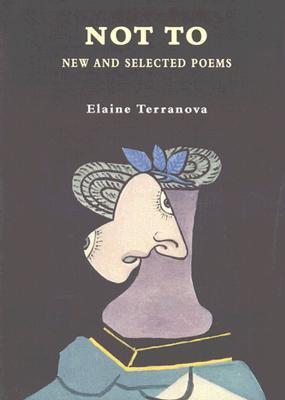
I’ve long been a fan of Elaine Terranova, whom I met many years ago in Philadelphia. I have all of her books but the latest (and will get to that one soon), but the one I’m re-reading is Not To, New and Selected Poems, which came out in 2006 and which contains selections from The Dog’s Heart, Damages, The Cult of the Right Hand, and from her early chapbook called Toward Morning/Swimmers –as well as about 80 pages of what were then new poems.

I don’t want to do a book review here, nor am I interested in poetry analysis right now. The reason I’m re-reading these poems with care and interest is to endeavor to understand why I appreciate her work so deeply. For one thing, Terranova consistently surprises me, but with quiet surprises. The turns in her poems are seldom the powerful, swift changes of mood, direction, or language that I like in many writers’ work…but they are there, and their subtleties and reflective twists engage me in ways perhaps more lasting. Because I have to think about where the poem chose to go, and how it got there. It’s not merely ambiguity, though sometimes the closure’s ambiguous, it’s because the last lines of Terranova’s poems feel so right to me. They don’t always circle back to an image or idea in the opening–sometimes, they travel quite a distance away. And I love her observations and the occasional aside that seems to break the fourth wall:

...Once a squirrel
dropped through the chimney into the whole
ruined civilization of the basement. Here,
I'm taking the squirrel's viewpoint.

That’s from “Small Hours.” How terrific is that–the ruined civilization of basements? And the little comment that suggests indeed, the squirrel has a viewpoint. This poem ends 8 or 9 lines later with the sense of “being swept up/and contained in my bed” but the image she chooses is that of a child on a bicycle, which (to this reader) evokes memory and those hours we find ourselves in the somewhere-else of sleep and remembrance. No statement. No whole-poem metaphor. How did she come to those closing lines? Why do they work so well?

I want to learn that.

~
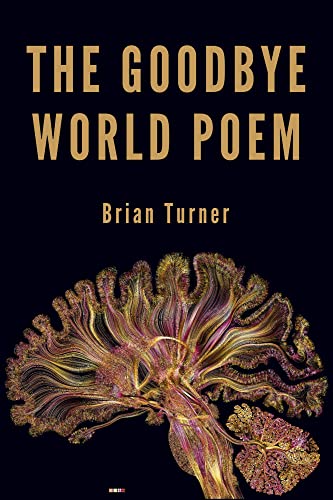
Brian Turner’s book The Goodbye World Poem is another re-read and feels utterly appropriate for a time of personal losses and deep reflection. And thankfully, it’s also a reminder of joy. These poems were written after the deaths of Turner’s wife (poet Ilyse Kusnetz), his father, and his best friend–truly, how does one find the means to say anything at such times? Yet somehow, Turner produced a trilogy of poetry books: The Wild Delight of Wild Things, The Goodbye World Poem, and The Dead Peasant’s Handbook, all published in one year (2023). Exploring what grief feels like has a long history among poets, and Turner’s work reminds me, in topic, of such collections as Donald Hall’s books Without and The Painted Bed, among others; Turner’s poetry is quite different from Hall’s, but the pain of loss and the gratitude for memories of the loved one are similar. And his work differs a lot from Terranova’s.

What do I want to learn from Turner’s poems, what is it he can do in these works that I would like to learn how to do? I love that I learn things in his work, information about whales, jellyfish, swamps, science. His work is usually narrative, doesn’t pretend to be anything but personal and memoir-based. Use of the first-person in poems doesn’t necessarily mean the poem is the writer’s experience or even her own memory/story, but it’s difficult to imagine Turner’s poems as being a stand-in persona. The imagery may offer metaphor but sure feels like “I saw this, I observed that.” Real stuff. Real life. That can get old in poems–but Turner keeps these observations new. Again, there’s reflection in the work that takes us past the surface words, tries to get the reader to find a way in to this grief, this loss, this mix of human feelings.

I think what I like in this work is how Turner acknowledges and presents the mix of human emotions and the movement toward compassion for the sufferer, whether the person suffering is a dying loved one or one’s own distraught and agonized self, whether the sufferer is an animal or a place (environment, region, biosphere). His poem “Fallen Giants” just gets to me each time I read it. It can be read almost as non-fiction prose, though it is lineated–long lines–and uses rhythm and repetition carefully. But, in fact, the poet is describing what whale fall might be like as the huge carcass descends through the silent ocean. And knows that whales are intelligent and can grieve:

...They fall into a hunger they cannot imagine,
with the sound of loved ones in their ears, calling to them, sonorous
and mournful, the pathos undeniable, and mournful because called out
for love's sake, the fluid world a conduit for the voices of these giants,
who sound themselves across the globe, across generations, speaking
to their loved ones...

This poem closes with the image of whales’ huge lungs, how they hold their breaths until they ascend “to the surface/ with a terrific blast of exhalation, a kind of announcement to the universe/that they were here, on planet Earth, a presence in this world, alive.” Compassion for whales that feels like compassion for human beings, for the earth, for the universe. I want my poems to acknowledge and evoke compassion in readers, remind them that the world is complex, beautiful, though often sad. And that it is good to be alive in the world, if only for awhile.

~

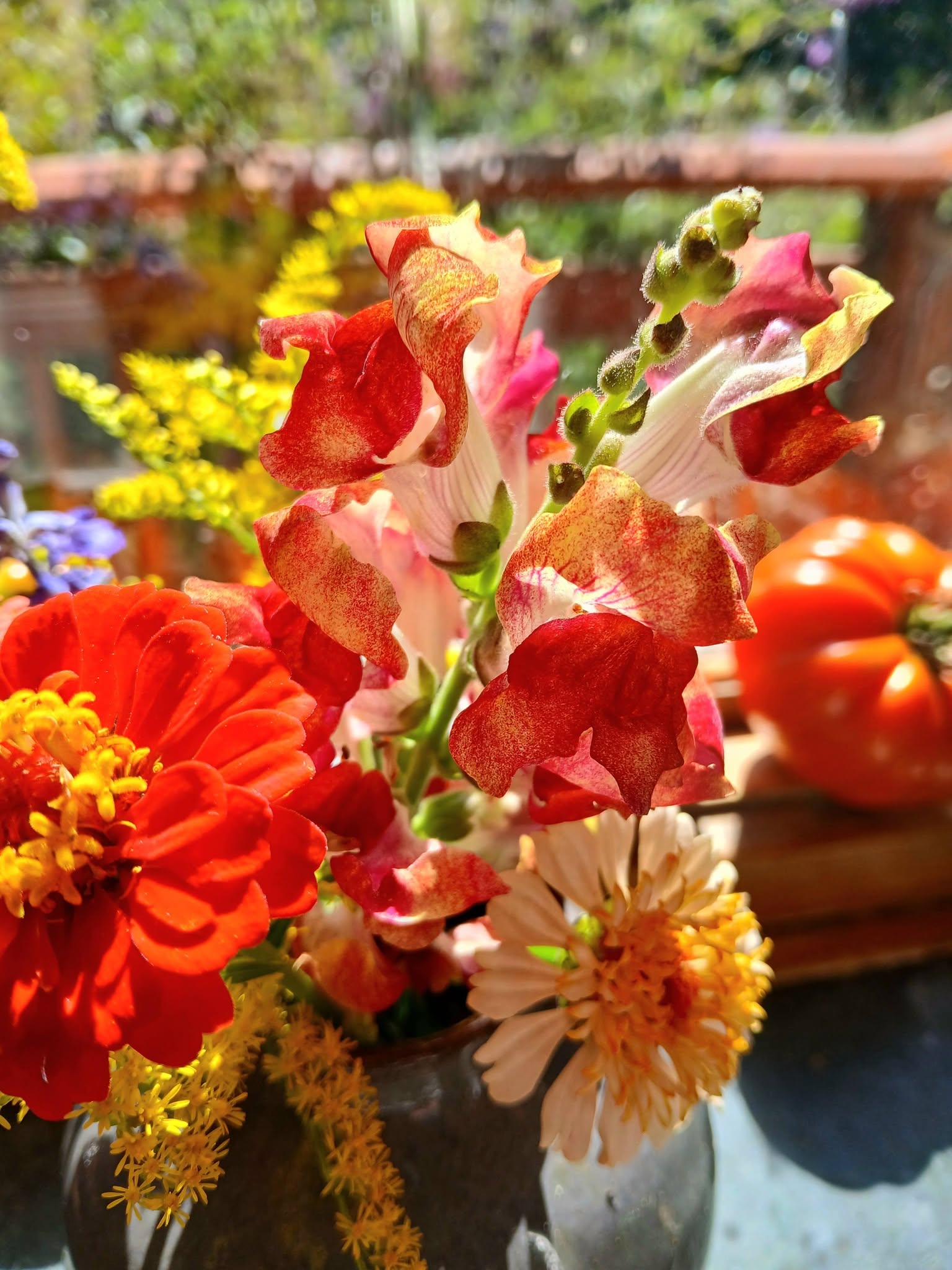
From the late summer/early autumn garden, several beautiful reminders of what life on Earth can offer. I recognize very clearly that not everyone has the good fortune to have a life that gives them bright flowers and ripe tomatoes. So I will be grateful today.
Interview & discussion

This TV interview was interesting to participate in, and I loved chatting with Marilyn Klimcho! She put me at ease, which is hard to do in front of cameras. I have watched the whole 20 minutes without hating myself or feeling too embarrassed. (Hooray?)

Is the show entertaining? Well…you have to be interested in poetry and poets, I suppose. Feel free to check it out. The link above should take you to the YouTube video.

~

National Poetry Month does, it turns out, raise the public’s awareness of poetry at least a little. Recently, I was invited to be a guest at a weekly online discussion of poetry and spirituality. The participants had been reading and discussing my poem “Deity’s Diary” and asked me whether I’d be available to read the poem and then discuss it with the group members at one of their meetings. They even sent me recordings of previous meetings’ discussions. I find it fascinating to learn how readers interpret my poems, what they get out of the work; so of course I obliged.

The group members asked intriguing, intelligent questions–clearly, they are accustomed to talking about poetry. That was refreshing, and it kept me on my toes. I learned that my poem (which is in four parts, so maybe it is poems) is doing the work I hoped it would do, at least with this group of careful and reflective readers. “Deity’s Diary” is intentionally paradoxical and questions many of western culture’s received ideas about god. It’s also pretty presumptuous, since I chose to write it in the persona of a deity…but, like all poems, it is decidedly a work of the imagination. (No, I do not consider myself a god!)

The discussion ranged from philosophical, scientific, and theological concerns to the nuts and bolts of writing and revising a poem, where I get my ideas, what the major influences on my work have been, and lots of other topics. Seldom do we lesser-known writers get to hear back from readers, especially in such detail–so this event felt like a real treat to me.

One participant said that reading these poems was like walking through an unfamiliar forest, not on a straight path, with possibilities of obstacles and turns in the track and the surprise of wildflowers, mosses, or lovely birds along the way.

That made my day.

Memoir-ish

When a poem uses a lyric approach, readers tend to assume initially that the poet is the speaker of the poem; in this respect, a reader might think of the poem as a personal revelation or–if the circumstances of the poem seem to warrant it–as a kind of memoir. People who have more experience with reading poetry (or who have been assigned to write a literary criticism of the work) may change their assumptions once they read more closely. That’s one of the reasons I enjoy poetry. It challenges my assumptions, surprises me, informs me of new facts and perspectives.

Prose memoirs, most of us assume, are less metaphorical and more “truthful,” at least from the writer’s perspective. Though there’s room for the unreliable narrator in memoirs, readers tend to feel betrayed if they determine the memoir writer hasn’t been honest with them (then we end up with controversies like James Frey’s). I find the blurring of genres rather fascinating, but generally, the folks I know who read memoirs want a mostly-unvarnished truth.

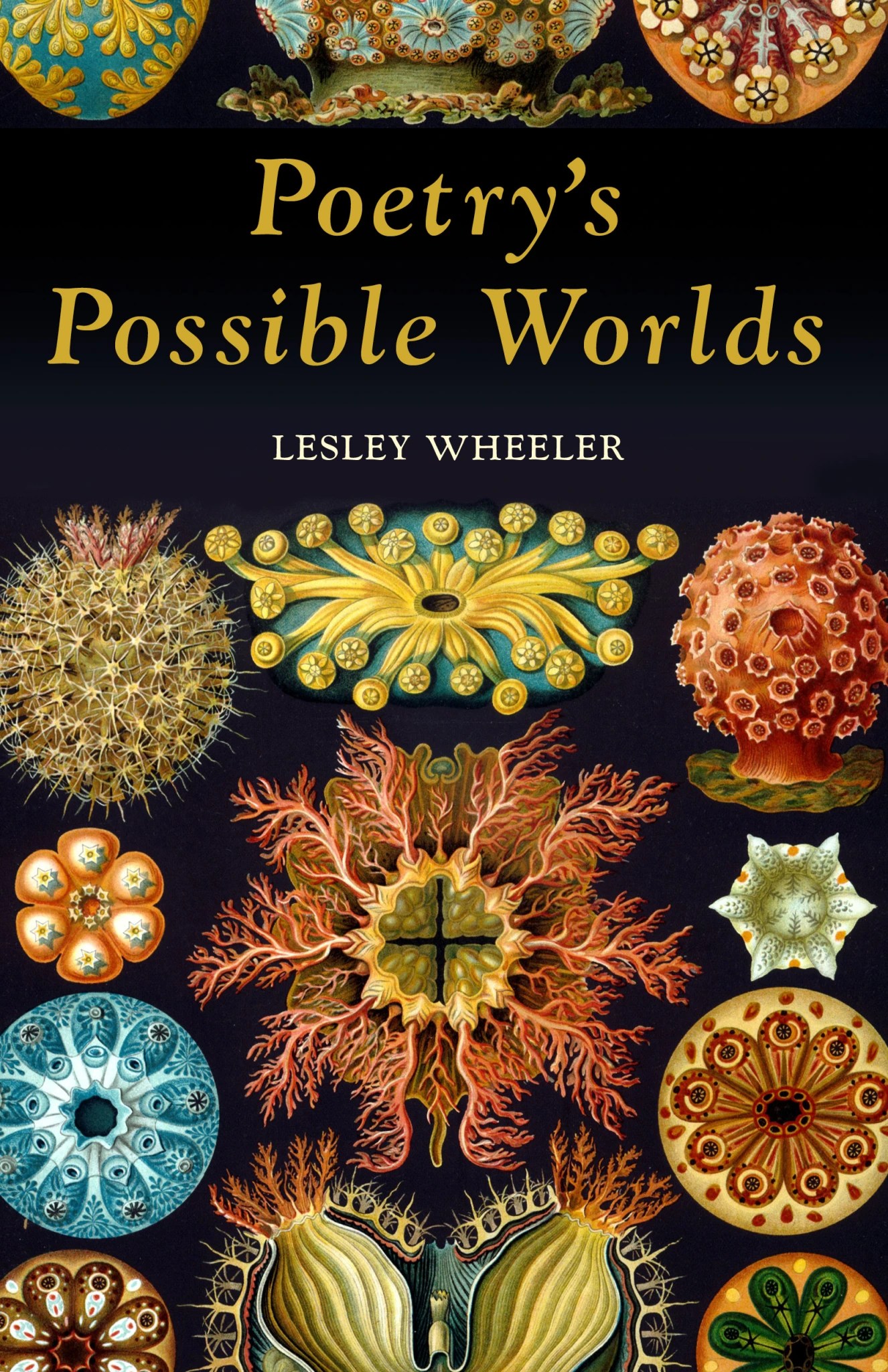
What about taking the memoir in a different direction: instead of blending or blurring toward fiction, into poetry? There are poetic memoirs in print, but they tend to be writers’ experiences expressed in poetry they’ve written themselves. Lesley Wheeler has opted for something different in her book Poetry’s Possible Worlds. Here, she uses the idea of “literary transportation” as a reader of poems, demonstrating how close reading can evolve into a form of reflection on, well, everything. She chooses 12 poems to examine, works that were not only resonant for her but that drew her into some understanding of why and how poetry manages to infect our gut feelings, exert its magic on the reader’s mind. She makes an interesting decision, too, in presenting 12 contemporary poems and avoiding the classic canonical works, a choice that focuses the reader on the newness of the text rather than on its famous backgrounding. It’s fascinating to me how this approach shook up my expectations. In this way, too, she does the readers and the poets whose work she’s curated a great favor: we get introduced to one another through a sensitive, penetrating interlocutor: Lesley Wheeler.

But the book does more than critique 12 poems; if anything, that’s the least part of Wheeler’s purpose. The book “qualifies” as memoir, in its genre-mixing way, because Wheeler explores her response to the poems through the lens of a difficult few years in her own life–here’s the memoir part. But instead of a prose memoir in chapters, each section acts as an independent essay centered around the poem she is reading and, as she revels in and puzzles through each poem, we learn about the challenges in her life. In this book, those challenges come largely from her unreliable, difficult father, whose betrayal(s) of the family snowball into messy misfortune. For Wheeler, poetry offered–still offers–transportation through the grief and anger and ways to navigate the gaps that all lives contain. I couldn’t agree more, and this book reminds me once again of poetry’s necessity.

The poet’s “I”

So often, when reading a poem written using the first-person perspective, my initial reaction is to consider the poet as the narrator–even though I ought to know better!

When I revisit the poem, when I analyze or interpret it on a more abstract or intellectual level, my view may alter. Interpretation sometimes leads me to decide that the “I” in a first-person poem may be a persona, a stand-in for the poet, or a perspective not of the poet’s personal experience but imagined or constructed. The foregoing are reasons to read and interpret poems with care and not to conclude, automatically, that the poet is writing from or of her own experience.

This makes poets sound like rather slippery or manipulative characters, employing use of the personal pronoun to mislead readers into believing something that isn’t “strictly true” (whatever that means). If I am telling a story, surely it must be my story; and if it isn’t my story—shouldn’t I confess that to my open-minded, engaged, possibly gullible reader? If a poem falls into the category of lyrical, readers tend to believe that the writer and narrator are one and the same, despite a reminder in the glossary of terms that the narrator who “expresses personal feelings” may be “the poet, the poet’s persona, or another speaker.” In other words—not the poet’s own feelings, despite the apparent authenticity implied in the use of the first-person pronoun.

Readers may feel betrayed by the writer. Yes, that happens. It also happens that rather awful human beings have penned soaring, beautiful, compassionate poems, because people are complicated and flawed and society often harms us.

And perhaps writing, in some complicated way, can redeem us. I’m not entirely convinced of that; but I do know that I have written poems that basically construct an experience or type of feeling I can imagine but do not authentically know, and that the work of having written such poems has felt like an enrichment of my own experience.

I have been asking myself why and how it happens that poets sometimes—often, perhaps—end up composing texts from other points of view, masquerading as their own. There seem to be a couple of reasons, one of which is simply that we practice writing by using our own much-loved poems as models. The lyric poem has a long history, and even autodidactic students of poetry eventually find that the biographies of some of their favorite writers do not correlate perfectly with the works themselves.

The lyric narrative has been around for less time, gradually supplanting the epic by drawing upon the ballad. And it’s here that readers often get confused about who is the “I” that tells the story, especially when emotional expressions of one kind or another enter the narrative.

I have more to say about this aspect of the poetic stance, the poet’s voice, and the lyrical narrative as lived or imagined experience. And about how that sort of thing evolves during the writing and revision process—with an example or two. But that is for another post. Meanwhile, I am mulling.

Image: Monterey Bay Spice Company

Mulling Spices

Poetry as a value

If individual consciousness exists among human beings, and I believe it does, it is however the collective consciousness that has the longest-ranging impact. We are social mammals. We crave some object or objective with which we can connect and form relationships around in order to create community. Humans cannot survive without communities.

Those communities can be centered around almost anything as long as the focus keeps social members busy with the process of group-forming, skill-sharing, skill-teaching, communication and, ultimately, the development of a shared history. Hence family, tribe, language, or religion–among many other social magnets–keep us cohesive. Until we bicker and subdivide. Society works in ways analogous to the brain and body: through complex systems and nearly-random relationships and long, twisty networks.

I’ve been thinking about the things we “worship”–things we value and therefore believe are inherent among good human beings–and how such perspectives affect the consciousness of entire civilizations. Simon A. May, in Love: A History, suggests that in the early 21st century, “Western” societies have been elevating the idea of love to that socializing focus. An interesting premise, and I suppose there are worse rallying concepts than love, though May points out ways in which even love can be transformed into an ideology rather than an emotion.ann e. michael

In a large society are many sub-societies, each with its own locus of organizing a human collective; these may often overlap or coexist with the vast variety of human interests. Reflecting on this, I consider myself as part of the society of educators, and of book-readers and book-learners, and of art lovers; and also a member of those people who feel that poetry assists in the lifelong endeavor to engage meaningfully and attentively to life.

Here is a list of people like me who subscribe to the necessity of poetry and who write about it on their blogs. Donna Vorreyer has compiled a listing of poetry-related blogs to follow. I will be following some of them, too.

https://djvorreyer.wordpress.com/2017/12/26/it-feels-just-like-starting-over/

Irritation, explanation, interpretation

I had another testy conversation about poetry analysis recently. Hence, this brief explanation, rationale, and license to interpret.

Feeling a mild irritation...

Feeling a mild irritation…

I truly sympathize with people who prefer to avoid any sort of literary analysis; so many times, it is such a badly-taught subject. Nevertheless, it is never a good idea to refuse to learn about something thanks to one or two negative experiences. If that were the case, no one would ever learn to walk (we fell down, we cried, we refused ever to rise up and take another step).

First, let go of the idea that the purpose of literary analysis is to understand exactly what the writer meant. Second, let go of the idea that poetry contains a symbolic hidden meaning.

Instead, recognize the following fairly obvious observations:

1] the poet wrote what he or she meant; the reader can interpret on the reader’s terms.

2] the meaning is in the poem itself.

Poetry is a form of communication, and it is not a detective story. The poet said what he or she said because the poet determined that was the best way to communicate the experience.

Problem: You, the reader, fail to understand the poem. All that means is that you and the poet may be speaking in different terms and that, to you, the poet’s determination of the best way to say what he or she meant does not convey much. Welcome to the world of human interactions.

The reader has choices: turn the page, for example, and ignore the poem. Or read the poem and find its sound or rhythm entertaining. Or read the poem for its summary–the top-line story, if there is one. Or relish the poem’s mood or use of language. Or its images.

Or throw the poem across the room in frustration or anger. Poetry is powerful enough to evoke such responses.

You could also try to examine the poem, look at how the poet uses rhythm or sound or language or image or metaphor or rhyme…you might learn something about how a writer puts a poem together; and even if you do not manage to shoo the “real meaning” out from under a chair, you may be able to come to terms with the poem in your own way.

You are permitted to interpret what the poem means for you.*

~

*CAVEAT: This approach may not get you an A on your analysis paper (though it might), but it will serve to enhance your lifelong appreciation of the poetic art.