Haiku impressions

The reading Friday at Blind Willow Bookshop, a lovely used bookstore specializing in literature and unusual or rare books, combined the voices and perspectives of three poets who are exploring Japanese poetic forms.

Here’s a summation of my own remarks, though Marilyn Hazelton and Ann Burke had much to share. I’m not including the poems we read, either–Ann Burke’s haiga-like tanka poems coupled with art work or photos were lovely, though, and I wish I had files to post. Marilyn included work from the tanka journal she edits, red lights.

~

I learned about the haiku form long ago, but I can’t remember exactly when. I think it may have been during my junior high school years, though I certainly didn’t learn it in school—there was no poetry taught at my schools. I was exposed to poetry through other means: church, nursery rhymes, my own reading, relatives, song lyrics.

Initially I learned the syllabic approach, 5-7-5 syllables in English. That is the way the form was taught in the USA the 1970s. And it was clear to me early on that haiku is visual or physically-based; the imagery is sensual and real—in other words, what is in the world is in haiku, and vice versa. So it is not imaginative in the sense of fiction or dream. It engages the imagination in other ways, which means the poet has to corral quite a bit of compressed and specific imagination into a few words. The intense compression of these brief forms requires the poet to work hard at expression through the tightest possible means in language without employing what we in the Western traditions term symbolism. Classic Chinese poems often used symbolism, but Japanese poems relied more on allusions of several types (historical, poetic, seasonal). We tend to term these “symbols” (ie, cherry blossom equals spring romance) but that is not actually an accurate way to define the way concrete imagery is used in Japanese poems.

Later, after more study, I learned some details and contexts for the seasonal allusion, the references to previous poets or poems, the cutting word, the reasons haiku in English may need to be briefer than 17 syllables for maximum effect; and I found out about related forms of Japanese poetry such as haibun, renga, tanka. I met Marilyn Hazelton and learned through her, as she studied and taught the forms, in English, to other aspiring writers. Japanese poetry forms may seem to follow arbitrary rules, but that is no more true than asserting that western sonnet forms follow arbitrary rules.

My study of this poetry brought me a better understanding of the Imagist poets of the early 20th century in the sense of how they were influenced by, and how they misinterpreted, the haiku poem, crafting in the process some critically important poems for western readers. Poetry is a marvelously flexible art, elastic and willing to morph as its authors are willing to experiment. I think of much of my work as based in a ‘haiku moment’ for inspiration or image.

I will be the first to assert that haiku is not my métier, nor is tanka form. My poetry—and I’ve written a great deal of it—is generally more Western in style and tone, no surprise given my cultural and educational background. Yet haiku appealed to me immediately because, I think, of my interest in visual art and in the natural world.
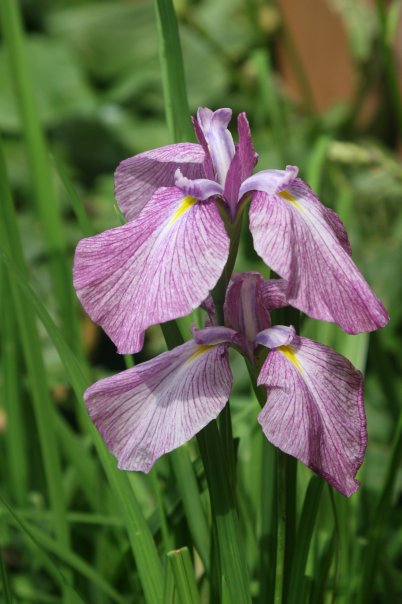
~

My attraction to haiku is therefore image-based. My interest in Japanese poetry also increased after I studied Zen. The two are inter-related, also no surprise. In my notebooks, and on random pieces of paper I use to jot down ideas for poems, nine times out of ten the phrases I want to capture are physical images. Later, I may try to craft these jottings into a haiku. More often, they get employed as lines in other types of poems.

Sometimes, a poem I attempt to write as haiku becomes a tanka…or a longer poem in some other form (free verse, blank verse, etc.); in any case, the sensual first impression is usually what I first observe and note. My own interest in nature and my physical environment make haiku-type poetry sort of an inclination. So the inspirations and influences for me include Zen, visual art, physical or concrete imagery, nature and season, brief observation, compressed or concise language use, and a quality of universality in the poem.

~

For writers who have done Westerners the service of exploring, interpreting, and explicating haiku and the Zen practice that leads to the haiku moment, I suggest Jane Hirshfield, Robert Aitken, William Higginson, Penny Harter, Hasegawa Kai, Earl Miner, Richard Wright, Gary Snyder.


Recitations

My brain still hurts, so I have decided to publish a radio commentary I did quite a few years back (for WDIY). If I can locate the mp3 file, I’ll post that, too.

I’ve chosen to post this essay for a number of reasons. The concept of having the time and the motivation to read, recall, and recite poetry seems like heaven to me at the moment. Then there’s the connection to rhythm, to pulse, that operates so fruitfully in metrical poetry. Finally, for sentimental reasons: it’s been ten years since my grandmother’s death, and now my parents have moved into an independent living community, and these events tend to lead to review, reflection, and—in my case—the desire to connect with poetry.

Recitations
to the memory of Lucille Bohnstedt

My grandmother was born in 1909. As a child, she lived on a small farm in the Midwest, rising early to do chores, after which she’d study her homework by kerosene lamp. I once asked her what subjects she most enjoyed in school, and her answers surprised me. “I liked doing sums,” she told me, “And Latin, and poetry—I always liked poetry.”

This was a revelation. My grandma always seemed such a practical person; I wondered what it was she liked about Latin and poetry. I was aware of her devotion to crossword puzzles—caught up in the crossword craze during the 1920s, she never gave up her love of solving word challenges. I’m sure her Latin helped her decipher many an obscure word. But puzzles involve a different part of the brain than poetry.

I love poetry, so I had to probe more, curious about what my grandmother had studied and learned in verse. Did she recall which poets she liked? No, she had pretty well forgotten, but she liked rhyme and recitation. She had been good at memorizing lines—she liked the rhythms. And those old poems, they told such good stories, some of them sad…

Recitations! Such an old-fashioned concept, but still very popular in the first two decades of the twentieth century. Schoolchildren stood at the head of the class reciting their pieces, and poetic ballads were popular recitations at community gatherings and amateur nights; heart-rending tragedies like Alfred Noyes’ “The Highwayman” (1906) were extremely popular. While most of these poems rhymed, their defining feature is the strong rhythm in the lines which carried listeners —who had never experienced the constant blare of television—into the powerful surge of words. Poems such as Wordsworth’s “Lines”:

Five years have passed; five summers, with the length
Of five long winters! and again I hear
These waters, rolling from their mountain-springs
With a soft inland murmur.—Once again
do I behold these steep and lofty cliffs…

Or Sir Henry Wotton’s ecstatic poem “On a Bank as I sat Fishing:”

And now all Nature seemed in love;
The lusty sap began to move;
New juice did stir the embracing vines;
And birds had drawn their Valentines…”

Many a schoolchild recited Emerson’s “Concord Hymn,” the fourth line of which has become so famous that few of today’s Americans could tell you its origin—

By the rude bridge that arched the flood,
Their flag to April’s breeze unfurled,
Here once the embattled farmers stood,
And fired the shot heard round the world.

The ballads of Edgar Allen Poe—Annabelle Lee was a favorite—and Phoebe Cary’s ballad of the Dutch boy whose finger stemmed a breach in the dike, and Longfellow’s classic poetic stories— “Listen, my children, and you shall hear/Of the midnight ride of Paul Revere…”—these were my grandmother’s texts, her introduction into poetry. I like to imagine my young grandmother milking cows in the darkness and murmuring “By the shores of Gitchie Gumee,/By the shining Big-Sea-Water,/Stood the wigwam of Nokomis,/Daughter of the Moon, Nokomis…” the sound of milk in the bucket echoing the rhythm of her hands as she milks. She earned an A in recitation from this practice. Maybe those resounding rhythms played some part in her steady endurance through a long lifetime that was not always easy.

My grandmother died in March of 2001, one less poetry-lover in the world. At her funeral I read Emily Dickinson’s “Farewell.”  This is the poem’s last verse—

Good-by to the life I used to live,
And the world I used to know;
And kiss the hills for me, just once;
Now I am ready to go.

~Here is a photo that shows Grandma’s less-practical side. She’s on the right (with her sister Faye), dressed in “flapper” style and riding side-saddle on a draft horse! I really ought to write a poem about this image.

100 Thousand Poets, and change.

 Reading, Pennsylvania has had its ups and downs. Recently, it made the national news for the sad distinction of being the poorest city in the USA. But like many struggling cities, it also has its share of citizens who are devoted to keeping the city not merely afloat and economically viable–a tough task in tough times–but also vibrant culturally. Where rents are cheap, artists can find studio space. Colleges can expand because there’s vacant space for parking garages and buildings ripe for re-tooling. Reading’s been host to quite a few poetry events lately, as a result of the aforesaid artist spaces and college expansions. (See GoggleWorks for one example of studio & performance space: http://www.goggleworks.org).

I spent the day at the Reading venue of the global event “100 Thousand Poets for Change.” On this overcast but mild day, there was a little disorganization at first, not uncommon for new festivals…but the  poets found one another, and before long there was a lively little crowd seated and standing near a performance space for what was billed as a series of featured readings with musical interludes but which became an open reading with music as background. And train sounds as background. And car and crowd sounds, and it didn’t matter because the audience members were paying attention to the readers.

At intervals, I wandered away and bought food from the vendors. Reading has some good ethnic food establishments, judging by the Vietnamese spring rolls and the falafel and such.

I sat on a park bench with my friend Marilyn Hazelton, a tanka poet and practitioner of haiku and haibun, and we discussed the young performance poets and the uses of structure in poetry and in life. We had a moment envying the young for simply being young and energetic, and then we spent a few more moments on what we’ve learned and the value of aging. Both of us are teachers, as are Craig Czury and Heather Thomas, two poets who were instrumental in putting the poetry aspect of today’s gathering together, so we also talked about teaching. Sometimes a quiet talk with a good friend revitalizes me. After our conversation, I felt energized enough to read a few more poems to the crowd. A man my son’s age shouted “Good stuff!”

All in all, a good way to spend the first Saturday of the autumn season.

Reading Reading

I love the wordplay inherent in presenting a poetry reading in Reading, PA: a Reading reading.

This Saturday, Reading is hosting on of the sites for a day-long, global poetry event called 100 Thousand Poets for Change. I’ll be reading around 5:30 pm (645 Penn St., if you are in the neighborhood, and you may want to bring a folding chair).

But by all means, come earlier and stay later: there will be music and poetry and other interesting goings-on all day.

Sat, September 24
100 Thousand Poets for Change and Street Music Festival
Courtyard and walking malls in the 600 block of Penn Street, Reading, PA
www.bigbridge.org/100thousandpoetsforchange/?cat=249

Sat, September 24
100Thousand Poets for Change
600 Block of Penn Street
http://iartreading.org/


The screech owls were very noisy at 5:45 am, so I couldn’t go back to sleep. Thank you, owls, for reminding me to post this notice about the reading.