In memoriam

Ariel Dawson, 1959-2013

I recently learned that a friend who was hugely significant in my life once, but with whom I had lost touch for 15 years, no longer walks the same earth that I do; in fact, Ariel Dawson died in 2013, unbeknownst to  me.

Ariel Verlaine Dawson

Ariel Verlaine Dawson

It is hard to lose friends, but losing the friends of one’s youth–those intense, passionate friendships that teach human beings how to navigate the world of human relationships–that loss cuts in a different way. For Ariel is perhaps the reason I am a writer. No–I would have become a writer. She is the reason I decided it was possible to be a poet. She amazed me with her vocabulary, her insights, her evaluative reading, her positively voracious and precocious reading, her charm, her gentle goofiness, her forthrightness, her neurosis; she seemed to fear nothing (but that wasn’t true); she had published poetry in real journals before she was 17 years old; she read Rilke and Yeats; had affairs with well-known poets; spent years fathoming Jung. In 1994, she wrote an opinion piece for what is now AWP’s Writer’s Chronicle responding indignantly to Dana Gioia’s article “Can Poetry Matter?”–a piece that started quite a dust-up among defenders of what has been termed “new formalism.”

Ariel had always been the sort of person who chose to disappear and then to reappear, to my joy, months or years later to take up the friendship without pause–and often without explanation for her absence. She had her reasons, and I respected that; but I missed her.

Ariel, 1977 or 78

Ariel, 1977 or 78

~

In the early 1980s, my (also late) friend David Dunn and I were publishing chapbooks under the small-press name LiMbo bar&grill Books. We approached Ariel for our second-ever chapbook: Poems for the Kazan Astrologer. She was, at the time, teaching creative writing at Old Dominion University. We were very happy with the outcome, but we had no good method of distributing the books. I may still have a box of 25 or so of these books somewhere in my attic.

Then Ariel became more intensely interested in Jungian psychology, though it had long been a passion of hers.

In subsequent years, she wrote less and less poetry and stopped submitting her work for publication. The response to her Writer’s Chronicle opinion was, I think, a bit shocking to her, though I know she stood by her opinion. She just decided, perhaps, that she felt more at home in the world of Jung and his followers.

During the past decade I have often tried tracking her down, imagining the internet would find her. My job at the college has made me a rather adept online researcher, but all that ever showed up was a listing for her psychotherapy practice in New York City. The number was incorrect.

Then, my father became very ill and other issues crowded my mind. Searching for a friend who clearly wanted to remain anonymous in an electronic era was not a priority.

Besides, I always assumed that Ariel would suddenly re-emerge, call me–my phone number remains the same as it was last time I saw her–and mention she was going to be in the area, and could she stop by? That’s how it had been before. And I’d be thrilled to see her, and we’d talk about poetry and art, and politics and pets, cheese, philosophy, psychology, parents, wine…

I assumed incorrectly. That’s what happens with assumptions. Just this past week, when I finally found myself with some spare time, I tried an internet search again. And found her “electronic obit” online, and the fact that she’d died in February of 2013.

~

I have no words to express how this information feels to me.

And also–

~

Arthur Cadieux, 1943-2015

Arthur Cadieux in 1978, a photo taken by Jim Terkeurst.

Arthur Cadieux in 1978, a photo taken by Jim Terkeurst.


279519_2290955317647_6522544_o

Arthur 2011, Eastport, Main

Arthur in 2015. Photo Elizabeth Ostrander.

Arthur in 2015. Photo Elizabeth Ostrander.


~

Arthur Cadieux was my art teacher at Thomas Jefferson College in the late 1970s. He and his wife, Helene, were exceptionally kind to young adults who had an interest in art and in observing the world around them. We had dinner at their house in Michigan and at their loft apartment in New York City. Years later, after Helene’s tragically early death, and after Arthur had moved back to Maine, he let me stay at their cottage on Leighton Point (he lived in a smaller house in town) so that I could have a personal “writing retreat.” He deeply understood the creative person’s need for reflection, evaluation, thought, imagination, boredom, and occasional moments of lively talk.  The universe needs people like Arthur Cadieux, talented and generous, who are constantly pushing their own boundaries. Many of us who benefited from his friendship will miss him. Arthur’s paintings can be found at his website, arthurcadieux.org.

~

May they be free from suffering and causes of suffering.
May they never be separated from the happiness that is free from suffering.
Writing the new year

To renew myself as a writer of poetry, I need–every now and then–some way of re-engaging with the work of writing itself. Revision, for example, often means hard effort slogging through material I wrote long ago; but the process renews my dedication to the salvageable poems and sharpens my analytical and evaluative skills.

Sometimes there’s no saving a poem, but the concept behind it might be worth exploring in an essay.

Sometimes there’s no saving a poem, but the words needed to be expressed at that time.

Revision requires taking a stance of compassionate distance from the work itself so that I can feel both judgment and kindness toward my own poems. The bonus here is that, often, the work of revision gets me writing new work.

Beside my desk at this moment is a stack of poems I spent the past few days thinking about and revising. The work creates its own energy; the buzz of words and imagery emanates…

I feel ready to write the new year.

🙂

objects, stories


Fear & peace

Human beings have a problem with fear.

I guess it is evolutionary, as well as anthropological, cultural, social…all those tribal basics, banding together to protect ourselves from anything that threatens, anything that is not us. From this perspective, how likely is it that we will ever learn compassion or know peace?GFS2

There is a practice among Buddhists called tonglen, a form of meditation to engage in compassion that is not just deep but also wide, spreading to “all sentient beings.” I’ve written a bit about it here, as well. In the past year, I have had personal and social concerns that urge me to confront fear in a loving and accepting manner; otherwise, I think I would despair.

The world offers comfort to its compassionate observers. Sorrow and pain are part of life, but they are not the sum of life; fear shuts us off from curious and open-minded observation.

We may never know peace–not in terms of a constant, steady-state peacefulness; evolution doesn’t operate that way. Physics doesn’t operate that way. Change can be painful, but it is necessary and beautiful in its many unfolding ways. I wonder if it isn’t peace we should be seeking but freedom from a close-minded, intellectual sort of fear.

I am posting this poem (from my book Small Things Rise & Go, available from FootHills Publishing). Readers respond to this piece, I’ve found, in startlingly different ways. It is, among other things, a meditation.

~

Liturgy

We will not know peace.
Hay clogs the thresher,
Snow stoppers thruways.
Starlings haggle out the morning.
Red fox probes her muzzle
Into the voles’ weed bunkers;
Harrier screams over moors.

We will not know peace.
Here, the caterpillar
Tires chew fields into slog;
Here a child’s toy erupts
Into a village of amputees.
Sands shift under an abstraction,
The sea grows warm.

We will not know peace,
During our lifetimes, the tines
Break, the cogs slip,
Polluted slough impedes
Our efforts at contentment.
Our own natures
Bully us down:   Peace—

Peace to those who do not know peace.
To the fieldhand knee-deep in grain.
To the broken doll clasped by a broken child.
To the small-time fisherman far at sea.
To my mother with war scrawled through her
To the empty church, the hill of snow, evening—

That may never know peace.

~

© 2002, 2006 Ann E. Michael

Poem for my dad

If you have been reading this blog for the past year, you may recall my posts concerning the 50th year celebration of the March on Montgomery and the Voting Rights Act. (Click on the links below if you want to read them). I mentioned in the first post that I was trying to write a poem about my father’s memories of the event.

January 14: Trying to write (Selma)

January 18: Guest blogger–My dad’s memoir

After much struggle and revision (and many thanks to my writing critique group), I did manage to write that poem.

And: the poem has been published! Here it is, in One – volume 7. Richard Krawiec of Jacar Press has placed the poems, one by each poet (hence the journal name) so that the readers can scroll one by one, taking their time through the pieces. There’s a feel of development in this form of editing. It reminds me a little of how a good record album–if you recall those days–worked song by song to create an album experience that differed from just hearing the tunes randomly. The result was not always thematic, but a sense of mood or tone arose. I guess it’s similar to what poetry reviewers call the “arc” of a book of poetry. An arc is not necessary, but sometimes a feeling of synthesis does enhance the poems.

“Arc” is particularly apt here, given the title of my poem–taken from Rev. Dr. Martin Luther King, Jr.’s famous speech on that day.

Arc of the Moral Universe, Bending toward Justice

~

Thanks for reading.


About that death/writing thing

Driving the road that clings to the south side of our hill I notice the round bright moon over newly-gleaned cornfields and find myself thinking about the last essay in Margaret Atwood‘s book Negotiating with the Dead. I finished reading the book some days back, but the title essay worries at me somehow; I can’t let it go. Maybe it is because I perceive connections between her ideas on the ontology of story-making and Boyd’s evolutionary premise for narrative, or between conscious mind and story-making arising from the cthonic, the deeps, the under-earth “hells” to which our myth-makers and shamans, goddesses, musicians, poets and heroes journeyed in order to bring back–if nothing else–the story of the trek and the resulting wisdom. Maybe it is because “negotiating” with the dead raises the problem of consciousness in peculiar and challenging ways as well as the problem of communicating with people of the past and of the future. Or maybe because of that bogeyman that awaits us all: Death.

When I was quite a young child, age seven or perhaps earlier, I was seized with an insomnia-inducing fear of death that kept me in agonies as soon as darkness fell. I wonder if that had anything to do with my later need to “be a writer.”

Atwood suggests that all writers truck with the dead. We read the work of our ancestors-in-the-craft; they are often our first teachers. That important aspect of craft so many of us struggle to attain–the ever-illusive quality of “voice”–is what we notice in many of our beloved writers. Voice, perfect example of metonymy. It stands in for the departed body, the dispersed consciousness.

Here is Atwood holding forth at a dinner party of fellow writers:

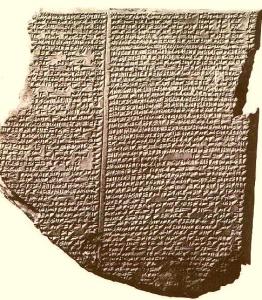
Gilgamesh was the first writer…He wants the secret of life and death, he goes through hell, he comes back, but he hasn’t got immortality, all he’s got is two stories–the one about his trip, and the other, extra one about the flood. So the only thing he really brings back with him is a couple of stories…and then he writes the whole thing down on a stone.

She adds that going “into the narrative process–is a dark road. The poets know this too.” So inspiration is not so much a clearing in the clouds but a kind of rappelling into a cave. At any rate, darkness, even with a full moon to light the road, seems as likely as a bolt of lightning to produce emotionally-resonant work. Maybe more so, because it’s harder work and more ambiguous (Lord knows, writing is both of those!). Darkness requires more interpretation. The audience has to listen, not simply see; the darker path gets traversed by both writer and reader.

The Flood

The Flood

Atwood also makes note of the threshold concept, that edge or invisible boundary line between the realms, any pair of realms. Life/death, yin/yang, heaven/earth, day/night. The one who seeks knowledge or magic or treasure (or lost love, viz Orpheus) at some point crosses the threshold, and then nothing is certain. He or she may not be able to return, for example. Edges are the interesting places, where all manner of things mesh and overlap–good spots for inspiration even if one opts not to take the stairway to the underworld; but they also pose danger. We humans, with our need for communities, invent parallel communities for our dead, not just physical cemeteries but supernatural abodes, and create all manner of “rules and procedures…for ensuring that the dead stay in their place and the living in theirs, and that communication between the two spheres will take place only when we want it to,” says Atwood.

I wonder if that is one reason I felt so unsettled by the idea of death when I was seven. I did not personally know anyone who had died (yet), but I knew the stories; certainly, I’d been taught about Jesus, though I was told he had defeated death. So why the early-onset angst? Did I fear that edge between the realms, being too inexperienced either to navigate it or to allow communication on my own terms? And maybe the fear is precisely what has led me to my ongoing inquiries into philosophy, consciousness, art, and mind.

Or was I precociously aware that I would have to venture into the darkness, into the coffin-holes and the caves and the seas’ depths, if I wanted to come back with a story to tell?


Work vs. work

Untitled-writerOutside Academia: The Writer…


Lately, I have felt overly-occupied with my so-called day job. The work I do at the college is personally rewarding and pays my bills; I love the challenges it offers and the people with whom I work, but I am not what one would term career-driven. Even though I am employed by a university, and even though I teach (just one class a semester), in many ways–as far as scholarship, research, and poetry go–I remain “outside academia.” An interesting paradox. But if I over-extend at my office, I find less to say at my writing desk at home.

Poets Mary Oliver and Kay Ryan also spent most of their careers working at colleges without climbing the spiral stairway of academia’s ivory tower. Well-received, excellent writers–and Oliver even sells quite well for a poet–they aren’t “academics.” It is heartening to know that such poetry luminaries are, like me, not academics. I often wonder how they managed to balance teaching with writing poetry.

~

What I do “at work” where I earn a salary, and what I do when I “work” on poetry, seem quite separate to me, and I question whether one informs the other. I feel that being a poet does influence, though subtly, the way I approach teaching and tutoring. (It does not seem to have any influence on the way I do record-keeping, spreadsheets, or paperwork.)

By contrast, my day job at the college seems not to have much sway over my poetry; I write prose about teaching and tutoring, but my career work does not often appear as topic or substance in my poems. I notice, too, that Oliver and Ryan do not often write poems about their day jobs (both of them have retired by now–but still). In fact, I would venture that the way my day job affects my poetry is mostly as a time and energy drain.

~

I have challenged myself to write at least two poems a month that in some respect relate to my work with students. That prompt forces me to remember that I am not two separate beings, one at the college desk and one, pen in hand, on the back porch at home. I remain my whole self, and I place my whole self into both endeavors. I can work with that.

Focus

On what do I focus when I write a poem?

This question has occurred to me before, usually under the guise of someone asking the ever-vague “What inspires you to write?” Focus differs from inspiration. For me, focus seems to derive from observation and is a process of discovering meaning.

Focus helps me understand what it is I’m experiencing and to decide how to express it. I focus when I need to make decisions; in the case of writing a poem, the decision might be one of craft approach or of imagery, or a realization that the poem needs a turn to create tension or resolution. What is the hub of the poem, the real kernel at its core? To make a poem “work,” I have to have a sense of what that might be.

This type of emphasis is a form of concentration. I think we learn from focusing; it teaches the value of close study, a skill needed for analysis. It can also be a reminder of what is outside the area of attention. Focus needs context, or it ends up as navel-gazing.

For a visual example, consider Andy Goldsworthy‘s “Rain Shadows,” which are among the most transitory of his ephemeral works.

The opposite of making a snow angel, in these conceptual art pieces–and he would object to me calling them by that term–the artist lies on a sidewalk and waits until a light rain falls just enough to leave his figure on the ground. Of course, in no time, the rain fills in the figure, so he documents the “shadow” with a photograph.

Goldsworthy talks about the process, in a recent interview with Terry Gross (see link below).

I just concentrate on the rain. I’ve learned so much about rain — the different kinds of rains, the rhythms of rains. And people will say, “Oh, why don’t you just use a hose pipe?” That would be totally pointless. The point is not just to make the shadow, it’s to understand the rain that falls and the relationship with rain and the different rhythms of different rainfalls.

The “art” in Goldsworthy’s rain shadows–he also does this with snowfall–consists in a focus, a learning, a process that the viewer cannot participate in. Which is kind of weird. Unless, of course, seeing his rain shadows prompts other people to try making them, during which they will learn about rain’s rhythms and varieties.

In this way, Goldsworthy encourages focus and close attention to the world in which we live. I think I will file that under “inspiration.”


Empathy & compassion

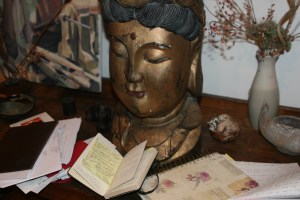
quanyin
Quan Yin, bodhisattva or goddess of compassion; the Chinese interpretation of Avalokiteśvara

Sensitive. Or: oversensitive.

These are terms I hear bandied about to describe people who react deeply to anything from wool clothing or sock seams to sarcasm or “charged language.” When I was a child, people told me I was sensitive; initially, I thought that was a kind of compliment, and sometimes that was the intention. The teenager I once was believed that sensitivity made me empathetic and compassionate.

As I matured, however, the term sensitivity took on more negative connotations of the “can’t you take a joke?” sort. Worse yet, the charge of sensitivity came loaded with accusations of narcissism, as in “you take everything personally.” In today’s phraseology, “It’s not all about you.” Under those terms, sensitivity does not resemble empathy.

Empathy is a feeling-response, true. It appears to have a like-kind relationship to sensitivity–but a person must be sensitive to others’ experiences in order to feel empathy; so the similarity’s not as swappable as it first seems. I thought that my feeling-response signaled that I was a compassionate person. Indeed, fiction elicits empathy in me. A lifelong bookworm and early addict to novels, I definitely feel along with the characters of the stories I read. Is it really the experience of others that makes me weep or feel joy as the characters forge through lives such as I will never be able to encounter? Or is it a feeling response to damned good writing?

I ask myself these questions because, given my inquiries into what consciousness is and what poetry does, it seems I have not made clear to myself the differences between sensitivity, empathy, and compassion.

~

My current thoughts on the differences have evolved through reading and writing poetry, not fiction, and through getting older. Nothing like life experience to knock a person’s youthful errors into strong relief.

Here goes:

Sensitivity is the strength of a person’s reaction. That reaction may be physical or emotional and will vary widely from one individual to another.

Empathy always means that one “feels within” another person (from Greek empatheia em- ‘in’ & pathos ‘feeling’); it is an inward response to external stimuli. As Daniel Goleman notes, there are several types of empathy psychologists have identified–here’s a brief article on that topic.

Compassion, while a noun, must be active. I think of it as behavior, as action, as verb in noun form. It is a response or reaction to suffering in others (empathy) that is accompanied by an urgent desire–the word desire isn’t strong enough to convey the feeling–to help alleviate the suffering.

That’s where the activity comes in. Until I feel a desire to act, I am “merely” empathetic and sensitive.

~

Recently, I have begun to recognize that my desire to write poetry is partly compassion-based. Art of any kind is process as well as result, and process is action. Additionally, my career as an educator has compassionate action structured into the job description. There are other ways we–I–can be compassionate in the world. This matters to me.

We can learn from the practice of tonglen: “Breathe in for all of us and breathe out for all of us. Use what seems like poison as medicine. Use your personal suffering as the path to compassion for all beings.” ~Pema Chödrön

And we can live in the world and begin to use our sensitivity to pain, and our sense of empathy, to activate compassion–as a verb.


Interpretation & finesse

A few months back, I heard from an editor who rejected a poem I had submitted. He said that the editors really liked the work, but that the journal generally did not publish “poems about poetry.” The critique was especially surprising to me because I didn’t realize that my poem was about poetry; the editors’ interpretation of my text was different from my own!

It is interesting to re-read one’s own work from the viewpoint of a reader who is not oneself. Actually, that’s an impossible task, but I tried. My interpretation of my poem is that it is a somewhat speculative, perhaps philosophical piece concerning the re-envisioning of the commonplace. Nonetheless, it is not an abstract poem on the surface. My poetry inclines toward physical imagery, often nature-based (no surprise to readers of this blog…). When I distanced myself a bit and tried to imagine what another reader might make of the poem, I could see that there would be a way to interpret the piece metaphorically as a reflection on the writing process.

That’s not what I thought I was writing, but the interpretation works just fine. Who knows, maybe I was kind of writing about writing, and it took a thoughtful critique by some editors to figure that out!

~

Which brings me to the whole topic of interpretation. I am not teaching poetry class this semester, but that does not mean I am not trying to impart to my students an understanding of what it means to interpret a text. The aim of any composition & rhetoric course is to assist students in learning how to express their original thoughts about a topic–any topic–and to ground those thoughts in evidence: in other words, to validate the student’s interpretation.

That process involves analysis, argument, inference, sometimes research, and composition whether the text the student responds to is literary, persuasive, commercial, visual, auditory, performatory, or digital. Critical thinking requires inference and metacognition. These tasks are harder than they seem; most students do not develop those abilities overnight and need a bit of coaching.

Then there are students who are capable of thinking analytical thoughts but are at a loss for how to express them on paper (or on word-processing software). That ability also requires a bit of coaching.

It can be difficult to ascertain whether a student I am tutoring needs help with the thinking or help with the expressing. Too often, early in my career as a writing tutor, I have inferred incorrectly about a student’s difficulties with the written word. Coaching takes finesse. Finesse takes awhile to develop.

Come to think of it, interpretation requires finesse as well. When a critic bludgeons a poem to pieces, the interpretation gets lost in the analysis (and critics can even bludgeon poems that they love).

I am glad that the above-mentioned editor read my poem with considerable care and finesse. He may have decided not to publish it, and he may have interpreted it differently that I would have myself, but he took the time to interpret. It is encouraging to know that my work has been read with such care.


Painfully conscious

I’ve just finished reading Melanie Thernstrom’s 2011 book The Pain Chronicles, a journalist’s inquiry into the concepts that “define” pain and the medical discoveries concerning chronic pain, in addition to a bit of memoir as a narrative device. Although I have experience with chronic pain myself, the part of the text that most interested me comes in her concluding chapters, in which she gathers the variously-disciplined evidence of her enterprise to suggest that pain is the ultimate test of the mind-body problem (thank you, René Descartes). The experts Thernstrom interviews disagree on how much we do know or can know about the human brain and how it processes anything, let alone such a complicated psycho-physiological event as pain. Some of them believe human beings will make enormous technological discoveries to unlock our brains’ workings, but the majority seem to have learned from research that each “a-ha!” leads only to further complications. Discussing the outlook for future fMRI scanning in brain research, Dr. John Keltner tells the author:

[N]obody has come up with a rich and complicated enough model to analyze the complexity of the distributed patterns of neural  networks and deduce anything like underlying rules…We’re literally grappling with the fundamental aspects of human beings. We naively believed that pain is simple–it hurts or it doesn’t hurt–so there should be a single brain state we could see every time someone is in pain. But what we’ve stumbled into is the discovery that there’s a relative universe of hurt–that hurting is an immense, rich, and varied human experience associated with an unknown number of possible brain states.

I find some of these analogies, and some of this language, appealing–I can think of poems that express “a universe of hurt.” I embrace the idea that hurting is immense, rich, varied, and human–we are aware (conscious) that we hurt, that others hurt, that hurt can be painful even when it is not caused by a toothache but through loss of a friend or lover…the beloved other, the pain in ourselves. Isn’t compassion born of this awareness? Does art have a place here, too? I wonder.

Thernstrom concludes with the agreement of several expert researchers: “pain and suffering are properties of the mind” [my italics]. That means pain is, at least in part, a property of that elusive thing we generally call consciousness. Scott Fishman of UC Davis explains that “[t]he mind is like a virtual organ–it doesn’t  have a physical address that we know of.” Consciousness, these researchers imply, is not merely the sum of firing neurons, a process that can be considered on some level mechanical. Thernstrom asks, “Do we need to understand consciousness itself in order to understand pain?”

If so, that is a tall order, one the author posits is analogous to understanding aesthetics (what is beauty?). But though the task appears daunting, the discoveries en route make the trek valuable.

Even if we never understand the answer.

neural matrix fiber topography, Johns Hopkins University

neural matrix fiber topography, Johns Hopkins University