Interpretation & finesse

A few months back, I heard from an editor who rejected a poem I had submitted. He said that the editors really liked the work, but that the journal generally did not publish “poems about poetry.” The critique was especially surprising to me because I didn’t realize that my poem was about poetry; the editors’ interpretation of my text was different from my own!

It is interesting to re-read one’s own work from the viewpoint of a reader who is not oneself. Actually, that’s an impossible task, but I tried. My interpretation of my poem is that it is a somewhat speculative, perhaps philosophical piece concerning the re-envisioning of the commonplace. Nonetheless, it is not an abstract poem on the surface. My poetry inclines toward physical imagery, often nature-based (no surprise to readers of this blog…). When I distanced myself a bit and tried to imagine what another reader might make of the poem, I could see that there would be a way to interpret the piece metaphorically as a reflection on the writing process.

That’s not what I thought I was writing, but the interpretation works just fine. Who knows, maybe I was kind of writing about writing, and it took a thoughtful critique by some editors to figure that out!

~

Which brings me to the whole topic of interpretation. I am not teaching poetry class this semester, but that does not mean I am not trying to impart to my students an understanding of what it means to interpret a text. The aim of any composition & rhetoric course is to assist students in learning how to express their original thoughts about a topic–any topic–and to ground those thoughts in evidence: in other words, to validate the student’s interpretation.

That process involves analysis, argument, inference, sometimes research, and composition whether the text the student responds to is literary, persuasive, commercial, visual, auditory, performatory, or digital. Critical thinking requires inference and metacognition. These tasks are harder than they seem; most students do not develop those abilities overnight and need a bit of coaching.

Then there are students who are capable of thinking analytical thoughts but are at a loss for how to express them on paper (or on word-processing software). That ability also requires a bit of coaching.

It can be difficult to ascertain whether a student I am tutoring needs help with the thinking or help with the expressing. Too often, early in my career as a writing tutor, I have inferred incorrectly about a student’s difficulties with the written word. Coaching takes finesse. Finesse takes awhile to develop.

Come to think of it, interpretation requires finesse as well. When a critic bludgeons a poem to pieces, the interpretation gets lost in the analysis (and critics can even bludgeon poems that they love).

I am glad that the above-mentioned editor read my poem with considerable care and finesse. He may have decided not to publish it, and he may have interpreted it differently that I would have myself, but he took the time to interpret. It is encouraging to know that my work has been read with such care.


Painfully conscious

I’ve just finished reading Melanie Thernstrom’s 2011 book The Pain Chronicles, a journalist’s inquiry into the concepts that “define” pain and the medical discoveries concerning chronic pain, in addition to a bit of memoir as a narrative device. Although I have experience with chronic pain myself, the part of the text that most interested me comes in her concluding chapters, in which she gathers the variously-disciplined evidence of her enterprise to suggest that pain is the ultimate test of the mind-body problem (thank you, René Descartes). The experts Thernstrom interviews disagree on how much we do know or can know about the human brain and how it processes anything, let alone such a complicated psycho-physiological event as pain. Some of them believe human beings will make enormous technological discoveries to unlock our brains’ workings, but the majority seem to have learned from research that each “a-ha!” leads only to further complications. Discussing the outlook for future fMRI scanning in brain research, Dr. John Keltner tells the author:

[N]obody has come up with a rich and complicated enough model to analyze the complexity of the distributed patterns of neural  networks and deduce anything like underlying rules…We’re literally grappling with the fundamental aspects of human beings. We naively believed that pain is simple–it hurts or it doesn’t hurt–so there should be a single brain state we could see every time someone is in pain. But what we’ve stumbled into is the discovery that there’s a relative universe of hurt–that hurting is an immense, rich, and varied human experience associated with an unknown number of possible brain states.

I find some of these analogies, and some of this language, appealing–I can think of poems that express “a universe of hurt.” I embrace the idea that hurting is immense, rich, varied, and human–we are aware (conscious) that we hurt, that others hurt, that hurt can be painful even when it is not caused by a toothache but through loss of a friend or lover…the beloved other, the pain in ourselves. Isn’t compassion born of this awareness? Does art have a place here, too? I wonder.

Thernstrom concludes with the agreement of several expert researchers: “pain and suffering are properties of the mind” [my italics]. That means pain is, at least in part, a property of that elusive thing we generally call consciousness. Scott Fishman of UC Davis explains that “[t]he mind is like a virtual organ–it doesn’t  have a physical address that we know of.” Consciousness, these researchers imply, is not merely the sum of firing neurons, a process that can be considered on some level mechanical. Thernstrom asks, “Do we need to understand consciousness itself in order to understand pain?”

If so, that is a tall order, one the author posits is analogous to understanding aesthetics (what is beauty?). But though the task appears daunting, the discoveries en route make the trek valuable.

Even if we never understand the answer.

neural matrix fiber topography, Johns Hopkins University

neural matrix fiber topography, Johns Hopkins University

Altercation, alliteration, & assonance

Recently, while driving to a restaurant just at rush hour, we witnessed a near-accident. The offending vehicles were blocking an intersection but had just managed to avoid collision, and the driver of one car was shouting from his rolled-down window–shouting words that it is a good thing my 90-year-old mother-in-law was too deaf to hear, I might add.

After scooting around to the shoulder and proceeding along our route, my son commented on the driver’s use of the epithet “douche canoe.” It’s one I was not familiar with. “What does that even mean?” I asked, unable to process it either literally or by metaphor; yet I grant there is something appealing about the phrase, for sound reasons (I am making a pun! I admit it!).

Not the insult variety of canoe

~

Poets tend to be enamored of the way language sounds, even those who “write for the page.” We can imagine the sounds, “see” them, as we write. Performative poems rely on sound and continue the ancient oral foundations of poetry in song and chant. Many American students encounter the Beowulf saga in high school; kenning appears on the curriculum, and it is the one aspect of the saga my students always seem to recall.

Dictionary.com says of “kenning”:

a conventional poetic phrase used for or in addition to the usual name of a person or thing, especially in Icelandic and Anglo-Saxon verse, as ‘a wave traveler’ for ‘a boat.’

Poets deepened these modifiers, using kenning to evoke allusions to well-known myths, for example, or doing tricky wordplay such as puns and alliteration…or all of the above.

Moving away from kenning and into the general field of poetic wordplay, poets and others who are facile with language can move with ease to the sarcastic, the suggestive, and the downright vile (a classic example is Catullus–here’s a link to a biography from the Poetry Foundation that includes commentary on some of his well-known insult poems). A quick Google search on Shakespearean insults yields dozens of results from the bard of Avon. One of my favorite strings of poetic invective is from King Lear: “lily-liver’d, action-taking, whoreson, glass-gazing, superserviceable, finical rogue.” Note the alliteration and the meter. Touché.

Closer to “douche canoe” in terms of era is playing the dozens, exemplified for boxing fans through the boasts and challenges of Muhammed Ali–here, crowing over a bout with Sonny Liston:

“The crowd did not dream when they laid down their money
that they would see a total eclipse of the Sonny.”

Elijah Wald has a scholarly book on the tradition of playing the dozens. These rhymes are intended to challenge, provoke, and amuse. The evolution into rap is easy to credit.

~

Despite the aural appeal of “douche canoe” with its long, repeated vowels, I doubt the phrase will enter my personal lexicon. It did remind me, however, of an alliterative insult I heard fairly frequently from my uncles when one of us kids was acting particularly balky:

“Don’t be such a horse’s hind end!”

hindend

Supportive critique

One discipline that keeps me practicing as a poet is ongoing, regular discussion of new work. It has been my great good fortune to be part of a critique group that has been meeting monthly for, I believe, over 20 years! Our participants have come and gone a bit; the group consists of four long-time stalwarts and up to three others. We try to keep to under seven members or the discussions get too lengthy for one evening.

When one has participated in a group like this for a long time, the occasional issue of expected responses comes up. At least, it does for me. When I choose a poem to workshop with my critique group, I might say to myself, “X prefers more narrative poems…Q will think this too wordy…Z will probably correct the dangling modifier…”

If I begin to expect certain stereotyped reactions, one could ask, why bother being part of a group with the same people in it all the time? Would it be more helpful to scout around for novel feedback?

Actually, no. While I am sometimes correct in my expectations of a group member’s initial feedback (and I am often wrong!), the discussions that evolve from that point onward prove tremendously useful. What I learn and can use as inspiration to revise tends to arise from other group members’ questions, challenges, and misreadings; unexpected revision ideas appear during brainstorming, and bouncing the ideas off of others helps me recognize that the poem must communicate or die.

These are good things which nourish the creative impulse.

When we do take on a new member, we fear that he or she may be a bit shocked by our frankness with one another: after 20 years, there’s not quite as much need to dance politely around a poem that isn’t doing its job. But those who settle in with us see that we practice non-defensive openness and that we always find genuine things to praise. Our group purpose is to assist one another in writing the best work we can. That means analysis and criticism, but it also means encouragement and generosity of spirit. It offers us exchange of accomplishments, prompts, book suggestions, setbacks, joys, and sorrows (there have been more than a few).

It may be a small community, but it is a community. And my fellow participants are as supportive as any community I have been part of these past two decades. They take our writing commitment seriously, recognizing that critique is just another step in the process and that dissenting ideas can get us toward brilliance. Once in awhile.

What I see

When I trek to New York City these days, I generally go for non-tourist reasons; my sister lives in Manhattan. It’s a day trip, and I don’t always avail myself of visits to big-city attractions–instead, I “hang out” with my sister and her family, which tends to mean home-cooked dinners in her apartment and walks around her neighborhood, greeting neighbors in the coffee shop or on the sidewalk. Often, that’s interesting enough, as she lives near Ft. Tryon Park and The Cloisters. On my most recent visit, however, we decided to take the A train south to tour the new Whitney Museum of American Art. It’s located at the base of the Highline Park, with views southward to the new World Trade Center and westward over the Hudson (making our evening visit gloriously pink-hued during summer sunset).

We spent a little over two hours at the museum, and our initial assessment was that both of us prefer the building itself as an architectural experience over the old Whitney building designed by Marcel Breuer. It isn’t all that much “prettier” from the outside; but the interior gallery set-up is more pleasant, light-filled, and navigable by patrons.

The opening show’s titled “America Is Hard to See,” a line culled from a slightly ironic Robert Frost poem (see an excerpt below). And the top floor gallery included a famous painting by e. e. cummings, so my poetry hopes were raised. The 8th floor of the museum was stunningly curated; I had high expectations for the rest of the galleries though, in the end, my reaction was decidedly mixed.

Thanks to Lederman copyright 2015. see whitney.org

Thanks to Lederman copyright 2015. See whitney.org

Levels 7 through 5 follow a chronological order, roughly, in terms of historical and cultural developments from the early 20th century to the present. This is a bit arbitrary, as artists alter their styles, and even their genres, over time–and some artists’ work spans decades, gaining and losing cultural momentum as fashions and criticism also change. As a result, there are clusters of pieces that cover similar themes but do not necessarily speak aesthetically to one another on the gallery walls. This was most obvious in the Viet Nam era gallery, which struck me as garish. The purpose in terms of education and theme was fine, but the aesthetics of the room as a display of art just did not convey, to me, what it might have in another perhaps less chronological arrangement.

Nonetheless, as far as getting visitors acquainted with American contemporary art, the new Whitney may be overall more successful than its predecessor. The former building’s galleries were arranged by donor collections and often had too much of the same, or else too little cohesion, and relied on the visitor’s being already reasonably familiar with contemporary art and art criticism. The exterior platforms of “outdoor galleries” (sculptural pieces) are impressive, though you may want to avoid the exterior stairways if you have a fear of heights.

I am happy to note that Calder’s Circus remains on display, along with the old and, by contemporary standards, poorly-produced video of Calder playing with these creations. I loved this piece as a kid and my own children also loved it.

~

Excerpt from “America Is Hard to See,” by Robert Frost

Had but Columbus known enough
He might have boldly made the bluff
That better than Da Gama’s gold
He had been given to behold
The race’s future trial place,
A fresh start for the human race.
He might have fooled them in Madrid.
I was deceived bywhat he did.
If I had had my way when young
I should have had Columbus sung
As a god who had given us
A more than Moses’ exodus.
But all he did was spread the room
Of our enacting out the doom
Of being in each other’s way,
And so put off the weary day
When we would have to put our mind
On how to crowd and still be kind.

The people on the streets and in the subways and in the neighborhoods were uniformly kind on this warm summer evening. Even when we got in one another’s way. That’s what I saw.

~

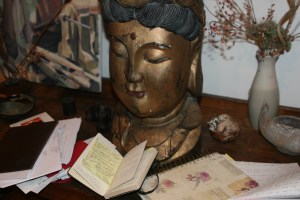
Buddhism, philosophy, consciousness (poetry)

IMG_1440~

Sometimes, a startling morning.

A few minutes that feel time-free, when the phrase “Be here now” inheres in the body, the air, the mind, the moment.

Free to recognize consciousness as a grounding, not as an end-in-itself. Part of the world, part of the cosmos.

~

Reflecting, I realize another thing: poetry does that for me, hands me a moment. When I listen to or read a poem, it moves me into a moment suspended in “now-ness.” I am with Seamus Heaney’s father, digging; I watch the horses in Maxine Kumin’s field. The poems that move me do so by allowing me, the reader, to enter that moment or that consciousness, that perspective, which I may or may not relate to, and may or may not layer through perspectives of my own. Yet there I am, in a real way.

~excerpt from “Digging” (see this link for the whole poem, and audio)~

Under my window, a clean rasping sound
When the spade sinks into gravelly ground:
My father, digging. I look down


Till his straining rump among the flowerbeds
Bends low, comes up twenty years away
Stooping in rhythm through potato drills
Where he was digging.


The coarse boot nestled on the lug, the shaft
Against the inside knee was levered firmly.
He rooted out tall tops, buried the bright edge deep
To scatter new potatoes that we picked,
Loving their cool hardness in our hands.


By God, the old man could handle a spade.
Just like his old man.

objects, stories

contemplation

~

Sometimes the momentary sense of time-free, liberated unity occurs on its own, smacks me by surprise. Or it may arise from mediation, contemplation, or during “mindless” work–such as digging.

Philosophy and criticism tend not to evoke that sort of free consciousness. They require the brain to operate in a different way, a distancing from one-ness; but I like that sort of brain-work because the intelligent and inquisitive people who write, or write about, philosophy, neurology, psychology, and criticism of all kinds offer insights I would not likely find on my own. They ask the interesting questions (it doesn’t matter to me if they do not have the answers).

~

So there’s a balance, right?

~

Poets also ask the interesting questions. Through reading a good poem, I am there in the poet’s moment, curious and uncertain. It is a kind of contemplative practice to read, with an open mind and an open heart, poetry.

(The criticism and the analysis come later. Let them wait!)


Learning the form(s)

I’m extremely pleased that five of my poems appear in the latest edition of Mezzo Cammin, a web journal devoted to formal poetry by women, edited by Kim Bridgford and beautifully designed by Anna M. Evans, both of whom are excellent poets–of formal verse–themselves.

My poetry often varies as to style; I am not a dedicated formalist, but I feel that writers learn a great deal from experimenting with many styles. Learning to write a sonnet, for example, requires considerable effort and ideally results in the production of many lousy sonnets. Many, many lousy sonnets. Until, one day, the motivation, language, imagery, and form coalesce into a good sonnet. The challenge derives in part from the frame and form the sonnet uses; other challenges arise with sestinas, rondelets, villanelles, haiku, sapphics, and (yes) free verse. Practice does not always make perfect in the case of poetry, but practice helps. One learns the form and its specifics, reads zillions of examples by the best poets, endeavors to write to suit the form, and finds that the resulting effort…fails. Miserably. And then one tries again.

The practice can be meditative, or it can be a kind of discipline. It’s certainly liable to be frustrating at times. I am reminded of my tai chi class, in which I am also tasked with learning a form and practicing its specifics until, after long study, I am not absolutely terrible at the movements. I learn a few more moves, integrate them into the series I have memorized for a couple of years now, and try to get my balance and position down and some grace and flow going. I might add–these are not personal strengths of mine. So it’s difficult.

In addition, my tai chi master teaches us qigong movements, and suggests that we experiment on our own time to invent sequences that work for us. But this is not the same as getting all jazzy and experimental with tai chi; no–in class, and when practicing the form, we students are expected to follow the moves as taught and as closely as we are physically able to do.

Does this mean that when writing in form, I maintain a strict formalist approach to poems?

Um, no–as can be seen in the five “nonce form” pieces in this issue of Mezzo Cammin. Sometimes I start with a standard and jazz it up. This is true for many poets writing today and in the past, because sometimes what we want to express carries an unconventional edge to it, and sometimes the ideas or emotions we want to convey (often mixed emotions or ambiguous ideas that require the reader’s engagement to decide) cannot be shoehorned into the strictest details of the formal framework.

The first of the poems in this issue of the journal is perhaps the most unusual for me–I was definitely experimenting. The allusion is biblical (the parallel verses Matthew 2:18 and Jeremiah 31:15) and the experience is second-hand, and I find the situation deeply sorrowful. Loss of a child–it’s hard not to feel overwhelmed with compassion and unable to know what to do for the mother. In this case, I felt I’d try to convey the ancient sadness in a contemporary setting, a retail shop, probably in some suburban mall. So I am mashing together the old with the new; an experimental set up for the poem just seemed necessary.

I would not do that in tai chi class.

Learning forms for poems–new forms, ancient forms, classic forms, forms from other languages and cultures–keeps a writer freshly informed with the world and engaged with the process of expression through words, rhythm, sound, and imagery. It helps a writer see the perspective of art, the framework, and to see beyond those things as well. Forays into styles, genres, and arts that one has not tried one’s hand at previously present vivid and useful learning experiences. Even if the result is a hundred lousy sonnets or some mediocre watercolors or the worst short story ever written. We learn from mistakes; they are our most relevant teachers.

coffee spoonsHere, a collage attempt–a collaboration between my then-teenaged daughter and me. Call it an effort to practice a different form (visual art). What is in the frame? The presentation of a line from a famous poem. Let’s see if you can figure it out. [Hint: those oblong dark spots are actually coffee beans.]


Between failures

“If forced to choose between failures, poetry is probably the better one.” —Charles D’Ambrosio

~

I recently read a blog post from poet Barrett Warner that made me laugh in a rueful way…poets not taking themselves too seriously is always a good thing. The post is titled “Failure Fridays” and begins:

June is my big rejection month. I can usually count on a little rejection all the time but by the end of the semester editors and judges seem to want to wrap things up. There’s a boat to catch, or a Yankees home stand, not to mention all the summery commitments.

Yes…that often does seem to be the case with literary magazine editors, though I’m sure it’s not true of all of them. But many literature journals are supported through universities and don’t even read submissions in the summertime, which makes sense. Nobody’s home then. [For those of you who are poets,  however, the ambitious and well-organized Diane Lockward, who is also very generous, publishes a list of journals that read in summer on her site Blogalicious.]

Warner promises to make public his rejections each week in June, because, he notes, “I mean, failure isn’t so bad.” Mistakes are how we learn, often enough; but rejection from a journal is not a mistake (unless the writer has randomly sent a free verse piece to a sonnets-only publication). I often suspect rejection is not a failure, either. Maybe the poem isn’t ready for prime-time; maybe it’s too sentimental or too vague; maybe the writer left in a few clichés. Or not. Maybe the editors already had enough material or just don’t care for poems that feature chickadees or Toyotas. Maybe the editors were just not feeling the words when they read that poem. Maybe the editors have different taste from the writer.

Maybe it’s the editor who made the mistake.

~

And remember, there is a gap between these so-called failures during which one might–for example–tend to composing new work or revising older work instead of drowning in one’s sorrows. That’s what I shall be endeavoring to do this month. Wish me luck.

Quiet earthiness

The beloved life partner of a long-time friend was interred in a green burial today, a glorious May morning full of flowers (she loved gardening…); and I find myself with little to say.

It’s been that way for the past two weeks. Not exactly writer’s block, as I have in fact drafted several poems, but an extreme sense of turning-inward. My nature is reflective–I’ve always fallen into the introvert category (INFP for those who are familiar with the Myers-Briggs assessment)–but my job requires pretty constant interaction with other people, students and colleagues for the most part, and quite a bit of listening and talking. I enjoy my job and find it rewarding; but the stressful weeks just before exams, when term papers are due, can be challenging for a person whose inclination is to read books and putter in the dirt.

I planted seeds in the earth, and picked flowers. And then placed flowers on a coffin woven of reeds which was lowered into the earth.

Returning home the quiet overcame me. I’ve been reading poetry today instead of the Sunday New York Times.

Also, I’ve been reading books on “good death” and “mindful dying,” and the guidance of some sensitive and experienced authors seems appropriate and grounded.

But grief is hard. It’s probably one reason we invented philosophy, religion, and poetry.

Shadblow, also known as serviceberry.

Shadblow, also known as serviceberry.

One of my go-to anthologies for sorrow is Pinsky’s The Handbook of Heartbreak, which I’ve mentioned in a previous post. In addition, I opened Christian Wiman’s book Every Riven Thing at random and came upon his poem “From a Window“–

Incurable and unbelieving
in any truth but the truth of grieving…


The poem comforted me (and I read other poems today, by other poets, that also comforted me). This one ends with the following stanzas:


Of course that old tree stood
exactly as it had and would


(but why should it seem fuller now?)
and though a man’s mind might endow


even a tree with some excess
of life to which a man seems witness,


that life is not the life of men.
And that is where the joy came in.


~
The joy comes in, somehow, through the quiet and the dirt and the trees.

Written by a human

Here’s a controversy for National Poetry Month–there are an amazing number of controversies surrounding poetry–which takes up the idea of whether a “machine” can write poetry. A good introduction is this CCR interview with Oscar Schwartz, who developed Botpoet as an experiment that is not so much about artificial intelligence as it is about what humans consider to be poetry. And perhaps about what language really is. If you follow the link to the site, you can participate in his research by playing “Bot or Not,” a game in which the player reads a series of poetic lines and then chooses between written by a human or not written by a human.

If you’ve read a great deal of classic and contemporary poetry, you may recognize some of the poems (I did); I suppose that is a way to cheat the system, since I have insider information. Nevertheless, I was wrong embarrassingly often. What, exactly, was I looking for in those words?

I think Schwartz is correct in his assessment of the more general population (though literary types may disagree with general assessments) when he says:

People generally seem to associate rhyming, “Romantic” poetry as being human. And they consider highly abstract, non-traditional poems to be of human provenance. Investigating as to why this might be the case is the project of my PhD.

He points out that written language is arbitrary and abstract, “an artificial medium” to begin with, and may have less to do with being human than we might like to think. Maybe the qualities that make a poem a poem are qualities that reside in the reader/interpreter rather than in the poet, another individual’s aesthetics or sense of what seems “creative.” That might be an unsettling thought for many writers, though it rather appeals to me.

Schwartz continues,

“So the results of Bot or Not, rather than telling us what human really is, is actually telling us that the category of the ‘human’ is an ideological, political space…The Bot or Not project works not because it tells us about computer software, but because it reveals things about what we assume to be human. It destabilizes the category of the human.”

As it turns out, the study of consciousness also tends that way–destabilizing our long-held category of what-a-human-is or what, if anything, differentiates us from other animals. Some interpreters of Zen philosophy suggest that Zen consists in finding balance within the inherent instability of the corporeal world. Or, perhaps, acceptance that humanness may be something we cannot categorize; the challenge then is to learn to flourish in a state of destabilization.

Let me sing the body electric…and the mind (possibly) electronic.

Walt Whitman in mid-life

Walt Whitman in mid-life