Quiet earthiness

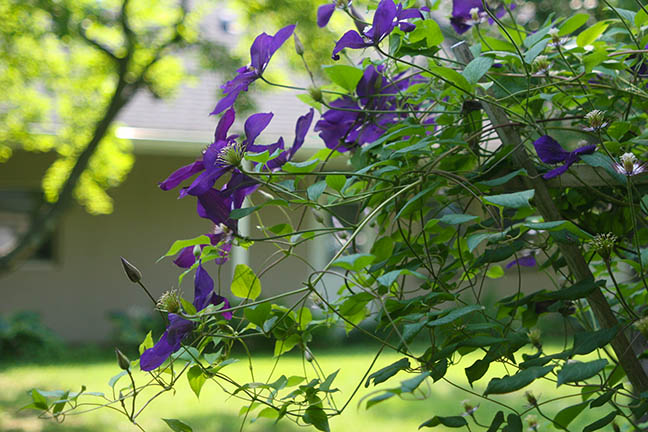
The beloved life partner of a long-time friend was interred in a green burial today, a glorious May morning full of flowers (she loved gardening…); and I find myself with little to say.

It’s been that way for the past two weeks. Not exactly writer’s block, as I have in fact drafted several poems, but an extreme sense of turning-inward. My nature is reflective–I’ve always fallen into the introvert category (INFP for those who are familiar with the Myers-Briggs assessment)–but my job requires pretty constant interaction with other people, students and colleagues for the most part, and quite a bit of listening and talking. I enjoy my job and find it rewarding; but the stressful weeks just before exams, when term papers are due, can be challenging for a person whose inclination is to read books and putter in the dirt.

I planted seeds in the earth, and picked flowers. And then placed flowers on a coffin woven of reeds which was lowered into the earth.

Returning home the quiet overcame me. I’ve been reading poetry today instead of the Sunday New York Times.

Also, I’ve been reading books on “good death” and “mindful dying,” and the guidance of some sensitive and experienced authors seems appropriate and grounded.

But grief is hard. It’s probably one reason we invented philosophy, religion, and poetry.

Shadblow, also known as serviceberry.

Shadblow, also known as serviceberry.

One of my go-to anthologies for sorrow is Pinsky’s The Handbook of Heartbreak, which I’ve mentioned in a previous post. In addition, I opened Christian Wiman’s book Every Riven Thing at random and came upon his poem “From a Window“–

Incurable and unbelieving
in any truth but the truth of grieving…


The poem comforted me (and I read other poems today, by other poets, that also comforted me). This one ends with the following stanzas:


Of course that old tree stood
exactly as it had and would


(but why should it seem fuller now?)
and though a man’s mind might endow


even a tree with some excess
of life to which a man seems witness,


that life is not the life of men.
And that is where the joy came in.


~
The joy comes in, somehow, through the quiet and the dirt and the trees.

Written by a human

Here’s a controversy for National Poetry Month–there are an amazing number of controversies surrounding poetry–which takes up the idea of whether a “machine” can write poetry. A good introduction is this CCR interview with Oscar Schwartz, who developed Botpoet as an experiment that is not so much about artificial intelligence as it is about what humans consider to be poetry. And perhaps about what language really is. If you follow the link to the site, you can participate in his research by playing “Bot or Not,” a game in which the player reads a series of poetic lines and then chooses between written by a human or not written by a human.

If you’ve read a great deal of classic and contemporary poetry, you may recognize some of the poems (I did); I suppose that is a way to cheat the system, since I have insider information. Nevertheless, I was wrong embarrassingly often. What, exactly, was I looking for in those words?

I think Schwartz is correct in his assessment of the more general population (though literary types may disagree with general assessments) when he says:

People generally seem to associate rhyming, “Romantic” poetry as being human. And they consider highly abstract, non-traditional poems to be of human provenance. Investigating as to why this might be the case is the project of my PhD.

He points out that written language is arbitrary and abstract, “an artificial medium” to begin with, and may have less to do with being human than we might like to think. Maybe the qualities that make a poem a poem are qualities that reside in the reader/interpreter rather than in the poet, another individual’s aesthetics or sense of what seems “creative.” That might be an unsettling thought for many writers, though it rather appeals to me.

Schwartz continues,

“So the results of Bot or Not, rather than telling us what human really is, is actually telling us that the category of the ‘human’ is an ideological, political space…The Bot or Not project works not because it tells us about computer software, but because it reveals things about what we assume to be human. It destabilizes the category of the human.”

As it turns out, the study of consciousness also tends that way–destabilizing our long-held category of what-a-human-is or what, if anything, differentiates us from other animals. Some interpreters of Zen philosophy suggest that Zen consists in finding balance within the inherent instability of the corporeal world. Or, perhaps, acceptance that humanness may be something we cannot categorize; the challenge then is to learn to flourish in a state of destabilization.

Let me sing the body electric…and the mind (possibly) electronic.

Walt Whitman in mid-life

Walt Whitman in mid-life

Online reading, online learning

I blog, therefore I am part of the digi-technological consciousness.

Here’s a situation Descartes might have had fun imagining…have we invented our own “evil genius” in Boolean or algorithmic forms? I won’t venture there, as I am not tech-savvy or social-media savvy enough to philosophize around tech aspects of modern culture; though, yes, I do use portal systems when I teach; I do use (limited) forms of social media for communication and to publicize my work; I do take part in the networks community online; my poems and essays appear in online journals; I read blogs and online journals although in general I prefer paper, especially for book-length works.

It isn’t as if I don’t consider the intellectual challenges these communication platforms offer. It would be silly to ignore them. They are not going to go away any time soon. One question is, however, to what extent should I employ or embrace them?

~

Recently, I’ve had a poem published in Carbon Culture Review, an online and print journal that states, as part of its mission, that the publication “advocates a creative, thoughtful and visually appealing dialogue about our complex relationship to technology. We strive to promote the work of those who employ technology and utilize technological designs and terms in art and literature.” The Intersection of Technology + Literature + Art, says the masthead; interdisciplinary in scope–that’s something I find fascinating, so I’m happy to report a rather atypical poem of mine has found a place in the new issue (“21st Century Research”).

I read Chronicle of Higher Education online and have linked to several of its essays in past posts. Lately, I find much of interest in Hybrid Pedagogy, a fairly new digital source about technology, teaching, radical re-thinking of the educational framework, and exploring the possibility of intentional, compassionate connections between teachers and students–even in the digital world. Here’s a recent essay that appeals to me: “Teaching as Wayfinding.” I am still wrestling with the challenges of how to create a genuinely interactive and personal learning space in the classroom, let alone via distance education. There is so much to learn, and welcoming interdisciplinary synthesis into the discourse of the humanities offers intriguing potential.

~

Speaking of the interdisciplinary: I am pleased to report that The College of Physicians of Philadelphia chose one of my poems, “How the Body Works” as an honorable mention in its Poetry Month contest celebrating medical/health themes in poetry. [You can also check my Events page for information and tickets.]

The College, a professional medical organization founded in 1787 (same age as the U.S. Constitution), is also the site of the Mütter Museum, which has a terrific slogan: “Are you ready to be disturbingly informed?” The College boasts a library of historic significance.

It’s a great venue for a reading, and if you are in the area, please join us. My brother says the food is really good, too–the ticket price includes a dinner. How festive is that!?

Let me remember joy

A good companion

A good companion

Excerpts and links to some vivid poetry as a kind of consolation, thanks to The Poetry Foundation and Poetry magazine, and to some wonderful writers:

Alicia Ostriker’s celebration of animal exuberance in Poetry:

…Pursuing pleasure
More than obedience
They race, skid to a halt in the wet sand,
Sometimes they’ll plunge straight into
The foaming breakers…

~~

A Dog Has Died” by Pablo Neruda

…all his sweet and shaggy life,
always near me, never troubling me,
and asking nothing.

Joyful, joyful, joyful,
as only dogs know how to be happy
with only the autonomy
of their shameless spirit…

~~

Bob Hicock’s “Unmediated Experience”

She does this thing. Our seventeen-
year-old dog. Our mostly deaf dog.
Our mostly dead dog, statistically
speaking. When I crouch.
When I put my mouth to her ear
and shout her name. She walks away.
Walks toward the nothing of speech.
She even trots down the drive, ears up,
as if my voice is coming home…

~~

Mary Oliver has a recent book of dog-related poems. Critics have derided it as sentimental–but that’s part of the role dogs play for us humans. Only part, though. There’s more, I think; but at present–no intellectualizing. Emotion–feeling–is fundamental to the human physiology.

Here’s my favorite photo of her.

524860_10200306585091559_756123494_nLooking out. Living in the moment.

~~

“Because of the dog’s joyfulness, our own is increased. It is no small gift.” ~Mary Oliver

Dogs & lions

By chance, I encountered the poem “Thorn Leaves in March” by W.S. Merwin (1956, Poetry magazine) a day ago and felt levels of resonance such as poems can evoke. The powerfully “clear expression of mixed feelings”–thank you again, W.H. Auden–converges with seasonal details in this early Merwin piece and merges, completely by happenstance, with events in my current life.

Walking out in the late March midnight
With the old blind bitch on her bedtime errand
Of ease stumbling beside me, I saw

At the hill’s edge, by the blue flooding
Of the arc lamps, and the moon’s suffused presence…

My elderly dog stumbles beside me on these late-winter nights; I do not think she will see another full-blooming spring. Resonance.

alicelamb

Rescue of an orphaned lamb.

“As a white lamb the month’s entrance had been…” Well, that has certainly been true of this year’s weather. And the lamb allusion makes me think not just of the old saying about March but about my daughter, who is spending this month’s last two weeks working among ewes on a farm in Scotland as lambing season progresses.

Merwin’s speaker refutes the aphorism; his March comes in like a lamb because it is white, and goes out in white, as well:

…as a lamb, I could see now, it would go,
Breathless, into its own ghostliness,
Taking with it more than its tepid moon.

The lion, he claims, is “The beast of gold, and sought as an answer,/Whose pure sign no solution is.” No lion in this quiet, late-winter/cusp-of-spring snowfall–the light is silvery, the budding leaves of the thorn trees translucent and cold. The speaker stands beneath the “sinking moon” and wonders, questions, listening for something he knows he will not hear.

The old dog, domestic companion (neither lion nor lamb), completes her mission; the man lets go of metaphysical thoughts; the earth inexorably turns toward summer–despite the snow.

I’ll keep this poem in mind as the next snowstorm heads my way on the equinox.


Roadkill

As the spring equinox approaches and creatures rouse from dormancy, the number of roadkill incidents spikes. Yesterday as I made a left turn into my driveway, I noticed a groundhog carcass lying in the middle of the street. I was stopped to retrieve my mail anyway, so I figured I should move the body off.

And then it moved–bloodied mouth opening and shutting, one heavily-clawed forepaw shuddering slightly. It wasn’t quite dead.

Poems about road kills sprang to mind. I thought immediately of Stafford’s “Traveling through the Dark” and that moment of swerving, replete with caesuras, in the last couplet; Billy Collins’ “Ave Atque Valealso skittered into my thoughts, that bloated woodchuck waving “hail, Caesar” to the passing vehicles.  As I pulled a plastic bag from my car, one of my own poems resonated–“Burials,” which is in my collection Water-Rites (available through this link and posted below).

I made a glove of the bag and grasped the poor beast by its tail, a precaution: it might have been lively enough to snap at me. Not the case this time. A car running over the body would have put the groundhog more quickly out of its misery, but by daylight drivers tend to avoid road kill; it gets smashed during the night hours. So I left it on the embankment to gasp out its last breath with the birds larking about above it and some damp wintry weeds under its dark body.

This sort of experience feels oddly metaphorical…obviously, not only for me but for people like Stafford and Collins. I am sure one could put together an anthology of very lovely roadkill poems.

~groundhog-day-groundhog

BURIALS

1.
Last week the neighbors’ dogs eviscerated a woodchuck,
left it, stinking, at the perimeter of our woods

which is how we found it, by the smell—
body bloated, partly hairless:

a scientific demonstration on the rapidity
and absoluteness of decay, the brief time it takes;

but today my daughter cannot bear the stray cat’s
road-killed stillness, the soft, domestic body,

the pet, which isn’t hers—she begs to bury it.
The schoolbus arrives with my promise

to give the cat some cover. Under mulberry I scrape
a shallow grave, in thin and gravelly roadside soil,

cover it with fallen leaves, an autumn prayer—
nothing more, because I know burial does not forestall

death’s swell, its stink, desiccation,
absoluteness; I do what I promised,

disguising the body’s inevitable progression
from the eyes of my grieving child.

2.
Shall I cover my gray hairs
with dry leaves, shall I layer
my wrinkled hands beneath clay,
hide my own departure—

or shall I teach my children
to understand the truth of maggots,
which consume equally
the treasured and the stray—

which arrive unasked,
fulfill their contract with the earth,
never seeking recognition
or time, more time?

~

© 2012 Ann E. Michael


March, march

March has been a busy month for me. Instead of composing posts on my usual topics (poetry, nature, education, philosophy), I am going to refer my readers to other sites or other writers…a treasury of riches on the web.

To commemorate the 50th anniversary of the Voting Rights Act of 1965, I ask my readers to check out my father’s memoir of the Selma to Montgomery March, here, and to consider this heartbreaking poem by the late Jake Adam York:

~~

For Reverend James Reeb
     9 March 1965, Selma, Alabama

The ministers rise from empty plates like the steam
of chicken and greens and puff into coats, prayers,

and then the unlit streets, the night, ready
for tomorrow’s march or gathering or prayers,

and then the dark is beating Hey niggers
though only their coats are black and the night and everything

so they cannot see what’s coming, what hits them,
what clubs or pipes, what feet are kicking

at their ribs, who’s saying Now you know,
now you know what it’s like to be a real nigger.

No one can see what lands, what cracks Reeb’s skull.
No one can see the hairline fracture

or what’s nesting, what’s beating there,
what wings are gathering in his eyes.

      by Jake Adam York

from the Blackbird archives.

Biography of Reeb here.

Barnacles, finches’ beaks, art

Cirripedia, the barnacles, occupied Mr. Charles Darwin for many years, even though his extensive studies of the class are not what he’s famous for (except among cirripedists). The average layperson knows Darwin as the man who came up with the theory of evolution–though that is not strictly what he did, and none of his books bear that title. After the publication of On the Origin of Species and The Descent of Man, and the subsequent and ongoing controversies that followed, pretty much everything in the world could be–and has been–examined “under an evolutionary lens.”

The original “lens” involved finch beaks, pigeon-breeding, and early geology studies. It was fueled also by taxonomy, anatomy, and barnacles, by a member of the landed gentry who stayed at  home, more or less, for 45 years after his five-year journey on the Beagle. A scholar, an “armchair naturalist” by today’s standards; a genius.

finch beaksMany people who interpreted what evolution suggested went off the deep end one way or another, which is what happens with ground-breaking ideas. Both critics and supporters re-interpreted and often misinterpreted Darwin and the implications of his work, as well, all of which means he accomplished something truly significant. Why not, therefore, examine fundamental human traits to see whether evolutionary currents can be discerned? Certainly Darwin and a few of his contemporaries speculated that altruism might have an evolutionary basis, a concept that was taken up, debated, and temporarily dismissed in the 1960s-70s; recent neurobiological and genetic studies have brought the possibility of a biological basis for kindness back into discussion (see also Damasio).

There is also the question of art (and aesthetics, though taste seems more likely to be social than biological–but who knows?), which brings me to Denis Dutton’s delightful book The Art Instinct: Beauty, Pleasure, and Human Evolution.

Rather than summarize my responses to his thought-provoking and rather convincing arguments, I’m posting some quotes. These are ideas I find juicy to consider; perhaps other readers will feel similarly.

~

Wondrous aesthetic experiences are possible in the absence of a sense of larger community: the response of an individual to a beautiful landscape, for instance, …or to a recording of the Goldberg Variations heard in solitude. If the arts were intrinsically social in the way that social-cohesion theory claims, people…would prefer standing in a crowd to see a painting in a museum, rather than standing alone.

Because of sexual selection, the arts retain an incorrigible sense of being made by one individual person for another…the motives of art, as even Darwin knew, are ancient and complicated–directed toward a community perhaps, but also created to captivate an audience of one.

~

The artist…probes the content of human emotional life with an eye toward articulating, or making clear, a unique emotion, an individual feeling.

Can you imagine taking [a] pill to save the expense of concert tickets, or even the time spent in listening to a recording of the piece? The answer is very likely to be no, and the reason tells us something about the nature of artistic expression. It is not just the emotion as bare feeling we want from art, it is the individual artistic expression of emotion–how emotions are revealed in the art, through technique, structure, balance, and the blending of sounds….Yes, we want feeling from art, but not as an end for which the art is a means: with art, the means is the end itself.      [italics mine]

~

Extending Darwin’s original suggestion, I believe this intense interest in art as emotional expression derives from wanting to see through art into another human personality: it springs from desire for knowledge of another person….talking about art is an indirect way of talking about the inner lives of other people.

~

All of the above excerpts are from Denis Dutton, The Art Instinct, 2009.

http://taxo4254.wikispaces.com/file/view/darwins_barnacles.jpg/274764236/409x262/darwins_barnacles.jpg

wikispaces.com/file/view/darwins_barnacles.jpg

Consciousness as story

Some recent questions to myself:

Reading philosophy and psychology for so many years, was I looking all along for an explanation of consciousness?

Through neurological and evolutionary science, and more philosophy and more psychology and, in addition, some anthropology, some history. And fiction. And rhetoric. Trying, perhaps, to understand the self? Through criticism, through art, through literature?

Looking carefully at art, reading literature closely: were those also endeavors to comprehend what mind is? Other minds? My own mind? Through the creative act, perhaps?

Is the ars poetica a kind of manifesto of human consciousness from an individual perspective, yet open to interpretation by other human minds? And the beautiful–what is it that even makes beauty a significant concept? Where did that come from? Evolution and the sexual drive (see Dutton riffing on Darwin)? Society? Synthesis? Ego? Inspiration? Angels?

Is every story a scaffold to consciousness? A hedge against oblivion? (Self-oblivion, the hardest navigation act there is: depression, hopelessness, loss of self-knowledge, coma).

I wonder if the stories we tell to others and to ourselves, employing memory selectively whether or not we realize it, act as a kind of (modern-day, metaphorical) Chain of Being through which we develop Theory of Mind and, beyond that, a sense not just of ego but of neurological consciousness. If stories are what make us human.

~

The chain of being, from Charles Bonnet, Œuvres d'histoire naturelle et de philosophie, 1779-83

The chain of being, from Charles Bonnet, Œuvres d’histoire naturelle et de philosophie, 1779-83

[Note: I do not hold the medieval concept of a hierarchy in which Man, angels, and God stand above all other things; the stone and the plankton have as much value–likely more–than I do in the workings of the cosmos, as far as I am concerned. I post this Enlightenment-Era engraving here for metaphorical and aesthetic reasons because I take pleasure in the delightful monkey.]

~

Stories have tremendous value to human beings in ways we are still discovering; see my previous posts here, here, here, and here (among others). I keep coming across claims for the significance of story in surprising places–most recently in Dutton’s The Art Instinct and in Atul Gawande’s latest book, Being Mortal. Widely different texts, similar observations.

How is it we know who it is we are?

Possibly, in the process of inventing the story of ourselves, we become human. Perhaps the story of ourselves is fundamental to conscious “human” minds.

Speculation. But I love recalling that my children, when they were very very young, consistently made one particular demand of me: “Mama, tell me a story!”

~

Key images

I had intended to post on Denis Dutton’s book The Art Instinct: Beauty, Pleasure, and Human Evolution; and I will (I suppose) at some point, because I enjoyed it immensely. Looking through my files, however, I found the transcripts from the initial interview Karen Jogan and Hernán Pereira conducted with me when they were compiling the book So Far…So Close and realized that my answers to some of their inquiries connect with my last post about poetic voice and Kunitz’s thoughts on key images. (The longer, but edited, version of the interview appears in the book).

~~

  1. What colors or aromas remind you of your childhood?

Cinnamon toast, mown grass, onion grass (wild garlic), lily-of-the-valley, cedar-water and pine trees, the scent of a muddy river in summer, wintergreen, play-dough, school paste, steam-irons, fresh peaches, campfires, burning leaves, talcum powder, Pepto-Bismol, air-dried clothes and linens, mimosa blossoms, roses, strawberries.snowdrops

  1. Describe yourself as a child.

I wonder from whose perspective I should attempt to answer this question. I know from others that I was considered to be shy and polite, talkative when comfortable, imaginative. I certainly felt uncomfortable among groups of people, preferring small groups of friends with whom I played make-believe. I made up stories which I told my sister and brother, and when I was old enough to write I made little children’s books that I illustrated and bound in cardboard.

My sister was my best friend, but I spent a good deal of time all by myself. When alone, I walked my dog, climbed trees, played on the swings, sketched and painted, and read books. I really was a bookworm and spent many happy hours with books and in libraries. Being alone was, and still is, deeply satisfying for me—it helps me regain creative energy.

  1. At what moment in your life did you begin to write?

I don’t remember when I began writing. My storytelling began early, and I suppose the writing developed from there. The first story I recall writing down was about a princess; I was in second grade. I felt proud of myself, even though the story was only about three sentences long. Apparently, the poems started when I was about nine. I don’t remember writing poems then, but I recently found some that I had composed and typed up (I was fascinated by the typewriter), and my mother’s notes said I was nine when I wrote them. What I really wanted to be was an artist, but writing seemed natural to me. I started keeping a journal when I was ten…

9yroldpoems010

Rhyming and typing and illustrating and bookmaking– at nine years old.

  1. What influences have been important to you?

Other writers, naturally, but first of all, visual art. From the time I was very small, I’ve loved paintings and sculptures and architecture. Church hymns and Bible verses and nursery rhymes were influential to me, as well as folk music and the lyricists of popular music when I was growing up. I am also influenced by non-fiction work, especially in the sciences, and philosophy. My early poetry influences were Donne, Shakespeare, Blake, and the King James Bible; but then I fell in love with contemporary women writers, then surrealist poets, then Latin American writers, then Asian poetry, then contemporary lyric poems…it goes on and on. It might be easier to say what I have not found particularly influential!

~~

With further reflection, I could go deeper about early images that have become, for me, “key” aspects of my writing voice…a particular landscape, the feeling of an empty nave, bees and birds, milkweed, cloud patterns, my parents singing, my little sister beside me in our shared bed, the sound of a symphony. They may not appear in my poems as such, but these images connect with me in ways I probably don’t understand. What do such keys unlock, I wonder?

~