A Poet’s Craft

I am enjoying a text by Annie Finch, a fine poet–but this is not a book of her poems. Finch is the director of the MFA program at Stonecoast (Univ. of Maine); and her new book, A Poet’s Craft, draws on her experience teaching people to write poetry. She begins in the best possible way: teaching people how to read poetry.

It’s a gentle, encouraging book but passionate. The examples she gives are excellent, varied, and surprising, spanning centuries and continents. Even if you have no  intention of ever writing a poem but would like to learn how to read and appreciate the art and craft of poetry, you should consider getting this book.

Meanwhile, a thunderstorm approaches. Time to close up shop at the computer and get back to reading!

Empty nest

robin nest empty nest Ann E. Michael

“The Atlantic”

 Atlantic by John Sevcik

A few years back, I was privileged to join John Sevcik, his wife Lynne Campbell–who is also a marvelous painter–and a few art students and friends for three lovely days of art talk and plein air painting sessions and terrific food at a beach house in NJ. This painting, by John Sevcik, inspired the following poem, which appears in Water-Rites.

The Atlantic

She and her mother
are knee-deep in water
their backs to the shore

What they discuss
as they look eastward
you cannot hear–

breakers, the wind,
the natter of laughing gulls
cover their conversation

Besides, you are busy
fathoming the sea’s tones
and mixing the sky–

Trying to stake claim
to the reflective shallows
between you and them

At this hour
they are your subjects
as the sea is

and what they say
she will share with you
later. Or she won’t.

It doesn’t matter, you
have set down on canvas
their communion

And your own conversation–
the one between mind’s eye
and artist’s hand.

~~~

Many thanks to John Sevcik for allowing me to post his painting here on my blog. To see John’s other works and find out about gallery showings, visit him at his web page. He is also a teacher, poet, playwright and actor.

Generous community of writers

Lately, my days have been busy with gardening and household chores and efforts to promote my book Water-Rites. I find I can jot ideas into my notebooks but that more sustained creative writing efforts are not possible at this time. That’s okay. Writing, for me, often comes cyclically, with the slow periods acting as collecting points and reflective opportunities that may result in poetry later on. Also, when I am not writing much, I have time to read.

On this blog, I have a page devoted to ART which featured links to work by painters, sculptors, and other artists of my acquaintance. Today, I’m posting links to websites of and books by friends. One thing about the solitary life of writers is that we still require community of some kind: readership, first and foremost; but also reviewers, friendly but useful critique, emotional and career support, and misery-loves-company ranting and hilarity. This community develops many ways–face-to-face, mentorship, virtual collegiality, networking, even postal mail–and sustains the generous community of writers over years and miles.

The event that precipitated my desire to post these links was reconnection with poet Alfred Encarnacion, whose first chapbook, At Winter’s End, David Dunn and I published in the early 1980s when we were running LiMbo bar&grill books. You can find Alfred’s 2012 collection The Outskirts of Karma here.

One poet who has quietly been disseminating poetry for 25 years from his tiny press in Kanona, NY is Michael Czarnecki of FootHills Publishing. From his website, you can order books by many of the people in my writing community: Michael himself, and also Craig Czury, Heather Thomas, Karen Bashkirew, Paul Martin (whose beautiful 2009 full-length collection is available here), Steve Myers, Kelley Jean White, Elizabeth Bodein and many others…including two of my own chapbooks.

Finishing Line Press, which sells through Amazon as well as its own site, has published many of my colleagues in the poetry community and particularly supports female writers; I urge you to purchase books by Celia Lisset Alvarez, Kelley Jean White, Nancy Scott, Elizabeth Bodein. Finishing Line also sells my book The Minor Fauna.

Through Dave Bonta, I met the folks behind Phoenicia Publishing and, through Dave and through the Women’s Poetry Listserv, met Ren Powell. Dave’s book and Ren’s book are available through Phoenicia, and so are print issues of Dave’s online blog literary journal, qarrtsiluni. Also through Dave, my literary community grew through meeting Luisa Igloria, whose books you should definitely check out. Another connection with the inimitable Dave Bonta? That would be Ron Mohring of Seven Kitchens Press, which will be publishing Dave’s next collection and which advocates for the work of Pennsylvania-based poets such as the late Lou McKee and another of my colleagues-in-writing, Harry Humes. August Evening with Trumpet is a particularly lovely book, and Harry is a master. Other Pennsylvania poets to whose tribe I am happy to belong include my much-lauded friend Barbara Crooker, the unpredictable and enthusiastic Barbara DeCesare, Patricia Goodrich (sculptor and poet), and that magnificent woman of letters, Elaine Terranova.

Attending an MFA program at Goddard College granted me an immediate community for which I continue to be grateful many years later. Books by my fellow students and by my mentors include but are not limited to the following (really, there are too many to recall!):

Alan Smerdjian, Jessamyn Johnston-Smyth, Elena Georgiou, Christian Peet, Bea Gates, Ian Haight, Barbara DeCesare, Jan Clausen, Janice Goveas, Bill Moser, Jen McConnell, and forgive me for running short on time or forgetting others…and from my long-ago days at The New School, the amazing Maurice Eidelsberg, whose poems in Shit, Sex, Love, Palsy will have you viewing life from a perspective you may never have imagined.

Through the Women’s Poetry Listserv I mentioned earlier and through conferences and festivals, the generous community of writers has led me to Diane Lockward, Pat Valdata, Elizabeth Raby, Rosemary Starace, Julie Kane, Elaine Heveron, Lori May, Juilene Osborne-McKnight and Steven Allen May of Plan B Press; Ned Balbo, Jane Satterfield, April Lindner among many others. Wendy Ellsworth has written a book on beading and spirituality; my cousin Scott entered the world of book writing with a children’s book you can find here. And my brother, a true Renaissance man, has published a novel and is working away at a non-fiction Rip Van Winkle-type story of archeology, empiricism, Stephen Jay Gould and Samuel Morton.

So  you see, the life of a writer need not be–and seldom is–solitary. Writers love to read, and they therefore support one another inadvertently. My community also includes Shakespeare, Mark Twain, Charles Dickens, Emily Dickinson, Jane Austen, Vladimir Nabokov, Elizabeth Bishop, Robinson Jeffers, Dante, and Dostoevsky. To name a few.

Fruition

In 1999, my beloved friend and fellow poet David Dunn died of a diabetes-related embolism. A few years later, some of the poems I had written as I worked my way through my grief made their way into my graduate school (MFA) thesis. After more years of writing and revision, that manuscript became Water-Rites

which is now a book. Many thanks to Keith Badowski and Ron Self of Brick Road Poetry Press and to the friends and colleagues who helped me to work on these poems and who encouraged me to persist in finding a publisher for the book. Link to purchase is here: Water-Rites.

water-rites by Ann E Michael

Thanks also to sculptor Steve Tobin, whose sculpture “Retretti River” as photographed by George Erml gives Water-Rites a striking cover image.

Thanks to my writing group for almost 20 years of critique and support, and to my mentors and instructors at Goddard College, and to colleagues who have written kind words about the poems. Here’s a quote from Barbara Crooker (whose poetry & website can be found here):

Ann Michael says, “There is nothing wonderful here,” but clearly, she’s wrong, as Water-Rites contains many wonders:  goldfinches, “lovely in the lost way of beautiful things,” the richness of beans that “lie warm / one inch below the earth; uncounted yet,” an ordinary robin’s egg, a yellow-shafted flicker in black and gold tail feathers. This is the natural world Ann Michael inhabits and explores: her home, her garden, the landscape of eastern Pennsylvania that surrounds it. Michael takes us on a journey through the woods of loss and grief in poems that are as clean and clear as water running over stone. “And what is as beautiful as water?” she writes.  These poems are unencumbered by unnecessary wordiness, enhanced by careful word choice and a richly varied vocabulary. “I know what I daily know,” says Ann Michael, and now we, her readers, know these things, too.

     ~Barbara Crooker, author of Radiance, Line Dance, and More

More thanks to my non-writing friends who have enriched my life in so many ways, and to my wonderful and supportive family members.

And to David Dunn, who is with me still wherever he is.

Reveries toward childhood

My childhood was happy and full of isolation—bored, lonely, occasionally melancholy daydreams and reflections. Some readers will find contradiction in that opening sentence, but Gaston Bachelard would have understood. His chapter (in The Poetics of Reverie) on Childhood and Reverie resonates deeply with me.

The claims Bachelard makes for the crucial importance of childhood reverie are that the child, solitary, daydreaming, finds happiness as the “master” of his or her reveries and that poetry is the way adults can return to the deep daydreams of childhood in which humans are—briefly—free beings and fully receptive: “Poets convince us that all our childhood reveries are worth starting over again.”

He further claims that images “reveal the intimacy of the world” and that all poetic images are a kind of remembering. I suppose this particular claim for poetry puts Bachelard in the “deep image” arena of poetry—Rilke, for example, as filtered through the concepts of Carl Jung, whose influence appears everywhere in The Poetics of Reverie. I waver in my complete acceptance of this claim, though I can’t yet articulate why—because I do agree image can evoke, or even be part and parcel of, intimacy. It may not be the sole method of achieving the shock of recognition or the tug of familiarity among readers, however. I’d assert that Ammons, Menashe, even Ponsot (in her tiny poems in Springing) get there by other means.

What I love about Bachelard’s philosophy on childhood reveries is the idea of “reveries toward childhood.” Interesting phrase, and I wonder if the translator (Daniel Russell) struggled with it. To dream toward childhood denotes an intentional action, a moving forward in order to reach back, a paradox. He claims we can almost reach (regain) the child’s “astonishment of being,” our “world of the first time,” through reading poems. We daydream with the poem itself…not with the poet, who remains a distinct individual with his or her own being and past.

I’ve experienced this feeling, and now Bachelard has described it for me.

The philosopher was late in his life when he composed these reflections; this is his last book. As he explores the “uselessness” of childhood memories, the flashes of recall through sensory stimuli, he posits that reveries toward childhood nourish the person who is in “the second half of life.” Combining memory and reverie can restore us, he says; and to do so, we first beautify our pasts—even our tragic episodes are reconsidered, reconstructed, through the lens of distant memory. (Hence the opportunity for sentiment). I think he means that once we have dealt with vivid past traumas earlier in adulthood, older people are able to recall the amazement of having once been new to the world. Perhaps this is merely sentiment, but it is certainly a phenomenon that appears in many works of drama, fiction, even memoir.

Bachelard describes such experiences as “the strange synthesis of regret and consolation” and adds that “a beautiful poem makes us pardon a very ancient grief.” (I love that sentence.)

In this way—among other ways, I might add—poetry’s images help us believe in the world, revive “abolished” reveries in a fresh light; the poet’s images may not be our images at all, yet they work to move the reader toward childhood, by which I mean toward a seeing-afresh of human experience. I may be parting ways with Msr. Bachelard here, for he classifies these images as almost wholly archetypal, and I do not; nonetheless, I don’t think our differences negate his claims nor hurt my general agreement with his insights. The amazement that took off the top of Emily Dickinson’s head when she read a great poem, the astonishment of being that arrives via the poem, strikes me (and the pun is intended) as exactly like the Zen whisk: “Wake up!”

And what is a child but a being who is wholly awake to the world?

“When we are children, people show us so many things that we lose the profound sense of seeing, Bachelard says. Yes, like Whitman when he “heard the learnéd astronomer”… Whitman’s speaker—the child in him—ventures outside to see the stars. He does not need to be shown.

This is a long blog entry, I know. But if you’ve gotten this far, I hope you are eager to go read some poems now.

Wake up and dream!

Still daydreaming in adolescence…(Switzerland, 1974)

22 years ago this week

Here’s another post from some time back, one I have updated to reflect current experiences: the graduation and the 22nd birthday of the subject of this brief reflection.

azaleas by Ann E. Michael

The morning was hot, and I had not kept up with the gardening. I needed to get the zucchini seeds, etc. in the ground before the weather got too hot and dry. We were a little behind schedule with the garden because we had a 17-month-old, and I was 9 months pregnant. I was sowing and weeding as women have done since the earliest establishment of agriculture, heavy with child, my back aching, working like a woman obsessed.

You know, that “nesting” thing you hear about with mothers-to-be? I was a week overdue and sick of waiting around; and  gardens won’t wait. The weather was perfect for planting the post-frost seeds. The time was–of course–ripe. Eight hours later, I gave birth to a daughter.

A couple of years later, too busy to write much, this set of cinquain stanzas arrived in my mind (published in 2001 in June Cotner’s anthology Mothers & Daughters, A Poetry Celebration).

Now, that infant is a grown woman with a  college degree. Happy Birthday, Daughter.

To My Daughter

Early
morning I had
planted seeds, cucumber,
melon, squash—I pressed them into
warm earth.

The blood
in my body
sang and I listened for
a cry to join my own—straining
to hear.

And there
you were, all pink,
unfolding in our hands,
a blossom opening with a squall:
daughter.

© 1994 Ann E. Michael

Fragments…

I just want to re-blog this brief and thought-provoking piece by Michael Klein in Ploughshares:

Notes on Narcissism and the Line

Klein’s musings have inspired me to go back to my drafts of the past year and look more closely at fragments, lines, and the self in the poems.

I’ve also discovered, via Deborah Barlow’s delightful art-centered blog, Slow Muse, the art and prose of Altoon Sultan. Reading and viewing creative pieces and creative critical thinking is a marvelous spur toward one’s own creative endeavors. Although I do risk spending more time online, reading and viewing, than I ought…

Enjoy!

A William Carlos Williams moment in Emmaus

As the spring semester closes, I am trying to get to some housekeeping of several sorts–literal and metaphorical housekeeping. Yard work, filing, dusting, going through poems and essays and books I meant to comment upon…revisions, half-finished proposals and papers, and folders on my computer that are obscurely titled and mysteriously organized.

One thing I thought I’d do when I have a few minutes at the computer is to upload some past notes from a site I no longer use. Most of them are not worth saving, but there are a few I still like. Here’s one dated Saturday, April 18, 2009:

~

Working in the yard and garden this morning. The peas are sprouting, the asparagus are poking up. Here’s the anecdote of the day for those of you who appreciate a little poetry allusion.

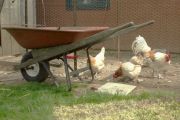
My husband, preparing to move some topsoil, yells to me, “Where’s the red wheelbarrow?”

And I was able to reply, because it was literally true: “Glazed with rain water, beside the white chickens!”

white chickens

[A photo from later in the day–the rainwater glaze had evaporated.]

Re-reading & reverie

Writing a book is a hard job. One is always tempted to limit himself to dreaming it.

Above all, the great books remain psychologically alive. You are never finished reading them.

–Gaston Bachelard

~

In The Poetics of Reverie, Bachelard writes of reveries on words, then moves to reveries on reveries themselves, which brings him to books. Books (philosophy, fiction, and poetry books in particular) are, for Bachelard, a kind of dream made real. Books are places to dawdle and to dream as one reads, places in which the reader can interact with imagination: the reader’s  imagination, not the author’s imagination. The author’s work, if it is great, tempts readers into reverie. For this reason, Bachelard says he likes to read his favorite books many times. Each reading produces new reverie.

The chapter in which he makes his case for literature as reverie is an odd one, less of a philosophical argument and more a blend of literature, psychology–particularly along Jungian themes, and sociology, with side trips into discussions of duality (more on the masculine and feminine), the physiology of sleep/dreaming, alchemy (more Jung!), Strindberg, Goethe, Nietzsche, Henri Bosco, and Balzac.

I prefer the chapters on either side of this one (on words and on childhood). But this section made me consider the books I have re-read in my lifetime, and the idea of dreaming with literature. And the lovely idea of books as “psychologically alive.” What a terrific observation!

When I was a child, I preferred reading the next book to re-reading a favorite, although there were a few books I read over, more than once in some cases. As I read my way through high school and college, my inclination toward novelty continued. Why spend time reading books I had already read? The dreaming-with the book aspect Bachelard describes did happen for me, but the reflection lasted only as long as my engagement with each text. I was not a “close reader,” and as a result it was easy to get wrapped up in the dream-world when I read fiction. Still, the dream was the book’s dream, not my own. Closer reading is what leads to reverie, I think: re-reading and reflecting.

It was poetry that taught me to read more closely, to re-read, to dream with the text, to find true reverie in the process of reading. Poetry has always felt psychologically alive to me, and I agree that one is never finished reading a great poem. Or a great book.

I find I must also concur with Bachelard that “one of the functions of reverie is to liberate us from the burdens of life.” Nothing like a daydream, or a great piece of literature or art, to free us–however temporarily–from the things that weigh us down.