Unlovely drafts

Well, I have been writing. But less about the current wintry days than I expected, because of the online poetry seminar I’m taking.

One recent prompt in Anita Skeen‘s workshop involves employing phrases from a text and using those words, or images, as a start to a poem that would not encompass or even relate to the original topic. I’ve written work that does that; but more commonly I continue the topic in some way, most notably with my long-poem/chapbook manuscript The Librarian of Pyok Dong. And what I notice is that I tend to choose “unlovely” texts, articles or essays that are historical, scientific, or academic, rather than to use the words of poets or novelists. Why that is, I can’t say for sure; it may simply be due to my deep-rooted nerdiness. But I think of poets like Martha Silano, Rebecca Elson, Muriel Ruykeyser, and others who have created amazing work, beautiful poems, from newspaper articles, scientific papers, academic texts, encyclopedias–so I feel encouraged. The result, for me, however, is often an unlovely draft.
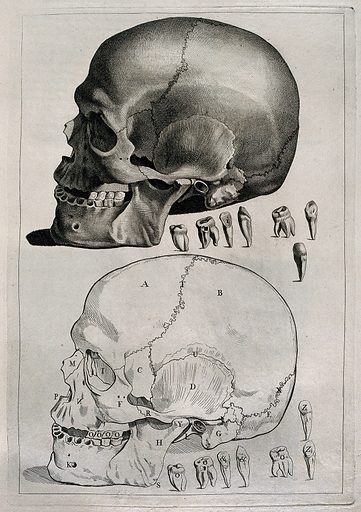
Etching by or after J. Gamelin, 1778/1779. Created 1779. Contributors: Jacques Gamelin. Work ID: h3ybfzwe.

I have recently spent some time proofreading one of my brother’s papers that addresses the origins of some of the crania in Samuel George Morton’s collection, which resides at the Penn Museum in Philadelphia and is among the controversial holdings there of sacred/religious objects and human remains. The University has committed to “repatriating” such items in its collections that belong to indigenous peoples, for example, and to returning human bones to places of origin or to “respectful interment.” The challenge with Morton’s large collection is to ascertain where, in fact, these human beings came from. [Informational page is here.] My brother has been trying to track down the people, likely young Africans, who made up one set of about 55 skulls collected in Cuba around 1839-1840.

It’s a terrible history, of course. The Middle Passage, slavery, illness, misery, abandonment even in death. And it’s an academic paper, so the language–not to dismiss the author’s writing ability, since he’s keeping to the conventional style–does not lend itself to poetry.

Basically, I’ve given myself a difficult task. Yet we learn through difficulty, do we not? Often, too, the unlovely poems are those that deal with how rotten human beings can be, or illuminate the worst of times and offer us insight and information that we had not been taught, hidden horrors, trauma, all of the above. I have written many lovely poems about lovely things. The world, however, manages to be far more complicated than beautiful, a mixed bag of joys and miseries, and it seems to me that literature and art ought to reflect that fact sometimes.

What I’m posting below is a very rough draft, just to demonstrate how I begin a difficult poem, a poem based upon historical facts that I’m learning myself. It’s a completely different process from when I write from an image or observation of my own. For example, the “Librarian” poem, which is about 15 pages long, took me a couple of years and a visit to the United States Army Heritage and Education Center (USAHEC) at Carlisle Barracks, PA! First I pull some quotes, make a lot of notes, highlight images or place names that seem most resonant. Then I develop these into what I call “jottings” and fragments, and start setting them into an initial sequence–which I often change later.

Stanzas? Line breaks? Metaphors? Meter? All of that can wait; I like to work on structuring the narrative first when I try something in this vein, and I want to find images that might speak to a reader. So it is clear to me that this poem is not one I’ll have finished before the end of the 5-meetings-long workshop. Assuming I ever do finish it. Yes, poetry is hard work.

~

José Rodríguez y Cisneros, Havana Physician, Ships 55 Human Crania
to Samuel George Morton, Anatomist (1840)


A Cuban journalist writes that by 1915
“The Vedado of my childhood was a sea rock
over which the seagulls flew”

sandy, overgrown with Caleta sea grapes
the nesting-place of rats, iguanas

but once a cemetery for paupers and bozales,
the unbaptized, slaves, the suicides

abandoned on this coast as carrion

where turkey vultures and wild dogs
fed on corpses hastily interred

el Pudridero” they called it—
the rotting place—
local people thought it cursed

for a more scientific-minded man, opportunity
to harvest skulls for anatomic pursuits.
Nameless, blameless nobodies

who were otherwise less than worthless:

the definition from a 19th century
Spanish dictionary:

bozales. A Negro recently removed
from his [native] country—
metaphorical and vernacular,
one who is foolish or idiotic…

can be applied to wild horses.”

~~

*note~

“the Vedado Interment Site…originated as a sinkhole that came to be utilized as a mass grave…[the majority] of the Vedado Group likely consisted of enslaved people born in Africa during the early 19th century, most of whom died of infectious diseases soon after arriving in Cuba.” John S. Michael

Poetry books & the $

April has been designated National Poetry Month by the Academy of American Poets–the campaign was launched in 1996–and because I write poetry and love the art, and read poetry and know poets personally as well as through books, I try to keep the awareness of the month-long love-feast for the crafted word going in whatever small way I can. Hence, if a reader should happen to type the words “National Poetry Month” in the searchbar on this page, said reader would find tagged posts on the subject going back about eight years.

Some years I have endeavored to draft a poem a day for 30 days, some years I have been active giving and performing readings, some years in teaching; it varies on circumstance and energy. This year, I am celebrating by reading more than by writing.

When I buy poetry books, I try to purchase them–if possible–from the author or from the author’s original publisher rather than more cheaply (Amazon, used books, etc.) The author gets no royalties from books bought second-hand, and because few poets are rolling in cash from book sales–and while gaining an audience may be of value–even a small royalty check is a welcome thing, a confirmation of the work in the world.

Best-selling poetry is not necessarily the “best” poetry. Those of us who love the art can contribute in small ways by using the almighty dollar to support the writers we think need to be read.

Here are some poetry books I have bought, or borrowed from my library, in the past two weeks or so. I don’t usually go this crazy with poetry-bingeing; but as I’m not doing much else for Poetry Month this year, I figured I would contribute by doing what I love best: reading books!

Lesley Wheeler, Propagation; Louise Gluck, A Village Life; Grant Clauser, The Magician’s Handbook; Jan Clausen, Veiled Spill: A Sequence; Luisa A. Igloria, The Buddha Wonders If She Is Having a Mid-life Crisis; Aaron Baker, Posthumous Noon; Ian Haight, Celadon; Erica Dawson, The Small Blades Hurt; Brian Turner, Here, Bullet; Margaret Gibson, The Broken Cup. There will be others!

And two notable non-poetry books I loved, Elena Georgiou’s The Immigrant’s Refrigerator, short stories; and Laura Miller’s The Magician’s Book: A Skeptic’s Adventures in Narnia (a subject close to my own heart–her approach to the book and her history with it ring close to my own experiences).

There will be others, if I have any spare time. I am also planning to read a book by philosopher Andy Clark and a biography of C. S. Lewis and to proofread my brother’s latest paper on Samuel George Morton. If only the weather were warm enough that I could read in the hammock!

hammock

image from www.meditationrelaxationclub.com


Curiosities & stories

Here’s James Delbourgo’s recent article in Chronicle of Higher Education (I read the Chronicle regularly, if that’s not already obvious) about collections of oddities. While the article itself is sometimes a bit maddening (what is his main idea here?), it put me in mind of Mantel’s The Giant, O’Brien and of collections my friends have accrued. Toshio Odate, for example, has some fascinating accumulations he keeps in clear acrylic boxes, and some of his art constructions feature curious things: a favorite of mine is a large frame displaying every pair of sneakers his son wore as a child.

Edmund de Waal wrote movingly about objects and collections in his book The Hare with Amber Eyes. Several months ago I promised myself I’d get back to the topic of objects and their stories, but it has taken me awhile to resume my meditations on the subject. As a child, I loved wandering slowly through the world, stopping and dawdling and picking  up acorns, buttons, marbles, leaves, whatnot. Sometimes I would arrange these found objects into tiny houses, or float them on puddles, or arrange them on my windowsill. I might imagine stories around them, drawing on Andersen’s “Thumbelina” or the song “Froggie Went A-Courting.”

"Swiss Shoot the Chutes" by Joseph Cornell

“Swiss Shoot the Chutes” by Joseph Cornell

Not too many years later, when I encountered Joseph Cornell’s work, I was enchanted. His boxes contained mysteries, stories, possibilities, and fears; and they were achingly beautiful to me. Not unsurprisingly, Cornell’s work gets a mention in Delbourgo’s piece, which is partly a review of Brian Dillon’s book Curiosity: Art and the Pleasures of Knowing.

From the Chronicle essay:

Curiosity, Dillon proposes, is a way of knowing that looks askance. It draws attention to the unexplained or overlooked fragment, to invite us, if possible, to look sideways and look closely at the same time. As such, its promise of knowledge is ambiguous. Does curiosity seek to unmask the strangeness that absorbs its attention, or is it an invitation to luxuriate in that strangeness? Does it carry an inherent Baconian injunction to go further and illuminate, or does it recommend the alternative pleasures of not knowing?

I like those inquiries and feel they may inspire some poetry. Later, while considering the way some collectors, particularly wealthy or scientifically-minded ones, made detailed lists of the oddities, Delbourgo notes that

Dillon suggests that such lists also constituted “a kind of story,” but do they? The list is an open form, not a closed and completed one. Curiosity collections could absorb countless new objects precisely because they didn’t propose a coherent narrative about them. Unlike spoils that tell of conquest, curiosities don’t preach and don’t teach. What makes them curious is their oblique relation to the world in which they’re embedded. And yet, as a matter of historical fact, early-modern Europeans accumulated curiosities in no small part through trade, colonization, and war…

The 18th-2oth century ascendancy of science and the current trend of interdisciplinary art-tech-science aesthetics gets a mention in the article, too:

Curiosity and wonder—distinct terms but often used interchangeably—turned out to be interwoven with theology, civility, craftsmanship, nature’s playfulness…Curiosity thus helped dethrone the modern fact from its hegemony over the history of science.

Again a connection with de Waal, and also with the work my brother has been doing in reconsidering the skull collection of Samuel Morton (and other early modern anthropological collectors). In the case of many people who collect ‘curiosities,’ there are thorny questions of ethics vs. the ‘value’ of extending knowledge or awareness. The political, the legal, the ethical–these can conflict with curiosity in many forms it can take, from the problematic Rauschenberg  sculptural combine “Canyon” which features a stuffed bald eagle, to the superficial thrill that gets us to sit through an adventure movie even if we can guess the ending.

Curiosity is basically an exploratory response, as psychologists term it, which covers a vast arena of animal and human perceptions of the environment to orient us to potential situations and to prepare us for behavior/action. In the late 1950s and early 1960s, D.E. Berlyne studied what I call curiosity quite extensively, including some exploration into art and aesthetics though mainly concentrating on the reactive responses that make us susceptible to enjoyment or evaluation of art, humor, literature. (He published, in 1954, A Theory of Human Curiosity, which I think I must read after I read Dillon’s book).

But now I am drifting far from my topic of stories and objects. Probably that’s Delbourgo’s influence, as his essay wanders a bit, though the author cites some books I plan to add to my to-read list; for that, I am grateful, but I would prefer to look at how objects inspire stories, or make the need for stories. There’s the sun in the sky each day, and it leaves each night. We make up a story about that, or about why the leopard has spots or why there are stars in the sky.

Here’s something from my own collection of curiosities, a wooden ampersand from an antique type magazine. &&001And there’s a story I could tell about it which would be more or less ‘true,’ but there are better stories yet to be invented.

Or, tell the story of Cornell’s “Observatory Box.”

http://www.thisisnotacraft.com/

“Observatory Box,” Joseph Cornell