Rainy-day reading

Much-needed rain has arrived, and therefore I’ve been inside all day instead of out in the yard and gardens. I thought maybe I would feel motivated to send some of my poems out into the wider world. Turns out that the motivation was a decided maybe, leaning toward lethargy. Instead, I curled up with a cat and Jeff Burt’s collection The Root Endures (Sheila-na-Gig Editions).
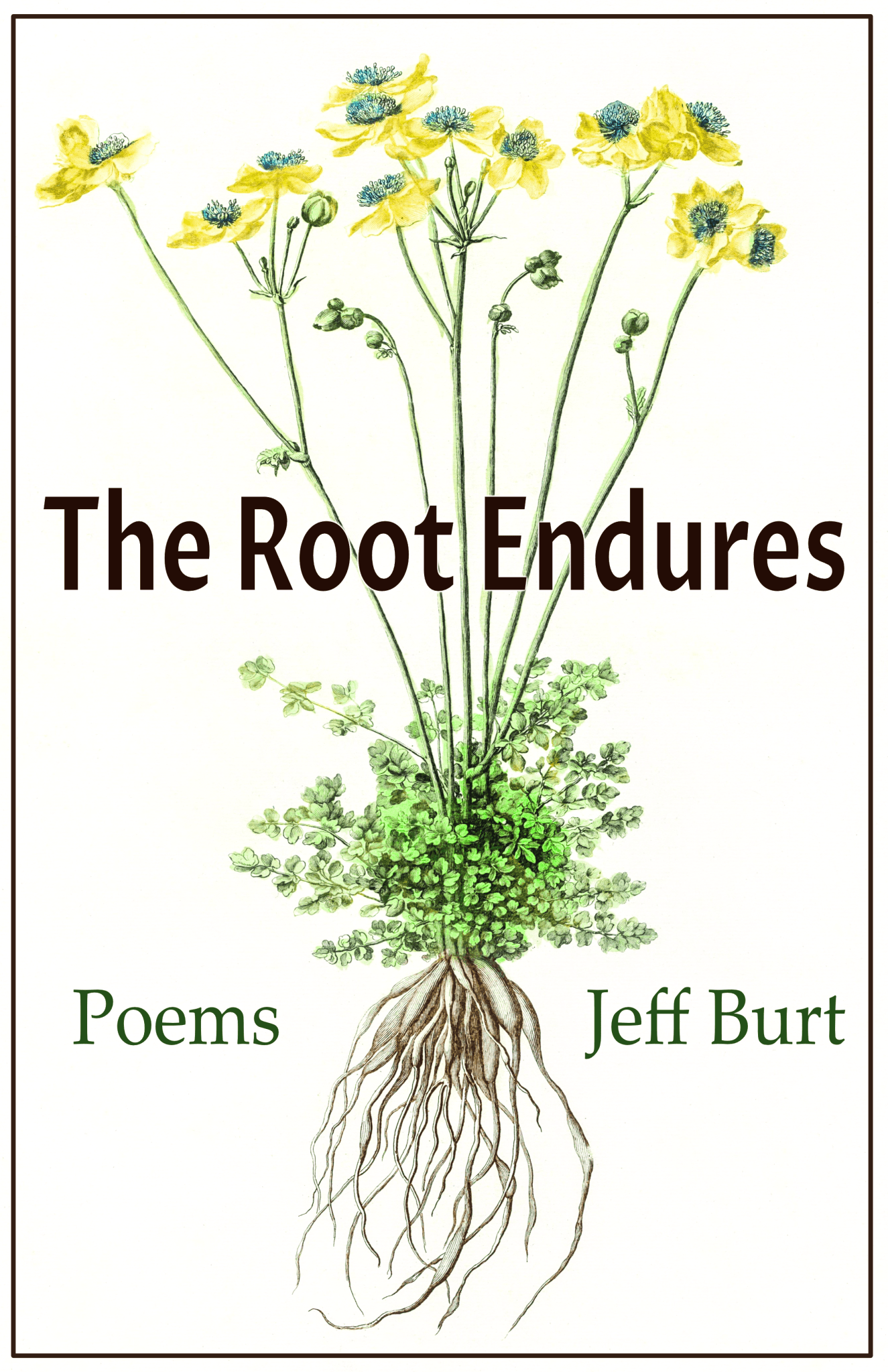
Actually, I read this book a week ago but decided to take a closer look so I could post about it, because I like it a lot. Jeff Burt’s poems contain nature-images and close observations of creatures, plants, and weather yet keep reminding the reader that there’s a decidedly human component here, an interior character who speculates about what human beings are doing here, thinking about, recalling. And how the world is constantly in flux. The rural Wisconsin of the speaker’s childhood feels vividly authentic, and I learned about lime bogs and de-tasseling corn. (I love it when I learn things from poems.) The book seems autobiographical in narrative but never becomes as specifically personal as a memoir would.

And frankly, I guess I might identify more deeply with this book than other, perhaps younger or more urban readers would. I grew up in the mid-Atlantic suburbs, but I spent all my childhood summers in the Midwestern small towns where my parents’ extended families lived. I infer that Burt is pretty much my peer, age-wise; some of his remembered details conjure up a kind of resonance I enjoy. What I’d like to learn from this collection is how to sustain a longer poem, which he does quite well. Not a strength of mine, though I’ve attempted it once or twice with some success. A poem that has numerous short stanzas and travels several pages needs to keep my attention, whether I’m reading it or writing it. Burt’s title poem (the last poem in the book) does this, as does the poem “As If Copper Wire Sang the Unleashing of Time” and “Into the Standing Grain.” Maybe studying writers like Jeff Burt and others can teach me how to write better medium-long poems when a longer poem seems necessary to whatever I’m trying to express. I don’t think I’m interested in writing really long poems–think A. R. Ammons, C. K. Williams, Robert Lowell–but I’d like to explore length a little more.

Whenever I read poetry, if I enjoy the work, I try to learn what the poet is doing that makes me like it. Sometimes it’s the perspective on a topic that surprises me, sometimes it’s the way the poet handles language or forms. Some writers have memorable phrasing or startling imagery, and some poets lift a lot of emotional weight with incredibly spare, condensed, or common words. Which is kind of amazing. Writers like Rebecca Elson, Martha Silano, and Tracy K. Smith create art out of physics and astronomy so that science enhances expression in new ways, or at any rate ways that are new to me. Tyehimba Jess’ Olio rocked my world with the possibilities of nonce forms, shape poems, historical narratives, and the ongoing tragedies oppression and racism have perpetrated.

I’ve always loved pondering and thinking (as a child, I was often accused of daydreaming but it isn’t the same), and poetry moves me into that happy space. Being curled up with a cat doesn’t hurt, either.
Widget

Grieving

I composed this poem during the pandemic not too long after my father died. It’s interesting how one responds to grief. The grieving man in this poem is not my dad; he died, I think, without too much weighing him down. He may have intended to live longer, but he was ready enough. I don’t think he had many regrets, and I know he felt loved.

And the grieving man is not my brother, though it could have been–he had a dog that was a great comfort to him while he mourned our dad, but I don’t think he was as gobsmacked with sorrow the way the person in this poem is; Dad’s death was not a surprise to us. The man in this poem isn’t symbolic, however, much as he may be a creature of my imagination. As the writer of this poem, I sense him as someone quite specific, whose loss was deep and perhaps unexpected–maybe a person whose loved one died from covid-19. A person who, like all of us, needs comfort and compassion; and I suppose this poem implies that the grieving man has someone, perhaps an adult child, who willingly extends that compassion in return: “lean your head/against his shoulder as you used to do/when you were small and aggrieved by/the world’s unfairness, and he sheltered you.”

A year or so later, I returned to the poem to do some revisions. Sheila-Na-Gig published it online and, much to my surprise, nominated it for a 2023 Pushcart Prize (a long shot, but an honor to be nominated). It’s my intention to include it in my next manuscript–the one I am working on now. I’m not holding my breath about when the next collection gets published; could be years. But I decided that this would be the poem to read for the Berks Bards 2024 poem-a-day project on BCTV this April. The link to my reading of this poem is here.

~

Grieving Man

Let him into your house, the grieving man,
blind, nearly, and so frail with sorrows
he cannot hear your comforting words
or move himself from room to room
without assistance. Give him
a careful bed, a friendly dog, a view
of mountains. Let yourselves open yourselves
to what he can give, hampered by limitations:
yours and his.

In a time of no touching, take his hand
in yours. In a time of isolation, lean your head
against his shoulder as you used to do
when you were small and aggrieved by
the world’s unfairness, and he sheltered you.
We turn about and find the unfamiliar.
When did he become the grieving man
and you sorrowful, in pain yourself, aghast
at the supermarket, the oil bill,
the nation?

He savors the soup you’ve made
and strokes the dog’s snow-dampened fur.
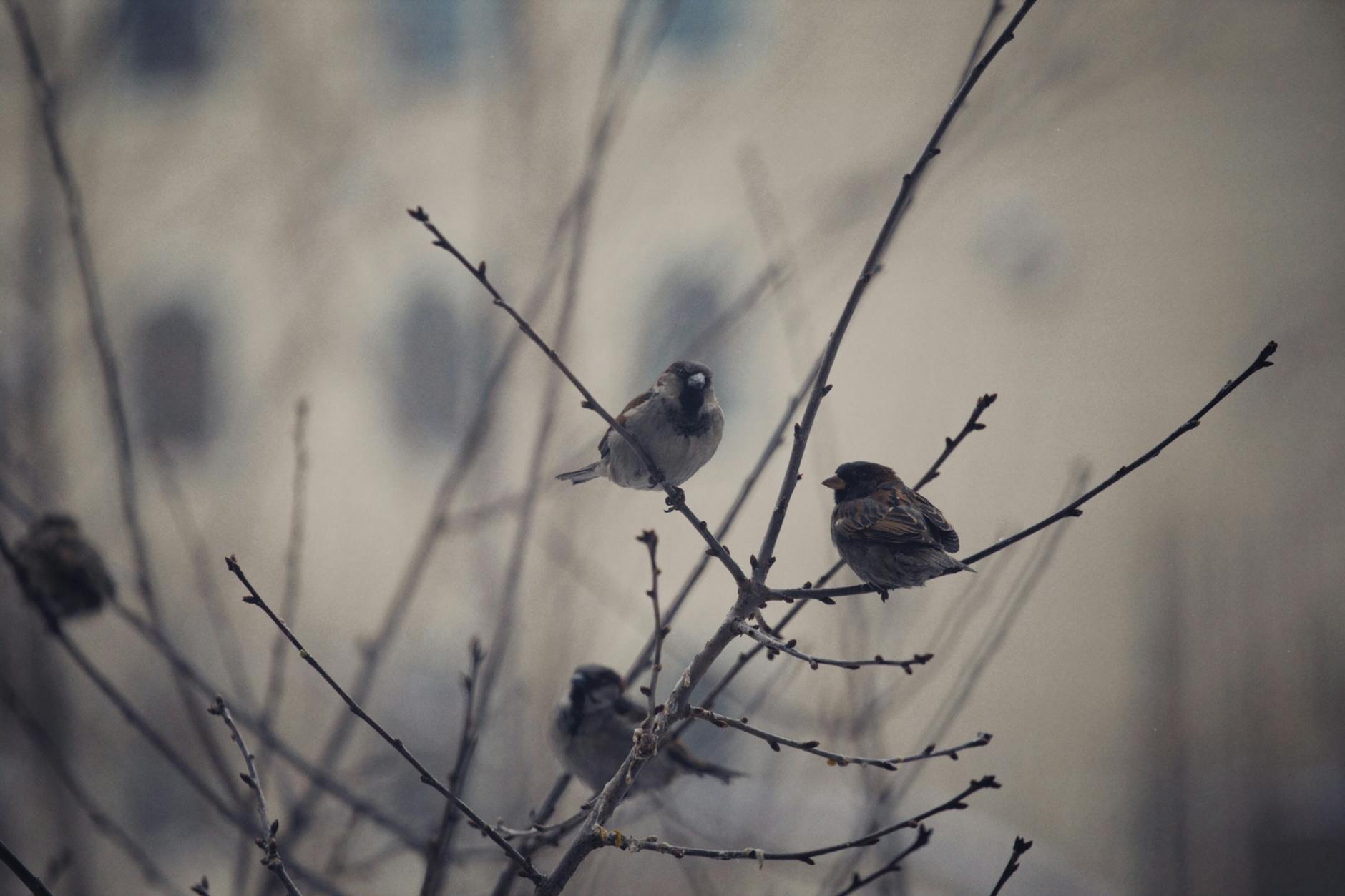
He asks whether the juncos still hop
on frost’s thin crust or if winter has
moved on north, a swath of crocuses
blooming in its wake. You rally your resources,
endeavor to describe the current moment
blind as you are and sorrowful, spreading seed
for the sparrows.

~


Photo by Alexey Demidov on Pexels.com

Local libraries

There are two local libraries near my house, and the campus library at the college where I used to work. And yet, until just a couple of months ago, they were rather underutilized by yours truly. I had developed into a bit of a book hoarder. I had enough disposable income to purchase books, and as a writer myself I felt an obligation to buy books–from the authors or their publishers when possible (some books are out of print and then…Amazon or ThriftBooks). Buying books helps to keep authors and publishers afloat. Win-win.

I’m now on a fixed income, however, and also have much more ‘free time’ because I have stopped working 40 hours a week. I can get to the libraries at ten a.m. and browse the stacks and ask for interlibrary loans. The first time I borrowed from the library in town, I received a receipt that said: “You checked out the following items,” followed by the due dates of each item, and then this cheerful little notice: “You saved $65.96 by using your public library!” Look at me, the savvy saver.

Maybe libraries have been doing this for awhile and I never noticed because I haven’t been using them. But I thought it was an amusing reminder. I guess it also serves to let people know they ought to donate money and books since, after all, they are saving so much by opting for the library. And so, while I slowly cull my own shelves for –er– “downsizing” purposes, I’ve been borrowing weekly from my free public libraries, one of so-called civilization’s greatest boons. I am sorry it took me so long to return to the safe and welcoming space of a public library.

ann e michael
The South Whitley Library as it was in 1967, with my grandmother in her Story Lady attire.

~

In most public libraries, the hardest books to locate are small-press poetry titles; but the campus library has a good selection of those and, as a former employee, I can drive over there when searching out poetry collections. This means that I will still purchase the occasional new or hard-to-locate poetry books by writers whose work I feel I simply must possess. It’s a big challenge to get over that hurdle of needing to own books, though. A series of full bookshelves feels somehow comforting to me. I’d much rather divest myself of clothing, shoes, jewelry, electronic devices, furniture, craft supplies, maybe even artwork or gardening tools, than part with my books…especially the poetry collections and the philosophy texts.

I’ll keep those for now. But I will also return this $65.96-worth of books to my local library and borrow another $66-worth of books in their place.

~ And in the happy news department, P.S. see below! The issue should be live soon. Amazingly, this is my third Pushcart nomination this year. The last time I was nominated for this annual prize was 1997. So, kinda gobsmacked…and grateful.