Writing act

Lately, I’ve been experimenting again with prose poems and with very short poems that are not quite tanka or haiku, but not much longer. Six to ten lines. Short lines. Then, the online journal Six Sentences got me intrigued about experimenting with that idea as a prompt–long sentences, short sentences, a mix of both–but only six sentences. I like playing around with words. I enjoy writing almost as much as I enjoy reading, and it’s fun to enjoy what I am doing these days, when so much else seems unenjoyable, sad, fraught, scary (another mass shooting, of children, today).

The garden offers comforts, too. Now we are in the harvest-and-rip-up phase as August nears its close. Lots of tomatoes, still a few green beans, plenty of butternut squash and sweet peppers and basil. It looks as though I will harvest a lot of hot peppers, too; although I only have one plant, it is robust and full of spicy peppers that will get hotter as they ripen. And the summer flowers, those glorious annuals, are lovely this year. We even have more butterflies than usual!

So many people have written about gardens, I sometimes find myself wondering what value there is in it, what could be political or artistic in a garden poem, what could make such a poem dangerous or antisocial. Why it is deemed necessary to yank NEA grants from poets, for example. What is it about the act of writing that makes us outliers? Can it be because any description or observation takes a perspective, possibly personal, possibly outside the norm, potentially widening another person’s viewpoint? And is that dangerous? (Perhaps.) Because a plant or animal or place name might evoke an event or person or symbolize something that might rock the boat–a sunflower for Ukraine, a bald eagle for the USA? Could that be risky? And might the interpretation be incorrect, but the writer assumed guilty of…whatever? (There is nothing new in any of this.)

Here’s a draft of a prose poem that came of my reflecting on such questions.

~~

The Act of Writing

only occurs when pen in hand meets paper, or the act is mere mechanics, pressing typewriter keys and imprinting page, or is virtual, encoded onto disk, on cloud encrypted, ephemeral, the act one of persona, a mood or dream, some moment observed, imagined, a recollection, a heart-stab, a shattered vase, anchors dragged along ocean floor, a plea, promise, letters never sent, a life of pain, a sworn compassion, or love that cannot otherwise be expressed, an argument for understanding. The act of writing rallies, rages, sets forth accusation or denial, sues for mercy, brays at nothing, pointlessly puts forth what’s known but long ignored, unacknowledged, unaccepted, an act political by proxy, being the kind of behavior those in power seek to suppress, who make the act of writing into reams of tedious fine print outlawing every fervent danger that clings to the very act of writing which is the practice of free and conflicted expression even when the reader sees only a description of deep scarlet bougainvillea arching over a poet’s unmarked grave in a landscape of olives and oleander.

~

Practice makes poetry

I’ve been challenging myself to write 7-line poems lately. Half-sonnets? Not necessarily. Just an exercise in writing a poem in brief. I have used haiku and tanka as brevity/image exercises in the past, and that work has been helpful. While I seldom write poems that are longer than, say, 30-35 lines, practice with conciseness never hurts, especially when my inclination is to go narrative.

I’m not knocking narrative poetry: I love it. Love reading it, love writing it–especially the lyrical narrative. In addition, I’m a big fan of the discursive and tangential in poems and essays (looking at you, Ross Gay). But one does tend to fall into familiar territory, and it’s useful to push away at what’s easy. That means, every now and again, trying something unusual: persona poem, aphorism poem, Spencerian sonnet, cadralor, surrealism, slant rhyme, golden shovel, or an invention of one’s own…something to freshen up the craft.

Many writers I know rely on prompts for imagery, language use, theme, or topic. For some reason, that sort of prompt seldom gets me really working in a new vein, though I can get a poem draft or two that way. Using a form, trying something new with how the words land on the page, is much harder to do (for me)–and therefore, more useful. I honestly want to feel as though I am working at poetry, doing the good and rewarding sort of work during which I learn new techniques and rediscover how craft can deepen meaning.

Real work takes practice. And real practice doesn’t actually lead to perfection. It leads to new explorations and revelations. There’s my wisdom-for-the-day to poets who are just starting out.

practice doesn’t make perfect…

Gratitude

Fountains of gratitude are flowing in my heart today despite the gray, humid weather that seems to set off every imaginable ache my body could have. ❤

Wow, that was a sentence of hyperbole and cliché, for which I apologize; let me begin again. I’m grateful for a number of reasons that I want to mention so I can give appropriate and public thanks to the people who have added to today’s happiness. The list starts with Dave Fry of Godfrey Daniels Coffeehouse & Listening Room in Bethlehem PA, who hosted an evening of poetry–with musical interludes and conversation–this past Wednesday evening. Two members of my long-time writers group and I read our poems and talked about a few poetic forms (haiku, waka/tanka, tanka prose, and short forms generally). Dave supplied some comments to encourage audience reflection and performed interludes on guitar. One observation he made is that the classic blues song follows a structure that has similarities to a short poem form: Line, Repeated line, Commentary line (often like a poem’s “turn”).

It was a lovely event and great to share the writerly camaraderie of a long & successful critique group onstage: Marilyn Hazelton and Susan Weaver are often the first readers of my own poems. I’m grateful for their support and for the way Dave gave us the opportunity showcase poems and maybe teach a few audience members new things about poetry. Another plus was that I sold a few books! Grateful to those folks, too. That’s one way to support the arts.

Thank you as well to my Best Beloved, who attended despite feeling a little lousy from allergies, and to those of my local friends who came out to hear us. The venue charges a cover, and not everyone’s willing to shell out for poetry. Therefore, I bow deeply to you all who do.

Today I also received a kind gesture from poet, scholar, educator, and blogger Lesley Wheeler. On her blog (which you really might want to follow), Lesley wrote a mini-review of my book The Red Queen Hypothesis and Other Poems, last summer. I’m thrilled that this week she included a mini-review of my brand-new book, Abundance/Diminishment (“ectoplasmic micro poetry reviews“). My book was in such good company! See the link above, between parentheses, for her comments on books by Diane Suess, January Gill O’Neill, Elizabeth Savage, and Jen Karetnick.

For promotional reasons, (ha!), I’ll close with what Lesley says about the collection:

“I have a similarly eerie sense of connection with a sympathetic mind reading Ann E. Michael’s Abundance/ Diminishment. This book tallies losses and bounties: it’s full of mathematical and scientific language, but what it counts and categorizes is deeply emotionally freighted. In ‘Filling Out Forms at the Gynecologist’s Office,’ she subtracts the number of her children from the number of times she’s been pregnant. In ‘Tongues,’ a child of six, mocked by classmates for the tongue sandwich in her lunchbox, prices out peanut butter–even as she loses her immigrant mother’s language. Also like Seuss’s book, this is poetry of maturity, from a time of life when a person has to begin giving it all away. I’m especially grateful, these days, for books from midlife and beyond. I learn what I need to know by reading them.”

I’m grateful, too, Lesley!

In which my dad appears

When does bereavement permit the writer to get back to the writing process? I have had quite a few conversations about this topic in the past few decades, and the answer’s pretty obviously “It depends.” I think of Donald Hall writing during Jane Kenyon’s illness and death and afterward–the stunning poems of Without. When my friend David Dunn died, I wrote immediately and often, sorrow emerging through elegies and remembrance. But I was younger then, and less experienced in the arena of bereavement.

During my mother-in-law’s two-year decline toward dying, I found myself writing about the challenges we faced–physical, emotional, communicational (that’s not a word, but I’m leaving it here all the same). Afterward, I could not/did not write. What interferes?

Why my thoughts turn this way: because, lately, my dad keeps turning up in my poem drafts.

I did not write much last year and did not submit any work.* For some reason, though I blogged and wrote long emails to friends and read many inspiring books, I did not feel particularly creative. But I wouldn’t have associated that semi-arid year with my father’s death; I figured my creative void was more about covid and an increase in chronic fatigue symptoms.

To jump start myself this year, I signed up for an online workshop (see this post). It has helped–I’ve drafted more poems in five weeks than I wrote in five months last year. But there’s been a peculiar outcome to these poems: despite widely differing prompts, source poems, and initial processes, my dad or something I connect with him appears in almost a third of the new drafts. I wonder what my subconscious is doing behind my day to day routine. Is this a response to bereavement, or a sign that I’ve accepted his death, or a reminder to self of what a huge loss it has been to me?

Not that I have a definitive answer to any of those questions. I do feel grateful for his appearance, though. He had a good sense of humor and loved to sing–nice things to have in a poem.

~

Thanks, Dad.

~

*Well, almost no work. Thanks to Marilyn Hazelton, editor of red lights tanka journal, I did submit tanka poems in 2021; and she accepted a few for this season’s edition (print only).

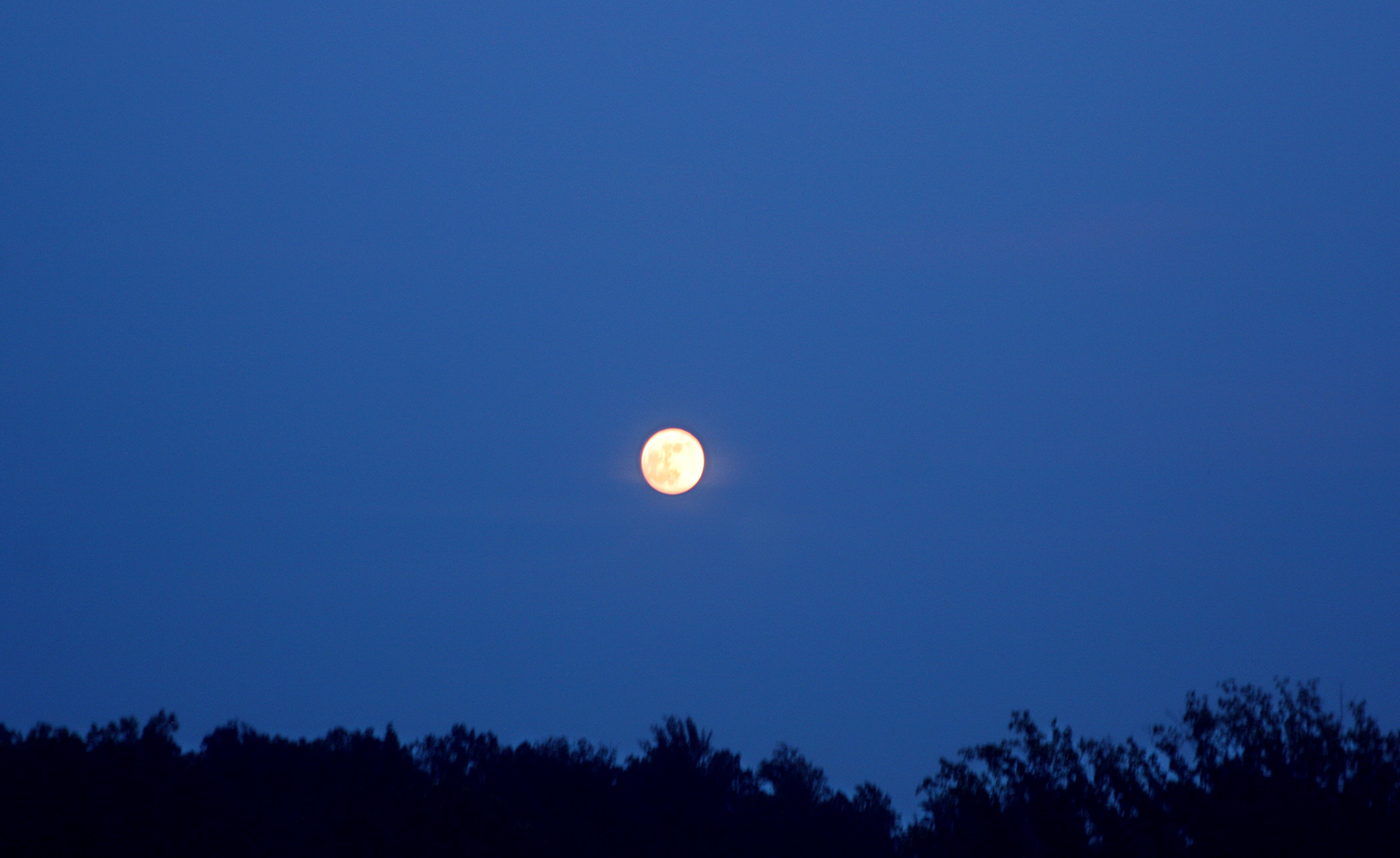
Moon

~

Full moon May

~

years ago
when the moon was full
I thought of much to wish for
tonight the moon
fulfills me

Short lines, few words

A friend has been sending me the occasional haiku she’s written; she says that the haiku form has kept her busy and creative during a time when her attention feels divided. I am reminded that, in the past, composing haiku has been a useful practice for me, as well–a method of retaining images and moments that might later prove useful in other types of poems..

My colleagues Dave Bonta, Michael Czarnecki, and Marilyn Hazelton, among others, find in haiku and tanka a wide range of possibilities for expression–and compression. Though I suppose that is true for any poetic form or strategy.

I just want to get writing again.

~

This morning I made some attempts at writing again. Writing poetry, I mean–different from my other acts of writing. Writing against frustration, grief, and absence and pain…obstacles, for me, to composition.

If I were a fiercer poet, a fiercer person, I might manage to write in media res, the midst of the goings-on; I might accomplish poems through my anger or sorrow. Instead, I have to wait it out, mull, observe, speculate. It’s just my natural modus operandi.

Maybe I’m lazy, or afraid.

~

No luck with haiku. I wrote a couple of mediocre tanka that might be salvageable once I work on them a bit.

I wrote this–no form, just words. Putting it out there for now, with an illustration. Not exactly haiga, not nearly luminous or complete.

Hey, Muse. This is all I got.

~

Introvert
 
Long-necked gourd
tangled in
its own vine
twists and curls.
There is something
fantastic in its nature,
imprinted in seed,
patterned and tendriled--
an urge to
turn
and flourish
hidden though it is
beneath broad leaves.


zucchino rampicante


Bittersweet

IMG_6549.JPG

These berry-laden vines are called oriental bittersweet–aptly named for this aggressive plant. Sweet because indeed, they are beautiful; but their introduction to the Americas has nearly wiped out American bittersweet and threatens trees because the vines are adept girdlers. They squeeze trunks as trees grow, sometimes killing the tree.

I should remove them from my hedgerows, but I haven’t the energy. Look at this link for the challenges involved. My lack of intervention probably falls under the category of deferred maintenance, and has led to a sense of plaintiveness, perhaps, and to these drafts of tanka poems on this late November day.

~

the leafless hedgerow
studded with red berries
each wintry morning
my walk’s accompanied
by bittersweet

~
how dull gold husks
open to red fruit
how such slender vines
grow to strangle trees
–bittersweet

~

an old cliché
take the bitter with the sweet
older now myself
I try balancing
life’s flavors


Tanka

The second day of my daily poem challenge won’t give me much time to compose. A tanka poem may be in order.

These 5-line poems pose considerable constraints on the writer and, in my experience trying to write them, require frequent revision to get the moment vivid enough. So this one will be a rough draft. An experienced tanka poet may be able to compose tanka rapidly; my attempts usually need eight or ten revisions…well, here goes.

~
Past midnight, silence
4 am, flying squirrels chirp–
maple buds redden at dawn

how sleep eludes
those who mourn

~


Other poets working on daily-writing include Michael Czarnecki of FootHills Publishing, who posts a daily poem (usually haiku) on his Facebook page here.

paintdaub copy


Resting

Taking a breather. Pausing along the path.

sit-up-poetry-art


This poem is thanks to Michael McClintock.

In defense of “is”

Contemporary poetry favors compression–perhaps all poetry employs that approach, condensing out of prose whatever has most vitality in terms of imagery, metaphor, emotion. Symbols, metaphors, actions, neologisms, wordplay, rhythm, whatever gets us to the kernel of the poem. My cultural inspiration began among biblical and metaphysical poems, however, and popular song lyrics (the lyrical narrative). Only later did I stumble upon the influences of Eastern poetic strategies, haiku and tanka, the Imagists, and the vividly imposing demand that writers of all kind, but especially poets, should avoid the “to be” verbs.

How would philosophy–or Hamlet–manage without to be? How shall a writer whose work often deals with the quandaries and paradoxes of being (namely: life, death) compose avoiding those verbs, verbs of existence? Existence has active components to it, to my way of thinking; and some of us need the to-be verbs, with all their various conjugations, to express the more inexpressible activity of being-ness.

During my long years of writing and of having my writing critiqued, I’ve been advised more than once to watch my verbs. I recognize the stylistic impulse and agree that too much to be, too much is, was, or has been, can slow or decompress a poem.

Sometimes, exactly what the poet intends to do.

Other times, exactly what the colloquially convincing narrator or character would say.

A time and a place for every verb.

~

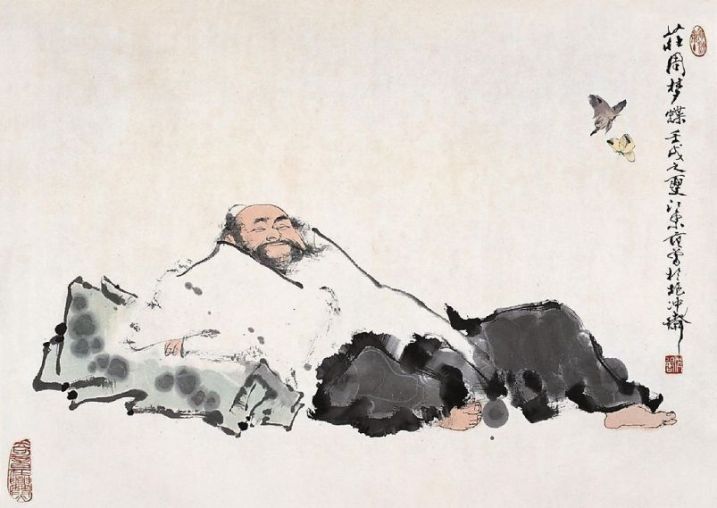
Zhuangzi:zhuangzi

“There is a beginning. There is a not yet beginning to be a beginning. There is a not yet beginning to be a not yet beginning to be a beginning. There is being. There is nonbeing. There is a not yet beginning to be nonbeing. Suddenly there is being and nonbeing. But between this being and nonbeing, I don’t really know which is being and which is nonbeing. Now I have just said something. But I don’t know whether what I have said has really said something or whether it hasn’t said something.” (Watson, trans.)

~

I wrote this post not as an encomium for the to-be verbs but as a suggestion that they exist for good reason and possess action in their compressed sayability, that to be does not sidestep to mean. I defend “is” and its siblings. The important thing? Use them well.

8ec3e3e95af7bcd79ca688e7e26076e7--lines-quotes-william-shakespeare