Relationships, resistance, AWP

This year’s Association of Writers & Writing Programs Conference vibrated with emotional content, resistance, persistence, and truths through facts and lived experiences–a host of perspectives and a sense of excitement enhanced by the host city: Washington, D.C., where the recent transition to a new government administration has been controversial, particularly among citizens who value social justice, education, the environment, and the arts. Some citizens feel that they are themselves outsiders, outliers, critical observers of the social norm, square pegs, immigrants, misfits, name your descriptor here:_______.

Maybe no surprise, but many of those who are not-quite-the-social-norm also happen to be writers.Adversaries 1

About 15,000 writers, teachers of writing, publishers of writing, promoters of writing, and lovers of writing showed up in D.C.; and I’m guessing a very large percentage of us feel we have, in one way or another, a little trouble “fitting in” with society and social expectations. We happen to write, also. What gives good writing its jazz is that there are zillions of fascinating, off-beat, marvelously creative perspectives a human being can write on just about anything.

One sense that came through to me as I listened to authors and teachers is that writing is almost automatically resistance. Resistance usually connotes against, as against a “negative” behavior, objective, rule, law, or person, for example. We can resist silence, though, and silence on its own is not negative; it is only something to resist in relation to an event or law that might be better spoken about. We write in relation to, and often that looks like against. But it isn’t that black and white (of course). Even when the ink is near-black and the page is near-white and the resistance feels like “writer’s block”–resisting the very act of revealing, speaking, communication.

Relation makes resistance and writing happen. Relationships make community and communication develop. Relationships connect the virtual world, and relationships link the long-dead writer to the living reader in a quiet room or on a crowded train.

~

This past week, thousands of (largely introverted) writers convened in a convention center in the nation’s Capitol; several square blocks hummed with interconnections that spanned far beyond those city streets, those bland conventional multi-storied buildings…into the social world and social media, into the range of the arts, the hearts of fellow human beings. The crowds could be overwhelming, but the energy was palpable and exciting (even to this introvert, who did need to retreat from the throngs now and then–thank goodness for “quiet lounges” and hotel rooms).

Did I mention the slightly off-the-cuff passion and stirring intensity of Azar Nafisi‘s speech, and the resonant coincidence of how relevant it was to have a naturalized American citizen, born and educated in Iran, as a keynote speaker? [The decision to have her speak was made over a year in advance of the conference.] Did I mention the honest and often amusing conversation between Ta-Nehisi Coates and Chimamanda Adichie, who is a dynamic one-person cultural ambassador, much as Nafisi is? What about poet Terrance Hayes‘ brilliant alliterative rhythmic sonnets that were sometimes-brutal take-downs of a president whose motives and values he mightily questions? Did I mention Rita Dove‘s transcendent reading? My discovery of a hugely famous Pakistani writer, Intizar Husain? Marvelous writing on The Body Electric, in three excellent essays–why, yes, I could say more, but I’m tired now and “still processing,” and post-conference life resumes…

~

Given some long-running, almost chronic adversity the beloveds and I are facing, before I close I want to give a thumbs-up to Emily McDowell. Emily McDowell’s line of Empathy Cards are really worth looking at when you have no words.

Sometimes, there isn’t a card for that.

What is American?

I have been setting up new training for the students I hire as writing tutors. My tutors are terrific students who understand coaching, modeling academic writing behaviors, and conventional essay structure better, often, than correct use of commas. Anyone can eventually figure out commas, though–that’s not the best use of a student’s time in a tutoring session. Writing tutoring works best when the tutor and student engage in understanding the assignment and the reading and then, mutually, figure out the most appropriate means of expressing the student’s stance and response. Only the final draft needs a bit of window-dressing for academic correctness, though that certainly is important…more important to some instructors than it is to others, and more important to some students than it is to others!

What I’ve lately come to recognize is that my tutors need a little more guidance in how to assist non-native-English-speakers. The need is not merely pedagogical–such as how to coach someone in the correct use of articles or of adjective-noun word order or verb agreement. The need is also cultural: my tutors should possess an awareness of cultural and ethnic variations in background that make content-reading, prompt-interpretation, and the structure of essay-writing far more complex than they may realize.

The college at which I work is small, religious-based, suburban, regional, and only recently multi-ethnic. My tutors tend to be from fairly privileged high schools and are, after all, quite young (undergraduate sophomores, juniors, and seniors, the oldest among them is only 22). I’m continually impressed by their willingness to expand their horizons–many of them have taken semesters or mission trips abroad, for example. Several of them have asked me for advice on how to conduct tutoring sessions with “ESL” students. Hence, some training is in order.

~

I encounter this new generation of students in my office, as well; and recently, one of them asked me what she could do to “become American more quickly.” She has been in the US for two years, and she does not know what to read or what to watch to guide her more rapidly into American culture other than self-help books, popular TV, and internet sites, which she finds unfathomable and uninteresting: Everyone speaks too quickly. She misses all the allusions. The material seems shallow and risqué.

Reasonable conclusions on her part. She is bright and observant.

My feeling is that cultural appropriation is American culture, and vice versa, but that notion is a bit theoretical for the writing center. One has to start somewhere, so what path can I show her? She is so eager, yearning written all over her face and her posture–and so full of questions that in her naivete she believes I can answer.

My tutors and I need to recognize ourselves as cultural informants§, and to proceed to assist students to write as clearly in US/American-English as possible while respecting the diverse knowledge and cultural differences we are liable to encounter more frequently as our institution becomes more open and diverse–a welcome diversity that will change and enhance the college mission.

My tutee’s earnest question has primed my thinking–what is “American”? Every time we converse with a student, we are inadvertently cultural ambassadors; we represent the culture that we unwittingly just are. So now, as we help at the sentence level, we ought also to think about who it is we are and what we can do to help newcomers to acclimate.

How? I believe the students we tutor will offer the best and brightest assistance in that direction.

~

§ See Staben & Nordhaus, “Looking at the Whole Text”

Writers. Groups.

Untitled-writerCreative writers, who are often solitary creatures given the kind of work we do, nonetheless must communicate with the wider world: that is, after all, the purpose of poetry. It is a form of artistic communication using words as medium. I do not know much about the (possibly long?) history of writers offering feedback, critique, encouragement or collaboration with one another aside from the more well-known spats and criticisms of Some Famous Authors. I do know that during the 20th century, evolving from artistic and literary salons of the 1800s, there arose the idea of writers’ groups and writers’ retreats, seminars, getaways, workshops…culminating in the MFA program, I suppose. Despite the popularity of the concept, I have had people ask me about writers’ groups and whether or not I recommend joining one.

First, I think we must ask: What is the purpose of a writers’ group? What do writers gain by meeting regularly and discussing their work, sharing their drafts, listening to feedback, and offering one another advice on publishing or goals or career moves? Is the writing group a place for jealousies and competition, or an environment of encouragement and networking? A bit of both? Is it good for friendships? Is it useful?

Then, we can ask: For how long can one expect a writers’ group to run? Months? Years? Decades? And how committed to the group is it necessary for members to be; and what number of members works best? How does it work, assuming that it does benefit the members? What happens if someone gets hurt, or angry, at the group or at a member in the group?

And where do we put the apostrophe? Writers’ group, or writer’s group? Or do we ignore the apostrophe? (Sorry. Had to make a punctuation observation.)

Full disclosure: I have been a member of writers’ groups for most of my writing life. I joined my first group in 1980 in Brooklyn, NY. I joined a loose coalition of poets when I moved to Philadelphia and some of us met for critique, though mostly we participated in readings. When I moved to my current region, I was invited to a feminist writers group; my spouse and I purchased our first house from one of the member poets! After that, I was invited to two other groups. One of the groups “clicked” for me. I have met with this core group of poets and writers for nearly 25 years now, and the experience has changed me.

The artistic question here is: Has the experienced changed my work for the better?

The personal question is: Have I benefited from the experience?

bookmkheartleaf

Redbud leaf in fall

I could perhaps write a book on these questions, but I am far too lazy. As to whether my work is better because of the discussion and critique, I’m pretty sure the answer is yes. Even though my colleagues are not famous writers, they are excellent and thoughtful readers–and that is what one most requires from this sort of group. If you want to improve your writing, you must have readers who can tell you whether or not they “get” your work.

Or make you reflect carefully upon why it is they don’t.

Have I benefited personally? That one is an easy and certain yes. I have a community, a very small community, devoted to creative writing and willing to read and think about that sort of work. I have learned–from their writing itself and from our discussions surrounding ideas pertinent to the process of writing and revision–much about their daily lives, backgrounds and fears and hopes, their cultures and their passions, their careers, their health, their homes (in which we meet). We have shared recommendations on which books to read, which poets to learn more about. Often, we disagree. Without conflicting opinions, no forward momentum. We are passionate, we are gentle, we are probing. Sometimes we probe too deeply. We learn to back off when necessary. We also embrace.

During 25 years, there have been serious losses, real tragedies, that our members have lived through, written about, survived. Such strength. Such humility. Such proof of the ways art can help people to express to others that in their grief they are not alone. That in their love and in their confusion they are not alone. That others feel the weird varieties of joy, the ambiguous sensations, the coincidences, the empty hours, the gladness in small things that human beings experience.

And also…might you consider a different line break here? It might heighten the punch of that phrase, and function as stronger alliteration in the following line.

Just a suggestion.  😉


Growing, watching

Garden update: my valley experiences, once again, a bit of drought.

And I have scored a victory–possibly temporary–against the bunnies, thanks to some very hard, hot work by a pair of my best beloveds and lots of chicken wire. Now, as the weather gets into long spates of heat and humidity, I watch and wait while the garden does its growing.

I watch the tomatoes ripen. I watch the birds:

IMG_2310

Three swallows among the tomatoes

The bluebirds enjoy perching on the fenceposts. This one doesn’t look too blue, but I promise it is a bluebird.

IMG_2312

I guess I need a longer lens.

I watch the herbs and vegetables flower. The cilantro and dill flowers bring all kinds of pollinators to the garden. I found a new kind of very tiny bee this morning, but my camera doesn’t have the best close-up lens. It was a cute bee, very small, grey, and fuzzy.

IMG_2309

The borage gets a bit thuggish but attracts pollinators; cilantro and dill manage to sow themselves among the onion rows.

The beans rows are missing, because the rabbits ate them all.

~

Speaking of bees and pollinators in general, I have found some lovely blogs by entomologists online, full of close-up photos, environmental information, and fascinating tidbits about bugs and their interactions with the flora and fauna that surrounds them. I am continually struck by the amazing interconnectedness of life when I read these posts. In addition, something about the sort of scientists who observe insects at close range and study their anatomy and life cycles seems to inspire a kind of geeky humor as they follow their biology passion into the field. Or maybe that quality exists only among the sort of entomologists who also blog!

Here’s one I like, Standing Out in My Field, the nature of a punny field biologist.

Possibly I should have followed my own third-grade dream of becoming “a scientist.” My tendency to watch things, especially as they grow–to be an observer–would have served me well in a scientific field discipline. Though it isn’t a bad quality for a writer to possess, either.

Writing process? Got that. Sort of.

Last year, I was invited into a blog-go-round for writers (see this post). Many thanks to Lesley Wheeler for tapping me for this 2014 blog tour on “the writing process.” I read Wheeler’s 2010 book Heterotopia and was wowed; she’s also the author of  The Receptionist and Other Tales, Heathen, Voicing American Poetry: Sound and Performance from the 1920′s to the Present  and other work. With Moira Richards, Rosemary Starace, and other members of a dedicated collective, she coedited Letters to the World: Poems from the Wom-po Listserv (Red Hen, 2008). We got introduced virtually via the Wom-po listserv.

Lesley is a formidable scholar and critic who writes a wise and witty blog, which you’ll find linked to her answers in the paragraph below this one. Now the Henry S. Fox Professor of English at Washington and Lee University, Wheeler has held fellowships from the Fulbright Foundation, the National Endowment for the Humanities, the Virginia Commission for the Arts, and the American Association of University Women. Wheeler received her BA from Rutgers College, summa cum laude, and her PhD in English from Princeton University. Despite all these amazing academic chops, which could appear intimidating, Lesley strikes me as approachable, generously interested in the wide world (not just ivory towers), and funny.

Click here for her answers to the prescribed questions. Below are my own.

~water-rites_cover

1)     What am I working on?

I have a completed manuscript that I sent out last year, The Red Queen Hypothesis; but I have had a change of heart about it. I am revising it completely. It’s a major renovation, because as I revisited the not-yet-book I found myself re-thinking the purpose of the collected poems. I had originally conceived the manuscript as an experiment in nonce forms, with a biological theme threading the poems together. As I re-read my work, I realized that my thinking, my purpose, for the poems has altered. Let’s just say some major life changes have been underway in the background of my creative efforts, and the influences made themselves felt. The book as originally imagined turns out not to be the book I want to write.

So, what I’m working on this year turns out to be what I was working on last year, only re-envisioned. I did complete (I think!) a collection of poems centering on adolescent girls of the 1970s that is a sort of a girls’-eyes-view of Bruce Springsteen songs–it’s called Barefoot Girls.  I’ll be sending that out to find a publisher.

Meanwhile, I am writing new work which, alas, seems to be rather dark–if you happen to consider poems about mortality to be dark.

2)     How does my work differ from others of its genre?

I would love to say that my poetry is wildly original in approach or style, but it isn’t. If you were to categorize my work as “eco-poetry,” it would be different from the genre because of a quieter rhetoric. If you were to call my poetry “nature poetry,” it would not fit quite comfortably into the genre because of its trending toward the intellectual. My poetry is usually “accessible,” but I don’t eschew the multisyllabic latinate vocabulary at all costs, and my allusions are often a bit arcane. I like form and classic poetic strategies, but I also like to break rules, and I adore free verse and prose poems. What did Stevens say? “All poetry is experimental poetry.” Yes. That.

3)     Why do I write what I do?

Journals, because of Harriet the Spy when I was 10, and ever since. Harriet_the_Spy_(book)_cover

Blogs, to practice the less emotional, more inquisitive side of myself and because I’m an autodidact.

Essays and criticism or reviews, because writing that type of work requires skills my brain needs to exercise in order to do other things, such as be an educator; and because I love to read and think about what I’m reading.

Libretti, because colleagues asked, and new things are compelling to attempt.

Poetry, because I can’t do without it.

4)     How does your writing process work?

Interesting question at this time, as I feel the way I go about writing is changing after many years of pretty solid operational process. It may be that I am getting older or because see above: significant life changes.

One thing hasn’t changed, and that is the need for a certain kind of solitude. Distractions aren’t in and of themselves anathema to my writing process, but the distractions need to be of a non-urgent kind. I don’t mind being distracted by a broad-winged hawk overhead or a siren in the distance or an overheard conversation, but sometimes even a loved one’s “Hello, I’m back from the grocery store!” shifts my focus irrevocably.

[aside: My loved ones do not really understand this effect.]

The way I begin a poem is akin to how I’ve heard mindfulness described. I allow myself to be relatively vacant, and something drops in to fill the moment. I assure you this is nothing like a bolt of inspiration from the blue; and usually all I get is a phrase, a metaphor, an image, an aphorism. But it’s a start. From there, the process is about association, relationships, combinations, experiment, and a certain amount of loopy freedom to write a bad poem if that’s what emerges.

Then, I pause. The draft sits there for days (weeks, months, years) until I decide to start revising poems, which I tend to attack in batches. That’s one thing I do differently these days: revise in bunches the way I did back in graduate school under a time crunch. What I currently notice changing, too, is the way that I enter emptiness. In years past, my favored way was to take a walk or to work in the garden. Physical issues have to some degree limited the amount of time I can spend doing those activities, and finding an acceptable substitute has been hard. I am muddling through, waiting to see what works best.

~

Next up, April Lindner and Zara Raab. They should have their writing process blog posts up sometime in the next 7-10 days; and I am excited to learn what approaches each of them takes.

April Lindner is the author of three Young Adult novels: Catherine, a modernization of Wuthering Heights; Jane, an update of Jane Eyre; and Love, Lucy, a retelling of E. M. Forster’s A Room With a View, forthcoming in early 2015 from Poppy.  She also has published two poetry collections, Skin and This Bed Our Bodies Shaped.  With R. S. Gwynn, she co-edited the anthology Contemporary American Poetry for Longman’s Penguin Pocket Academic series.  April lives near Philadelphia with her husband and sons.

Zara Raab’s latest book is Fracas & Asylum. Earlier books are Swimming the Eel and The Book of Gretel, narrative poems of the remote Lost Coast of Northern California in an earlier time. Her poems, essays and reviews appear in River Styx, West Branch, Arts & Letters, Crab Orchard Review, and The Dark Horse. She is a contributing editor to Poetry Flash and The Redwood Coast ReviewRumpelstiltskin, or What’s in a Name?  was a finalist for the Dana Award. She lives near the San Francisco Bay.

Studio. Space.

Contemporary artist and blogger Deborah Barlow writes: “A studio, like a womb, is a vesseled space, a geolocation from which one’s work, intentionally free of its context, can emerge.” http://www.slowmuse.com/2013/11/25/up-stairs-in-sight/

In another recent post, she talks about artists’ decisions about whether or not to offer studio tours, and art critics’ decisions about whether or not to visit studios. The critics she mentions (Saltz and Smith) prefer not to see the studios of artists whose work they are reviewing. The sense I get is that the critic needs more objectivity–a disinterestedness–and that a working artist’s studio is a personal space, one through which perhaps the critic might learn too much (context? biography? vulnerability? …one wonders).

I wrote my graduate thesis on how time works in poems, and for a long time I considered writing a followup on space in the poem, particularly the kind of vesseled, nested, interior space to which Barlow alludes (and Bachelard, in The Poetics of Space).

What spaces are conducive to the creative process? Such variety! I have friends who love to write in diner booths or cafes, and others who need complete silence, no distraction (Annie Dillard wrote in a closet; Robert Frost in a shed). One writer I know must be in bed to write. Another must be outdoors. The place matters to many people–but not to all of them.

Writing’s different from painting, sculpting–arts that require at least a few tools at hand.

But some of my writing friends need a computer, or a candle; a pencil and a legal pad, or a fountain pen and a spiral notebook; a bookshelf; darkness; classical music, or the blues.

I don’t really have a studio these days. Maybe it is time I lent my mind to carving out a creative space? –Somewhere nestled, vesseled, interior: (A Room of Her Own).

Below: A location…space, intentionally free of context.  🙂

IMG_0252

Depression & the creative process

I was recently chatting with a psychiatrist about the creative process, specifically among poets. He admitted that he doesn’t know much about poetry, but I was nevertheless surprised to learn that he believed the stereotype of the poet who works most creatively when depressed.

“You deal with depressed people all the time,” I said. “Do they strike you as particularly motivated to do anything creative?”

He admitted that one hallmark of depression is loss of motivation–to do anything, let alone create expressive art of any kind. So it would follow, I suggested, that a period in which a person is seriously working at what he or she loves would be unlikely to coincide with a full-blown depressive episode.

“What about those poets who write about, say, staring out a window and sadness,” he asked, “They seem to write about being depressed, to express the feelings of depression.”

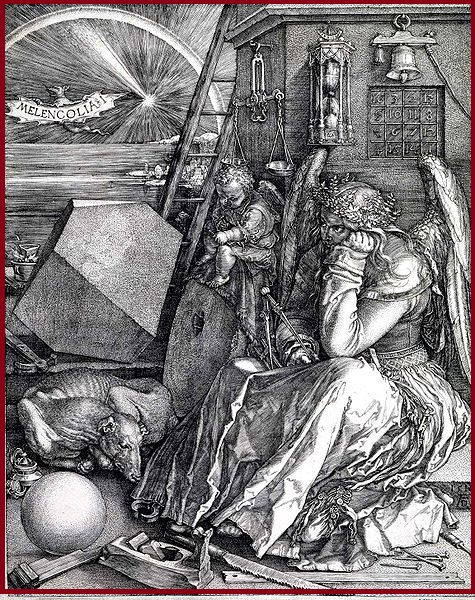
True, some poets experience depression (some commit suicide, too); and some express those feelings in verse. Yet none of the working writers I know who struggle with forms of depression write while in the midst of the “black mood.” They can only write well when the mood has not seized them fully; and while they may try to convey those feelings of the ‘inexpressible,’ they write and especially, revise, the work during more productive hours when melancholia has tapered a bit.

Melencolia_I_(Durero)

Drurer’s Melencolia I (wiki images)

It takes concentration, creativity, and analysis to craft a poem that adequately means what depression feels like. You cannot access such things when you are truly depressed. Some writers want to portray the experience; others want to explain it; still others prefer to write about the desire to escape, or even to embrace, the melancholy; others simply relate what they observe. Trying to pigeonhole all writers who address despair defies reason and suggests that all writers undergo the same feelings and experiences. Excuse me, we are individuals–diversely, wildly, enthusiastically unique.

That said, I cannot make the claim that no one has ever created a great work of art or poem while in the midst of a clinical depression; I merely posit that it’s likely that poetry composed while the author is gripped by existential melancholy will not meet the poet’s own standards.

Lewis Wolpert, a biologist and author, says, “I claim that if you can truly describe what it is like, then you have not had a true depression. It’s an illusion, and completely unlike anything else. When you are immersed in it, you enter a world without reference points, so once you recover it is very hard to relate how you felt.”

A world without reference points–that is the attraction depression might hold for a writer: the creative summons to relate an experience that is essentially beyond description. But most writers are not able to answer that summons while in the depths themselves.

And many writers are not troubled by depression at all. [See this 2012 article from the UK’s Mental Health Foundation for essential insight and clarification of an earlier study–that abstract is here.] The studies do suggest that writers are more likely than the general population to have bipolar disorder, which makes a kind of sense to me: after the sinkhole of a depressive period, the active “manic” phase might permit a writer to accomplish a great deal, including possibly a description of the void. Or it might not.

At any rate, I hope that people–psychiatrists, for example!–eventually recognize that we should not stereotype artists and poets any more than we should stereotype people who have mental illnesses, different accents, or skin color that is dissimilar to our own. What makes artists “different from other people” remains a mystery despite years of research and speculation, and my gut feeling is that the difference has more to do with other aspects of the creative process than it does with depression of any stripe.

“Next Big Thing”

A friend & colleague-in-poetry, April Lindner, has invited me to participate in the round-robin writing blog event (termed a “blog hop”) called “The Next Big Thing.” Thanks to Molly Spencer for coordinating this web-event, which has been going awhile, so she is no longer curating it as actively. At the end of this post, I’m linking my readers to a handful of other participants. From their sites, you can locate others…and so on! We hope to foster discovery of writers our own blog followers–or random visitors–are not yet familiar with, and to spur readership in general. I love to read, and I have a mission to introduce more people to reading, to poetry, and to contemporary artists–especially word-artists. Therefore, I’m thrilled to be asked to add my 2¢ to The Next Big Thing…even though some of the formulated “interview questions” lend themselves more to fiction writers than to poets. Some of the answers may end up sounding a bit far-fetched, or simply silly.

But poets do possess senses of humor, folks. We are not all depressive garret-dwelling introverted cynics. [Ha!]

~

Now to commence with the interview questions:

What is the working title of your next book (or story, or project)?

I have two. One manuscript is finished, and I am seeking a publisher–that one is titled The Red Queen Hypothesis. The work-in-progress is tentatively called Barefoot Girls.

Where did the idea come from for the book?

imagesThe Red Queen Hypothesis seems to be culled from a bunch of my poems musing on science. I love science because it is so weird, much odder than so-called real life. Also, the nomenclature…I swoon over those latinates, Greek roots, and things-named-after-other-things. Here’s the biological definition of the Red Queen Hypothesis from Wikipedia: “an evolutionary hypothesis which proposes that organisms must constantly adapt, evolve, and proliferate not merely to gain reproductive advantage, but also simply to survive while pitted against ever-evolving opposing organisms in an ever-changing environment.” As Alice and the Red Queen are hurriedly running through the chessboard of Wonderland in Through the Looking-Glass, the Queen remarks, “Now, here, you see, it takes all the running you can do, to keep in the same place.” Don’t we often feel that way?

PBS has a good little article on it here, for those who want to learn a little science with their poetry.

Barefoot Girls evolves as I revise. As of now, the poems are memoir-based about being a teenaged girl in New Jersey, and many of them allude to Bruce Springsteen songs. The collection is, I suppose, lyrical narrative in style. Mostly free verse but with some ballad-type pieces and even a sonnet or two. I may have some trouble getting that manuscript into print because I have to get Springsteen’s permission to use a couple of epigraphs. God knows how long that will take–or if it is even possible!

What genre does your book fall under? Poetry. No other genre need apply.

Which actors would you choose to play your characters in a movie rendition?  

I would love to have Gary Cooper or Barbara Stanwyck play characters in my poems, which makes about as much sense–since they are dead–as making a movie of a poetry collection.

What is the one-sentence synopsis of your book?   

Life, love, family, environment, death, memory, animals, youth, curiosity, god.

Will your book be self-published or represented by an agency?

1) No.

And 2) –you have got to be kidding! Literary agents in the USA generally avoid poets as though we harbor west Nile virus.

How long did it take you to write the first draft of your manuscript?

Four years, generally, though some individual poems evolve more slowly. My first full-length collection, Water-Rites, took much longer…closer to ten years.

Who or what inspired you to write this book?

Ah, the “inspiration” question. I have a deep indifference to the question of inspiration. I suggest you read other writers on this topic.

What else about your book might pique the reader’s interest?

The Red Queen Hypothesis includes numerous poems that employ formal strategies, as well as plenty of nonce forms; I think of them as experiments, the way scientists frame their work though experiment.There are also philosophical undertones. It is a book of questions that are scientific, speculative, spiritual and philosophical. Barefoot Girls, the project in process, also poses questions–but of a different kind. More social and gender-related questions, more coming-of-age curiosity. The fact that these poetry pursuits came one after the other intrigues me since they seem in many ways fairly unrelated. Perhaps I will discover the relationship as I continue to revise Barefoot Girls.

Meanwhile, if anyone can suggest a publisher for RQH, I’m all ears!

Who are you tagging for The Next Big Thing?

~As The Next Big Thing is on hiatus, I suggest my readers browse for it or follow the links below that will lead to other links & literary discoveries!!

Here are some other Next Big Thing posts:

http://boysinger.wordpress.com/2013/02/24/the-next-big-thing/

AWP conference 2013

I am heading up to Boston next week with about nine thousand other writers, writer-educators, writer-publishers, academics, and business people. The annual Associated Writing Programs conference will be in session March 6-10. I posted about the conference briefly last year...and last year’s conference introduced me to Brian Boyd’s work on cognition and storytelling. So I am hopeful that this year’s programs and panels will prove equally enlightening.

The conference offers a chance to meet or at least hear some of my favorite writers and to talk with interesting colleagues. Best of all, there are thousands upon thousands of books and literary magazines to browse. If I feel shy, I can interact with books at the Bookfair and “meet” my fellow writers through their polished texts instead of face-to-face (or body-to-body in the packed bar). The main problem with any event of this kind is the lack of places for introverts to regain equilibrium. At AWP, there are quite a few introverts; and people tend to claim a spot by a window, balcony, or corner somewhere in the conference area and send out “don’t disturb me, I’m recharging” body-language signals. Or they eat alone in the restaurant without looking too uncomfortable about the status of solo diner.

Writers understand.

~

Lori A. May offers her insights on the conference here, with a focus on people who are considering graduate school programs. I will be participating in a panel on that topic: the Low-Residency MFA. My main interests, however, remain bibliophile-oriented: discovering poets whose work I haven’t encountered before, finding new books by favorite poets, learning who is editing which long-running journals, and finding new journals to peruse.

By contrast, here’s a lovely, very funny article by Kay Ryan that appeared in Poetry magazine in 2005. The second paragraph sets the tone:

Once, when I was about twenty-five and not yet entirely aware of the extremity of my unclubbability, I did try to go to a writers conference. Thirty minutes into the keynote address I had a migraine. It turns out I have an aversion to cooperative endeavors of all sorts. I couldn’t imagine making a play or movie, for instance; so many people involved. I don’t like orchestral music. I don’t like team sports. I love the solitary, the hermetic, the cranky self-taught. Make mine the desert saints, the pole-sitters, the endurance cyclists, the artist who paints rocks cast from bronze so that they look exactly like the rocks they were cast from; you can’t tell the difference when they’re side by side. It took her years to do a pocketful. You just know she doesn’t go to art conferences. Certainly not zillion-strong international ones, giant wheeling circuses of panel discussions.

How, then, one wonders, can it be that I have just come back from AWP’s annual conference in Vancouver, treading upon a lifetime of preferring not to?

I fear I am rather in her camp. I do like orchestral music, but I prefer chamber ensembles. I don’t care for team sports. I love the solitaries, the St. Simeon Stylites of the world; there’s a bit of the hermit in me. Crowds–shudder! Yet a conference of writers at least offers the promise that I will be among others who understand how I feel and who feel that way themselves now and then.

St. Simeon Stylites

St. Simeon Stylites

Another advantageous aspect to this event is that I get a chance to talk about poetry and creative writing with people who are as passionate about it as I am. I can discuss the logic and music behind free verse line breaks and learn contemporary writers’ opinions about the sonnet. Is the metaphor dead? Does symbolism have any place in modern writing? Is hypertext the new L=A=N=G=U=A=G=E poetry? Does anyone understand the significance of the tattoo that says “December 10, 1830” on that young woman’s arm? (It’s Emily Dickinson’s birthday). I can talk about my book Water-Rites with people who are working on getting their own poems published and discuss current projects with folks who are sure to have ideas and advice to share.

So the event is worth a bit of discomfort on my part. If I get too overwhelmed, I can go back to my room or walk the chilly Boston streets or have a chat over coffee with just one person at a time.

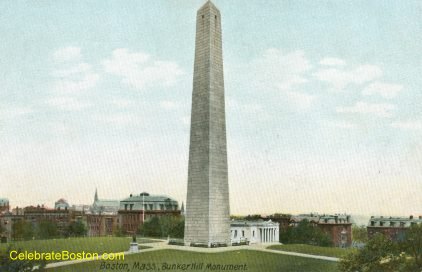
Or maybe find a pillar in a park somewhere. I think I recall one at Bunker Hill….

bunker-hill-monument

Associating with allusions

Human beings use the power of association to create art; indeed, without association, it would be difficult to create or even to learn anything at all. Paolo Friere observed that all true learning is based on previous experiences and associations; Pavlov, in a different field, established the same thing while experimenting with instinctual responses. In literature, in the poem especially, the art of the work depends upon associations. The writer makes cultural, historical, linguistic and personal references and allusions, establishing imagery based upon place, time, art, experience, event. How would metaphor, or simile, operate without prior knowledge and associative power? Allusion’s a crucial tool for poets.

In his textbook/anthology To Read a Poem, Donald Hall notes that allusions can, however, be problematic in poems and may “act as a barrier to understanding.” Indeed, a common criticism in poetry workshops is that an image, word, or allusion is obscure. Such critiques often center around an indirect reference that readers “don’t get.” A poem no one can understand or appreciate is certainly a failed poem, but what if the failure is the fault of the reader’s lack of experience or education? Is the poet to blame for being elitist, or is the reader to blame for his or her innocence? What if the allusion is based on something integral to the author’s perception of life and is meant to further the understanding of the piece, not to build barriers? How is a writer to judge whether or not an allusion is working in the poem?

Let’s back up a bit and start with a definition: an allusion is simply an indirect, but meaningful, reference. It is not the same as writing a poem based on a quote or news article; not the same as direct referencing in a line, stanza or epigraph. It is not a symbol—it does not stand in for anything, merely points indirectly at an experience. Because of its indirectness, allusion operates on a more complex level than does other imagery; and because of that complexity, allusions deepen meaning. A good allusion works on several levels, dependently and independently.

But an allusion is also meant to be understood. Robert K. Miller, in his textbook The Informed Argument, defines allusion as “an unexplained reference that members of an audience are expected to understand because of their education or the culture in which they live.” That expectation—and the assumptions that go with it regarding culture and education—has the potential to make an allusion into a sandpit of obscurity. Yet great poems avoid getting mired. Great poems work even when history has intervened and allusions have been lost: one can read The Inferno with notes and explanations about politics in the city-states of medieval Italy and Biblical references; or one can read it naively uninitiated and still find it to be a fabulous, weird narrative, a guided anti-quest. The uninformed reader has lost some aspects of the poem (perhaps its irony, its parodies of important men, etc.). The uninformed reader has not lost everything in the text, however. He or she does not return impoverished from a reading of Dante by any means. The art is still in the poem, the narrative, the craft, the intention. In a good poem, the poet’s point of view and range of experience can transform the reader’s experience.

il_fullxfull.369385736_ddho

What if the contemporary writer’s experience includes a love of Ovid, a familiarity with Hindu cosmology, or twenty years as a coroner? Educated readers of a century ago would have caught allusions to Greek and Roman classics, but that’s less true today (a fact that has not stopped Billy Collins or Anthony Hecht from employing classical allusions or references, however). I’ve recently had students who were not able to recognize allusions that referenced Shakespeare, Wordsworth or the Bible. While this is dismaying to me as a teacher, it has not interfered with these students’ ability to enjoy—and understand—poems by such writers as Collins, Glück, Pastan and others: poems containing allusions to literature, history, art, and experiences beyond these readers’ ken. A good poem alluding to a coroner’s working knowledge of the body and its various means of demise (without directly referencing or explaining this knowledge) would certainly pique my curiosity, and that of my students. Maybe it is difficult to get the news from poems, but through poetry we can expand in other ways.

Besides, people read to learn, and each unfamiliar reference or allusion offers the chance to further that learning. Why bother to tell people what they already know? In my own experience, poems have led to the dictionary, the encyclopedia, to libraries, art museums, philosophers, scientific theories, and to other poems. Granted, I am the sort of reader willing to do that extra work; and this points out that deciding whether or not to use an allusion entails a couple of decisions. Who makes up the audience for a poet or poem? That’s the issue Miller addresses in his definition of allusion—who’s reading, and what experiences and education these people have access to. The recent interpretations of Wordsworth’s language of the “common man” have on the one hand encouraged accessibility in contemporary poetry but have also led to some ridiculous directives in poetry seminars. (Example: A student of mine was told by a conference instructor never to use the word “vermillion” in a poem because “people won’t know what it means.” While there are poems in which “red” is a better choice than “vermillion,” there are certain styles and subjects in poetry that benefit by the use of the “more obscure” word). The second question a writer must ask is: does the poem work even if the reader misses the allusion?

The first question is intellectual and is less important than the second one—but it can help the writer decide whether to keep the allusive image/phrase or to direct-reference, clarify, footnote, or delete it. In a culture as overwhelmed with media as our own, even contemporary allusions can be missed (what if your readers don’t watch commercial television? or keep up with CNN? or know what blogging is?), let alone well-considered indirect references to, say, American life in the 1950s, composers other than Beethoven and Mozart, or most writers once considered essential to the “classic canon.” So it does help to know who your audience is. This is as true for allusion as it is for vocabulary choice in the poem.

The second question is absolutely necessary for the poet to ask, for allusion often arises spontaneously if it is deeply grounded in a writer’s experience. Because the poet’s experience drives the poem, a writer who is dissuaded from, or afraid to harness and use her experience, risks losing her investment in the work. While obscurity is also a risk, too much concern over being democratically accessible may result in what one of my students called “the dumbing-down of the poem” (a phrase which is itself a contemporary, political allusion). The condensed complexity of poetry is possible thanks in large part to the associative powers of allusion. Strange and surprising associations and metaphors and multiple, list-built associations evoke fresh responses from the reader through transformative acts within the poem. If no one “gets” the allusion, but readers still “get” the poem—if they do not stumble over the language or the images, do not lose the narrative or miss the overall meaning of the piece—the poem has surely succeeded: some kind of transforming language, some synthesized meaning that leaps out of and past the accepted denotations of words, has occurred.

If a reader comes along who does catch the allusion, that reader will have an enriched perception of the poem, a deeper insight into the writer’s inspiration and purpose. That’s how a reader can tell the chosen allusion works. And that’s how the poet can tell, too.