Beatrix Potter, interdisciplinary artist

Beatrix Potter came to mind yesterday when I watched a young rabbit struggle into a fix as it tried to escape from me through the newly-reinforced fencing. It had gotten in at a spot we left open after some hours of work on a hot day yesterday, but it could not locate the open span when I cornered it among my beans.rabbit-014

In “The Tale of Peter Rabbit,” Potter writes: “Peter was most dreadfully frightened; he rushed all over the garden, for he had forgotten the way back to the gate…he ran on four legs and went faster, so that I think he might have got away altogether if he had not unfortunately run into a gooseberry net…”

Very observant description of cornered-bunny behavior. I felt rather sorry for the bunny in my vegetable patch. It had squeezed itself between a gap and then found itself impressed against chicken wire, and for a few seconds there was a mash-up of fur, feet, and fencing in a whir of sheer panic. The rabbit freed itself, however, with an acrobatic twist through a gap, ran back into the garden; and after a few false tries, finally located an unreinforced section of the garden fence and escaped toward the hedgerow.

~

Potter was an admirable writer of engaging prose, a terrific watercolorist and an amateur mycologist whose careful observations of the plants and animals in her Lakes District farm environs still draw admirers to her work. I think of her as a kind of turn-of-the-century interdisciplinary artist, though I cannot imagine she would ever perceive of herself in that light. She might agree that she was an excellent observer of the world–a quality that benefits scientists, artists, writers, journalists, and farmers. If all you think of when you see her name is “children’s books,” go to the Beatrix Potter Society’s website and learn how much you did not know about her.


Valuable to know

One of the philosophy faculty members at my college perennially assigns an end-of-term paper in which the freshman student must defend whether (or not) a philosophical principle, view, or argument “is valuable to know.” He has a list of possibilities, such as “Is Descartes’ concept of the body-mind problem valuable to know?” and “Is Aquinas’ proof of God’s existence valuable to know?”

The students wrestle mightily with these essays, although the professor’s question does not in itself constitute a major philosophical argument; even when we disagree with something, we may still feel it is valuable to know. The students do not always recognize that they have to make and defend only the view that knowledge is valuable. They tend, instead, to re-argue the philosopher’s claims…which confuses them, but also works to help them learn what those claims are and how they operate as arguments.

This bust resides in the Louvre, and was found here: http://www.humanjourney.us/greece3.html

Socrates. This bust resides in the Louvre, and was found here.

Philosophy, the art of thinking about thinking, by its very nature creates confusion on the path toward greater understanding. Or anyway, that should be the intention. What I like about this assignment (which I often see when I am tutoring) is the way young people come to terms with the material while they are in the process of composing the paper.

Here is how the tutoring sessions tend to go: I look at the first paragraph for context and clarity. Then I look at the claim and help the student clear up any grammar or mechanical errors. Then the student writes about what, for example, Aristotle’s claims about moral and intellectual virtue are. Usually this section comprises two rather vaguely-worded general paragraphs presenting claims by the philosopher, paraphrased in freshman-student sentences, and two short paragraphs presenting opposing views come next.

Here is where grammar and rhetoric are friends. I read each sentence, and I tell the student what he or she is saying in the sentence–based on how well the student can write or proofread, what the sentence says and what the student meant to say may be rather distant partners. So we work on that. As we plow through the paragraphs, the student gets a chance to re-think his or her arguments about and understanding of the philosophical questions at stake in the essay. Sometimes, I can almost see the lightbulb of comprehension beginning to glow in the student’s mind.

It really demonstrates what I tell my students all the time: Writing helps thinking! And so does discussion. In my office, for half an hour, the student gets a sounding board for his or her own ideas and then writes them down. Not all of my students get terrific grades, but it fascinates me to watch them in the process of coming to understand that pretty much anything can be valuable to know.


Connected

Jonathan Franzen’s The Corrections revolves in part around a family’s interconnected–and expanding–circles of influence (of harm, mostly, but also of steps toward healing) as the “patriarch” begins to lose his health and independence. It’s a depressingly familiar scenario for many of us who have aged parents. I often hear anecdotes from friends and colleagues about how an elderly parent’s decline tears apart family connections and lately have been living the problem a bit more close at hand.

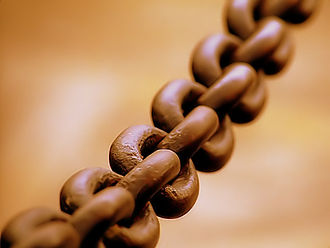
So I am mulling about how we are interconnected, and also about how we decide to narrate our connections: the stories we tell ourselves, the stories we tell others. That’s the poet/observer in me mulling; but I also want to find out more about the psychological side of the equation, so I recently read Christakis’ and Fowler’s book Connected: The Surprising Power of Our Social Networks and How They Shape Our Lives, which takes a social-science and statistical look at what connects human beings to other human beings. 330px-Broad_chain_closeup

Writers are often our keenest social observers, and as it happens, Hungarian poet and writer Frigyes Karinthy wrote a story (“Chains”) that more or less posited the six degrees of separation theory back in 1929. Franzen’s novels tend to explore how even seemingly-minor disruptive or dysfunctional human relationships create butterfly-effect chaos among those connected to it–even among people not closely connected to the ‘disrupter.’

Christakis and Fowler examine much more than the six-degrees theory, such as how those human connections build themselves into social cascades, cultural norms, support systems, clans, families, political parties, and economic outcomes. On the one hand, these claims seem obvious: of course our relationships are based upon shared connections, and of course those relationships have impacts upon our lives. We know this intuitively, but now scientists want to give us proof.

Stuart Kauffman’s book At Home in the Universe offers “hard science” studies (though based upon theoretical computer- or math-based simulations) in physics and biology that suggest random disturbances, or chaos, can create chain or even lattice-like behavior. He suggests that if molecules or genes behave the way the simulations do, the cosmos may continually undergo a sort of self-organization that leads to forming connections.

Hence: life. Or life as we experience it. In which small differences in initial conditions can be amplified into transformational events that do not affect anyone in exactly the same way.

That’s more or less the butterfly effect, but it could not happen in social situations among human beings if we were not so interconnected or interdependent. Social beings require other social beings as support systems: that’s how humans work (with, naturally, the occasional outlier).

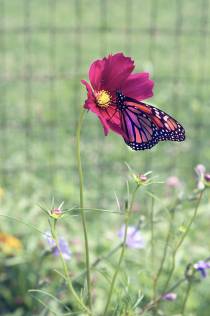
butterflyOur poets, playwrights, and our fiction writers–the narrators of human existence–understand isolation and community in non-scientific but no less valuable and authentic ways. They have been telling us for thousands of years the many ways we are connected.
Maybe what the scientists should do next is read hundreds of years of great literature as evidence of how social networks shape our lives. Science can learn as much from the humanities as the humanities have learned from scientists…

What we, as observant human beings in a chaotic world, intuitively understand.


Siesta, lacuna, pause

I am preparing for travel, and then I will be away from my computer for about a fortnight; and then, I shall be recuperating from my travels! For the first time in quite awhile, I am taking a rest from blogging.

Though I fully intend to get back to these pages after my return. There is nothing like a journey to invigorate, to inspire reflection…the clichés about journeying and questing are well-earned. Another part of the journey that is less celebrated, however, is the need for pause and the space between journeying and being home (or at journey’s end–which may not be home).

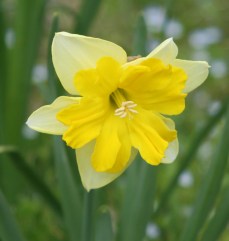
One activity I’m sure I’ll be doing is walking, and some of that walking will be along the paths of Windermere. Perhaps I will even encounter “a host of golden daffodils”–it’s about the right season for that.daffodil photo Ann E. Michael

Maybe I’ll read Gloria Steinem’s latest book, My Life on the Road, as I travel. She’ll make me feel like quite the amateur.


How to start

My students often get confused at the beginning of their essays; a common complaint is “I don’t know how to start!”

I feel for them. Beginnings are difficult. Recently I was wondering why that is so.

~

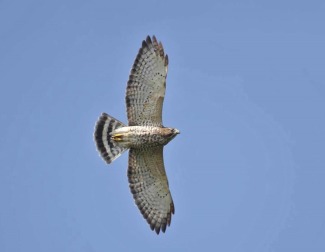
Driving home during a blizzard–concentrating on seeing the road, staying off the shoulder, anticipating the curves, watching for oncoming vehicles. Tense, I’m trying not to clutch the steering wheel. Eight miles home seems long when the visibility is nearly zero and the back roads have not been plowed. And then a blur of activity to my right, a thunk against the passenger side window, and a sweeping shape looms in front of me, veers; a fan, dark stripes, pale breast-feathers, strikingly yellow claws. I’ve nearly hit a broad-winged hawk. And that thunk was a smaller bird that had been harrying it through the snow.

Broad-winged Hawk Flying

A startling incident, that experience heightened my awareness of where I am (in the world), in which environments (natural and human-made), and when (now!).

Sometimes, happenstances such as this evolve into, or figure in, poems that I will eventually write. The image, the occurrence, offers a way in.

~

Returning to my question about how to start: the blockade many people make for themselves is that they think they have to know what they want to say before they write anything. “What is it I am trying to say?” the writer asks. We have been instructed to keep in mind our aims when we write.

I suggest it may be a mistake, though, to figure out what one wants to say before trying to write. When my student writers are truly stuck at the start, I ask them to write what they notice, what they experience, what they hear. Just write it down, describe it: the soft thud of the sparrow (if it was a sparrow–allow for speculation), the sound of wind against the car body, the clearly-visible buteo in the windshield where before there had been near-whiteout. What is it I want to say about the drive, the shock, the tension, the world of natural things? I don’t yet know, but I am writing.

~

Thanks to Hawk Mountain Sanctuary and Raptor Preserve, Kempton PA.

Work vs. work

Untitled-writerOutside Academia: The Writer…


Lately, I have felt overly-occupied with my so-called day job. The work I do at the college is personally rewarding and pays my bills; I love the challenges it offers and the people with whom I work, but I am not what one would term career-driven. Even though I am employed by a university, and even though I teach (just one class a semester), in many ways–as far as scholarship, research, and poetry go–I remain “outside academia.” An interesting paradox. But if I over-extend at my office, I find less to say at my writing desk at home.

Poets Mary Oliver and Kay Ryan also spent most of their careers working at colleges without climbing the spiral stairway of academia’s ivory tower. Well-received, excellent writers–and Oliver even sells quite well for a poet–they aren’t “academics.” It is heartening to know that such poetry luminaries are, like me, not academics. I often wonder how they managed to balance teaching with writing poetry.

~

What I do “at work” where I earn a salary, and what I do when I “work” on poetry, seem quite separate to me, and I question whether one informs the other. I feel that being a poet does influence, though subtly, the way I approach teaching and tutoring. (It does not seem to have any influence on the way I do record-keeping, spreadsheets, or paperwork.)

By contrast, my day job at the college seems not to have much sway over my poetry; I write prose about teaching and tutoring, but my career work does not often appear as topic or substance in my poems. I notice, too, that Oliver and Ryan do not often write poems about their day jobs (both of them have retired by now–but still). In fact, I would venture that the way my day job affects my poetry is mostly as a time and energy drain.

~

I have challenged myself to write at least two poems a month that in some respect relate to my work with students. That prompt forces me to remember that I am not two separate beings, one at the college desk and one, pen in hand, on the back porch at home. I remain my whole self, and I place my whole self into both endeavors. I can work with that.

Focus

On what do I focus when I write a poem?

This question has occurred to me before, usually under the guise of someone asking the ever-vague “What inspires you to write?” Focus differs from inspiration. For me, focus seems to derive from observation and is a process of discovering meaning.

Focus helps me understand what it is I’m experiencing and to decide how to express it. I focus when I need to make decisions; in the case of writing a poem, the decision might be one of craft approach or of imagery, or a realization that the poem needs a turn to create tension or resolution. What is the hub of the poem, the real kernel at its core? To make a poem “work,” I have to have a sense of what that might be.

This type of emphasis is a form of concentration. I think we learn from focusing; it teaches the value of close study, a skill needed for analysis. It can also be a reminder of what is outside the area of attention. Focus needs context, or it ends up as navel-gazing.

For a visual example, consider Andy Goldsworthy‘s “Rain Shadows,” which are among the most transitory of his ephemeral works.

The opposite of making a snow angel, in these conceptual art pieces–and he would object to me calling them by that term–the artist lies on a sidewalk and waits until a light rain falls just enough to leave his figure on the ground. Of course, in no time, the rain fills in the figure, so he documents the “shadow” with a photograph.

Goldsworthy talks about the process, in a recent interview with Terry Gross (see link below).

I just concentrate on the rain. I’ve learned so much about rain — the different kinds of rains, the rhythms of rains. And people will say, “Oh, why don’t you just use a hose pipe?” That would be totally pointless. The point is not just to make the shadow, it’s to understand the rain that falls and the relationship with rain and the different rhythms of different rainfalls.

The “art” in Goldsworthy’s rain shadows–he also does this with snowfall–consists in a focus, a learning, a process that the viewer cannot participate in. Which is kind of weird. Unless, of course, seeing his rain shadows prompts other people to try making them, during which they will learn about rain’s rhythms and varieties.

In this way, Goldsworthy encourages focus and close attention to the world in which we live. I think I will file that under “inspiration.”


Empathy & compassion

quanyin
Quan Yin, bodhisattva or goddess of compassion; the Chinese interpretation of Avalokiteśvara

Sensitive. Or: oversensitive.

These are terms I hear bandied about to describe people who react deeply to anything from wool clothing or sock seams to sarcasm or “charged language.” When I was a child, people told me I was sensitive; initially, I thought that was a kind of compliment, and sometimes that was the intention. The teenager I once was believed that sensitivity made me empathetic and compassionate.

As I matured, however, the term sensitivity took on more negative connotations of the “can’t you take a joke?” sort. Worse yet, the charge of sensitivity came loaded with accusations of narcissism, as in “you take everything personally.” In today’s phraseology, “It’s not all about you.” Under those terms, sensitivity does not resemble empathy.

Empathy is a feeling-response, true. It appears to have a like-kind relationship to sensitivity–but a person must be sensitive to others’ experiences in order to feel empathy; so the similarity’s not as swappable as it first seems. I thought that my feeling-response signaled that I was a compassionate person. Indeed, fiction elicits empathy in me. A lifelong bookworm and early addict to novels, I definitely feel along with the characters of the stories I read. Is it really the experience of others that makes me weep or feel joy as the characters forge through lives such as I will never be able to encounter? Or is it a feeling response to damned good writing?

I ask myself these questions because, given my inquiries into what consciousness is and what poetry does, it seems I have not made clear to myself the differences between sensitivity, empathy, and compassion.

~

My current thoughts on the differences have evolved through reading and writing poetry, not fiction, and through getting older. Nothing like life experience to knock a person’s youthful errors into strong relief.

Here goes:

Sensitivity is the strength of a person’s reaction. That reaction may be physical or emotional and will vary widely from one individual to another.

Empathy always means that one “feels within” another person (from Greek empatheia em- ‘in’ & pathos ‘feeling’); it is an inward response to external stimuli. As Daniel Goleman notes, there are several types of empathy psychologists have identified–here’s a brief article on that topic.

Compassion, while a noun, must be active. I think of it as behavior, as action, as verb in noun form. It is a response or reaction to suffering in others (empathy) that is accompanied by an urgent desire–the word desire isn’t strong enough to convey the feeling–to help alleviate the suffering.

That’s where the activity comes in. Until I feel a desire to act, I am “merely” empathetic and sensitive.

~

Recently, I have begun to recognize that my desire to write poetry is partly compassion-based. Art of any kind is process as well as result, and process is action. Additionally, my career as an educator has compassionate action structured into the job description. There are other ways we–I–can be compassionate in the world. This matters to me.

We can learn from the practice of tonglen: “Breathe in for all of us and breathe out for all of us. Use what seems like poison as medicine. Use your personal suffering as the path to compassion for all beings.” ~Pema Chödrön

And we can live in the world and begin to use our sensitivity to pain, and our sense of empathy, to activate compassion–as a verb.


Too busy to write (sigh)

May’s dry weather affected the peas, but otherwise the garden’s been outdoing itself this year–with no real help from me. The tomatoes have expressed their vine-nature, stretching to 7 feet in height, with the gold cherry tomatoes flinging their branches far into the tomato patch and other areas of the garden. That means I can pick cherry tomatoes and zucchini at one go! And whenever I get a free moment (not too many lately), I am harvesting or cooking or freezing the produce instead of writing.

I had two “volunteer” vines this year, cantaloupe and butternut squash. Their seeds survived winter in the compost bin, and they sprouted near the fence at opposite sides of the patch. I let them be, and was surprised to find they fruited well (the cantaloupe was from a grocery-store purchase, was surely a hybrid, and therefore might have produced flowers only, or bland fruit). The squash is terrific; and the melon, while not as sweet as one might hope, nevertheless had good flesh and flavor.

At this time of year, the garden’s become a butterfly and bee haven as well as a cutting garden. It looks a mess: tall cosmos of several varieties, sunflowers and perennial sunflowers and queen-anne’s-lace, cornflowers and zinnias and tithonia clustered together, colors clashing, pollinators buzzing, finches and other small birds busy at the seed-heads.

For I have not been weeding, as I have not been writing. Other priorities are claiming the be-here-now of my life; but I’m happy to find that the garden, and my writing life, can be sustained through other things and returned to at better times. Namaste. Have a tomato.

Bounty

Bounty


Drought

I hate droughts. I’m a gardener who lives in a temperate region that, on average, receives about 1,150 mm of precipitation annually (45″). Here we are, in the middle of springtime, blooms on the dogwoods and azaleas, peonies beginning to bust out; and I haven’t heard the welcome noise of rain on the roof for over 5 weeks. Generally, May brings this region 2-4 inches of rain. I miss it, and so do the birds and the deer and the insects and the salamanders and toads…and the few remaining farmers.

I water my vegetable garden daily, but I cannot water the whole lawn, the perennial beds, the hedgerows where the larger trees grow. So the grass becomes crisp. And I worry that a strong wind, or a sudden downpour (please?!), might topple a weak-wooded tree that’s been gasping for nourishment.

Drought is also so metaphorical. It signifies lack. A lack of ideas, a creative drying-up, a kind of writer’s block where words harden into obstacles–those things are droughts of a kind that stop thinkers into stasis. If you don’t move, you end up mired.

Not too distant a stretch from the concrete phenomenon of drought to the existential phenomenon of an artistic or emotional “dry period.”

There are several ways to contend with droughts; some require large-scale changes in industry, agriculture, population centers. On the smaller scale, I practice a version of xeriscaping; after years of experimentation, I have learned which plants hold up best under extremes of dry periods or deer depredation. I am alert as to which seedlings are hardiest, which plants can contain themselves in a sort of dormancy until the rain comes. That means I have to let go of my desire to grow certain species and cultivars no matter how envious I am of the way they flourish in someone else’s garden.

And it’s the same with a droughty period in my creativity. Certain things I let go of; I work instead with what struggles along in the mud cracks, what creeps under the brickwork or waits for the next real rainfall. There’s often surprising beauty in those hardy emotions and ideas that stay around when the going gets tough, the things that manage to find shade or that–like cacti–prefer a drier clime.

Being adaptable is important if one wants to make art, to write poems, to compose. Because life isn’t always going to offer ideal circumstances for the creative or aesthetic effort.

~

I hate droughts not only because they hurt my plantings but because they signal a potential disaster in terms of global climate change, and because thousands of people die for lack of that essential element–water. I recognize, though, that suffering sometimes motivates human beings to make changes, to create new approaches…even to make art.

Life is complicated. We evolve through change.

Meanwhile–let it rain!