Focus

On what do I focus when I write a poem?

This question has occurred to me before, usually under the guise of someone asking the ever-vague “What inspires you to write?” Focus differs from inspiration. For me, focus seems to derive from observation and is a process of discovering meaning.

Focus helps me understand what it is I’m experiencing and to decide how to express it. I focus when I need to make decisions; in the case of writing a poem, the decision might be one of craft approach or of imagery, or a realization that the poem needs a turn to create tension or resolution. What is the hub of the poem, the real kernel at its core? To make a poem “work,” I have to have a sense of what that might be.

This type of emphasis is a form of concentration. I think we learn from focusing; it teaches the value of close study, a skill needed for analysis. It can also be a reminder of what is outside the area of attention. Focus needs context, or it ends up as navel-gazing.

For a visual example, consider Andy Goldsworthy‘s “Rain Shadows,” which are among the most transitory of his ephemeral works.

The opposite of making a snow angel, in these conceptual art pieces–and he would object to me calling them by that term–the artist lies on a sidewalk and waits until a light rain falls just enough to leave his figure on the ground. Of course, in no time, the rain fills in the figure, so he documents the “shadow” with a photograph.

Goldsworthy talks about the process, in a recent interview with Terry Gross (see link below).

I just concentrate on the rain. I’ve learned so much about rain — the different kinds of rains, the rhythms of rains. And people will say, “Oh, why don’t you just use a hose pipe?” That would be totally pointless. The point is not just to make the shadow, it’s to understand the rain that falls and the relationship with rain and the different rhythms of different rainfalls.

The “art” in Goldsworthy’s rain shadows–he also does this with snowfall–consists in a focus, a learning, a process that the viewer cannot participate in. Which is kind of weird. Unless, of course, seeing his rain shadows prompts other people to try making them, during which they will learn about rain’s rhythms and varieties.

In this way, Goldsworthy encourages focus and close attention to the world in which we live. I think I will file that under “inspiration.”


Empathy & compassion

quanyin
Quan Yin, bodhisattva or goddess of compassion; the Chinese interpretation of Avalokiteśvara

Sensitive. Or: oversensitive.

These are terms I hear bandied about to describe people who react deeply to anything from wool clothing or sock seams to sarcasm or “charged language.” When I was a child, people told me I was sensitive; initially, I thought that was a kind of compliment, and sometimes that was the intention. The teenager I once was believed that sensitivity made me empathetic and compassionate.

As I matured, however, the term sensitivity took on more negative connotations of the “can’t you take a joke?” sort. Worse yet, the charge of sensitivity came loaded with accusations of narcissism, as in “you take everything personally.” In today’s phraseology, “It’s not all about you.” Under those terms, sensitivity does not resemble empathy.

Empathy is a feeling-response, true. It appears to have a like-kind relationship to sensitivity–but a person must be sensitive to others’ experiences in order to feel empathy; so the similarity’s not as swappable as it first seems. I thought that my feeling-response signaled that I was a compassionate person. Indeed, fiction elicits empathy in me. A lifelong bookworm and early addict to novels, I definitely feel along with the characters of the stories I read. Is it really the experience of others that makes me weep or feel joy as the characters forge through lives such as I will never be able to encounter? Or is it a feeling response to damned good writing?

I ask myself these questions because, given my inquiries into what consciousness is and what poetry does, it seems I have not made clear to myself the differences between sensitivity, empathy, and compassion.

~

My current thoughts on the differences have evolved through reading and writing poetry, not fiction, and through getting older. Nothing like life experience to knock a person’s youthful errors into strong relief.

Here goes:

Sensitivity is the strength of a person’s reaction. That reaction may be physical or emotional and will vary widely from one individual to another.

Empathy always means that one “feels within” another person (from Greek empatheia em- ‘in’ & pathos ‘feeling’); it is an inward response to external stimuli. As Daniel Goleman notes, there are several types of empathy psychologists have identified–here’s a brief article on that topic.

Compassion, while a noun, must be active. I think of it as behavior, as action, as verb in noun form. It is a response or reaction to suffering in others (empathy) that is accompanied by an urgent desire–the word desire isn’t strong enough to convey the feeling–to help alleviate the suffering.

That’s where the activity comes in. Until I feel a desire to act, I am “merely” empathetic and sensitive.

~

Recently, I have begun to recognize that my desire to write poetry is partly compassion-based. Art of any kind is process as well as result, and process is action. Additionally, my career as an educator has compassionate action structured into the job description. There are other ways we–I–can be compassionate in the world. This matters to me.

We can learn from the practice of tonglen: “Breathe in for all of us and breathe out for all of us. Use what seems like poison as medicine. Use your personal suffering as the path to compassion for all beings.” ~Pema Chödrön

And we can live in the world and begin to use our sensitivity to pain, and our sense of empathy, to activate compassion–as a verb.


Too busy to write (sigh)

May’s dry weather affected the peas, but otherwise the garden’s been outdoing itself this year–with no real help from me. The tomatoes have expressed their vine-nature, stretching to 7 feet in height, with the gold cherry tomatoes flinging their branches far into the tomato patch and other areas of the garden. That means I can pick cherry tomatoes and zucchini at one go! And whenever I get a free moment (not too many lately), I am harvesting or cooking or freezing the produce instead of writing.

I had two “volunteer” vines this year, cantaloupe and butternut squash. Their seeds survived winter in the compost bin, and they sprouted near the fence at opposite sides of the patch. I let them be, and was surprised to find they fruited well (the cantaloupe was from a grocery-store purchase, was surely a hybrid, and therefore might have produced flowers only, or bland fruit). The squash is terrific; and the melon, while not as sweet as one might hope, nevertheless had good flesh and flavor.

At this time of year, the garden’s become a butterfly and bee haven as well as a cutting garden. It looks a mess: tall cosmos of several varieties, sunflowers and perennial sunflowers and queen-anne’s-lace, cornflowers and zinnias and tithonia clustered together, colors clashing, pollinators buzzing, finches and other small birds busy at the seed-heads.

For I have not been weeding, as I have not been writing. Other priorities are claiming the be-here-now of my life; but I’m happy to find that the garden, and my writing life, can be sustained through other things and returned to at better times. Namaste. Have a tomato.

Bounty

Bounty


Drought

I hate droughts. I’m a gardener who lives in a temperate region that, on average, receives about 1,150 mm of precipitation annually (45″). Here we are, in the middle of springtime, blooms on the dogwoods and azaleas, peonies beginning to bust out; and I haven’t heard the welcome noise of rain on the roof for over 5 weeks. Generally, May brings this region 2-4 inches of rain. I miss it, and so do the birds and the deer and the insects and the salamanders and toads…and the few remaining farmers.

I water my vegetable garden daily, but I cannot water the whole lawn, the perennial beds, the hedgerows where the larger trees grow. So the grass becomes crisp. And I worry that a strong wind, or a sudden downpour (please?!), might topple a weak-wooded tree that’s been gasping for nourishment.

Drought is also so metaphorical. It signifies lack. A lack of ideas, a creative drying-up, a kind of writer’s block where words harden into obstacles–those things are droughts of a kind that stop thinkers into stasis. If you don’t move, you end up mired.

Not too distant a stretch from the concrete phenomenon of drought to the existential phenomenon of an artistic or emotional “dry period.”

There are several ways to contend with droughts; some require large-scale changes in industry, agriculture, population centers. On the smaller scale, I practice a version of xeriscaping; after years of experimentation, I have learned which plants hold up best under extremes of dry periods or deer depredation. I am alert as to which seedlings are hardiest, which plants can contain themselves in a sort of dormancy until the rain comes. That means I have to let go of my desire to grow certain species and cultivars no matter how envious I am of the way they flourish in someone else’s garden.

And it’s the same with a droughty period in my creativity. Certain things I let go of; I work instead with what struggles along in the mud cracks, what creeps under the brickwork or waits for the next real rainfall. There’s often surprising beauty in those hardy emotions and ideas that stay around when the going gets tough, the things that manage to find shade or that–like cacti–prefer a drier clime.

Being adaptable is important if one wants to make art, to write poems, to compose. Because life isn’t always going to offer ideal circumstances for the creative or aesthetic effort.

~

I hate droughts not only because they hurt my plantings but because they signal a potential disaster in terms of global climate change, and because thousands of people die for lack of that essential element–water. I recognize, though, that suffering sometimes motivates human beings to make changes, to create new approaches…even to make art.

Life is complicated. We evolve through change.

Meanwhile–let it rain!

Key images

I had intended to post on Denis Dutton’s book The Art Instinct: Beauty, Pleasure, and Human Evolution; and I will (I suppose) at some point, because I enjoyed it immensely. Looking through my files, however, I found the transcripts from the initial interview Karen Jogan and Hernán Pereira conducted with me when they were compiling the book So Far…So Close and realized that my answers to some of their inquiries connect with my last post about poetic voice and Kunitz’s thoughts on key images. (The longer, but edited, version of the interview appears in the book).

~~

  1. What colors or aromas remind you of your childhood?

Cinnamon toast, mown grass, onion grass (wild garlic), lily-of-the-valley, cedar-water and pine trees, the scent of a muddy river in summer, wintergreen, play-dough, school paste, steam-irons, fresh peaches, campfires, burning leaves, talcum powder, Pepto-Bismol, air-dried clothes and linens, mimosa blossoms, roses, strawberries.snowdrops

  1. Describe yourself as a child.

I wonder from whose perspective I should attempt to answer this question. I know from others that I was considered to be shy and polite, talkative when comfortable, imaginative. I certainly felt uncomfortable among groups of people, preferring small groups of friends with whom I played make-believe. I made up stories which I told my sister and brother, and when I was old enough to write I made little children’s books that I illustrated and bound in cardboard.

My sister was my best friend, but I spent a good deal of time all by myself. When alone, I walked my dog, climbed trees, played on the swings, sketched and painted, and read books. I really was a bookworm and spent many happy hours with books and in libraries. Being alone was, and still is, deeply satisfying for me—it helps me regain creative energy.

  1. At what moment in your life did you begin to write?

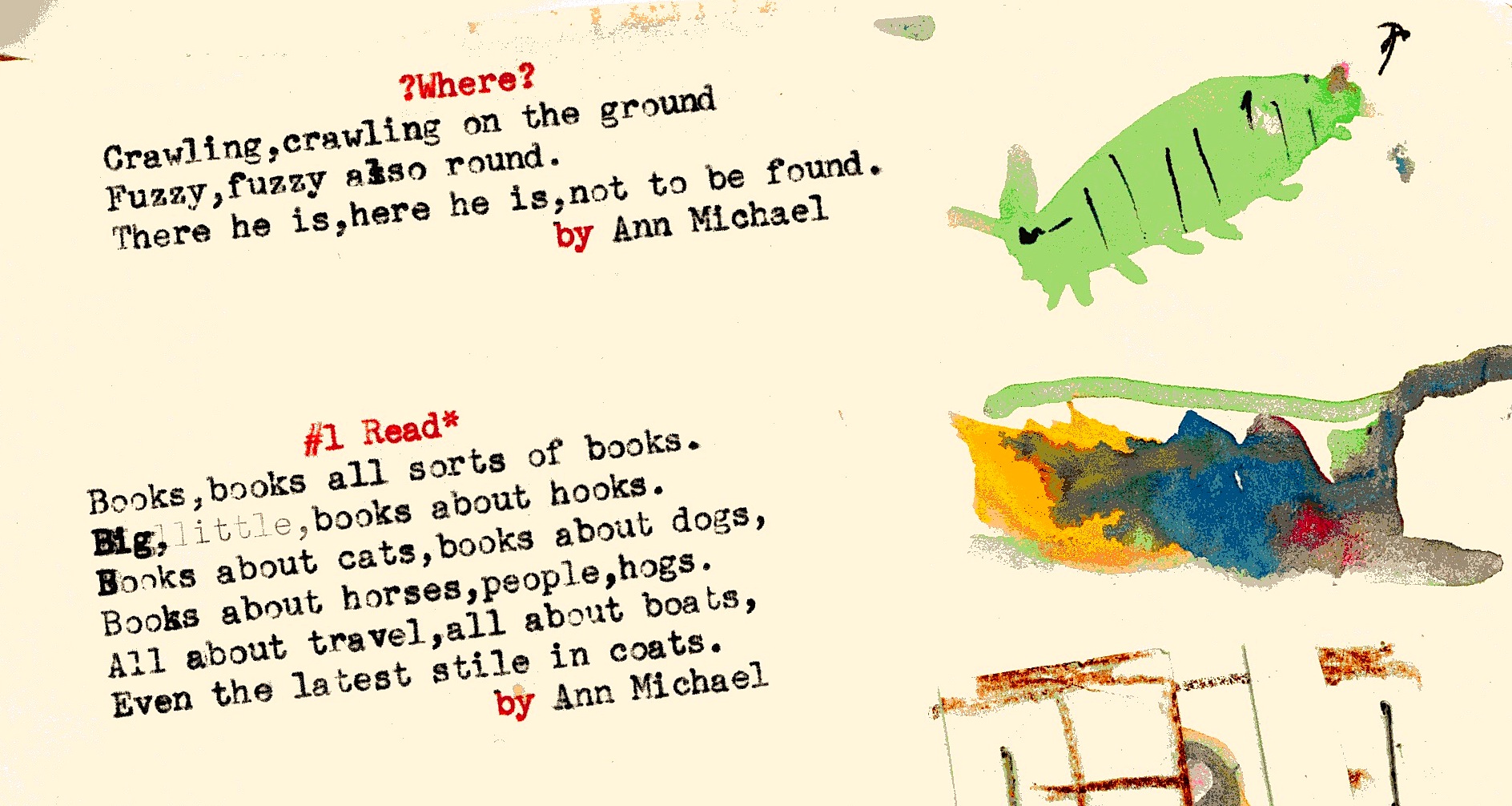
I don’t remember when I began writing. My storytelling began early, and I suppose the writing developed from there. The first story I recall writing down was about a princess; I was in second grade. I felt proud of myself, even though the story was only about three sentences long. Apparently, the poems started when I was about nine. I don’t remember writing poems then, but I recently found some that I had composed and typed up (I was fascinated by the typewriter), and my mother’s notes said I was nine when I wrote them. What I really wanted to be was an artist, but writing seemed natural to me. I started keeping a journal when I was ten…

9yroldpoems010

Rhyming and typing and illustrating and bookmaking– at nine years old.

  1. What influences have been important to you?

Other writers, naturally, but first of all, visual art. From the time I was very small, I’ve loved paintings and sculptures and architecture. Church hymns and Bible verses and nursery rhymes were influential to me, as well as folk music and the lyricists of popular music when I was growing up. I am also influenced by non-fiction work, especially in the sciences, and philosophy. My early poetry influences were Donne, Shakespeare, Blake, and the King James Bible; but then I fell in love with contemporary women writers, then surrealist poets, then Latin American writers, then Asian poetry, then contemporary lyric poems…it goes on and on. It might be easier to say what I have not found particularly influential!

~~

With further reflection, I could go deeper about early images that have become, for me, “key” aspects of my writing voice…a particular landscape, the feeling of an empty nave, bees and birds, milkweed, cloud patterns, my parents singing, my little sister beside me in our shared bed, the sound of a symphony. They may not appear in my poems as such, but these images connect with me in ways I probably don’t understand. What do such keys unlock, I wonder?

~

A good start. Possibly.

My most recent reading material is The Feeling of What Happens: Body and Emotion in the Making of Consciousness, by Antonio Damasio. Damasio is convincingly on the neurological/evolutionary trail to recognizing how consciousness operates and why we have developed it, though he allows for mysteries we do not yet and may never understand.

Damasio is clearly not a dualist who thinks the consciousness can exist separately from the body (one of his previous books is aptly titled Descartes’ Error). He doesn’t address the “soul” in The Feeling of What Happens, but argues that reason requires feeling in order to operate effectively, that feeling is a more “conscious” form of emotion, which is “unknowing” in the sense we call consciousness and is founded upon core consciousness, which is reliant upon the physical organism…a vastly complex array of cells, nerves, you name it, generally self-regulating and not by nature in particular need of a conscious mind.

So next time someone tries to explain why a situation happened and just says, “It’s complicated,” maybe you ought to accept that. Because, apparently, it’s really really really complicated!

http://www.isys.ucl.ac.be/descartes/images/Descartes.gifThat does not keep people like Damasio from trying to track down what goes on in the minds of sentient beings.

Having just read Flow, I immediately thought of what Csikszentmihalyi says about the way true flow experiences depend upon deepening levels of complexity–that’s how we keep from becoming bored by routinization of a task. Dennett suggests that consciousness consists of layers: “multiple drafts,” and Damasio calls the human brain, and the brain-body unit, a series of “systems within systems.” But there is no little self, no metaphorical or actual homunculus, at the very bottom of the system, or at the very top. There are only more and varied connections, he asserts–with profound respect and amazement at what biology has wrought.

I also thought about Csikszentmihalyi’s idea of a life project. Some years ago, I began a journal devoted to exploring my poetic project and learned that I do not really think about my writing as a project per se, at least not in the formal sense of poetics. [Here’s Dorothea Lasky harping on the whole concept of a poetic project, in a bit of refutation aimed at poetry critic David Orr.]

What I think I was doing, in fact, was trying to figure out my life project, in the way Csikszentmihalyi defines that concept. What is my life’s philosophy in terms of guiding tasks, principles, goals, projects, challenges? Is teaching part of the package? Motherhood? Gardening? Writing? Human relationships? Learning? Speaking of human consciousness, do I have a conscious path or goal?

Maybe my goal is to keep on amid the complexity and to relish it as much as possible, since it is unavoidable. And perhaps by accepting the complications, I will find my life becomes simpler. That could be a possible outcome–right?

I think of Reineke writing on Marcel Proust’s narrator and his struggle with status, jealousy, conformity, and desire. I read the Proust novel(s) when I was in my early 20s and found his narrator frustratingly neurotic but also a little too familiar, as my life experiences in many ways mirrored his. Eventually, he learns that the way to cure the pain of desire is to discipline himself to let go of desire itself; (and no, neither Proust nor his narrator were Buddhist).

And what happens when he gains this recognition is that he can write the novel. He develops flow, and a life project.

I am past 50, a good time to establish more consciously what my life project is. I know it involves relentlessly and joyously learning new things. I think it will include poetry in some way. And discipline of some kind, conscious effort. For now, those things constitute a good start.


October focus

69082_1682385823790_1949308_n~

October. I’ve put my vegetable garden to bed, deadheaded and pruned the perennials. The leaves are yellow and red and orange and brown, and the white pines are dropping their old needles. Quieter days, quieter nights: fewer insects, amphibians, and birds making their noises.

Well–there are the danged woodpeckers

I expect to keep this blog less frequently this month, or to make the posts shorter, because I am taking part in what is for me a new endeavor: an online poetry workshop. I am taking a month-long class with Daisy Fried through Providence’s Fine Arts Center, 24 Pearl Street.

Daisy Fried lives in Philadelphia, 24 Pearl St. is in Rhode Island, and my fellow workshop participant-peers live in NH, MA, IN, MC, ME, NY, VA, NJ, VT, CA, AL and IL. Oh, the amazing connectivity of the world-wide web!

I’m somewhat tech-savvy but only to a limited degree, and reading online is still cumbersome for me. Nonetheless, I am curious to see how the virtual critique will work, given that we are not face-to-face as we comment, enthuse, and suggest. Interpretation takes on multiple meanings in an environment such as this one. And whether I can keep on top of the comments and reading! That’s another type of challenge during the academic year for me.

I feel thrilled to be back in the position of student, though. I’m the sort of person who might stay in school perpetually if I could manage it. Even autodidacts sometimes enjoy the camaraderie of peers.

If you are interested in the process, and how it goes for me…I shall eventually report back on these “pages”!


Introspection & narcissism

In August 2014, New York Times writer David Brooks wrote about the differences, if any, between narcissism and introspection. His opinion column explored whether self-questioning and rumination might lead to self-centeredness rather than self-discovery; he begins the column with the concept of the personal journal or diary and whether that practice has value or not. (Certainly there are other methods of introspection, but for a literate society it is writing that first comes to mind).

Citing research from several psychological studies, Brooks states:

We are better self-perceivers if we can create distance and see the general contours of our emergent system selves — rather than trying to unpack constituent parts.

Interestingly, this suggestion more or less jibes with the multiple-levels-of-self version of consciousness as theorized by Douglas Hofstadter and Daniel Dennett.

Writing as a means to recover from trauma or to “make sense of the world” seems most effective when the writer puts some reflective distance between experience and feeling (see The Writing Cure), although James Pennebaker’s research argues that even immediate expressive writing can help psyches and bodies to heal. Brooks outlines three ways, different from the microscopic introspection of the narcissistic diary-entry, that self-reflection can develop into something other than self-absorption.

One of them is narrative, which makes perfect sense to me–human beings are story-makers. In fact, all three approaches to introspection Brooks mentions find expression in poetry, storytelling, fiction-writing, creative nonfiction, and in good journalism.

Creating our narratives from a reflective “step away” from intense analysis helps human beings to navigate the inner and the outer worlds.

I’m seeing this approach in action with my college freshmen this semester. More on that in a later post.

Difficult writing?

Here’s Will Buckingham on writing and difficulty. Worth a read! I don’t know how to embed the blog into my post, so here’s the link.

http://willbuckingham.com/the-pleasure-and-difficulty-of-writing/

Writing can indeed be a pleasure–most of the time! There are periods of difficulty when I feel frustrated, but those periods make for puzzles and challenges; and I enjoy puzzles and challenges. They push me, force me to stretch a bit, engage with what’s not so simple or superficial, change my perspective, alter my expectations and assumptions, discover something new. I learn from these experiences. I would not want life to be easy all the time, nor would I want creative writing to be easy all the time. Although it’s pleasing to lie in a hammock on a mid day and sip a cold drink and listen to the birds and read a book…pleasure also encompasses inventive challenges. Motivation. Inspiration. Different forms of joy.

Buckingham mentions a biography of the writer and artist Tove Jansson, best known in the USA for her Moomintroll series but clearly a creative artist of the first rank. I’d put this book on my reading list, but it is at present only available in Finnish! Marina Popova at Brainpickings has posted some of Jansson’s vivid illustrations of Alice in Wonderland here.

On the pleasures of difficult reading, please see my past posts here, here, and here.

Maximally bent & broken

bent and broken

bent and broken

The linguist/scholar David Crystal writes that “Poetic language is the domain where linguistic rules are maximally bent and broken.”

The context here (in his book The Stories of English) is an explanation of how historians of language accomplish their sleuthing; Crystal notes carefully the differences between written and spoken versions of the same language, not to mention dialects and artistic expression and diversified diction based upon the intended audience, and uncertainty as to region, origin, and date of the manuscripts and texts under scrutiny. He cautions readers not to take linguistic theories and received stories about language evolution too readily; the story is a multitude of stories, examinable from a variety of disciplines and perspectives. Much of the story is ephemeral, being oral/aural and carried on in dialects. A fascinating puzzle, really, full of lacunae and contradictions…and a reminder that when I am in my teaching role, I should remain mindful that Standard English is something of a misnomer. A living language, as Crystal demonstrates, operates on many levels and evolves concurrently with social, economic, religious, and technological trends.

I fervently agree that poetry offers language new routes of expression, a place to expand, warp, and break rules while managing all the same to convey information. The information may be conveyed in surprising ways, though, non-standard ways: neologisms, compound words, old words used in a new fashion, or as a different part of speech. Poetry is a major arena for this sort of experimentation, though not the only one. Further, I am inclined to follow a non-prescriptivist approach to writing  even though my job at the college is to impart the basic rules of Standard English, a task which (alas) tends to involve judging things as less-than-correct or “in need of improvement” for the sake of clarity and general comprehensibility.

Should I therefore be more tolerant of non-standard use of the apostrophe? I’m not quite ready for that, because the resulting texts are still so frequently confusing. The point of good writing is, most often, to convey information–though that could be argued–

~

Crystal points out that much stereotyping of speech patterns and much arbitrary standardizing (to the degree possible) has been due to our creative writers, and compounded by writers’ love-hate relationships with printers (and, later, editors) who rely upon codification. A widely-literate audience benefits from generalized written standards, he notes–but there’s no need to become “Grammar Nazis” despite human beings’ natural inclination to be conservative and, let’s face it, contentious. He takes a sociological all-embracing stance about English, welcoming changes.

Having read this text, I am of the opinion that ours is another of those linguistically-transformative periods of messy additions and alterations thanks, largely, to technologies and the sciences but also to media and particularly social media. [viz, meme. What an adaptable coinage!] As long as I have been teaching, I have reiterated to my students that I am giving them a code, a tool, Standard Written English; the way they speak or write is not wrong or incorrect. It is simply not clear and standardized enough for academic work. Get the right tool for the job!

~

Crystal lauds Samuel Johnson for his zeal for language and languages and dialects, even as Johnson sought to “stabilize the disorder” of English in the 18th C. The author goes on to insert his view that prescriptive, “correct” approaches to the language “prevented the next ten generations from appreciating the richness of their language’s expressive capabilities, and inculcated an inferiority complex about everyday usage which crushed the linguistic confidence of millions” (not to mention enforced class distinctions even further). I need to remember this balance between clarity and variety. I admit I have been a not infrequent eye-roller at the “sloppy, slangy, abbreviated” English of television, tabloids, Twitter, texting, and my students’ lingo. It is refreshing to think of these annoyances as potentially enriching–rather than degrading–to the language I love to read, speak, and write.

When I read poems, I know there are writers who employ archaic words, dialect words, slang words, colloquial syntax, interrupted syntax, irregular capitalization and punctuation, neologisms, invented compound word-phrases, curses, technology terms, scientific jargon, Latin, Spanish, Spanglish, Chinese, obscure place names, alternate spellings (orthography)…and on and on. Some are looking back; others look ahead. Some are encapsulating the moment–now–in the framework of a verse. They bend and break the language in startling, haunting, beautiful, memorable ways. This they can do because a living language allows them to.