Persistence & belief

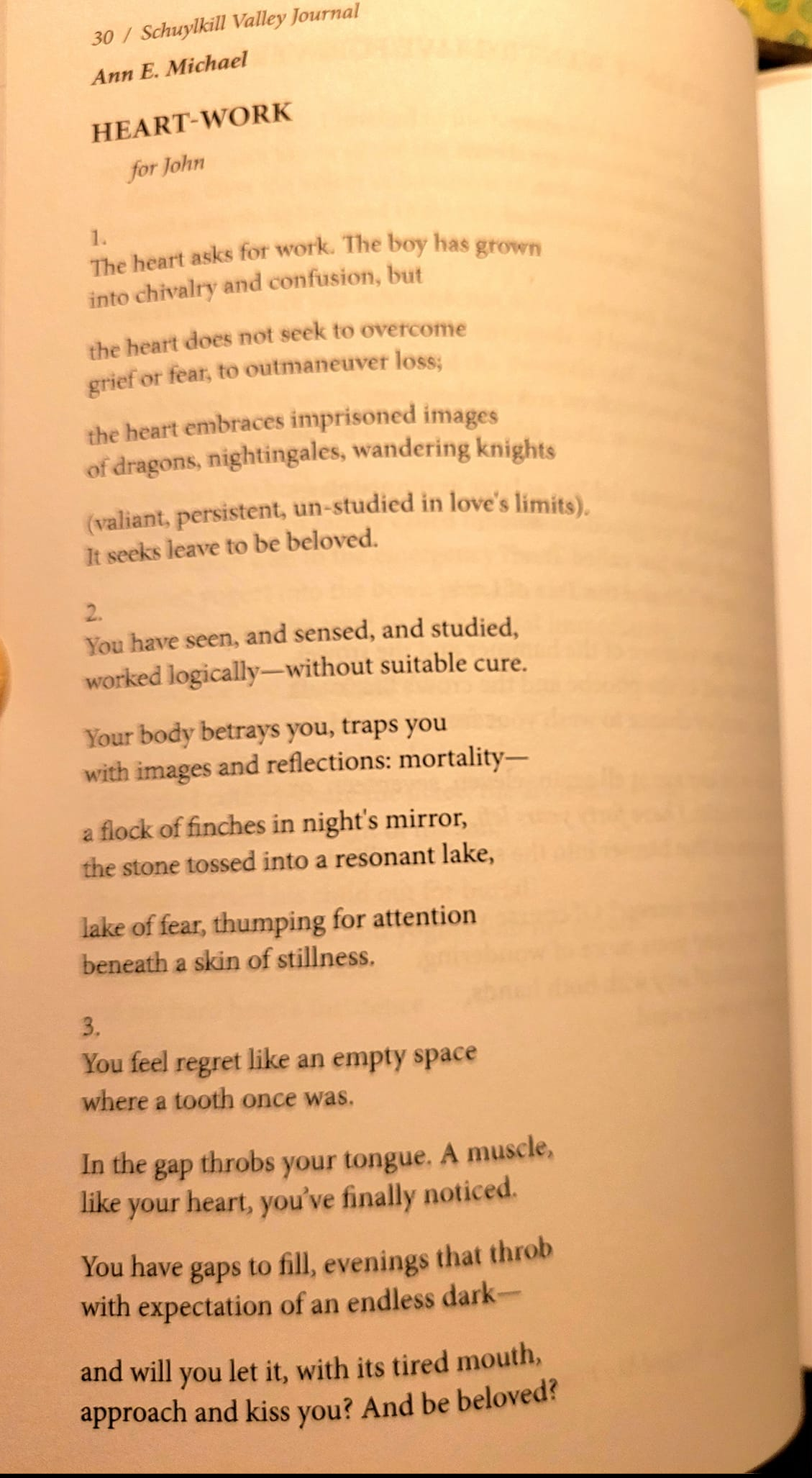
I wrote a poem for my brother 25 years ago or more, when he was in his early 30s and having mysterious and frightening cardiac issues. He was working on geological and wetlands surveys for the county and feeling fairly uncertain about his career, as often occurs when one is in early mid-life. My initial drafts included a quote from a Rilke poem and some geological terminology. That poem draft, as a whole, didn’t quite “work,” however. I gnawed on it for well over a year, tweaking and revising. I showed it to Ariel Dawson, a friend (alas, now gone) whose critique and suggestions I respected. She gave me some ideas for revision and told me she thought this was a poem with real possibility. I just hadn’t quite gotten to the final possibility yet. She told me it was a poem I should believe in, keep working on.

Some years later, after a major reworking, I sent it out. Several times. No one accepted it; a couple of years later, I realized where it was in need of a change. Tried that. It felt better to me. But no one accepted it for publication. Fast-forward about 18 years, and I made yet another change in the poem. I thought maybe it was still worth submitting to journals. Nope. But, last year, reassessing some older work, I came across this poem and thought it was actually a pretty good poem, worth sending out a few more times. One might say I believed in the poem.

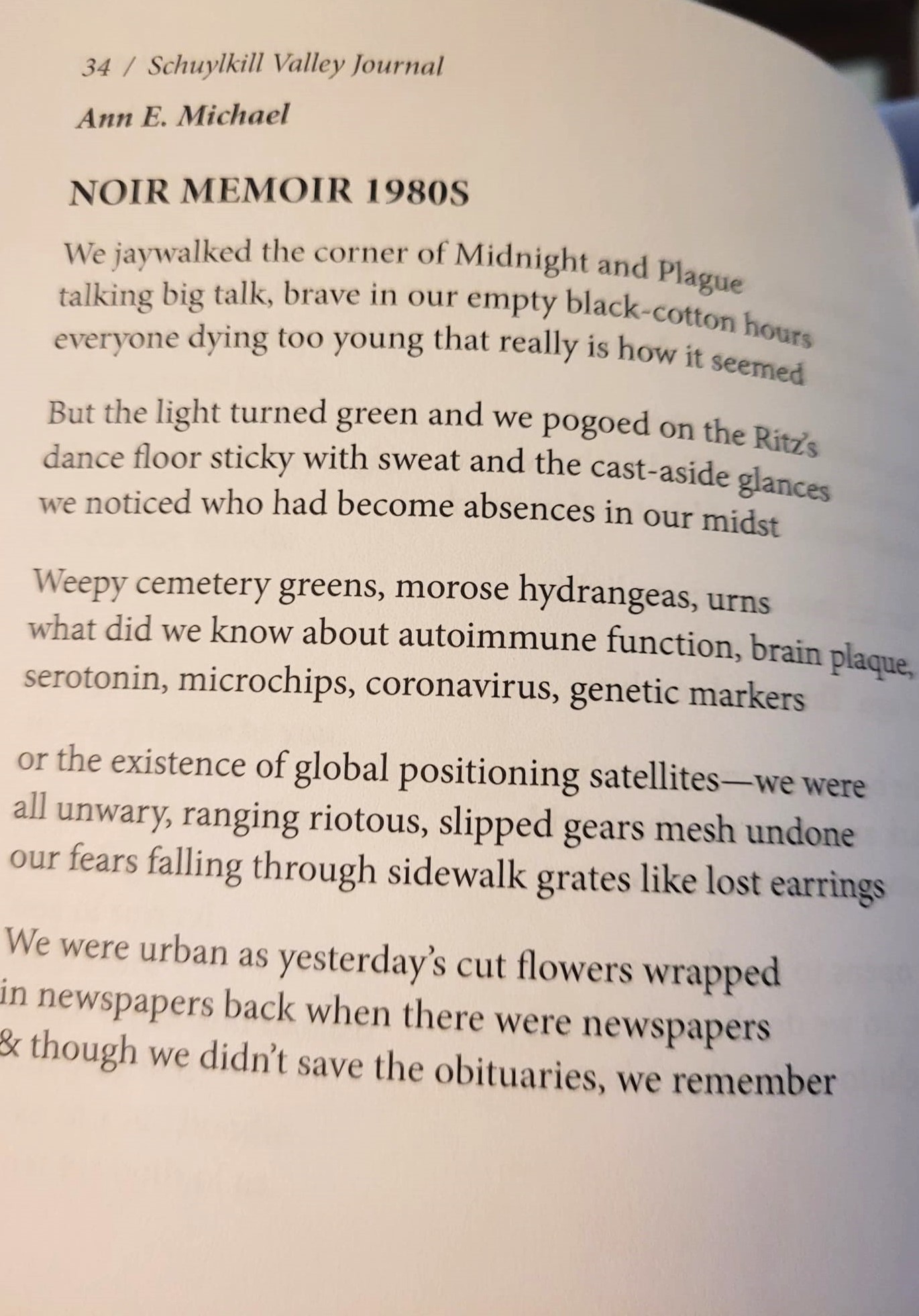
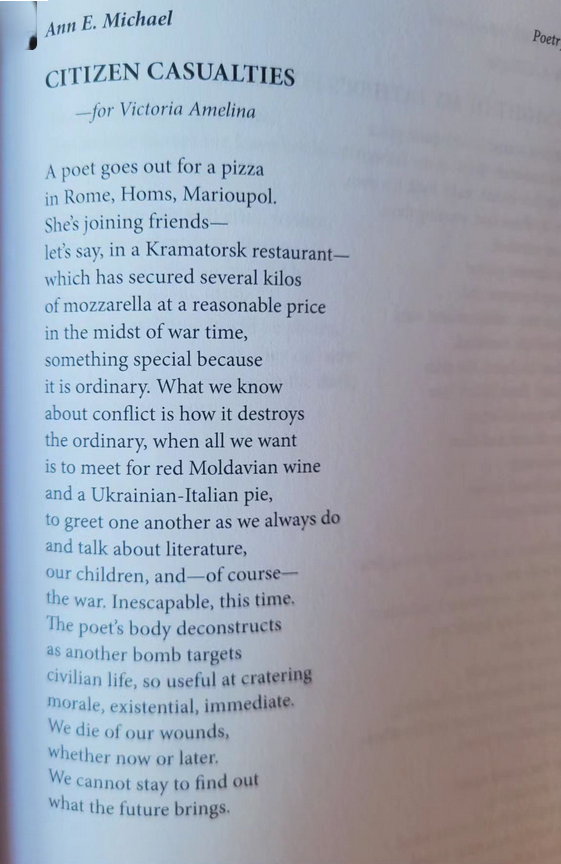
This post is to say: Be persistent, writers, and do believe in your work! Because Jane Edna Mohler at Schuylkill Valley Journal chose “Heart-Work” and two of my other poems for the issue that just came out in print (and I do love print journals!). [Purchase the issue by clicking here]

That poem found its way into print 25 years after I first drafted it.
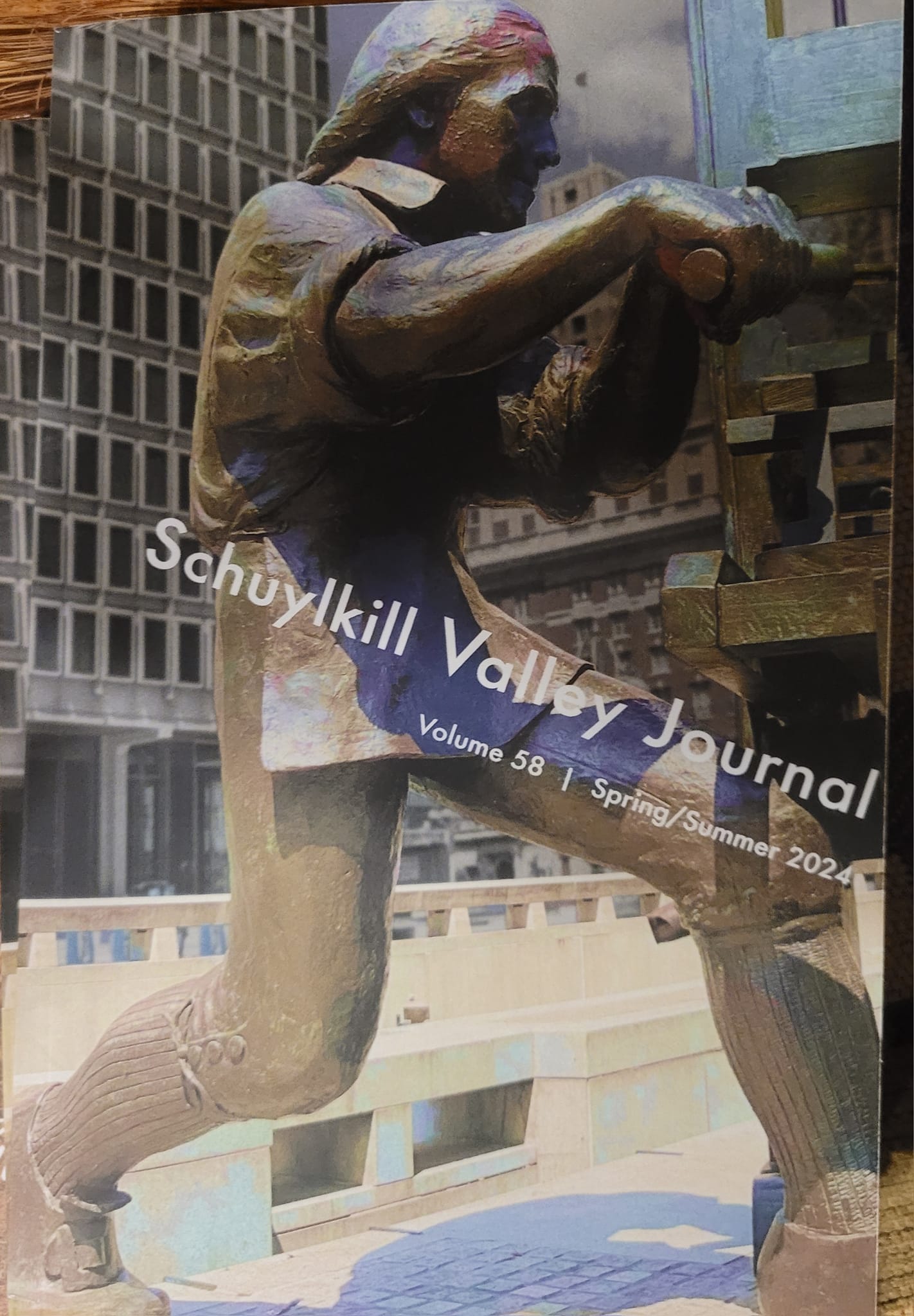
Something equally as nice occurred when I received the print copy in my mailbox. Peter Krok, the long-time editor in chief at SVJ (since 1990) and a long-time colleague-in-poetry, sent along a lovely note in which he praised Jane Edna’s editorial sensibilities and then kindly said he felt that my poem “Heart-Work” was exceptional. How frequently does that happen? Not often, I can promise you–although I suspect such comments are more likely from small independent journal editors and presses. Those lovely people are involved in the arts for the love of poetry and the humanities. When they find time, they can be marvelously encouraging. Let us thank them personally and to the world!

~
Useful avoidance

Trapped inside with the air conditioner on for over a week, I sat by my bookshelves going through the poetry books in my library. I’m re-reading, assessing which books I truly want to keep because I turn to them often or learn something each time I read them, which books I keep for sentimental reasons (maybe I know the author personally), which ones to keep because they are signed copies, which ones are long out of print and I would never be able to replace them. Some of them remind me strongly of places or eras in my life: I bought this one in a small bookshop in Grand Rapids MI, or this one at Barnes & Noble when it was just one store on a NYC street corner, or these at the storied and much-mourned Gotham Book Mart or St. Mark’s Bookshop. What are good reasons to keep books when I really have to downsize? It’s not an easy task, and the first of many in the process of getting rid of stuff so my kids won’t be stuck doing it. Besides, I enjoy re-reading these books. My children are not as enthusiastic about poetry as I am, so it makes sense that someone who loves the works on the shelves be the one who makes such decisions. It feels good to be surrounded by the words of wonderful writers when the outdoors is brutally hot and humid, and every joint in my body aches.

Surrounding myself with other people’s books also acted as one more way of avoiding my own creative work. Sometimes, though, waiting around and doing nothing on a project ends up bringing clarification or new ideas. It can prove useful. I have been stalled on my in-progress manuscript, so a month or so back I asked someone to take a look at it–and then I got caught up in doing other things. Like getting cataract surgery and having covid, and then it was gardening in full swing under sweltering weather, and then the bookshelves… I wasn’t exactly procrastinating, but neither was I actively working on, or even thinking about, the collection.

Acquired when I was much younger, and cool bookshops abounded.

And one night recently–during a much-needed rainstorm–I got a brainstorm! I realized I was trying to pack too many topics into what really should be a manuscript more closely focused on how people who love one another vary in their relationships to old age and death, and on how the contemporary social and medical aspects of the aging process pull us in uncomfortable directions, often distancing us from those relationships. So yes, there should be family poems, hospice poems, biblically-influenced poems, and dealing-with-everyday observation poems. Also some poems of hope and love, poems reminding me (and readers) of the need for compassion in all dealings. But the draft had 92 poems in it, far too many; and some were there just because I like them or they’d been published in a good journal. Which are actually not good enough reasons to include a poem in a collection, according to most of the editors I know.

I am back to thinking about the manuscript and digging up potatoes–a nice crop this year–instead of culling the poetry books because, thank goodness, the heat wave’s subsided a bit. But in the process of this non-routine summer I have allowed numerous weeds to flourish and set seed; all the more work for NEXT year’s gardening, but it’s been too hot to deal with said interlopers. I like to believe the weeds and I are reaching a sort of understanding, but it is not really a compromise. All the concessions have been on my part. [Note: weeding a personal library is less physically taxing but not really any easier.]

Speaking joy

When my children were learning to talk, I remember finding the process of language acquisition so amazing that I briefly considered going back to college to study it. I have two children about 18 months apart in age; many of my friends had babies the same time I did, so I had a range of small children to listen to and be amazed by. Each child seemed to develop their own method of learning to talk, beyond the general similarities among human beings that many scientists and linguists have studied. I wondered what made those small differences–the way parents spoke to the child or to one another? The temperaments of the children? Exposure to music or grandparents, older siblings, the radio??

I can admit that I was an exhausted young(-ish) mother, but also so intrigued. I wanted to learn as my children were learning. There was such excitement and joy–it seemed as though every new day brought further leaps in communication as my kids discovered pronunciation, verbs, adjectives, vocal stresses, and body language to convey what they were noticing, experiencing, needing, complaining about. As a lifelong learner, autodidact, and amateur researcher, I found myself reading up on language and its acquisition and history.

A few moments stay vividly in my memory. One summer day when we had a sun shower, my barely two-year-old son pointed up to the sky and announced, “Sun out. Rain coming down.”

I think of that with joy every time we get a sun shower. Over 30 years later.

~

Now, I’m trying to find the same fascination, the same learning-endeavor, with my mother’s loss of speech. I want there to be some joy or benefit in this reversal of language, something I can take away from it other than a deep sense of losing the person she was. This has meant reading books about dementia, aphasia, aging, and all the rest. It’s meant trying ways to get her attention and jog her memories when visiting her; talking with her caregivers; and reminiscing with my siblings, as well as conferring with them about her current situation as it evolves.

It’s meant finding some humor in the inevitable mix-ups that happen when communication gets woefully impaired. It has also meant finding peace, or comfort, in just sitting beside my mother in silence, holding her hand in her quiet room. She was always a fairly reflective person–capable of hilarity and chattiness, but more often keeping things to herself. Maybe revealing her thoughts some time later. Now? Who can tell. I find that I return from my visits with her feeling increasingly reflective myself, wondering where she “goes” when her attention seems to wander, wondering what she would say, if she could. I find myself wanting to research, even more than I have, information on neurology and cognition and what happens when the neural synapses that lead us to language begin to get trimmed away.

Not everyone who gets past 90 experiences such neural shut-downs in the language-generating parts of the brain; I know several folks who were, and are, quite fine with speech and thinking into their late 90s! Alas that my mom isn’t one of them. My task is to find joy in whatever her moments of being are at present while she is still physically among us. Not always an easy task, it sometimes saddens me. But joy tempers sorrow, just as sorrow so often tempers joy.

Momma. If you could only read this, or understand me when I say it: I love you.

Sweltering

I do not much care for air conditioning, and I believe it is bad for the environment; yet I admit I’m grateful for it lately, as I reside in one of the many regions of the USA that’s been enduring dangerously high temperatures for more than a week straight. I feel lucky that we’re not struggling with the heat wave–that we can shut up the windows and turn on the AC. We’re also in an earlier-than-usual drought situation though the air feels muggy and humidity has been as high as 98%.

My garden needs water every day; I generally water in the evenings because that is when the garden is in shade. The barn swallows swoop around me as I make sure the tomato and cucumber plants’ roots are getting a deep soaking. While I water, I watch for insects–fireflies, moths, dragonflies. And for bats, which have returned but aren’t as numerous as they once were. It’s pleasant for me that there are fewer mosquitoes and gnats, but I’m concerned about a drop in the number of junebugs and moths, and even (yes) mosquitoes. The heat and drought have taken a toll on all kinds of wildlife.

This morning, a pair of finches dive-bombed a squirrel that was up in the pear tree, chasing it far into the hedgerow. It may have been after the unripe pears, but squirrels also sometimes eat songbird eggs or chicks, especially when the squirrels are nursing kits or when there’s a lack of other food. The deer are so thirsty and desperate for greens that they’ve eaten every last hosta in my landscape, including the ones right up at the house foundation. They are consuming plants they have overlooked before, but I can’t blame them. Since it has been so miserable outside, I haven’t picked black raspberries this year; I’m sure the deer are happy about that. But I do wish they’d eat the poison ivy, wintercreeper, oriental bittersweet, and honeysuckle vines…that would make my landscaping tasks easier!

I’ve kept a garden journal for 30 years. If you have a garden, you don’t need to be an environmental scientist to recognize that the climate is undergoing changes. This is not a political statement but a fact. Everything right now is stressed–including the gardener! The stress enters into my consciousness and, I suppose, into my creative life. My poem drafts of the past week have been a bit on the bleak side.

Here’s a draft of one of the 7-line poems I was working on last week. Suits the weather, I guess.

~


Sweltering

A description accurate for the days past solstice
when even the wind lies sweating in a hammock
unable to rise for a brief turn around the block.
Blackbirds slow their trills, robins shelter in shade,
all the tasks we should tend to we leave undone.
Hours of lethargy seep into skin and set up house,
keeping us damp, achy, sunburned with the blues.

~