Key images

I had intended to post on Denis Dutton’s book The Art Instinct: Beauty, Pleasure, and Human Evolution; and I will (I suppose) at some point, because I enjoyed it immensely. Looking through my files, however, I found the transcripts from the initial interview Karen Jogan and Hernán Pereira conducted with me when they were compiling the book So Far…So Close and realized that my answers to some of their inquiries connect with my last post about poetic voice and Kunitz’s thoughts on key images. (The longer, but edited, version of the interview appears in the book).

~~

  1. What colors or aromas remind you of your childhood?

Cinnamon toast, mown grass, onion grass (wild garlic), lily-of-the-valley, cedar-water and pine trees, the scent of a muddy river in summer, wintergreen, play-dough, school paste, steam-irons, fresh peaches, campfires, burning leaves, talcum powder, Pepto-Bismol, air-dried clothes and linens, mimosa blossoms, roses, strawberries.snowdrops

  1. Describe yourself as a child.

I wonder from whose perspective I should attempt to answer this question. I know from others that I was considered to be shy and polite, talkative when comfortable, imaginative. I certainly felt uncomfortable among groups of people, preferring small groups of friends with whom I played make-believe. I made up stories which I told my sister and brother, and when I was old enough to write I made little children’s books that I illustrated and bound in cardboard.

My sister was my best friend, but I spent a good deal of time all by myself. When alone, I walked my dog, climbed trees, played on the swings, sketched and painted, and read books. I really was a bookworm and spent many happy hours with books and in libraries. Being alone was, and still is, deeply satisfying for me—it helps me regain creative energy.

  1. At what moment in your life did you begin to write?

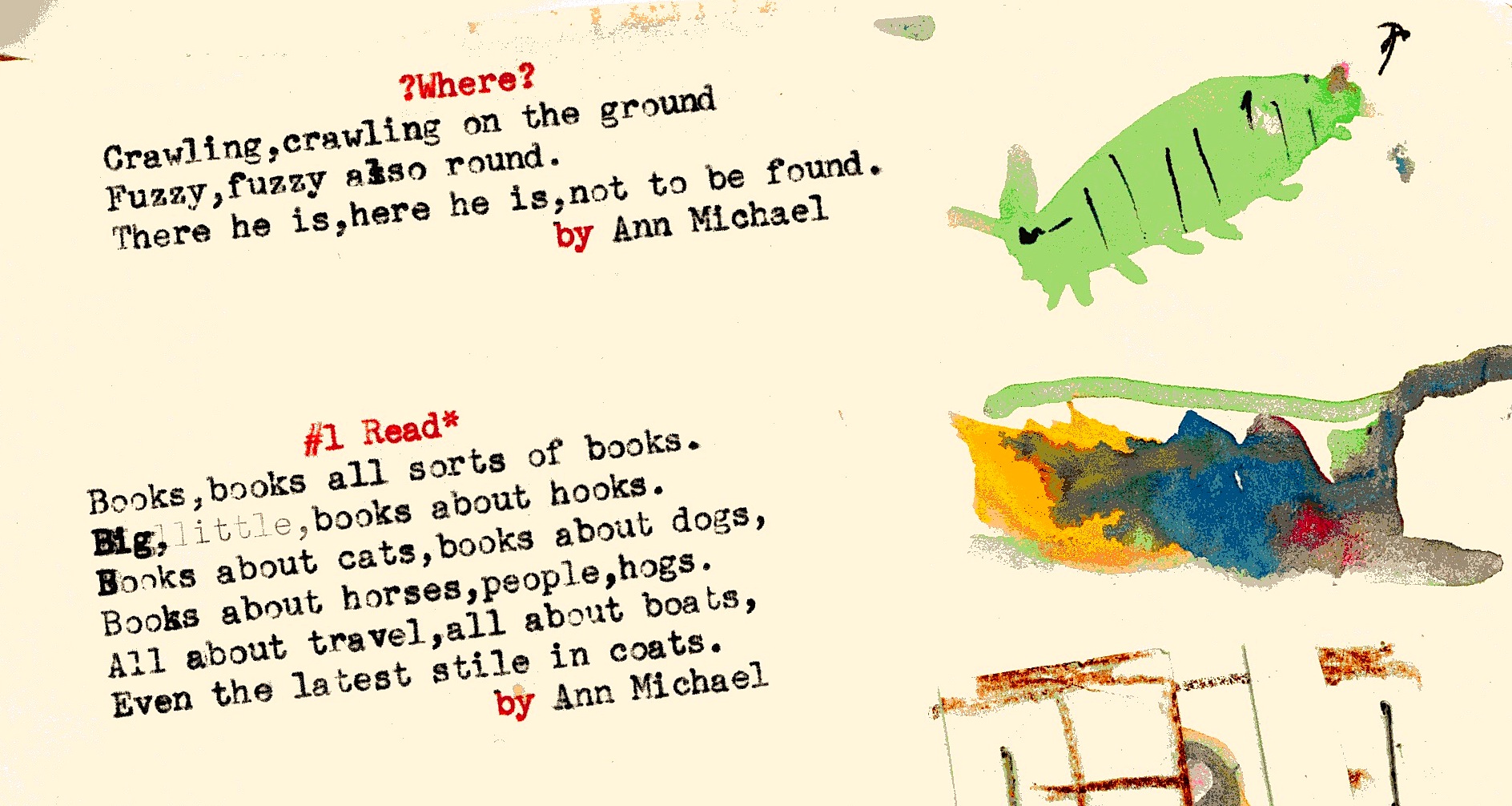
I don’t remember when I began writing. My storytelling began early, and I suppose the writing developed from there. The first story I recall writing down was about a princess; I was in second grade. I felt proud of myself, even though the story was only about three sentences long. Apparently, the poems started when I was about nine. I don’t remember writing poems then, but I recently found some that I had composed and typed up (I was fascinated by the typewriter), and my mother’s notes said I was nine when I wrote them. What I really wanted to be was an artist, but writing seemed natural to me. I started keeping a journal when I was ten…
9yroldpoems010

Rhyming and typing and illustrating and bookmaking– at nine years old.

  1. What influences have been important to you?

Other writers, naturally, but first of all, visual art. From the time I was very small, I’ve loved paintings and sculptures and architecture. Church hymns and Bible verses and nursery rhymes were influential to me, as well as folk music and the lyricists of popular music when I was growing up. I am also influenced by non-fiction work, especially in the sciences, and philosophy. My early poetry influences were Donne, Shakespeare, Blake, and the King James Bible; but then I fell in love with contemporary women writers, then surrealist poets, then Latin American writers, then Asian poetry, then contemporary lyric poems…it goes on and on. It might be easier to say what I have not found particularly influential!

~~

With further reflection, I could go deeper about early images that have become, for me, “key” aspects of my writing voice…a particular landscape, the feeling of an empty nave, bees and birds, milkweed, cloud patterns, my parents singing, my little sister beside me in our shared bed, the sound of a symphony. They may not appear in my poems as such, but these images connect with me in ways I probably don’t understand. What do such keys unlock, I wonder?

~

Voice

I follow the Women’s Poetry Listserve (Wom-Po), and recently there was a discussion there concerning what poetic voice is. Can it be defined clearly? Does it differ, and if so how, from style? Is it personal, belonging to the writer herself–an attitude? Is it distinct from the creator of the poem, as the “speaker” of the poem arguably is in the case of poetic voice/persona?
A listserv member offered this quote from Kunitz:
“One of my convictions is that at the center of every poetic imagination is a cluster of key images which go back to the poet’s childhood and which are usually associated with pivotal experiences, not necessarily traumatic. That cluster of key images is the purest concentration of the self, the individuating node. You can tell the poets who are working at their center by the distinctiveness of their voice, their constellation of key images, their instantly recognizable beat.” … from Stanley Kunitz‘s 1975 lecture at the Library of Congress, “From Feathers to Iron.”

A constellation of key images may seem to be imagery, not voice at all; but Kunitz’s decision to connect distinctive voice with a recognizable beat and images, and to further suggest that these mesh to in the compositions of a poet who is writing with clarity and authenticity (my interpretation of what he means by “working at their center”), indicates that voice is a critical component of poetry. I have read the above-mentioned lecture, but Kunitz does not there elaborate on whether he means the writer’s personality, style, or attitude or whether he means, instead, persona. It seems to me, though, that he wasn’t talking about persona (the “speaker” or mask the writer uses in an individual piece). I interpret that the key constellation of images, the “individuating node,” would have to be personal experience of the actual writer–Roland Barthes be damned.

CH Chucrch

Gaston Bachelard’s phenomenological approach to poetics and, to some extent, psychology, appears to jive with Kunitz’s pivotal childhood images. It is easier to recognize one’s own key images in one’s work, of course…and I cannot help but recognize that Kunitz has nailed it for me, at least, if not for all poets (writers, artists, musicians, etc.). My own cluster of images, drawn from childhood, include the church. Also the beat of hymns and responsive readings and the King James and RSV Bibles. Also the bleat and wail of diesel engine horns, the progression of fields and trees and flowers, the hum of highways, the sluggish flow of certain rivers. To mention but a few that stay with me.

I am not an adherent to any particular style or form of literary critique, and I am not a whole-hearted phenomenologist, either–but I have to admit that these concepts (the individual’s key images, the individual voice and the persona voice, the rhythm or beat of a writer/speaker) intrigue me. I find them well worth exploring, mulling over.

See Dave Bonta’s Via Negativa post here for a mini-photo-essay that illustrates what I mean.

Gestation

Without committing to any resolution to do so, I spent some time recently with my own poetry: the unfinished drafts, the partially-revised pieces, the fragments and the poems I had put aside for the time being. “For the time being” was, in some cases, over a decade.

This putting-aside led me to wonder what process–other than forgetfulness–leads me to abandon a poem for such a long time. I am aware that artists in other media experience this sort of pause in the working of making; sometimes, the years on a project are full of revision and detailing (Rodin’s doors “The Gates of Hell,” for example) but often, the composition just lies about for a perhaps-indefinite number of years. I believe the poet Donald Hall refers to this as a poem’s necessary gestation.

In a 2008 interview (by Wendy Andrews), Galway Kinnell said, “When I can take a poem of mine that I think is finished and put it aside for a month and pick it up and read it and find it interesting, and if I encounter no place where I think it should be changed, and if at the end it surprises me, even though I wrote it, I think it might be done.”

That’s what I have been endeavoring to accomplish for the past two weeks or so: a reading of my own drafts to discover whether any of the poems are capable of surprising me, or if any of them might be revised into achieving that state. It is a lengthy project and a quiet one that requires considerable internal analysis and an objective stance. And maybe that is one benefit to letting the work sit around for so long…by the time I peruse the draft again, I have forgotten the initial inspiration, so the poem has to operate on its own merits as a composition rather than through any residual inclination or emotional attachment I may have once had for it.

If my own work manages nevertheless to impress me in some way, I tend to harbor the hope that it may be salvageable. If not, I can keep revising, or put the drafts into my “dead poems” file and consider it incapable of resuscitation.

The parallels to pregnancy and gestation may be inevitable–parents harbor hopes that their children will be good people who are successful in the world, just as poets want their poems to be “good” –but that sort of gestation analogy only goes so far. We cannot revise or rework our human offspring, and an objective analysis of their strengths and weaknesses is unlikely to lead to betterment of either party. But a work of the imagination can be re-envisioned, reconsidered, and made new.

That’s the work of the next many weeks. I am curious indeed as to where the work, after its long gestation, will lead me.

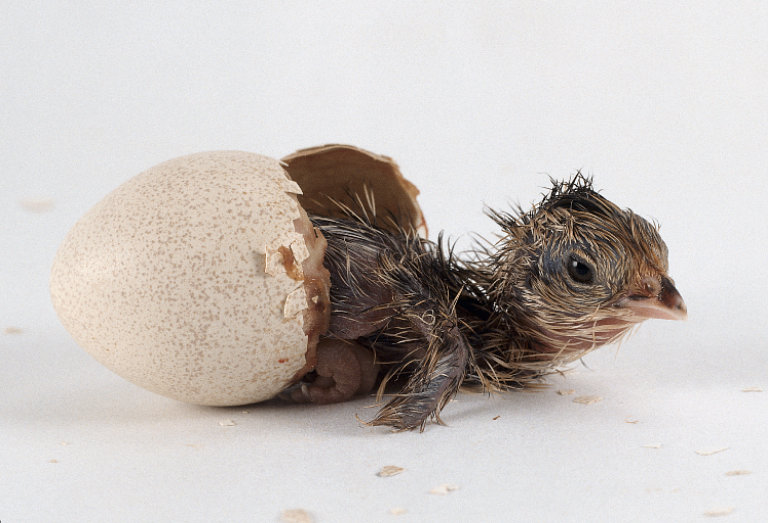
chick-hatching

Synthesis & coincidence

&&001“and per se and”

Ah, synthesis! The conjoining and combining of objects, ideas, theories, values and systems, arts, media, experiments, research, disciplines, metaphors, symbols, rhythms, patterns, DNA, et (“&”) cetera.

Synthesis can be planned, hypothesized, purposeful–and it can be spontaneous, unexpected, coincidental. There are times when I feel as though the overlapping and intertwining of experiences seems to have been somehow “planned by the cosmos” (or some higher power); but coincidences occur more often than we think, especially when our consciousness is primed to make connections.

I have primed my own brain, recently, to synthesize thinking about aesthetics, neuroscience, the arts, philosophy and consciousness. So it should not surprise me–though it does!–that the books I have recently been reading connect many threads of my thought, including other recent readings. For example, Martha Reineke’s Intimate Domain: Desire, Trauma, and Mimetic Theory is an exploration of family “romance” in psychoanalytic theory that draws on Freud and Girard; but because Reineke uses Girard’s early writings as her basis, she cites Merleau-Ponty and phenomenology quite often. Furthermore, mirror neurons and the place and operations of consciousness appear in her claims and explorations in this (difficult) text. Mirrors and mimesis, minds and spirits…Gabrielle Starr’s Feeling Beauty, which I’ve mentioned in recent posts, examines the art-body-mind connections in neurological domains and mentions, more than in passing, the phenomenological aspects of the experience we term “art.” Arthur Danto’s The Transfiguration of the Commonplace: A Philosophy of Art (1983, though I read it last month) also wove itself into my thinking as I read Starr’s more current book. In addition (oh, there’s always an “in addition” with synthesis), I am re-reading Csikszentmihalyi’s classic, Flow: The Psychology of Optimal Experience. The states humans experience when we work hard at challenges we enjoy, such as art-making, are deeply connected to our brains and also rooted in our bodies.

So there is a coming-together, a process not unlike chemical bonding, that all of these texts and ideas produce in my mind. This post is one outcome, I suppose. But there will be others.

~

From Carl Sandburg’s “Tentative (First Model) Definitions of Poetry” (1928): “Poetry is the achievement of the synthesis of hyacinths and biscuits.”

387236_10201085579685937_1062169370_n


The knot of contrariety

~
Sometimes, human beings feel contrary: irritable, grumpy, stubborn. It does not matter that we may be well-versed in rational critical thinking, or aware that a Zen approach can offer balance, or that an understanding of the psyche, or studies of consciousness, or even immersion in some sort of spiritual practice might help us to clear whatever baggage happens at this moment to burden us.
We’re just cranky, and for the moment, we feel justified in our contrariety. Here’s Walt Whitman:
I too knitted the old knot of contrariety,
Blabb’d, blush’d, resented, lied, stole, grudg’d,
Had guile, anger, lust, hot wishes I dared not speak,
Was wayward, vain, greedy, shallow, sly, cowardly, malignant;
The wolf, the snake, the hog, not wanting in me,
The cheating look, the frivolous word, the adulterous wish, not wanting,
Refusals, hates, postponements, meanness, laziness, none of these wanting…

~

What appeals to me in the passage above is not so much Whitman’s confession–any of us might admit to others our foibles and our sins–but the extravagant and beautiful mode of his expression: lists, near-synonyms, expansions on meanings, metaphors following the verbs, nouns, and adjectives, “none of these wanting.”

128-2848_IMG

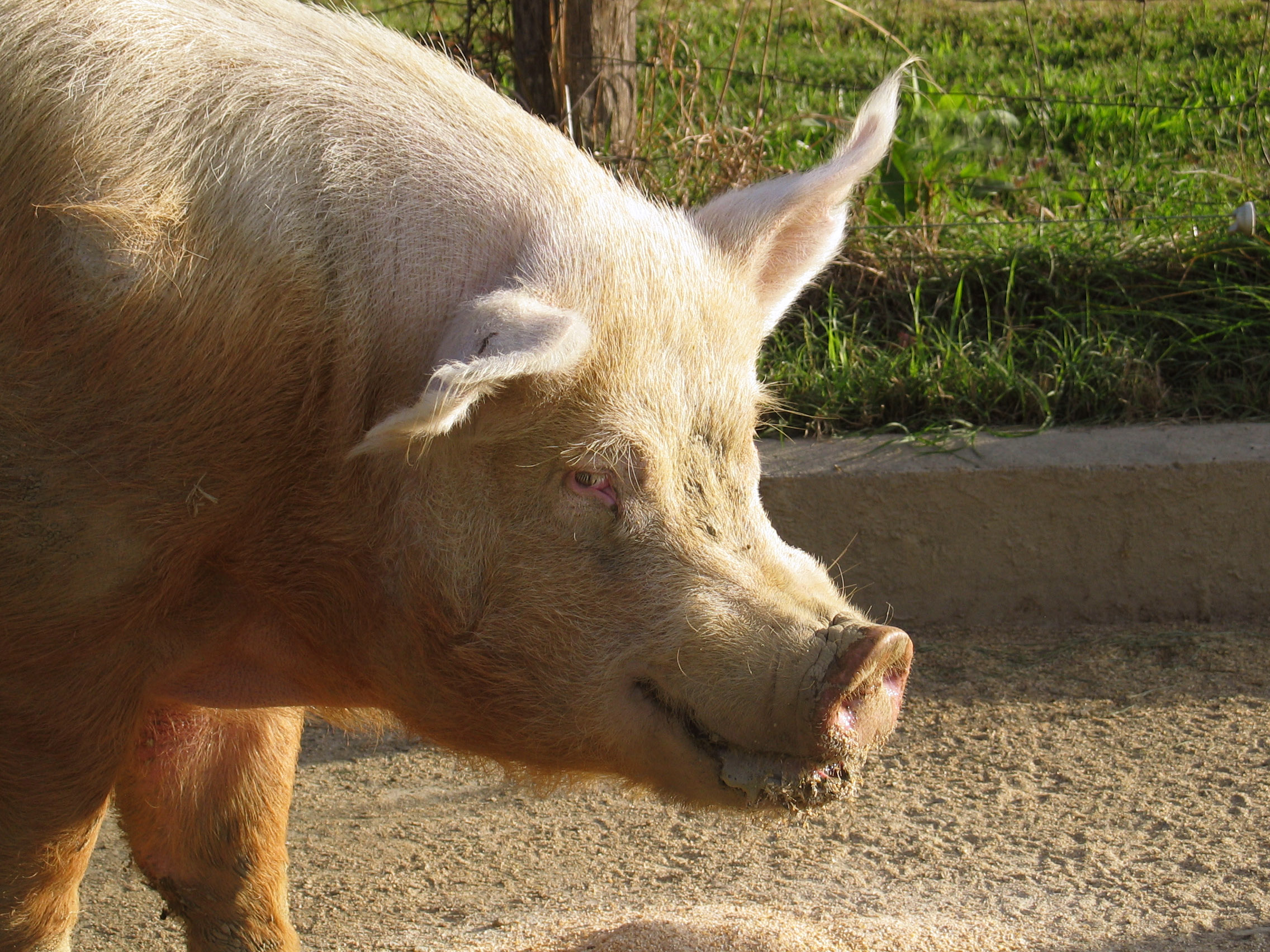
Hog… [His name is not Walt]

What appeals to me, really, is the way these lines make the litany of our petty evils so beautiful to behold. Perhaps that indicates that the aesthetics of a poem move the purpose beyond mere description and into the realm of art. I will be reading more about this in the coming week as I make my way through the book Feeling Beauty: The Neuroscience of Aesthetic Experience by G. Gabrielle Starr.

~

Meanwhile, I am threading my way through the thorny knottiness of everyday life, trying to shed my contrariety as I proceed.

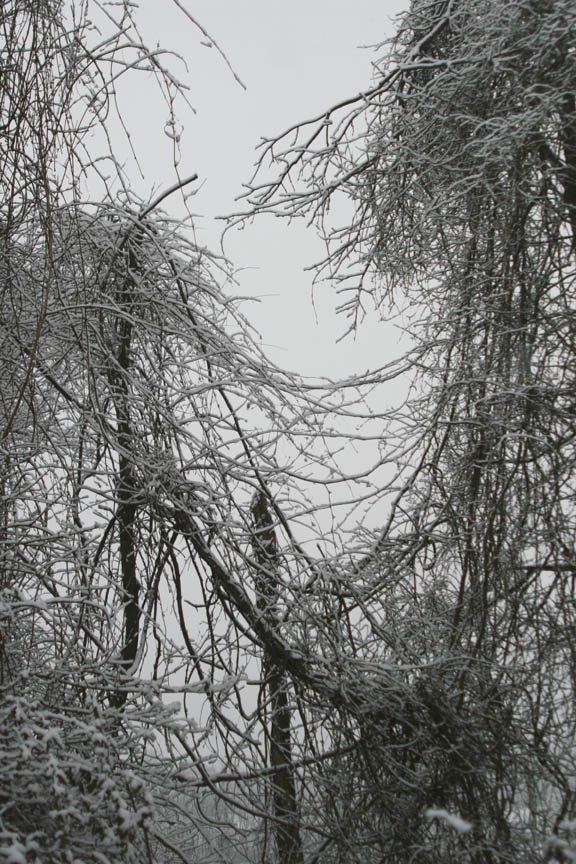
Knotted vines

Knotted vines

Local vs. National

Election season is upon us, and this being a non-presidential voting year, US citizens tend to avoid the polls in droves. I’ve been talking with my students about herd mentality, informational cascades, and the pros and cons of non-conformity recently; local elections make a good example of the theory that people tend to do what they think others are doing (see this post for more on conformity and dissent). Which may include not doing what others are not doing, such as going to the polls.

This train of thought got me thinking about poetry, oddly enough. Years ago, when I was more ambitious for myself, I spent considerable time and effort trying to get my work published in national journals. There was, for me, a sense that the cachet of publication in certain “top tier” magazines would somehow confer legitimacy on my work (vocation or avocation, depending upon how one defines being a poet in the USA). But I am not strongly suited to the organization, persistence, and promotional oomph required to get my work into the limelight; also, I may have lacked the required talents as a poet. At any rate, during that time in my writing life, I was advised to avoid ‘local venues’ of publication because these were not top-tier and might devalue my work.

To which I now say: humbug!

Annshumbug1

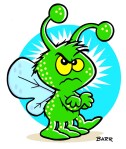
Humbug by Steve Barr, cartoonist

~

Local voting is crucial to a democratic society. Local politicians and local legislative changes affect a voter’s life more immediately than national elections do.

By the same token, local arts potentially have more impact than nationally-known artists and art events; yet citizens are often rather clueless, and often woefully unsupportive, of regional arts and artists. (To visit Steve Barr’s website, click on the humbug.)

I am no longer a young, ambitious poet who aspires to national prominence. My ambition revolves more around becoming the best poet I can be given my abilities, education, and circumstances. Furthermore, I now firmly believe that local is a crucial step in global: the two can no longer be separated, as parts of the environment, the social and economic and cthonic ecosystems that are intricately dependent upon connections and relationships.

I am happy to report, therefore, that I am one of three regional, if virtual, “resident poets” for the autumn season of the online e-zine Lehigh Valley Vanguard–a local journal devoted to the “subversive arts.” Several of my poems will appear among its posts over the next three months. Please check occasionally for poetry postings! The first of these is “Post-Exodus,” although an earlier poem, “Regional Conflicts,” appears here.

~

My ambitions for my own poetry center, these days, on what I want the words and the work to accomplish regardless of status or publication. My aesthetics have perhaps changed along with my assumptions…and my evaluations of the value of local and national and global recognition.

Local is where I live. Local’s good. Check out the Vanguard, and take a little time to find out what’s happening wherever it is you reside.

~

Here’s another bug. 🙂

Difficult writing?

Here’s Will Buckingham on writing and difficulty. Worth a read! I don’t know how to embed the blog into my post, so here’s the link.

http://willbuckingham.com/the-pleasure-and-difficulty-of-writing/

Writing can indeed be a pleasure–most of the time! There are periods of difficulty when I feel frustrated, but those periods make for puzzles and challenges; and I enjoy puzzles and challenges. They push me, force me to stretch a bit, engage with what’s not so simple or superficial, change my perspective, alter my expectations and assumptions, discover something new. I learn from these experiences. I would not want life to be easy all the time, nor would I want creative writing to be easy all the time. Although it’s pleasing to lie in a hammock on a mid day and sip a cold drink and listen to the birds and read a book…pleasure also encompasses inventive challenges. Motivation. Inspiration. Different forms of joy.

Buckingham mentions a biography of the writer and artist Tove Jansson, best known in the USA for her Moomintroll series but clearly a creative artist of the first rank. I’d put this book on my reading list, but it is at present only available in Finnish! Marina Popova at Brainpickings has posted some of Jansson’s vivid illustrations of Alice in Wonderland here.

On the pleasures of difficult reading, please see my past posts here, here, and here.

Mimesis

Mimesis: “Imitation, in particular. 1.1 Representation or imitation of the real world in art and literature”… “a figure of speech, whereby the words or actions of another are imitated” … “the deliberate imitation of the behavior of one group of people by another as a factor in social change” (OED).

“Nature creates similarities. One need only think of mimicry. The highest capacity for producing similarities, however, is man’s. His gift of seeing resemblances is nothing other than a rudiment of the powerful compulsion in former times to become and behave like something else. Perhaps there is none of his higher functions in which his mimetic faculty does not play a decisive role.” —Walter Benjamin (“On the Mimetic Faculty,” 1933)

~

From time to time, I mull over mimesis and its role in human learning. Research on animal behavior since Benjamin was writing has somewhat undermined his assertion that the “highest capacity for producing similarities” belongs to human beings, but the concept remains generally accurate. What I notice among my students, however, is the human ability to perceive differences. My students much prefer to focus on what makes things different than on what makes them similar, but perhaps the reason is that similarities seem so obvious (due to our capacity for “producing similarities”) that we take them for granted. I introduce poetry to my students as an ancient art derived from exactly what, no one is certain, but likely from invocation or ritual or song or the human desire for narrative–and I tell them that it has been carried along through history by, among other compelling things, mimesis–that mimetic faculty we possess that makes us want to repeat or copy, in order to learn, to love, to pass along, to entertain, to communicate, to enjoy. We can look in the mirror and see another human’s face, or our own faces slightly changed through the process of copying another.

The mimetic urge has a long history among those people who intellectualize. Theories of Media (Univ. of Chicago: W. J. T. Mitchell) glossary offers a concise but comprehensive “mimesis” entry authored by Michele Puetz–the article in which I found the Benjamin quote above. (By the way, the Theories of Media glossary project is a great resource!) As I looked through my go-to philosophy resources, though, I was left with the distinct impression that the concept of mimesis has moved from the realm of the philosophical–Plato and Aristotle are our main thinkers on mimesis in the philosophical arena, so that’s pretty far back–and into the realms of sciences, both social and biological. Mimetic response has been researched, and speculated upon, by psychologists, cultural anthropologists, and neurologists (see the initial excitement about “mirror neurons” in this 2006 New York Times article). The term has found considerable employment in the writings of Rene Girard, whose writings span cultural anthropology, literary criticism, psychology, theology, and philosophy.

Writes Gabriel Andrade, in the Internet Encyclopedia of Philosophy:

“Girard believes that the great modern novelists (such as Stendhal, Flaubert, Proust and Dostoevsky) have understood human psychology better than the modern field of Psychology does. And, as a complement of his literary criticism, he has developed a psychology in which the concept of ‘mimetic desire’ is central. Inasmuch as human beings constantly seek to imitate others, and most desires are in fact borrowed from other people, Girard believes that it is crucial to study how personality relates to others.”

Clearly, human psychology and biology cannot be simplified to mere reflection and copying, but it is equally clear that the metaphor of mirroring can be fruitful as we explore the complexities of mind and consciousness, culture and art. Sometimes I take on the role of educator; and when I do so, I recognize the need for student learners to imitate, to hear information repeated, and to attempt to create their own “similarities.” Sometimes I take on the role of poet; and when I do that, I am clothed in centuries of form, rhythms, sounds, similes, stylings and borrowings and references: copies and reflections, altered through time.

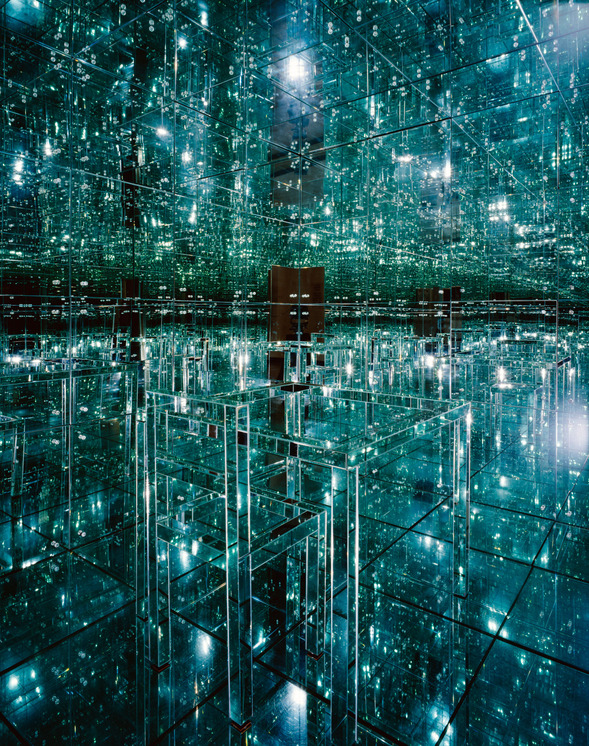
Mirrored Room by Lucas Samaras

Mirrored Room by Lucas Samaras Photo: © Albright-Knox Art Gallery/CORBIS

~
A brief aside: When I was eight or nine years old, I went with my parents to an art museum–it may have been the Chicago Art Institute–and there was an installation of Lucas Samaras’ piece “Mirrored Room.” [See the photo at left.] I was deeply impressed by the mirrored room, partly because it was inside this artwork that I finally understood, metaphorically, the concept of infinity. I was awed by the many diminishing selves I could see, the way a single “I” could change (in size), and by the tricks of light and how easily one could get lost in such a small space.

The mirrors copied me.

Mimesis implies something active, a borrowing, a taking–a kind of theft, on the one hand, and a kind of tribute or ritual motion on the other. It is also inherently continuous. The behavior does not stop at the first copy; it is carried on, perhaps through generations, like DNA.

Here is the brilliant Anne Carson:

“[It’s] what the ancients mean by imitation. When they talk about poetry, they talk about mimesis as the action that the poem has, in reality, on the reader. Some people think that means the poet takes a snapshot of an event and on the page you have a perfect record. But I don’t think that’s right; I think a poem, when it works, is an action of the mind captured on a page, and the reader, when he engages it, has to enter into that action. And so his mind repeats that action and travels again through the action, but it is a movement of yourself through a thought, through an activity of thinking, so by the time you get to the end you’re different than you were at the beginning and you feel that difference.”

~

Carson describes how I feel when I’ve read a poem or novel that moves me deeply. For that matter, it is how I feel when I find a work of visual art, or a play or dance, that seems to speak with immediacy to my own sense of experience, which arouses my passion, compassion, or emotion and alters my entire psyche for awhile– “by the time you get to the end you’re different than you were at the beginning and you feel that difference.”

Sometimes I even manage to compose a poem that gives me that sense of feeling different than I was at the beginning. On those rare times, I may look at myself in the mirror and see a changed face.


Symbiosis: Lichen, moss, John Donne

lichenslate~

Lichen on slate makes a kind of mandala, a small moon, or star, of mutualistic symbiosis–because lichens are amazing compound organisms: a fungus and an alga, although apparently there can even be three living, botanical parts to some lichens. I find this amazing. Unsurprisingly, “Reproduction can be tricky for a compound organism,” because which organism’s reproductive directive does a composite organism adopt? Some explanations can be found at this site, the homepage of THE book on lichens by Irwin Brodo and Sharon and Stephen Sharnoff.

It is spring. The rain brightens up the mosses, and photosythesizing organisms begin to turn green. Bryophytes lack a vascular system, so they cannot draw water up through capillary action via xylem cells. They have to absorb water instead, and that is why mosses generally need moist, shady places in order to thrive.

Mosses decay, adding more moist humus to keep the soil damp or to extend the reaches of creeks very gradually, which is good for the riparian ecology and for the moss. A more metaphorical symbiosis, but we could stretch the concept.

japanesemapleSymbiotic relationships fascinate me, partly because of the evolutionary brilliance–nature is so “wise”–and partly because symbiosis is richly metaphorical if one’s inclined to think that way (which I am). For example, my personal sense of the relationship between art and poetry feels symbiotic: the disciplines “need” one another, help one another out, in terms of how I imagine and structure my world.

I do not think the world needs me, but I need the world; that’s dependency, not symbiosis. But mutualism–human beings need that reliance on one another. We are community-building creatures for all our harping on being self-reliant and independent. “No man is an island.” That over-used phrase (along with the over-used phrase that closes the same poem) is worth revisiting in Donne’s original:

No man is an island,
Entire of itself,
Every man is a piece of the continent,
A part of the main.
If a clod be washed away by the sea,
Europe is the less.
As well as if a promontory were.
As well as if a manor of thy friend’s
Or of thine own were:
Any man’s death diminishes me,
Because I am involved in mankind,
And therefore never send to know for whom the bell tolls;
It tolls for thee.

~

“Any man’s death diminishes me/because I am involved in mankind.” Would that more of us would remember these lines, and consider how they inform the poem’s lovely and significant purpose.

Ink art

Last weekend, I went to New York with friends to see the Ink Art exhibit at the Metropolitan Museum of Art. The art, all of which is contemporary (the oldest artist represented was born in 1953), has been installed in the museum’s extensive Asian galleries alongside ceramic, sculptural, religious, and paper works going back centuries.

The rationale behind this juxtaposition, says the museum’s site, is to point up “how China’s ancient pattern of seeking cultural renewal through the reinterpretation of past models remains a viable creative path. Although all of the artists have transformed their sources through new modes of expression, visitors will recognize thematic, aesthetic, or technical attributes in their creations that have meaningful links to China’s artistic past.” That certainly proved true for me; and I cannot decide which was more intriguing, the similarities or the differences.

The young artists in Ink Art employ age-old cultural tropes: the triptych, the scroll, woodblock printing, calligraphy, moody landscapes, ideograms, ink, and repetition. The resonance with Chinese heritage is palpably authentic and is often employed in the service of criticism, mostly criticism aimed at the destruction of cultural icons and of the environment (some of the represented artists are exiles). Mounting the exhibition in the Asian galleries meant that the visitor confronts the historical and the contemporary simultaneously.

In Yang Yongliang’s “View of Tide,” the artist uses digital photography collaging to replicate the mood of an ancient Chinese landscape scroll which, on closer inspection, reveals that the austere and mystical imagery of sea and mountains has been composed of smokestacks, highways, powerlines, and the like. I found this work powerful as commentary and shocking in the best possible way.

Being a word person as well as a visual art appreciator, I was especially drawn to the section of the exhibit called “The Written Word.” The highlight of this section is Xu Bing’s installation “Book from the Sky”. My friends and I–avid readers all–entered this room and felt shivers of recognition and joy at the concept of a room-sized, descending, ascending, wall-to-wall book. (I urge my readers to click on the link for a peek.) The information plaque notes “while the work is inspired by the form and typography of traditional Chinese woodblock publications, faithfully replicating every stylistic detail of traditional Chinese printing, not a single one of its roughly 1,200 characters—each printed with type hand-carved by the artist—is intelligible. Each of these imaginary characters conveys the appearance of legibility but remains defiantly undecipherable.” The paradox and the beauty of the concept are amazing; in addition, I find it oddly thrilling to think of the imagination and the craft and simple hard work Xu Bing put into creating meaningless calligraphic pictograms, cutting them into woodblocks, and repetitively setting up the careful lines in rows on long scrolls.

What emerges when the scrolls are installed on ceiling, walls, and floor manages to be indecipherable but not meaningless. There is in fact much opportunity for meaning in “Book from the Sky,” and for discussion and interpretation and playfulness.

One example: after reading about “Book from the Sky” and taking in the environment for awhile, my friend Mark commented, “Imagine if you were a beginner learning Chinese script, and you encountered this room. You might just spend hours in here trying to figure out whether you could read any of it…I mean, if  you hadn’t read that it was indecipherable. Or even if you had that knowledge, maybe you’d spend a long time here thinking that at least something in all this text meant something you could translate. Wouldn’t that be awfully frustrating?”

Or maybe that’s the point?

Carved type for “Book from the Sky” by Xu Bing

~~

Conceptual metaphor. Art. Thinking. Decipherability; communication. These are large ideas, and crucial ones in the scope of human community. Without art–how can we encounter such metaphors? How would we share them?