Storms

This week, I’m reflecting on Kyna Leski‘s marvelous little book The Storm of Creativity. How to describe this text? It’s written by someone who teaches architecture as well as designs spaces, and who reads across disciplines and thinks both deeply and widely. It is not a how-to book; more of a how-it-works book. I learned of this book through Deborah Barlow (in 2015!) and finally have gotten around to reading it.

storm-of-creativity-cover-367x550

Leski uses the analogy of a storm system, from moisture in the ground or bodies of water through the gathering of the storm organizing itself into, say, a hurricane, and takes the process all the way through to dissipation (a kind of “death”) and restarting the cycle, when what we have is new again–and will not be exactly the same next time.

Rob Harle, reviewing the book, says:

“Leski’s approach is far better and much more practical than those found in books that delve deeply into neurophysiology, neuro-transmitters in the brain and so on when trying to understand what happens when creative people work. The neurological approach may be useful as far as it goes, and for specialized reasons. However, knowing that a certain neurotransmitter fires up a certain part of the brain doesn’t help us understand, or more importantly, deal with, for example, writer’s block. Leski’s storm metaphor and analysis does!”

Her vimeo video offers an animated visual of the storm process.

Here’s the thing: she captures the process as I myself experience it. I keep re-reading sections of this book and nodding in recognition. I am not the sort of person who spends much time analyzing creativity; I prefer to read how other people analyze the process and decide whether their reflections or analyses dovetail with my own. In this case, yes. For me, anyway, the creative process organizes like a storm.

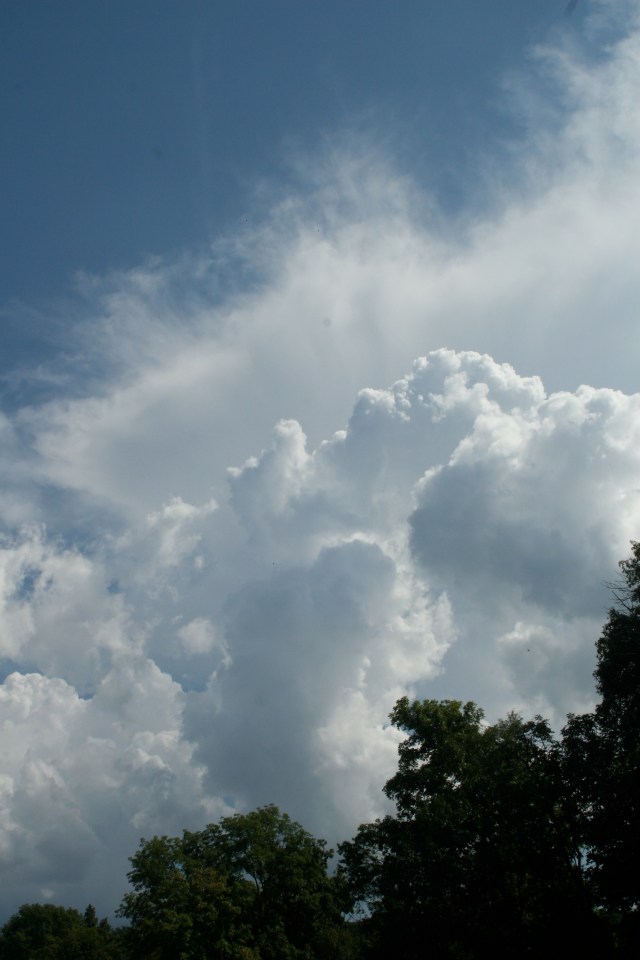
The gathering part of the work coincides with that aspect of writing that I call observing. Gathering is a good word for it (Leski uses denotations and etymology as she defines her process, so that appeals to me, too). There’s a phrase my relatives used referring to someone daydreaming or loafing reflectively: “woolgathering.” Despite this interesting inquiry into the appropriateness of the phrase to mean loafing or daydreaming, in our family it meant daydreaming. I used to think the phrase referred to watching clouds–one of my favorite activities as a child–because clouds often look like wool. At any rate, woolgathering’s essential to my writing practice.

And sometimes, those clouds collect together, and create a storm.
IMG_5605


Bro-ken

In the northwest sky this morning, mackerel-sky and mares’ tail clouds like fins, wispy and broken up against the blue, brought to mind the book I’m reading: Robert Macfarlane’s Landmarks. In this book, essays on place and environment interweave with “word hoards” or mini-dictionaries, a rich lexicon of regional terms that describe specific observations concerning weather, geographical formations, topology, the sea, plants, moorlands, mountains, and mines. He uses the word adit! (See my post here.)


7e47a62eacd4a9462e664b3e9b043031

mares’ tail clouds


Macfarlane’s word hoard draws mostly from the British Isles, but his essays–in this collection, many are based on books he has loved–assert that naming is noticing, noticing is loving, and loving means preserving or saving. “Language deficit leads to attention deficit,” he says. He’s not incorrect. My own experience concurs; for the past few years, I have had less time and energy to walk my meadow and take the two-mile amble along the back roads of our neighborhood, and as a result, my written expression feels both a bit contracted and less precise. I need to get back to the land.

Meanwhile, more broken things, from which (see this post) we may encounter or derive good words. The most recent break happens to have been the nose of a Best Beloved. I think it is time the broken things spell gave us a break.

In that vein, here’s a 1932 poem by Carl Sandburg, “Broken Sonnet”:

May the weather next week be good to us.
The strong fighting birds, so often ugly,
Jab the songsters and bleed them
And send them away; the wranglers rule,
The fast breeders, the winter sparrows,
The crows.  The weeds, the quack grass,
The tough wire-grass, they have it all
Their way.  May the weather next week
Be good to us.

~


Thesaurus obscurus

When I moved into my work office many years ago, I inherited a bookshelf with a few books on it. There was a battered paperback Volume I of The Oxford Anthology of English Literature; A Manual of Style, 12th edition (1969) from University of Chicago Press; The New American Bible for Catholics; a Catechism; a Bartlett’s; several old volumes of The Writing Center Journal; and Webster’s Collegiate Thesaurus from 1976. There was a dictionary as well.

Of these older reference works, the one that most entertains me is the thesaurus. The editors employed the alphabetical-style organization, reasoning that a “main entry of a concise statement of the segment of denotation in which a group of words can be construed as synonyms, a strictly alphabetical organization, and the entry at its own alphabetical place of each word that appears as a synonym at a main entry” would “minimize the consultant’s need to grope and guess.” *

But what puzzles me is the choice of entry words in this 1976 text. What college student, ever, would be searching for a synonym for entrammel? Or phthisis? Or incondite? [By the way, WordPress’s spelling checker does not recognize any of these words, although they are all acceptable English terms.] Exanimate may be an interesting replacement for “dead,” but why make it a main entry in the thesaurus? I was a college student in 1976, and I cannot imagine consulting this book in order to find a suitable synonym for drossy. “Worthless” or “pointless” would have sufficed in most cases–and why make the choice of inutile? Wouldn’t that impede the reader’s understanding? Or maybe not–the reader for university writing would have been a scholar, I suppose. brad-hammonds-flikr-books

I find myself wondering whether these choices reflect an era on some sociological level, and on what level that might be. My freshman reading list was longer and “more difficult” than the reading with which my current students are tasked, but those assignments were based on the assumption that we had read considerable canon literature in high school. Nonetheless, in the 70s, we were not scrambling to find synonyms for fainéant unless we were trying to paraphrase a source.

Maybe the answer lies in how long it used to take to get a reference text produced. Surely the research for the collegiate thesaurus would have taken ten years or more; and the text would have been edited by many persons and proofread, typeset, proofed again and again before getting to the printing press, being bound, and finally reaching bookshelves in college bookstores. Were college students in the late 1950s more likely to write using the word culmen or adit?

Honestly, I’m thinking: No.

~

These days, there are many online thesauruses; but they tend to give short shrift to English’s wide range of approximate synonyms, each with their connotations. My students’ papers often suffer from vague and random use of online thesaurus “suggestions.” The electronic thesaurus, like the dictionaries and encyclopedias online, fail in another important way: it turns out that groping around for a word or a meaning can lead to stumbling upon new words, new connotations, and interesting forays into the depths that our language has to offer.

Anyway, I appreciate an out-of-date reference text for historical and linguistic reasons and because–you never know–sometimes those archaic words inspire, influence, or appear in one of my poem drafts. Groping and guessing may impel a Parnassian to chivy exceptional words through the adit of English and wraxel with new expressions.

~~

* Seriously. Try to unpack that series of dependent modifying phrases. I even edited down the sentence!


Acedia

While sorting through my work, I found a poem titled “Acedia,” and I have been musing on the concept again. The poem (below) referred, when I wrote it, to a kind of numb depressive state. In contemporary English, the term means boredom, ennui, apathy–with connotations of a spiritual aspect to the torpor. PsyWeb says, “Acedia refers to a failure of will to control one’s longings or reactions to daily life, while depression is considered a medical condition or a failure of the body.”

Doing a bit of research into the etymology and history of the word took me to the Desert Fathers, Christian hermits in the early centuries of the faith. Acedia referred very specifically to a kind of spiritual laziness. Here’s a little tour of the history by Kelsey Kennedy on Atlas Obscura:

Evagrius was a member of the Desert Fathers and Mothers, a group of devout Christian monks and hermits who lived in the Egyptian desert beginning in the third century. By the time Evagrius joined their ranks in the late 300s, there were several thousand monks living in organized communities. They spent their days fasting, working, and worshiping, often in isolation. When the sun and the heat peaked, life could be quite uncomfortable. So it makes sense that Evagrius dubbed acedia the “demon of noontide,” a reference to Psalm 91. Siegfried Wenzel, in his book The Sin of Sloth: Acedia in Medieval Thought and Literature, wrote that “in the end acedia causes the monk to either give in to physical sleep, which proves unrefreshing or actually dangerous because it opens the door to many other temptations, or to leave his cell and eventually the religious life altogether.” Acedia could be resisted, but only through endurance, prayer, and sometimes even crying.

John Cassian, a student of Evagrius’s…helped spread the concept of the cardinal sins beyond the Desert Fathers. But as soon as acedia left the desert, the demon of noontide started to become a whole different animal.

What it became was the cardinal sin of Sloth. But Despair continued to be viewed as dangerously heretical, because it led to suicidal thinking (and suicide was until recently classed as one of the mortal sins).

Thomas Merton, in his book Thoughts in Solitude, supports (without quite saying so) the Roman Catholic view that despair is a sin; but, as is usual for Merton, he frames the depression experience with compassion and offers a gentler perception of the experience. He suggests that when a person believes of him or herself “I am nothing,” there is another way of being with that thought: “I am not who I wish to be.”

This concept strikes me as so perfectly sane. When I have felt deeply depressed, the ingrained mind-numbing idea that surfaces is that I am worthless or that I am nothing. And really, what I feel is that I am not who I wish to be.

Why does the latter sentence feel less like despair? Anyway, it feels that way to me. Thank you, Thomas Merton.

Now here’s the poem in its revised-draft form, though I’m not sure it’s really finished yet.

~~

Acedia

It is what looked up at you
from the eyes of the wounded doe
what the clock said to itself
when the mainspring gave way.

It is the last few shudders
your father’s body made
when his heart wrote hopeless
on the hospital bed

the long sigh of a black dog
and your beloved’s parched skin
when she could make no more tears
and told you go now.

It is the dead nut
in the infertile basalt cave
it is all the days I tell you I can’t
but you are right

there is desire.
The numb body’s in-taken breath
yearning to stay alive:
remind me that it is desire.

~


Silence & solitude

Sara Maitland’s A Book of Silence. James Ragan’s Too Long a Solitude. Jane Brox’s Silence: A Social History. Thomas Merton’s Thoughts in Solitude

Is it just a coincidence, or did I subconsciously start reading books dealing with silence and solitude in the weeks before I planned to spend a few days alone in a friend’s rural cabin? And will the relative silence make my somewhat maladaptiveness to busy environs even worse? For I freely admit that living for thirty years in an area that borders on the rural, and spending so much of my time in the garden, has made me less inured to excess, human-made noise.

Sara Maitland writes, after spending some years outside of London ensconced in a quiet town, that “going to cities, to large parties, or to any place where there are a significant number of loud, overlapping but different sounds remains stressful and tiring at best.” This reaction is not mere “introversion”–indeed, for most of her life, Maitland appears to have been an exceedingly social and sociable person, quick with a retort, response, or witty reply and often in the company of boisterous, talkative people. She definitely cares deeply about relationships and communication, both between close friends or family members and between reader and writer/author. Like her, though more of a shy person in my younger years than she was, I value communicative aspects of conversation and togetherness while finding it harder than ever to live in the midst of noise pollution.

IMG_1997a

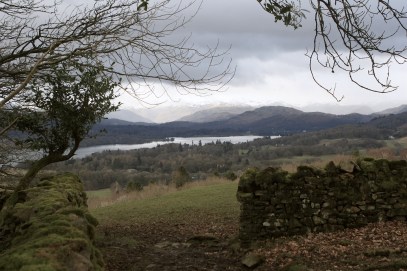
Near Windemere, where Wordsworth trod…

Of course, writing is a communicative act, a form of creating relationships between reader and writer, and therefore may not always or necessarily thrive amid silence, or in solitude, though that Romantic notion remains intact in most people’s minds. When I consider my own work, I recognize the lyric “you” (implying an Other), the narrative action (requiring the behavior of living beings dwelling in the world with Others), and various interactions among the lines that set up relationships that are not only abstract or metaphorical but concrete and physical, even when the poem skates along the reflective mode (how can there be a consideration of  a Myself without an Other?).

So although part of my brief upcoming “retreat” is, in fact, for solitude’s sake–a few days to be alone with my own writing process and make some creative decisions–the solitude’s less urgent than the silence. I’m not an ascetic nor a spiritual seeker, just a writer who wants a few days unplugged (and not entirely so) to mull through ideas and revise some poems. This process seems easier to me when I do not have to deal with anyone’s society, even the companionship of those I love. It’s been quite awhile since I last made this kind of silent time for myself, and I’m curious as to what will result.

Maybe just some naps and daydreaming, which might not be an entirely fruitless harvest.


IMG_6423.jpg


Prose poem, memoir

The prose poem seems a fraught and contradictory thing to its critics, a formless form, different in some way from flash fiction–more lyrical? More imageric? Lacking plot? Years ago, I went through a period of writing them, usually taking on a persona. Lately I find I am writing them again. Sometimes I think I’m writing a haibun, yet there’s no accompanying haiku. But mine do tend toward the lyric impulse.

And here’s a prelude to a prose poem draft, which follows (if you can be patient).

~

Perhaps it was not the most sensible thing to do, given my sore foot, but I had planned a trip to Poets House for a Finishing Line Press-sponsored reading by James Ragan and did not want to forego my visit. Ragan’s poems are lovely and often deep, and he offers a reading in the spirit of a raconteur. All the places I needed to stop were within three blocks of the A train, and therefore the main concern was going up and down subway stairs. It seemed do-able, and it was; though I am physically “paying” for my journey today, it was worth it.

The bus ride to New York and back takes about two hours, during which I read, nap, or daydream. We take the Lincoln Tunnel into town, a route familiar to me for decades, this time evoking memories that have been tucked away for ages.

Of course, some of this draft is invented–when I start writing, I often have no idea where I will end up. This one surprised me.

~

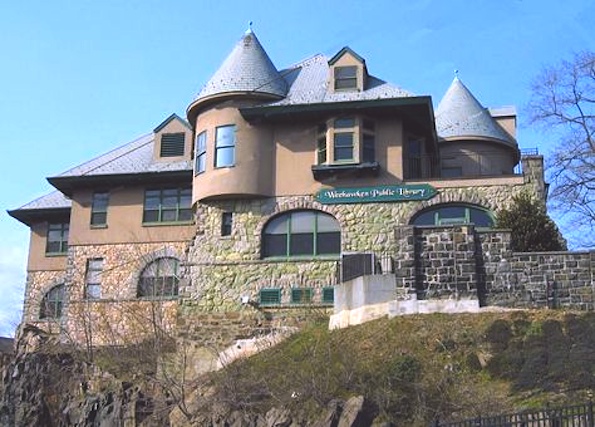
We were children in the years of Sunday drives, burning fossil fuels to tour the countryside and leave the city’s skyline, obscured in puce-yellow, lead-bearing smog, for tree-lined back roads and a picnic lunch. Sometimes over bridge, sometimes under the Hudson. Each crossing tested our bravery: fear of heights, of darkness. We had a song for the bridge which we sang while watching cables’ span. We were too small to see out the windows down to sailboats and barge traffic. The tunnel had no song. We hunched in the back seat, held hands, squeezed shut our eyes, expecting to drown. On the curved ascent in New Jersey my sister chose the house she wanted to live in—many-dormered, stone, with a round tower, it jutted over Weehawken. Once we’d learned to read, we realized it was the town library, which suited her imagined lifestyle. She would choose that even today, retire to live in a library and work part-time in a bookshop. She imagines I will join her there, perhaps I might.

~

Memory to prose memoir to prose poem. Founded on rocky physicality.


weehawkenlib

The Weehawken Free Public Library

Anticipation

Public relations and poetry are quite separate pursuits, in my mind, yet how else will readers learn that I have another chapbook nearing publication? Yes! Barefoot Girls, a series of 24 poems winnowed from a much longer set, will be appearing in print from Prolific Press later this year.

2021 still seems quite a way off, but perhaps it isn’t too early to mention that my full-length poetry collection The Red Queen Hypothesis will see publication then from  Salmon Poetry, an independent publisher in County Clare, Ireland.

Anticipation! I’m eager to see what the books will look like, eager to know whether anyone will read them, and experiencing that little frisson that comes with waiting for potential delight.

I cannot express how grateful I am to the folks behind small independent literary presses for all they do to keep poems circulating, to publish lesser-known writers, and to promote the literary arts generally. They are not making money from the process; they do it for love. Society benefits. Bless them all and donate to them if you can. But the best way to help small independent presses and publishers is to purchase books from them. Browse Prolific Press’ bookstore here, Salmon Poetry’s poetry book catalog here, and Brick Road Poetry’s books here (scroll down far enough & you’ll see my book Water-Rites, still available). Another small-press venture that has been plugging along for years is Michael Czarnecki’s FootHills Publishing. Two of my chapbooks are available from its website.

Dear Readers, purchase a few books from these stalwart independents, even when there’s a lower price used on Amazon. I’ll be thrilled if you buy one of my books but gladder still if you take a chance on an author you don’t know and discover some terrific poems and poets in the process.

Of course, when anticipation becomes realization and my new book becomes available, I will try to don my PR hat and let you know it’s in print. Thank you!!

bfg

Barefoot Girl ca. 1974 or 75

Waves & relationships

I had planned to take a little “vacation” from difficult books this summer and read a bit of fiction, go to the movies, work in the garden. And while Maryanne Wolf’s Proust and the Squid covered the challenging topic of reading and delved into some neurological explanations for the process of how we read and how literacy changes our brains, Wolf writes in layperson’s terms and divides her text into easily understandable chunks. It was a relatively easy read on a complex topic and reminded me that I need to re-read Proust’s famous essay “On Reading Ruskin.”

Then my dad said I should read Reflection in the Waves by Pablo Bandera. Here’s a physicist with a philosophical bent who tries “reconciling the realism of Aquinas with the empirical evidence of quantum mechanics.” I like Bandera’s interdisciplinary approach, a blend of physics–his main area of expertise, a “true” science–and philosophy, anthropology, evolution, even theology. Does Bandera entirely succeed in persuading me that the observer effect of quantum physics is a human-based, perspective conundrum that may not be a problem at all? Not completely, but it is an intriguing theory about which I remain open-minded. The recognition that being human alters the observing mechanism seems sensible to me.

I would never suggest that Reflection in the Waves is an easy read for the average informed person. It contains a few fascinating observations and summaries, however, that relate to human relationships (our need to connect), to communication, literature, and art. He writes:

What distinguishes us humans from other objects around us, including other measurement devices, is not that our reality is not somehow irrelevant for the physical world, but that our relationship to this world is such that it transcends the mere subject-object relationship currently envisioned by the physicist.

Reality=relationship to others and the world. That’s a contemporary way of interpreting Aquinas. I’ve never before thought of myself as a Thomist, and the very idea makes me giggle. But as a writer, especially as a poet, the relationships and connections in the physical world are the stuff of metaphors that engage the conscious mind of abstract thought and help to put the poem across to other readers’ minds (thank you, Maryanne Wolf). Perhaps not so far from philosophy, or physics, or neurology, after all.

Altered perspectives

One of the arguments Arthur W. Frank makes in his book The Wounded Storyteller–and in his subsequent books about “illness narrative”–is that there’s a compelling ethics for medical diagnosticians and caregivers involved in just listening to the other person’s story. The difficulty emerges when the storyteller cannot put his or her story into words or lacks enough objective distance from the illness to narrate the kind of story that others are expecting.

When people’s circumstances push into the chaos realm, they’re in the midst, overwhelmed; few of them can construct a cogent and concise narrative. In their pain, in their grief, everything seems equal–no beginning, no end, all middle.

The listener expects: a beginning. a middle. an end.

The listener expects: chronology. a goal. a desired outcome.

If the listener’s job means determining a course of healing, the listener requires history, onset, comparisons. Truly good diagnosticians therefore need more than sleuthing skills, experience, and education. They need to listen well in the midst of the storyteller’s chaos; Frank calls this listening with.

That often means taking a deep breath and endeavoring to change perspective.

~

[Which, by the way, is excellent practice for poets.]

Tibet-Mountains-Everest-Kailas-Tibet-tours-Tibet-travel-Tibet-trekking-Tibet-hiking-3-of-8-1024x676

Himalayas: view from a high lake plateau (Snow Lion tours)

natural_fractals_tibet

Himalayas from satellite: a fractal view

~
We cannot climb into an airplane and get an overview of a human being’s situation. Nor can we get into another person’s thought processes to determine what’s going on. Listening without rushing the person, without offering advice, without finishing the sentences with what we expect to hear–that’s a hard task.

In a previous post, I tried to replicate what it was I could hear when someone I cared for experienced cognitive damage.

It was very, very difficult to listen. For me, heart-breaking because of my previous understanding of who the person was. It was only in her final days that I started to realize I’d needed to change in my relationship with her in order to get some idea of what she wanted to say. And it was too late, really.

~

As another Best Beloved is now experiencing significant cognitive changes, I want to do better. I need to acknowledge the chaos narrative, the interruptions, the lacunae in the person’s story. It’s important that I develop a new perspective on what a conversation entails, too; my expectations surrounding a conversation no longer hold, and both of us will get frustrated if we stick to former habits.

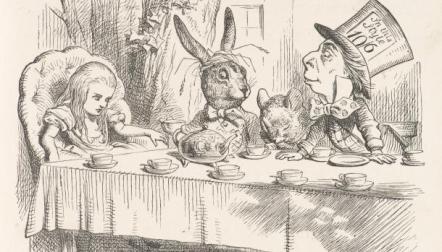
If sometimes a visit feels a bit like the Mad Hatter’s tea party, so be it. There’s a story in that, after all, thanks to Charles Lutwidge Dodgson.

mad hatter tea party tenniel

Tenniel’s sketch for Alice’s Adventures in Wonderland

And, just as an aerial view of the Himalayas alters the perspective of what the mountains are and how they appear, an altered perspective of a loved one keeps the person, as a human being still in the world (no matter how changed), in view. True, perhaps with changed patterns and unexpected gaps that we who love them may grieve the loss of. The conversations may be interrupted and chaotic, or full of long pauses and grasping for words and concepts. It is just a different kind of human communication.

Not what I expect, but what I am given. I’m trying to listen with, before it is too late.

Listen better

Arthur W. Frank’s The Wounded Storyteller, which I’m currently reading, deals with medical ethics, personal narrative, illness, and the community (all of us, really) who may need care, give care, and/or who realize there is a socio-emotional impact when friends, coworkers, and family members become ill and thus require care. A sociologist by training, Frank examines illness stories as testimonies that point to a social ethic and asks all of us both to tell more when we experience pain and to listen better when others are telling us about their experiences of illness.

“Tell me about your despair, yours, and I will tell you mine.”

Mary Oliver, from “Wild Geese

At first this idea sounds unpleasant–one thinks of the stereotype of tedious conversations among the elderly about various surgeries and too-intimate revelations about prostates, livers, stomachs, and bowels (my dad calls these monologues “organ recitals”). That response–evasion, withdrawal, revulsion–is exactly what Frank seeks to change.

But then I consider the way I have heard stories of illness experience from hospice patients. How varied they can be. Some fragmented, some specific, some pious, some stoic, some anxious. And some that are beautiful. These stories aren’t just for (about) the person who has undergone the suffering. They are also for me, the listener. “When any person recovers his voice,” says Frank, “many people begin to speak through that story.”

He later writes:

One of our most difficult duties as human beings is to listen to the voices of those who suffer. The voices of the ill are easy to ignore, because these voices are often faltering in tone and mixed in message, particularly in their spoken form before some editor has rendered them fit for reading by the healthy. These voices bespeak conditions of embodiment that most of us would rather forget our own vulnerability to. Listening is hard, but it is a fundamental moral act…in listening for the other, we listen for ourselves. The moment of witness in the story crystallizes a mutuality of need, when each is for the other.

He would like to see an ethics among medical people and caregivers that dictates not just a compassion for the lot of the ill person but a perspective that the person, as a person, is not diminished by the fact of illness–not made into data, case study, or even into patient or client, any of which reduces the person to a body containing disease or disability. He argues for a full embodiment of pain in narrative as well as in physiology, for only with and through storytelling can we begin to experience the perspective of the other.

I am not very far into the book yet, but I’m finding the concepts relevant to my current life circumstances. I know how deeply I treasure a good listener. So working on listening better, myself, offers more people the chance to recover their voices, to speak through story.