This weekend, I am trying to concentrate on poetry-wrestling, herding poems, culling and grooming and all that. So–less time to reflect on writing my own blog posts.
However! I follow many poets and writers, and one or two philosophy and science blogs, would like to direct my readers to two writers who responded to Mary Oliver’s recent death--both of these poets commented on Oliver’s reputation as a nature writer and a poet of “joy.” Reputation isn’t the same as analysis.
Here is Grant Clauser, wondering whether it will be possible for him to write gladness into his observations (which are quite keen and worth reading).
And here is Catherine Pierce, a poet much younger than I who admits to her own prejudices when deciding which poets to read–which poets are “worth the effort” of reading (ie, which writers teach us most about life and about poetry-writing).
The death of a beloved animal companion some years ago took me to Oliver then. And in the sorrow, I recalled the gladness of having that dog in my life.
“Nature poets” can be fierce, asserting the need for stewardship of our blue planet; poets who write happiness well understand–and convey–that pain and sorrow remain our companions in life. That does not mean a focus-on-the-positive Pollyanna attitude. No–to compose poems that show us we have every reason to love what we encounter takes bravery, because we so often fear what the world offers. To do so takes deep acknowledgment of suffering, not just a glancing nod, but compassion. The poet may not “behave well” in his or her own life but has the practiced gift of observation and enough craft to show the reader difficult perspectives.
Sometimes, gladness and optimism and beauty get obscured by experience and griefs. Next time that happens, maybe turn to poems?
My brother, whose avocation is science historian and whose papers I often proofread, has acquainted me with the 18th-c. comparative anatomist Johann Friedrich Blumenbach. As often occurs when one becomes attuned to new knowledge or focus, I suddenly seem to find Blumenbach’s name or theories “everywhere.” Mostly in books, of course, but also in a natural history museum where I came face to face with a trilobite that bore his name. I have also been reading Andrea Wulf’s book on Alexander Humboldt, The Invention of Nature; Blumenbach was one of Humboldt’s professors and influencers.
calymene blumenbachii
Wulf’s book begins as a biography of Humboldt but closes with several chapters on others who were inspired by his work; she makes the claim that Humboldt’s ideas about the deep connectedness of everything on earth laid groundwork for environmentalists and the discipline of ecology. Indeed, Darwin, Thoreau, Marsh, Muir, and many others found his texts revelatory and transformative. His writing is supposedly poetic and emotional–he did not think the earth and its denizens deserved less than awe and appreciation. Even though his books are packed with measurements, comparisons, careful botanical descriptions, and minute observations of practically everything he encountered, he allows space for admiring the view. Or, so Wulf’s book says. Now, I suppose I shall have to do a bit of reading Humboldt!
~
Along these lines, the lines of the natural world’s connectedness and relationships–ourselves among these, despite our frequent destruction of them–I find myself thinking of the recent death of poet Mary Oliver. I so admire the work and the woman, or what little I knew of her from a few appearances and through friends who studied with her. My social media feed has been alive with tributes, postings of her poems, and some critique about her standing as an American poet, as if that would matter to her (I doubt it would).
I can just make note that her poems have encouraged me to continue to write about nature, even when I’ve been told nature poets are unfashionable, uninteresting, or unnecessary. Her work taught me how to observe closely, like Aristotle at the tidal pools or Haeckel peering at radiolaria. First notice, listen; then describe, then try to obtain more information, and all the while percolate what experience has created within the observer herself. Maybe nothing earth-shattering comes of the process, but sometimes there’s a poem…
Here’s one of Oliver’s early poems (from Twelve Moons, 1979), one readers are less likely to find in all of the tributes to her but which offers a sense of how well-observed–for all their ‘simplicity’–her poems are.
Buck Moon–from the Field Guide to Insects
Eighty-eight thousand six-hundred different species
in North America. In the trees, the grasses
around us. Maybe more, maybe
several million on each acre of earth. This one
as well as any other. Where you are standing
at dusk. Where the moon
appears to be climbing the eastern sky. Where the wind
seems to be traveling through the trees, and the frogs
are content in their black ponds or else
why do they sing? Where you feel
a power that is not yours but flows
into you like a river. Where you lie down and breathe
the sweet honey of the grass and count
the stars; where you fall asleep listening
to the simple chords repeated, repeated.
Where, resting, you feel
the perfection, the rising, the happiness
of their dark wings.
Her poems are not metaphysical by any means, but Oliver is avowedly spiritual, which is not a fashionable thing. I am not spiritual, but I have always respected that in her. May she rest in the perfection and the happiness of those dark wings.
As I have mentioned before in many previous posts, telling stories matters to humans. It’s the best way to get a person’s attention: if a writer wants to bring a fact, claim, event, person, or history to light, the best way to reach a wide audience requires spinning a good story about it. I recently finished reading a book about so-called living fossils, including bacteria and worms (not my favorite subjects), because the author’s enthusiasm for his subject was scaffolded onto a story of world-travel and time-travel. In the process of learning about coelacanths, horseshoe crabs, and echidnas, Richard Fortey also makes an impassioned plea for biodiversity–and storytelling.
“…I am not in sympathy with the idea that what matters about a species is how we humans react to it, which seems allied to a view that nature is only validated by observation from this particular hominid…We don’t reckon the worth of a species by the “damage” its extinction would do to other ecosystems. We cannot rank the products of more than 3 billion years of evolution in utilitarian lists. The richness of the biological world is the most wonderful feature of the biosphere, and every story is worth telling no matter how humble, or indeed insular, is the the organism concerned.” [my italics]
The lyric, the epic, the myth, the story written in the genome or the geology or the great vast cosmos–all of the things we know contain mysteries–intrigue us when we hear a narrative. Who knew that microbes and bacteria and alga have stories? They cannot tell their own unless “the storytelling animal” interprets them, raising their stature and importance in the eyes of “particular hominids.” In 1971, Dr. Seuss invented The Lorax for such a purpose.
It takes all kinds of people to tell good stories. Keep reading!
“Human consciousness has at least as great an impact on the planet as any force of nature, yet its existence is in doubt because science does not know how to describe it.” —Marilynne Robinson
~
One of the things I most enjoy when reading Marilynne Robinson’s essays is her earnest yet delighted devotion to the preciousness of being a human on the Earth. “The sheer plenitude of things a mortal encounters is a marvel in itself,” she writes, and her prose illustrates how all that she encounters deserves attention and compassion. Humanity, in particular, is a marvelous anomaly (“What a piece of work…”) which she lovingly defends while noting our “propensity to error” leads us into great evils but also to the kind of wide-latitude indeterminancy within which “we construct our minds and our civilizations.”
With clear logic and complex ideas and sentences, Robinson dismantles the logic that dehumanizes us. She demonstrates “that much influential thought is fundamentally incoherent” (this thought includes philosophy, psychology, and scientific theory) but nonetheless informs our norms, our behaviors, the tenor of our beliefs and our entire lives. Too often we are reflexive rather than reflective. Too often we dismiss feelings as irrational, when they originate in our bodies and minds and often work to alter what we regard as facts, thus biasing our perspectives. Emotions are part of our beings as humans. So are questions, especially the unanswerable questions.
Robinson says science “exploits accidents and relishes surprise”–something that poetry does, too (my aside, not hers, though I doubt she would disagree). But scientific method does not “provide an all-sufficient test for the reality of everything.” By implication, the biblical texts and so-called creation myths offer people a method of grasping the awesome that science cannot answer for and may never yield to, as each marvel reveals new mysteries and new questions.
We cannot say that the stars were arrayed to instruct us in the glory of God, to dispose our minds to wonder, to make us feel our finitude within an order of Being for which millennia are more transient than breath. This, for all we know, is the accidental consequence of the accidental emergence of the constellations, the fortuitous interaction of our unfathomable brains and senses with dazzling reality…We must step back and acknowledge that any accounts of the initial moments that make the event seem straightforward and comprehensible are deeply wrong. Nothing else could be true, considering what it has yielded.
I have not mentioned the words theology or philosophy in conjunction with Robinson, because so many readers would be less inclined to read her work. She’s not afraid to use those words and to examine, often rigorously, what they have meant to societies. Don’t be put off. In the final chapter of her book What Are We Doing Here?, Robinson writes about slander. It’s a short essay I wish all of us would read and think about, especially relevant to our current moment.
For now, I will be taking a break, putting on the brakes, pausing for a breather. Briefly, though! Blogging has been not just a good discipline for writing practice but also for thinking practice. It has offered me a place to “bookmark” books that matter to me and to reflect on my teaching, my environment, my garden, and on The Big Stuff–consciousness, values, aesthetics, culture.
Urged along by other poetry bloggers (see Poetry Bloggers), I have posted 60 times in 2018. I felt quite disciplined about that feat until I looked at my WordPress statistics and learned that, for example, in 2014, I wrote 74 posts. This year I was no more or less active than usual (say the statistics). My average number of posts per year over the decade is pretty close to 60. Respectable enough–there are other things to do.
The college semester has closed. We are now “on break.” And I want to take advantage of the gap by making a break with our family tradition, just this once, and to relish the pause my job contains when the students are off campus. I’m especially happy to be breaking bread with Best Beloveds this holiday season. Before the year closes, I plan to enjoy long breaths in high altitudes and to look at the Milky Way.
May your breaks and breaths be of the best and most nourishing kinds.
I have read reams of advice and guidance on how to choose poems for a collection, how to order them, whether to construct an arc in a poetry collection, and so on. I have also had the excellent personal input of good poets and mentors in the process, all of which leaves me deeply grateful and still stumbling when I once again begin the process.
One challenge is excess. I have put off revising for collection for a few too many years, and now I need serious critique and culling; thus, I didn’t know where to begin (as I mentioned in an earlier post). Given a problem, however, creative people tend to develop a method. I chose the simplest one I could come up with: start by pulling all the published work that is not in my previous collections, and see what happens.
What I will discover–in fact, in the early process, already have noticed–is that not all work accepted for publication in a poetry journal reflects my judgment of my strongest poems. Then, too, down the road I will pull some good poems from the evolving manuscript because they do not play well with the others…that is, in terms of tone or subject. As I add things up, I’ll begin to see what might be missing or needed, or I’ll be reminded of an unpublished piece that ought to be included.
This work is exciting. And it takes weeks or months. It will change; my feelings about what I want the collection to say will change.
And then the reading will begin. I will read and re-read the book-as-it-exists and ask generous friends to read and critique the whole.
If I were a more ambitious and organized person, I might approach the manuscript process differently–certainly sooner, and possibly with more of a projected arc in mind from the start. I know that putting together another manuscript will be yet another learning experience, different from chapbook-writing, different from the past books I have composed. The poems differ, too–of course! My perspective, my physiology, my experiences, even my environment, though I have lived in the same house for 20 years.
At this stage, a month or so into the process, a coherence begins to occur. Yes, a book exists in the piles of poems. Probably two books, in fact–but let me begin with abundance (or perhaps, with diminishment) and proceed from there.
Something I’ve been thinking about lately: how to organize a collection of poems into a manuscript? I have done it before; after all, I have managed to get several chapbooks and a long collection into the world already.
This slideshow requires JavaScript.
And yet. The difficulty never departs, so I have once again been seeking inspiration and practical advice. The interwebs disclose a bounty of information from experts. There are hundreds of articles and blogs concerning this particular challenge, a challenge that seems unique to poets, though I suppose short story writers may encounter similar concerns when choosing how to organize and what to include in a book. If you find yourself wrestling with this task, encouragement and guidance abound. Here are a few articles to check out:
~
Chicago Review of Booksposted this article, asking four poets how they went about the task (and by the way, all four of these books contain wonderful work–definitely worth reading).
Poet & publisher Diane Lockward’s book The Practicing Poet includes not only prompts and craft suggestions but chapters on manuscript organization and getting published.
~
Now I need to take these generous people’s advice.
I have been lucky in print this year. Two literary journals that I’ve long admired, Bellevue Literary Review and Prairie Schooner, published my poems, and so did the newer journal Naugatuck River Review. This is “a big deal” to me, because it is always exciting to be admitted into the pages of a magazine I like and because, despite the advantages of online/cloud-based literary journals, I love print!
There’s something inexpressibly marvelous about holding a book in my hands, turning the pages, and having a physical object–paper, binding, print–to carry with me.
Online magazines, theoretically at least, have a longer reach and can capture more readers (“hits”) than print. Literature requires audience, and the interwebs offer potentially millions of visitors to the poem online; but the operating word here is potential. What’s possible isn’t what generally happens. The readers of online literature, those people who stay on the poem long enough to read it–and then read the next poem, and the next, on-site–are not as legion as we poets might wish.
Through moderate use of social media, I do publicize my own work when it appears online (see links to the right on this page!). I welcomed the appearance of literature on the internet because one of my purposes for writing is to communicate with people. Readers matter to me. Getting my words into the public domain is the only way to begin that process of communication, and though online journals seem like the most ephemeral form of ephemera, they do make it easier for me to “share” (thanks to Facebook, I am beginning to despise that word) the poems or essays I’ve crafted.
Print journals, like books, lack the immediacy of the online publication. They are not interactive in the way some online journals can be (see my recent audiofile and poem in The Maynardas an example), although some print journals are pretty experimental and interactive in quite innovative ways, such as Ninth Letter.
I encourage anyone who reads my blog to check out other bloggers on literature and poetry, and a good place to start is with Dave Bonta’s Poet Bloggers Digest. Searching the internet will open up a world of excellent poetry in carefully edited and curated literary journals.
The internet platform permits poets to read their own work, in podcasts and on YouTube, and to launch videopoems into the world. It has been a boon for poets to find audiences of all kinds, not just people who read poetry journals.
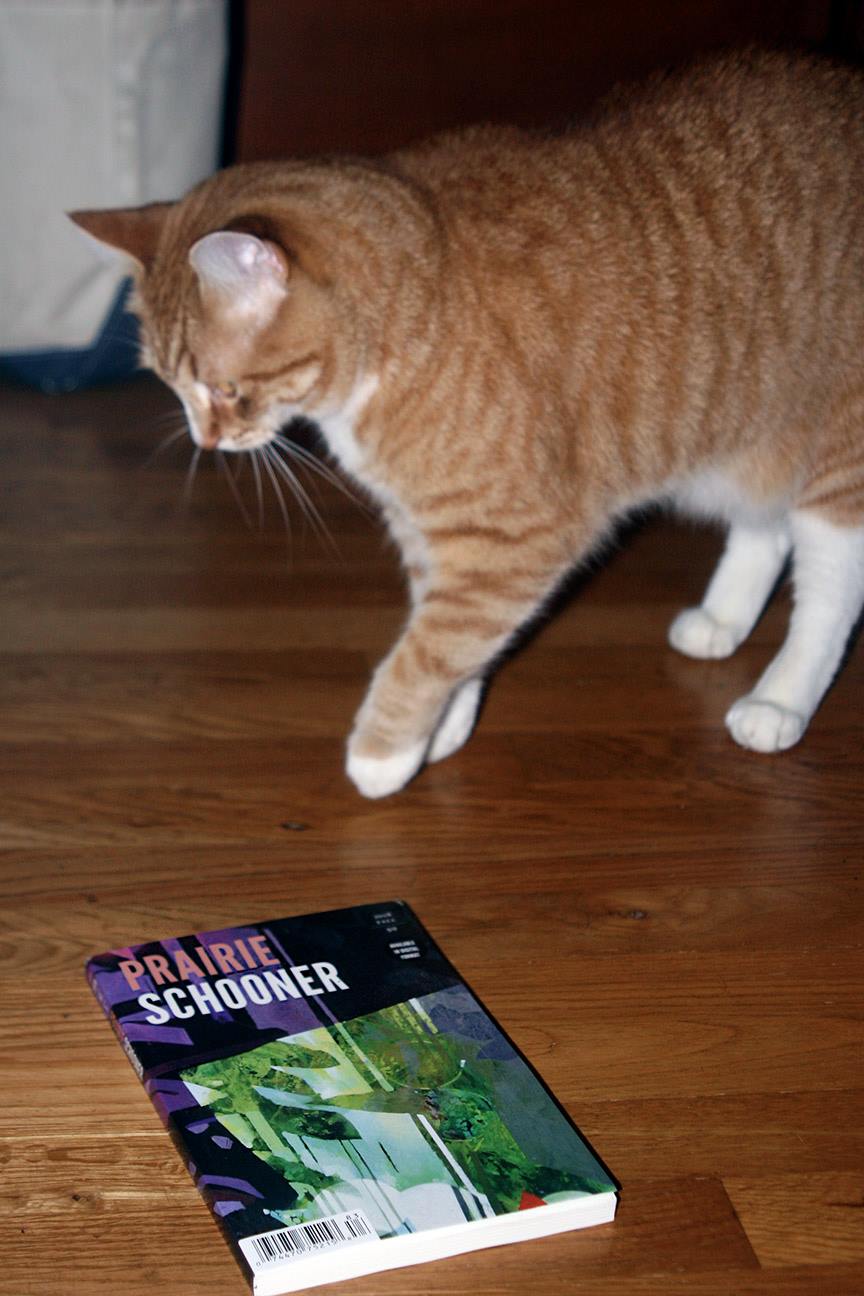
However, my cat will never circle and then settle on an online literary journal. So there’s that…
~
[I tried to snap his photo when he sat on Prairie Schooner, but he jumped up and moved on.]
I attended a lively and unpredictable poetry reading/performance recently, No River Twice. The poets who participate in the group reading develop the concepts at each performance, endeavoring to find meaningful and entertaining ways to permit audience members to sense an active engagement with poets and to experience poems more vividly. It appears to be an evolving performance process, and I enjoyed myself!
Grant Clauser explains the idea on his blog. Most of the poets involved have at least some acting or performance background. They are also active as mentors, instructors, advocates for the arts, and “working poets,” by which I mean they get their work published and performed and are constantly writing, revising, and reading the work of other poets in the service of learning new things.
The poets who performed in Phoenixville, PA, on Friday evening are as follows, but I understand the line-up may change from event to event.
Steven Pinker‘s early book, The Language Instinct (1994)–controversial among linguists, psychologists, social anthropologists and probably semiotics philosophers–is nonetheless relatively easy for the interested non-scholarly layperson to read. Pinker has since become well-known for his best-selling books, TED talks, and willingness to engage in lively debates on controversial topics such as violence in society and his claims for the embodied brain, scientifically-supported atheism, and rational culture. [Totally off topic, but I’m a great fan of his current wife’s novels and philosophy books–Rebecca Goldstein–what an amazing mind she has! Not that Steve Pinker is a slouch in that department, either…an intellectual power couple indeed. But I digress.]
The Language Instinct got me thinking more broadly about grammar, especially as the semester is about to begin and I’m once again wrestling with how to teach conventional writing skills to under-prepared, newly-minted college freshmen. I harbor no intentions of talking to them about linguistic theories. But I do want them to understand that they can already express themselves perfectly well verbally, with the help of body language (even students who are still learning English; even students who have told me that they have learning disabilities). The tool they need to succeed at the college level is the skill of writing that employs enough agreed-upon conventions–prescriptive grammar–to convey clear ideas to the standard reader.
Lots of assumed definitions there: who is the ‘standard’ reader? How many and which ‘conventions’ are enough, and who is it that agrees upon them? I have to let the students know that the answer is: “It depends.” They are seldom very pleased to hear it, but human beings are nothing if not adaptable.
~
After defending slang, split infinitives, the ‘verbing’ of nouns, and other shibboleths, Pinker–in a chapter denigrating language mavens (hence his Jeremiah example toward the end of this excerpt)–writes:
The aspect of language most worth changing is the clarity and style of written prose. Expository writing requires language to express far more complex trains of thought than it was biologically designed to do. Inconsistencies caused by limitations of short-term memory and planning, unnoticed in conversation, are not as tolerable when preserved on a page that is to be perused more leisurely. Also…a reader will rarely share enough background assumptions to interpolate all the missing premises that make language comprehensible. Overcoming one’s natural egocentrism and trying to anticipate the knowledge state of a generic reader at every stage of the exposition is one of the most important tasks in writing well. All this makes writing a difficult craft that must be mastered through practice, instruction, feedback, and–probably most important–intensive exposure to good examples…a banal but universally acknowledged key to good writing is to revise extensively…Anyone who does not appreciate this necessity is going to be a bad writer. Imagine a Jeremiah exclaiming, “Our language today is threatened by an insidious enemy: the youth are not revising their drafts enough times!”
Indeed, I agree with him here. Taking the time to read good writing frequently, and taking the time to revise carefully when writing pretty much anything (even a Twitter post) would go a long way toward improving anyone’s writing.
Mergenthaler’s Linotype machine
We do need concise, standardized, well-revised written texts, especially when we are relaying new information, instructing others how to do something, or convincing our professors that we comprehend the fundamental theories of the coursework. That’s not “grammar,” the magical tool that my students think they somehow missed learning in grades K-12, it’s craft, attention, and revision–with a few prescriptive rules, enough to level the ground on which the we lay our communicative foundations. The rest is work.




 ann e michael