Coincidence & synthesis

I adore random synthesis. I love how coincident information, ideas, and experiences connect to enrich my understanding or pique my interest.

Today, a friend sent me a link to a chapter from the Dalai Lama’s book and another friend sent me to New York Magazine‘s Science of Us blog to read Cody Delistraty’s piece on the neurology of poetry reading. Meanwhile, I have been cleaning my bookshelves and reading Jane Hirshfield’s Ten Windows.
books1Delistraty’s essay reports on a study (in Germany) conducted by Eugen Wassiliwizky, a researcher at the Max Planck Institute for Empirical Aesthetics, on what happens in the human brain when people read or hear poetry. The Institute has sponsored quite a few studies on the neurological responses to the arts, which offers researchers not just the findings from one area of aesthetics but the opportunity to compare responses across artistic disciplines.

For example:

…[Neurological] responses… seemed to be unique to poetry: Scans taken during the study showed that listening to the poems activated parts of participants’ brains that, as other studies have shown, are not activated when listening to music or watching films.

The authors also found evidence to support the idea of poetry’s pleasure as a slow-building experience, or what they called a “pre-chill”: While listening to poems they found particularly evocative, the listeners subconsciously anticipated the coming emotional arousal in a way that was neurologically similar to the reward anticipation one might get from, for instance, unwrapping a chocolate bar.

Delistraty notes that in this study, “the poetic lines that most emotionally stirred people were also most memorable for them later.”

Our brains ready themselves for surprise, delight, arousal, some emotional leap in the poem–even before the poem ends–anticipation. I know that feeling well. We are anticipating some kind of surprise or delight as the poem unfolds in our reading or listening real-time imaginations: a kind of freedom that we anticipate but cannot expect (the poem may surprise us in ways we had not anticipated; or it may disappoint our hopes).

Hirshfield writes:

On the one hand…poetic transformation occurs by what might be called the paradox of intimate distance. The freedom inherent in art to choose stance, attitude, approach, form, word, is in itself an act of emancipation. When distance increases…we often feel more, not less, because we are able to take in the whole.

What we “take in” as whole includes the phenomenon of reality, even though the poem operates in the imagination–another paradox. Reading a good poem, then, opens consciousness. bkmk-violet
I realize that in the years keeping this blog, I have never yet found a satisfactory understanding of what makes human beings conscious or from whence consciousness originates; but that’s one reason I keep reading and writing, Socratic gadfly that I am. And that brings me to the third random reading that, to my mind, synthesizes well with the essays I’ve mentioned. Here’s an excerpt from one of the Dalia Lama’s books that was posted on Lion’s Roar, a Buddhist-oriented website. In this chapter, His Holiness has been visiting with neurosurgeons and brain researchers at the cutting edge of medical science–people deeply, empirically engaged with the science of the human mind:

~

The Buddhist understanding of mind is primarily derived from empirical observations grounded in the phenomenology of experience, which includes the contemplative techniques of meditation…

The view that all mental processes are necessarily physical processes is a metaphysical assumption, not a scientific fact. I feel that, in the spirit of scientific inquiry, it is critical that we allow the question to remain open, and not conflate our assumptions with empirical fact…A crucial point about the study of consciousness, as opposed to the study of the physical world, relates to the personal perspective. In examining the physical world, leaving aside the problematic issue of quantum mechanics, we are dealing with phenomena that lend themselves well to the dominant scientific method of the objective, third-person method of inquiry… In the realm of subjective experiences, however, the story is completely different. *

~

Part of what makes poetry, or any art form, “work” is that appeal to the subjective. Subjectivity excludes the empirical; there’s always, somehow, more to art than science can explain–wonderful as science is. Delistraty writes, “poetry transcends…methodical scrutiny. It valorizes the unconscious, opening us up to new perspectives; it implies the possibility of unlimited pleasure.”

Hirshfield names that pleasure, that surprise, that alteration within the reader “hope” –a wonderful synthesis.

snowdrops

~

* The Universe in a Single Atom by His Holiness The Dalai Lama; full discussion on https://www.lionsroar.com/studying-mind-from-the-inside/

Hyacinths & biscuits

Synthesis results in innovation, imagination, surprise.

Carl Sandburg, in Good Morning, America (1928): among 37 other “definitions” of poetry, Sandburg wrote that poetry is “the synthesis of hyacinths and biscuits.”

Well, maybe not. Then again, my recent reading has resulted in synthesis in my own gray matter, and it is not difficult to see where the reflection leads.

Lakoff & Johnson’s Philosophy in the Flesh; Greenblatt’s The Swerve, which describes how 16th-century book hunter Poggio Bracciolini rediscovered Lucretius’ poem On the Nature of Things and what resulted to change Western thought; a re-reading of said poem (available in prose or verse translations); some verses by Li Po; and Mary Oliver’s 2009 collection Evidence.

Add to this thought processing a beautiful spring day spent out of doors, gardening and visiting with friends.

What results? I don’t know, really. But it feels a bit like joy in the moment.

hyacinth burpee

Image thanks to Burpee gardens

Support for poetry

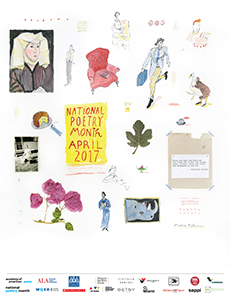
It is April, and April is National Poetry Month, among many other things that April is.

2017npm-poster_0People have told me that poetry has helped them through times of fear and times of grief. That’s a familiar response when, on rare occasion, I happen to tell someone I am a poet. The thing is–I am not sure poems do that for me. Maybe writing poems helps, but reading them sometimes hurts even more.

Not that hurt is such a bad thing when one is grieving; there is the comforting recognition that sorrow is a shared experience, that others have been through and survived pain and sadness, that there is a community of Others who feel compassion and who can express it well and honestly. Too, there are poets I find myself reading when I just need to hear a familiar voice in my head. That familiarity in itself offers a kind of comfort to this reader.

This week, I am turning to familiar poetry voices although I am reading collections I have not read before. Jane Hirshfield, Mary Oliver, Wendell Berry. “Old friends” of mine.

I am not contributing to National Poetry Month much this year: I am giving no readings and attending only a few. My contribution this year is to book-buying: I have made several purchases of books by poets I do not know well or who are completely new to me.

Book-purchasing from small independent presses and through the poets themselves–not through Amazon, not second-hand–supports poets and poetry publishers. Another way to support poets is to borrow poetry books from your public library, so that the books are noted as “circulating” and thus are less likely to be culled when the library updates its collection.

Love can be expressed and shared in many forms. I ❤ poetry!

The 4 Cs

white

Sometimes, when I am in reading-after-a-hard-day-at-work mode, I feel mentally unprepared to tackle difficult books. On such days it is better to settle on the sofa with a glass of chardonnay and a text that entertains as well as informs. I confess that Ruth Whippman’s America the Anxious: How Our Pursuit of Happiness Is Creating a Nation of Nervous Wrecks had me snorting my wine a few times; her wry British cynicism kept me giggling even when her observations strongly critique some serious aspects of the culture and nation to which I belong.

In her book, Whippman finds understandable fault with the commodification of happiness, but she also threatens an American sacred cow: the concept of individual happiness that arises from our foundation document concerning our rights to life, liberty, and the pursuit of happiness. Implied in her critique of the American “happiness industry” (including positive psychology, attachment parenting, yoga, mindfulness, Facebook…) is that maybe our nativist stance of rugged individualism and the freedom to make money on anything we can capitalize upon, thus pulling ourselves up by our own bootstraps, does not result in “happiness.” (Maybe Jefferson meant something else by that term. We cannot really know.) One reviewer mentioned that it is just Whippman’s “outsider” status as a person not raised in the USA that makes her book so useful. Changing one’s usual perspective, as I constantly reiterate to my freshman students, can hardly fail to be a valuable exercise in critical thinking and broadening one’s outlook.

Here is an observation of Whippman’s with which I heartily agree: “If happiness is community, then a psychologically healthy society takes collective responsibility for the well-being of its most vulnerable members.” I agree, however, because Whippman’s conclusion happens to coincide with my culture, upbringing, or perspective. Like her, I am willing to accept contentment–with occasional bouts of joy–rather than run relentlessly after happiness; and like her I find most contentment among human beings, though I may want them to shut up and just hang out quietly in the same room with me for awhile! Furthermore, it increases my happiness when I know that in my community (or nation), other people are cared for, not just me. In my point of view, happiness–including personal happiness–arises when I know that all human beings have their needs met.

But I recognize that not everyone will agree with Whippman’s, or my, conclusion that community is happiness; indeed, there is a good argument to be made for Sartre’s “Hell is other people,” too.

~

Recent discussions on diversity among fellow people employed in academia (what it appears to mean, what it might include) and reflections on mortality, consciousness, the notion of the self–and spirituality and religion–not to mention science writing on evolution, have pushed me into a deeply introspective mode. Yet I find I want to converse with other people about these ideas, not hole up in my own head; I seek, and have been happy to participate in, discourse with others.

In another word: community.

~

Here’s a paragraph from Daniel Dennett’s Breaking the Spell that I want to share with my students:

If you can approach the world’s complexities, both its glories and its horrors, with an attitude of humble curiosity, acknowledging that however deeply you have seen, you have only just scratched the surface, you will find worlds within worlds, beauties you could not heretofore imagine, and your own mundane preoccupations will shrink to proper size, not all that important in the greater scheme of things. Keeping that awestruck vision of the world ready to hand while dealing with the demands of daily living is no easy exercise, but it is definitely worth the effort, for if you can stay centered, and engaged, you will find the hard choices easier, the right words will come to you when you need them, and you will indeed be a better person. [italics Dennett’s]

Complexity, community, curiosity, contentment. The four Cs?

Oh, let’s add chardonnay. Make it five.  🙂

Beautiful brain

While waiting for the snow to evaporate and melt, the gardener experiences agitation; the days are longer–it must be time to plant seeds…but the soil is too wet and too cold.

Fortunately, there are always books! I have read Daniel Dennett on religion, George Lakoff on the embodied basis for philosophy, and am plowing rapidly through Ruth Whippman’s (acerbic and very funny) America the Anxious.  Also I am slowly savoring an anthology of Jewish women’s poems, The Dybbuk of Delight, that I randomly discovered in the library.

beautifulbrainbook04-1080x644

But here’s a book I want to own, when I can justify more book purchases: Beautiful Brain: the Drawings of Santiago Ramon y Cajal, because Art! because Neuroscience! because Beauty! The blog Hyperallergic says the drawings are going to be touring museums (see The Dynamic Brain Drawings of the Father of Neuroscience), which might also become a must-do for me when the exhibit travels to New York City next January.

What Cajal was doing back at the turn of the last century still inspires artists, not just medical scientists, today (see my post on Greg Dunn’s neuro-artworks). These compellingly beautiful and quite accurate drawings may also inspire poets and armchair philosophers who have lately spent a great deal of time pondering the resilience of the brain and the challenges that rupture a sense of self when cognition is interrupted.

beautifulbrain01-1080x1373

~

Credit goes to Abrams Books for these graphics and for the decision to publish this beautiful text.


Randomness & poems

The past weeks unloaded upon the blogger a host of responsibilities and reasons for reflection: reams of student essays to read and grade, piles of snow and the resultant delays and work closure leading to backlogs, and such usual complaints. In addition, the dropping-of-everything while attending to the death of our no-longer-resident nonagenarian, not to mention the bureaucratic heaps of forms and notifications that follow a passing.

I’m writing poems. It seems to be what I need to do at present, despite the state of my household environment and the backlog at work.Untitled-writer

~

The blizzard put my gardening on hold, though I remembered to purchase some seeds and thus can get to the tomato-starting process within a week or so. Before the snow came, I did get outside to prune and deadhead a bit while the weather was unseasonably warm. A little at a time. Such things are sustaining to me, emotionally.

And watching the birdfeeders has been soothing and delightful. Today a small nuthatch joined the party. My youngest cat spends large segments of his day crouched by the window, as fascinated as I am (but for different reasons, I suppose).

scoot window

~

I am thinking of a friend-in-poetry who has need of special care and financial assistance while going through and recuperating from some extremely painful, delicate, dangerous and potentially-disabling surgery-&-rehab. She will need more than the initial $4K this GoFundMe portal suggests, so if any of my readers feel inclined toward a random act of (financial) kindness: Jessamyn’s Medical Fundraiser. Thanks.

~

Addendum: Yes, I’m sticking to my determination to read more poetry. And it is helping. Most recently, re-reading early Li-Young Lee, Mark Doty’s Deep Lane, Dave Bonta’s Ice Mountain: An Elegy, and a really wonderful new collection by Kim Roberts: The Scientific Method.


Problems of moral order

“Authority in the moral sphere is modeled on dominance in the physical sphere. The moral authority of the parent over the child is metaphorically modeled on the physical dominance of the parent over the young child…it is a metaphorical model in which the logic of moral authority makes use of the logic of physical dominance.”   –from Philosophy in the Flesh, George Lakoff & Mark Johnson (p. 301, my italics)

Here is a problem: “folk philosophy” assumes that the moral order is the natural order, a logic much used in the dogma of many Western religions; but Lakoff and Johnson point out how such suppositions lead to “a hierarchy of moral superiority and authority.” Because we are corporeal, physical phenomena in a physical world and our initial human relationships get established through the parent-child model, human beings have a hard time escaping the physical dependence-physical dominance-physical responsibility metaphors, which we incorporate into our languages and philosophies.

There is no reason to refute or escape such metaphors, fundamentally embodied as they are, as long as we are aware of them. For people who accept physical dominance as the natural order without recognizing it as evolutionary and metaphorical, however, the logic that [this metaphor]=Natural Law=Moral Order can be harmful.

And not just to them but to their families, their neighbors, and their societies.

Lakoff & Johnson write, “The consequences of the metaphor of Moral Order are sweeping, momentous, and, we believe, morally repugnant…the Moral Order metaphor gives us a better understanding of what fascism is: Fascism legitimatizes such a moral order and seeks to enforce it through the power of the state” (p. 304).

The authors later note that “the view of moral concepts as metaphoric profoundly calls into question the idea of ‘pure’ moral reason” (p. 330). In other words, pretty much all of Western philosophy since Aristotle. Which makes me contemplate whether that question also suggests there is no “pure” abstract consciousness–whether there is any me (I do not mean Ego here) without the body I inhabit.

content

Then again,  Dürr’s speculation that memories exist as data–a kind of cloud network, as an analogy–and somehow persist, merits some consideration. I find Lakoff persuasive, however. I know he has since added to, altered, and labored on the concepts laid out in this 1999 book.

The foundations and evolutionary development of our families, tribes, and languages create our philosophies; this much seems as certain to me as anything–and thus arrive in our collective consciousness as metaphors, stories, poems.


Complex ambiguities

Rebecca Solnit from Ploughshares, May 2016: “We live in a time when …purveyors of conventional wisdom like to report on the future more than the past. They draw on polls and false analogies to announce what is going to happen next, and their frequent errors… don’t seem to impede their habit of prophecy or our willingness to abide them. ‘We don’t actually know’ is their least favorite thing to report.” [My italics.]

I am the sort of reader who loves to hear experts announce “We don’t actually know.” But I recognize I am in the minority–in this respect–in my culture. That most Americans are willing to abide such speculative prophecies worries me a bit, and I do what I can in the classroom to waken my students to the possibility of erroneous thinking, even on the part of supposed experts and aggregate sources.

Yes, once again I am teaching argument to freshmen…the classic example of what Solnit calls naïve cynics:

Non-pundits, too, use bad data and worse analysis to pronounce with great certainty on future inevitabilities, present impossibilities, and past failures. The mind-set behind these statements is what I call naïve cynicism. It bleeds the sense of possibility and maybe the sense of responsibility out of people.

Maybe it also says something about the tendency to oversimplify. If simplification means reducing things to their essentials, oversimplification tosses aside the essential as well. It is a relentless pursuit of certainty and clarity in a world that generally offers neither, a desire to shove nuances and complexities into clear-cut binaries. Naïve cynicism concerns me because it flattens out the past and the future, and because it reduces the motivation to participate in public life, public discourse, and even intelligent conversation that distinguishes shades of gray, ambiguities and ambivalences, uncertainties, unknowns, and opportunities.

Scholarly argument should ideally create discourse, not embattled absolutism on things that cannot ever be “proven.” In fact, I have forbidden my students to employ the word “prove” (or any of its conjugations) in their argument papers. They know my rationale for this lexical excision; I also warn them away from “always,” “never,” and “everyone.” But they are not yet experienced enough critical thinkers to recognize that my practice is also to encourage research and nuance, to shove them (gently) out of their naïve cynicism into the world of no-easy-answers, no-slippery-slope-thinking; a world of wonderfully complex ambiguities waiting to be more fully explored.

I think of my oldest child who, many years ago, was insistent on knowing ahead of time how everything was going to turn out: “Does the movie have a happy ending?” “Does the Little Red Hen get anyone to help make her bread?” “Can I win this game?”photo ann e. michael

Raising a child who is temperamentally anxious requires a form of parenting that offers comfort but admits to unknowingness. (Next up on my reading list: America the Anxious, by Ruth Whippman!) Solnit says the alternative to naïve cynicism is “an active response to what arises, a recognition that we often don’t know what is going to happen ahead of time, and an acceptance that whatever takes place will usually be a mixture of blessings and curses.”

I don’t think I have ever heard a more accurate description of what being a human entails.

Story as vagabond: Intizar Hussain

Kahani to awara hoti hai. Story is a vagabond…My nani…used to tell me a story in which a girl says to her father, “I love you as much as salt.” My nani didn’t know about King Lear…She belonged to a tradition of storytelling in which space was unbounded and time was fluid; the hero could travel across forests instantly, and ignore borders separating Heaven, Earth, and Hell. Fairy princesses and monkeys spoke classical languages, and trees and birds told stories. This made for a more generous world, and, of course, a more imaginatively vibrant one; and it made the question “What does it mean to be human on this Earth?” a genuinely inclusive one–because the answers had to account for our relations with everything around us. It is because I am an inheritor of this way of thinking and being in which boundaries are always porous, always shifting, that I can accept that there is a grave of a Muslim disciple of Krishna in Brindiban…

~Intizar Hussain, Pakistani (but, earlier in  his life, Indian–from Dibai) fiction writer, from an interview with Alok Bhalla in Manoa journal. [The surname can be spelled either Hussain or Husain in English.]

33414458Bhalla–one of several translators of Husain’s work into English–comments during this interview: “The poet-storyteller is both blessed and cursed; he is exiled from Heaven and the courts, but he understands how integrally he is ‘of this Earth’–that is, secular. This seems to be the tradition in which you have been trying to locate yourself. Isn’t that why both the religious fanatics and the ideologically motivated find it difficult to accept you?”

~

Earth–we are embodied of earth, part of earth, indivisible from our earthliness, and we exist in relation to the things of this earth.

It might be wise to stay mindful of our necessary integration with all things earthly and embodied, to recognize how intricately we are connected. Bhalla, whom I met at this year’s AWP, mentioned that Husain was fundamentally opposed to identity politics; in  his generous inclusiveness, he believed that to define oneself under a single identity forces boundary-relationships with others, that tribalism has led to nationalism and thence to genocide in far too many instances of human history.

Naturally that means he had a fraught relationship with Pakistan itself, and–to quite some extent–with Islam [he upheld the notion of Mussalmani]. He was revered enough and diplomatic enough to keep those boundaries porous and those relationships open.

Few of us will ever be as wise.

~

This lovely issue of Manoa features cover artwork and illustrations by Imram Qureshi, whose work I walked upon at the Met in NYC, roof garden installation, 2013.


Relationships, resistance, AWP

This year’s Association of Writers & Writing Programs Conference vibrated with emotional content, resistance, persistence, and truths through facts and lived experiences–a host of perspectives and a sense of excitement enhanced by the host city: Washington, D.C., where the recent transition to a new government administration has been controversial, particularly among citizens who value social justice, education, the environment, and the arts. Some citizens feel that they are themselves outsiders, outliers, critical observers of the social norm, square pegs, immigrants, misfits, name your descriptor here:_______.

Maybe no surprise, but many of those who are not-quite-the-social-norm also happen to be writers.Adversaries 1

About 15,000 writers, teachers of writing, publishers of writing, promoters of writing, and lovers of writing showed up in D.C.; and I’m guessing a very large percentage of us feel we have, in one way or another, a little trouble “fitting in” with society and social expectations. We happen to write, also. What gives good writing its jazz is that there are zillions of fascinating, off-beat, marvelously creative perspectives a human being can write on just about anything.

One sense that came through to me as I listened to authors and teachers is that writing is almost automatically resistance. Resistance usually connotes against, as against a “negative” behavior, objective, rule, law, or person, for example. We can resist silence, though, and silence on its own is not negative; it is only something to resist in relation to an event or law that might be better spoken about. We write in relation to, and often that looks like against. But it isn’t that black and white (of course). Even when the ink is near-black and the page is near-white and the resistance feels like “writer’s block”–resisting the very act of revealing, speaking, communication.

Relation makes resistance and writing happen. Relationships make community and communication develop. Relationships connect the virtual world, and relationships link the long-dead writer to the living reader in a quiet room or on a crowded train.

~

This past week, thousands of (largely introverted) writers convened in a convention center in the nation’s Capitol; several square blocks hummed with interconnections that spanned far beyond those city streets, those bland conventional multi-storied buildings…into the social world and social media, into the range of the arts, the hearts of fellow human beings. The crowds could be overwhelming, but the energy was palpable and exciting (even to this introvert, who did need to retreat from the throngs now and then–thank goodness for “quiet lounges” and hotel rooms).

Did I mention the slightly off-the-cuff passion and stirring intensity of Azar Nafisi‘s speech, and the resonant coincidence of how relevant it was to have a naturalized American citizen, born and educated in Iran, as a keynote speaker? [The decision to have her speak was made over a year in advance of the conference.] Did I mention the honest and often amusing conversation between Ta-Nehisi Coates and Chimamanda Adichie, who is a dynamic one-person cultural ambassador, much as Nafisi is? What about poet Terrance Hayes‘ brilliant alliterative rhythmic sonnets that were sometimes-brutal take-downs of a president whose motives and values he mightily questions? Did I mention Rita Dove‘s transcendent reading? My discovery of a hugely famous Pakistani writer, Intizar Husain? Marvelous writing on The Body Electric, in three excellent essays–why, yes, I could say more, but I’m tired now and “still processing,” and post-conference life resumes…

~

Given some long-running, almost chronic adversity the beloveds and I are facing, before I close I want to give a thumbs-up to Emily McDowell. Emily McDowell’s line of Empathy Cards are really worth looking at when you have no words.

Sometimes, there isn’t a card for that.