The morbid book group

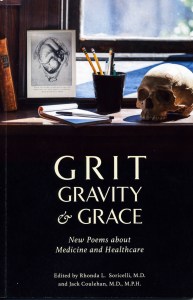
[FYI, readers, I have a poem in this anthology, which relates to this post.]

~

A little over a year ago, I was invited to participate in a book discussion group that  focuses on texts that offer varying perspectives concerning health, surviving cancer, different cultural views of aging, and dying; books on “dying well,” hospice and palliative care, and on hope and healing; books on chronic pain and on neurology and the medical establishment, on birth traditions, on the history of medicine. We have also read The Tibetan Book of Living and Dying by Sogyal Rinpoche, Still Here by Ram Dass, and discussed books that have topics such as placebo effects, psychology, alternative medicines, the pharmaceutical industry, hospitals, the training and practice of doctors, and the death & dying ‘industries,’ including works by authors with personal and moral perspectives on how to live (and how to die). The people involved have included a pediatric palliative care expert, a NICU nurse, a hospice team spiritual counselor, a minister, a former nurse and massage therapist who’s a tai chi instructor, and others–most of us “of a certain age,” by which euphemism I mean we have been living through the experience of having parents in extreme old age and of having long-time friends who now contend with chronic or potentially fatal illnesses. At least one of us has survived cancer.

For a perspective on how most Americans view a serious study of such topics, I offer my husband’s assessment. He calls this “the morbid book group.”

In fact whenever I mention that I participate in a book group (a popular American activity), people ask me if the group has a theme; I tell them, “The theme is medicine, and wellness, and how we die.” And there’s inevitably a pause, and usually my friend asks, “Isn’t that kind of depressing?”

No. It has not been depressing, in fact. I have gained more than I can say from these books and from our small group discussions: information, perspective, philosophy, insight, dare I say wisdom? Not to mention freedom to talk about those things we tend to evade in polite conversation, the space in which to say “This really sucks” or “This saddens me deeply” or to ask, “What can we do?” The book selections have led to great discussions–and have helped me to forge some new friendships as well as to confront and accept different points of view on controversial issues surrounding health care. And death, yes (hello morbid books!), and grief, and–most of all–compassion.

Difficult books? Challenging reading? Have I ever shied from it? I relish exploring this kind of non-fiction-fact-science-ethics-cultural criticism. Participating in this book group is one of the highlights of my current life experience; it’s up there with my long-running poetry critique group and my MFA years in terms of transformational engagement and exchange of ideas.

Below, a list of some of the books we have read and talked about. Just in case any of my readers wish to begin a morbid book group of their own.

~

Radical Remissions, Kelly A. Turner

Knocking on Heaven’s Door, Katy Butler

Buddha’s Brain, Rick Hanson

Death’s Door, Sandra Gilbert

Living with a Wild God, Barbara Ehrenreich

Still Here, Ram Dass

Being Mortal, Atul Gawande

The Anatomy of Hope, Jerome Groopman

The Tibetan Book of Living and Dying, Sogyal Rinpoche

Birth, Tina Cassidy

The Empathy Exams, Leslie Jamison

Counterclockwise, Ellen Langer

The Pain Chronicles, Melanie Thernstrom

Choosing Civility, P.M. Forni

Healing Spaces, Esther M. Sternberg

Die Wise, Stephen Jenkinson

…& more ahead, as we plumb consciousness, placebos, the medical hierarchy, and compassionate ways of living in the world. By the way, readers–suggestions for further readings are welcome!


Jisei

I have been re-reading a lovely anthology called Japanese Death Poems, edited by Yoel Hoffman. I purchased this book years ago when I was immersed in the study of haiku, haibun, and the early Chinese poetry forms and approaches that influenced many Japanese poets. Hoffman’s book offers excellent examples of jisei (poems composed near the moment of death) and his informational text places the poems in the context of various cultural, economic, power, and belief structures.

For a person raised in a contemporary western culture, the concept of death as a constant partner in our consciousness seems–while perhaps obvious–rather uncomfortable. We are not likely to approach our deaths with a sense of acceptance, let alone friendly understanding: “This is how it is.” But the death poems, as I read them, suggest that while death is universal, each person’s awareness of it is unique, even among people in the same culture who may hold similar beliefs.

Jisei intrigue curious folk, because death is A Big Thing to Be Curious About. Digital photographer Hank Frentz, a young artist who’s been inspired by Hoffman’s collection of jisei, has posted a series of mysterious and beautiful photos paired with the death poems, a sample of which can be viewed here. Please follow the link, as his photographs seem to me to be aesthetically and “spiritually” close to the poems he chooses, creating a kind of haiga (俳画) effect.

~~


I have also been revisiting Earl Miner’s translation of Shiki’s brief verse diary, “The Verse Record of My Peonies.” Written in 1899, when Shiki was suffering agonizing pain from spinal tuberculosis (he died in 1902 at the age of 35), the haiku and the prose of the diary recommend the reader to an understanding of physical pain, uncertainty–will I live, or die?–and humor, friendship, grieving. The diary is as layered as a peony blossom; each time I read it, I find something new to contemplate in its few pages: joy, aesthetics, nature, the human body, the solace of friendship and the isolation of illness, the nearness of death, the challenge of uncertainty, the many ways poetry can supply a place or grounding for a person struggling with ambiguities.

Two flakes fall
and the shape of the peonies
is wholly changed.

[tr. Earl Miner]


Composer Libby Larson has used Shiki’s verse diary as a text basis for a 7-minute composition for voice available here.


The skill of grieving

In a recent post, Sigrun of the blog sub rosa pointed me to Poetry Society of America’s page on Natalie Diaz; I’m even going to post the same paragraph she does, in which Diaz states:

When I write, I bring all of my truths, even the Judas-truths that make me feel like the betrayer whose dirty hands are resting on the table for everyone to see, including God. For me, writing is less a declaration of those truths than it is my interrogation of them. Uncovering the darkness in me that led to some of the poems about my brother also lights up the hard, bright way in which I love him and the small wars I wage to win him back…the truths that have built in me a strength and compassion that help me to survive this world. Truth is that little animal we chase and chase until we suddenly glance over our shoulder and realize it has been chasing us all along.

This passage about “uncovering the darkness” and the hard ways in which we sometimes love–maybe with some people, there is no other way to love–interestingly coincides with my recent reading of Stephen Jenkinson’s Die Wise, a manifesto on how we die and how we might die better (wiser) if we carried our darkness better, as Diaz suggests in the passage above. While I am reading Jenkinson for specific reasons around end-of-life concerns, there’s no doubt that there is often poetry in his philosophy that we need to learn the skill of how to grieve and to learn all that such a skill contains, including its “Judas-truths” and its unflinching confrontation with the ways in which death is a gift to us collectively and individually.

Most of us do not see death as any kind of gift, and Jenkinson admits it can be a challenging perspective; he endeavors to persuade the mostly-American or European reader that each of us and each of our societies or cultures would benefit by reclaiming death as a natural sequence in our being in the world.

Claiming or reclaiming death (you might read here: darkness), says Jenkinson, requires us to face the fact that we have no language for dying, not really. He says “we are taught almost nothing about what language to use or why when we are trained for the job [of tending to the dying].” The Dying, he writes, are “them,” meaning they are “not us.” Which makes them outsiders and invisible and yet all of us die; we are all of us dying–and we work so hard to distance ourselves from the fact.

Poetry is a language that, I think, sometimes guides us toward the hard truths, when poetry is well-made and conflicting and sundered with surprise. Poetry isn’t the language that gets us to dying, exactly; but it can do some of the hard work of teaching us how to grieve.

This is not to say that poets or artists are any better at dying than the rest of us. Sometimes the darkness uncovered in the fiction or poem or painting is true and authentic and deep, but the artist does the grief-working well in art and not so well in life’s physical dying process. Artists who choose suicide may be people who suffer pain and can express it artistically without actually learning the work of grief, which differs from suffering. If we learn that anything that does not last forever is meaningless (an idea drummed into many of us through the concept of “eternal life”), we are apt to feel bereft at every loss and may embrace a kind of horrible existentialism. Sometimes our artists strive to overcome the meaningless through lasting works of art, but their personal desire to be somehow immortal may bog them down as death nears.

We admire this artistic striving, but it is a kind of working against our darkness rather than confronting it with the love Diaz mentions. Jenkinson writes: “Dying isn’t the end of true things…It is one of the true things, that is all.” [My italics.]

However, I do believe that art–particularly the storytelling arts–can offer much in the way of teaching us the physical, on-the-level, hard work of grieving. Really good novels and plays can help teach us if no one in our “real lives” does. Even if we weep at the end of the book and wish the author had chosen a different way of ending it. Good poetry that leaves us excited and confused by complexity or blasted with gut-level sorrowing might be teaching us the ways of grief we aren’t learning from our culture.

When a loved one dies, we often get lost, pushed away from grief through the signing of papers and the bland condolences of marginal friends and the plea to move on with our lives. Good poems can keep us dangling in the now of real grief and force us to figure our way through the losses we incur–losses which do not exclude even our selves. Because “death waters the living.” And so does poetry.

http://www.philamuseum.org/collections/permanent/82820.html

Rain [La Pluie] Vincent van Gogh, 1889. Thanks to the Philadephia Museum of Art


Writing the new year

To renew myself as a writer of poetry, I need–every now and then–some way of re-engaging with the work of writing itself. Revision, for example, often means hard effort slogging through material I wrote long ago; but the process renews my dedication to the salvageable poems and sharpens my analytical and evaluative skills.

Sometimes there’s no saving a poem, but the concept behind it might be worth exploring in an essay.

Sometimes there’s no saving a poem, but the words needed to be expressed at that time.

Revision requires taking a stance of compassionate distance from the work itself so that I can feel both judgment and kindness toward my own poems. The bonus here is that, often, the work of revision gets me writing new work.

Beside my desk at this moment is a stack of poems I spent the past few days thinking about and revising. The work creates its own energy; the buzz of words and imagery emanates…

I feel ready to write the new year.

🙂

objects, stories


Responses

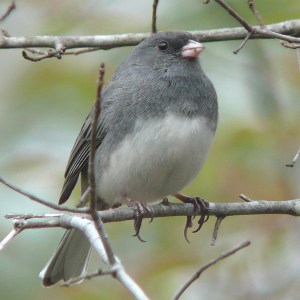
The semester is over, and the juncos have returned to my back yard. One thing I have trouble assessing after teaching my class is whether the students have made any inroads into learning the difference between a fact and an opinion, and argument and a disagreement, an interpretation and an analysis. But a response can be any of these things.

Recently I have been entertained by Rebecca Solnit’s responses (as opinion). She’s made a bit of an earnest-minded internet buzz with her brief essay concerning Esquire magazine’s “80 Books All Men Should Read.” [As an aside, I really enjoyed her early book Wanderlust: A History of Walking.] Her opinion piece on Lithub is smart and funny, and she irked many readers; yet I do not see how anyone can argue with her final paragraph:

…that list would have you learn about women from James M. Cain and Philip Roth, who just aren’t the experts you should go to, not when the great oeuvres of Doris Lessing and Louise Erdrich and Elena Ferrante exist. I look over at my hero shelf and see Philip Levine, Rainer Maria Rilke, Virginia Woolf, Shunryu Suzuki, Adrienne Rich, Pablo Neruda, Subcomandante Marcos, Eduardo Galeano, Li Young Lee, Gary Snyder, James Baldwin, Annie Dillard, Barry Lopez. These books are, if they are instructions at all, instructions in extending our identities out into the world, human and nonhuman, in imagination as a great act of empathy that lifts you out of yourself, not locks you down into your gender.

Roth, Caine, Miller– “just aren’t the experts you should go to” if you want to understand half the human species; I love that tongue in cheek understatement. I also love her list of “heroes,” although it doesn’t hurt that she names among them many of my own heroes. She says she reads and re-reads work that she has opinions about–and admits her opinions may not align with the generally-accepted opinions. Which is fine, since she reminds us, quoting Arthur Danto, art can be dangerous, risky, uncomfortable, as long as it means something.

She does raise the point that “[y]ou read enough books in which people like you are disposable, or are dirt, or are silent, absent, or worthless, and it makes an impact on you. Because art makes the world, because it matters, because it makes us. Or breaks us.” In this way, she reminds us that readers are people who may have perspectives that vary from one another, particularly as to the social, psychological, or artistic merit of a piece of literature. Lolita, for example. That’s one book she mentions that evoked considerable response from Lithub commenters.

Rebecca Solnit’s response to her detractors–or “volunteer instructors,” as she calls them at one point–and her willingness to walk around the Himalayas with a medical team (recounted in a recent New Yorker piece) count as reasons her work has moved to the top of my to-read pile of books. I think I will start with Men Explain Things to Me and A Field Guide to Getting Lost.


About that death/writing thing

Driving the road that clings to the south side of our hill I notice the round bright moon over newly-gleaned cornfields and find myself thinking about the last essay in Margaret Atwood‘s book Negotiating with the Dead. I finished reading the book some days back, but the title essay worries at me somehow; I can’t let it go. Maybe it is because I perceive connections between her ideas on the ontology of story-making and Boyd’s evolutionary premise for narrative, or between conscious mind and story-making arising from the cthonic, the deeps, the under-earth “hells” to which our myth-makers and shamans, goddesses, musicians, poets and heroes journeyed in order to bring back–if nothing else–the story of the trek and the resulting wisdom. Maybe it is because “negotiating” with the dead raises the problem of consciousness in peculiar and challenging ways as well as the problem of communicating with people of the past and of the future. Or maybe because of that bogeyman that awaits us all: Death.

When I was quite a young child, age seven or perhaps earlier, I was seized with an insomnia-inducing fear of death that kept me in agonies as soon as darkness fell. I wonder if that had anything to do with my later need to “be a writer.”

Atwood suggests that all writers truck with the dead. We read the work of our ancestors-in-the-craft; they are often our first teachers. That important aspect of craft so many of us struggle to attain–the ever-illusive quality of “voice”–is what we notice in many of our beloved writers. Voice, perfect example of metonymy. It stands in for the departed body, the dispersed consciousness.

Here is Atwood holding forth at a dinner party of fellow writers:

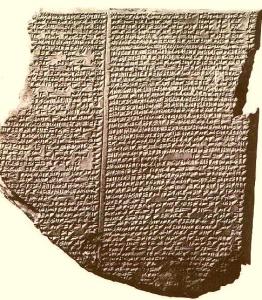
Gilgamesh was the first writer…He wants the secret of life and death, he goes through hell, he comes back, but he hasn’t got immortality, all he’s got is two stories–the one about his trip, and the other, extra one about the flood. So the only thing he really brings back with him is a couple of stories…and then he writes the whole thing down on a stone.

She adds that going “into the narrative process–is a dark road. The poets know this too.” So inspiration is not so much a clearing in the clouds but a kind of rappelling into a cave. At any rate, darkness, even with a full moon to light the road, seems as likely as a bolt of lightning to produce emotionally-resonant work. Maybe more so, because it’s harder work and more ambiguous (Lord knows, writing is both of those!). Darkness requires more interpretation. The audience has to listen, not simply see; the darker path gets traversed by both writer and reader.

The Flood

The Flood

Atwood also makes note of the threshold concept, that edge or invisible boundary line between the realms, any pair of realms. Life/death, yin/yang, heaven/earth, day/night. The one who seeks knowledge or magic or treasure (or lost love, viz Orpheus) at some point crosses the threshold, and then nothing is certain. He or she may not be able to return, for example. Edges are the interesting places, where all manner of things mesh and overlap–good spots for inspiration even if one opts not to take the stairway to the underworld; but they also pose danger. We humans, with our need for communities, invent parallel communities for our dead, not just physical cemeteries but supernatural abodes, and create all manner of “rules and procedures…for ensuring that the dead stay in their place and the living in theirs, and that communication between the two spheres will take place only when we want it to,” says Atwood.

I wonder if that is one reason I felt so unsettled by the idea of death when I was seven. I did not personally know anyone who had died (yet), but I knew the stories; certainly, I’d been taught about Jesus, though I was told he had defeated death. So why the early-onset angst? Did I fear that edge between the realms, being too inexperienced either to navigate it or to allow communication on my own terms? And maybe the fear is precisely what has led me to my ongoing inquiries into philosophy, consciousness, art, and mind.

Or was I precociously aware that I would have to venture into the darkness, into the coffin-holes and the caves and the seas’ depths, if I wanted to come back with a story to tell?


Slightly less difficult books

photo ann e. michaelI recently read Paul Bloom’s book Descartes’ Baby while simultaneously reading Daniel Dennett’s Content & Consciousness. Of these two, the latter falls a bit under the “difficult books” category, but it is not too hard to follow as philosophy goes. Dennett’s book is his first–the ideas that evolved as his PhD thesis–and in these arguments it is easy to see his trademark humor and his deep interest in the ways neurology and psychology have aspects useful to philosophy. Bloom’s book, a somewhat easier read, suggests that the mind-body problem evolved naturally from human development: young children are “essentialists” for whom dualism is innate; Descartes simply managed to write particularly well about the evolutionary project (with which, I should note, Bloom disagrees; as a cognitive psychologist, he maintains a more materialist stance).

It turns out that because I have read widely if shallowly in the areas of philosophy, cognitive psychology, evolution, art, aesthetics, and story-making, I find myself able to recognize the sources and allusions in texts such as these. Quine, Popper, Darwin, Pinker, and Wittgenstein; Schubert, Kant, Keats, Dostoevsky, Rilke…years of learning what to read next based on what I am currently reading have prepared me for potentially difficult books. [Next up, Gilbert Ryle and possibly Berkeley.] I don’t know why I feel so surprised and happy about this. It’s as though I finally realized I am a grownup!

And I am glad to discover I am not yet too old to learn new things, young enough to remember things I know, and intellectually flexible enough to apply the information to other topic areas. Synthesis! Building upon previously-laid foundations! Maslow’s theory of humanistic education! Bloom’s taxonomy! The autodidact at work in her solitary effort at a personal pedagogy.

If I ever really discover what consciousness is, I’ll let you know.


Painfully conscious

I’ve just finished reading Melanie Thernstrom’s 2011 book The Pain Chronicles, a journalist’s inquiry into the concepts that “define” pain and the medical discoveries concerning chronic pain, in addition to a bit of memoir as a narrative device. Although I have experience with chronic pain myself, the part of the text that most interested me comes in her concluding chapters, in which she gathers the variously-disciplined evidence of her enterprise to suggest that pain is the ultimate test of the mind-body problem (thank you, René Descartes). The experts Thernstrom interviews disagree on how much we do know or can know about the human brain and how it processes anything, let alone such a complicated psycho-physiological event as pain. Some of them believe human beings will make enormous technological discoveries to unlock our brains’ workings, but the majority seem to have learned from research that each “a-ha!” leads only to further complications. Discussing the outlook for future fMRI scanning in brain research, Dr. John Keltner tells the author:

[N]obody has come up with a rich and complicated enough model to analyze the complexity of the distributed patterns of neural  networks and deduce anything like underlying rules…We’re literally grappling with the fundamental aspects of human beings. We naively believed that pain is simple–it hurts or it doesn’t hurt–so there should be a single brain state we could see every time someone is in pain. But what we’ve stumbled into is the discovery that there’s a relative universe of hurt–that hurting is an immense, rich, and varied human experience associated with an unknown number of possible brain states.

I find some of these analogies, and some of this language, appealing–I can think of poems that express “a universe of hurt.” I embrace the idea that hurting is immense, rich, varied, and human–we are aware (conscious) that we hurt, that others hurt, that hurt can be painful even when it is not caused by a toothache but through loss of a friend or lover…the beloved other, the pain in ourselves. Isn’t compassion born of this awareness? Does art have a place here, too? I wonder.

Thernstrom concludes with the agreement of several expert researchers: “pain and suffering are properties of the mind” [my italics]. That means pain is, at least in part, a property of that elusive thing we generally call consciousness. Scott Fishman of UC Davis explains that “[t]he mind is like a virtual organ–it doesn’t  have a physical address that we know of.” Consciousness, these researchers imply, is not merely the sum of firing neurons, a process that can be considered on some level mechanical. Thernstrom asks, “Do we need to understand consciousness itself in order to understand pain?”

If so, that is a tall order, one the author posits is analogous to understanding aesthetics (what is beauty?). But though the task appears daunting, the discoveries en route make the trek valuable.

Even if we never understand the answer.

neural matrix fiber topography, Johns Hopkins University

neural matrix fiber topography, Johns Hopkins University

Rest & reading

It’s been a busy week, and I am exhausted mentally and physically; I am taking the three-day weekend as relaxation time–which means: reading, mostly. Currently, my “difficult books” concentration is Maimonides’ Guide for the Perplexed, though I am not finding it as challenging as I expected, because Maimonides is a good teacher! I am not among his target audience, however, as I am a woman. He was quite forward-thinking for a 12th century Talmudic scholar with an Aristotelian bent, but women were not considered qualified to study the deep mysteries of metaphysics. [Alas, I read without repentance for my heresy.]

My reading also means catching up with blogs I follow. Here’s the link to Theodora Goss’s latest musings on aesthetics and beauty–a lovely blog-essay. I hope you will read it.

ann e michael


Seeking

The semester has begun. I’ve been immersed in reading Marilynne Robinson (Absence of Mind) and Daniel Ariely (Predictably Irrational) while procrastinating on uploading materials to the software platform for my class and making tomato sauce at home.

Robinson detects, amid all of our human endeavors, a search for answers. That we have questions at all seems proof of sentience, if there can be such a thing as proof. Certainly the process, myth, and language of seeking surrounds most human developments: religion, art, philosophy, science, and others. It’s the classic quest narrative that runs through anthropologically vast distances, from Gilgamesh’s efforts to find eternal life to the Ramayana (with Sita as the prize, in Ravana’s clutches) to Rowling’s Harry Potter, who snags the role of “Seeker” in a game–a metaphor that continues through the series.

But are there answers to our questions? And a corollary: are we asking the “right” questions?

256px-Chaos_Monster_and_Sun_God~

Ariely, like Dan Kahneman, reminds us that we do not always–in fact, hardly ever–choose the most rational actions or answers to dilemmas. We fail to ask ourselves the better questions. We fail to act upon the better actions or decisions.

But we keep seeking. I find that intriguing.

~

Event Ahead:

On September 16, I’ll be taking part in an art-&-poetry event at a gallery in the “Christmas City” (Bethlehem, PA). Info on my Events page, here.