Philosophy of cities

I’m going to let the late Lewis Mumford speak for himself in a couple of excerpts from The City in History. Even though I love history and have perused many a book on the subject(s), I learned a great deal about Western history from this book. What intrigues me most as I’ve read, though, is Mumford’s roles as historian-as-sociocultural-critic and historian-as-philosopher. When writing a book of this scope, no matter how founded on data, archeological and textual records, it’s hard for this writer to avoid thoughtful forays into philosophy. Mumford looks forward, too, speculating on city life in the future–and he takes rather a dim view of where megalopolises were heading in 1961. He was prescient indeed. While today’s citizens may argue that his judgments are overly negative, it is difficult to refute the accuracy of his speculations, particularly when he foretells the modern city’s environmental impact on society and on earth’s resources.

So much of the book is a warning: cities have a tendency to collapse, and there are reasons for that. Such reasons have to do with greed, power, poorly-applied technology, lack of foresight, overcrowding, ignorance of the need for balance in any system–governmental, agricultural, environmental, social, economic, etc. He sounds like a Cassandra at times, and we all know that aphorism about being doomed to repeat history, as does Mumford. But ultimately, he makes a passionate call to creativity and human life, warning us not to let our burgeoning technology reduce human activity to the level of the hive. He revels in the arts, in the conscious purpose of human living, in the genuine communication among persons, and in the joys available to those who understand an organic system must be balanced.

[He refers to men and mankind using the typical non-gender-neutral language of the era, which I am not going to alter in these excerpts.]

green

A bit of green…

Here he is discussing the “Green Matrix.” Remember, he’s writing in 1961!

~

“The maintenance of the regional setting, the green matrix, is essential for the culture of cities. Where this setting has been defaced, despoiled, or obliterated, the deterioration of the city must follow, for the relationship is symbiotic. The difficulty of maintaining this balance has been temporarily increased, not merely by the incontinent spread of low-grade urban tissue everywhere, dribbling off into endless roadside stands, motels, garages, motor sales agencies, and building lots, but by the rapid industrialization of farming itself, which has turned it from a way of life into a mechanical processing business no different in content or aim or outlook from any other metropolitan occupation…”

~

Following Mumford’s observation that overpopulation is often a result of privation, rather than the expected other way around, and leads to the “bursting” of the city as a healthy, organic system, he notes (with clear reference to his much earlier chapters on the decline of Rome):

“No profit-oriented, pleasure-dominated economy can cope with such demands: no power-dominated society can permanently suppress them. Should the same attitude spread toward the organs of education, art, and culture–man’s super-biological means of reproduction–it would alter the entire human prospect, for public service would take precedence over private profit, and public funds would be available for the building and rebuilding of villages, neighborhoods, cities, and regions on more generous lines than the aristocracies of the past were ever able to afford for themselves. Such a change would restore the discipline and the delight of the garden to every aspect of life; and it might do more to balance the birthrate, by its concern with the quality of life, than any other collective measure….significant improvements come only through applying art and thought to the city’s central concerns, with a fresh dedication to the cosmic and ecological processes that enfold all being…the best economy of cities is the care and culture of men.”

The care and culture of “men” meaning, “human beings”: that’s a lovely purpose for a city–or a nation–a noble one, and one too many people tend to forget as we occupy ourselves with the busy-ness of our own isolated lives.

~

Of note: The USA’s 50 “greenest” cities…which does not mean they are good cities by Mumford’s definition, but which is probably a good start. Click here.

Short books and re-reading

~

clockWhen life gets busy and over-scheduled, even an inveterate reader may find she has to give up some of her precious book time to life’s other adventures and responsibilities. Philosophy and meditation require enough time for reflective, slow thinking; a hectic week precludes such activities. Creative thinking gets funneled into problem solving of a more mundane and practical variety. Creative writing? It may have to move, temporarily one hopes, to a back burner.

Last week was one of those over-scheduled periods when I take advantage of brief, unscheduled minutes to read short books. The beauty of reading short books is that the best short books reveal depths upon re-reading–one of the beauties of poetry as well. And if those short books happen to be books of poetry? “More’s the better,” as my great-aunt used to say.

During my crazy week, I managed to read three short collections of contemporary poetry, all by poets with whom I am personally (if marginally) acquainted. All three books are wonderful: layered, varied, well-crafted, interesting, moving, refreshing, surprising reflections on and of modern life with enough empathy and reach toward the “universal” to keep the poems valuable beyond today’s context. All three books are going on my re-read list so I can study and savor them again later, yet each collection is vivid and entertaining enough to read when crunched for time.

~

Will Greenway’s 1999 collection Simmer Dim was published by University of Akron Press and offers the reader a travelogue to many places in the world without as well as the more interior worlds of memory, relationships, and reflection. Greenway writes in both free verse and in rhyme, which he employs so well it seems natural even in the informal diction his work often takes.

April Lindner’s 2012 collection This Bed Our Bodies Shaped was published by Able Muse this summer. The poems offer the sense of a personal speaker, suggesting intimacy that is revealed subtly through well-crafted lines and images of flowers, scene-settings, and  allusions from the classic to the modern (rock n roll). Lindner presents the woman’s perspective as individual, surprising, and non-stereotypical; when she writes about jobs, a lover, motherhood, or menopause, her observations are often quirky but wonderfully observed.

Elaine Terranova’s 2012 collection Dames Rocket was published by Penstroke Press. I love Elaine’s work, steeped as it is in the natural world, plausible and tactile, yet positively ascendant in tone. Her memoir-type poems evoke the kind of childhood that is fast becoming historical, and her awareness of that fact–the fact of aging–gives these pieces poignancy and occasional irony.

~

All three books are also available on Amazon.com. Or ask your librarian to locate a copy for you.

Amazon…

The second week of August is always a busy one for me. There’s little time for reflection–or writing.

I do have some news to impart, however: Water-Rites is now available on Amazon.com at this link. In the best interests of my publisher, Brick Road Press, I’m going to request that you order from the press itself if you can.

Thanks!

Fragments

The web journal qarrtsiluni is running an issue on “fragments.” I feel a bit fragmented myself lately. Here are a few recent, fragmentary thoughts.

~

I am reading Lewis Mumford’s tome The City in History and enjoying it for a number of reasons. One is Mumford’s ability to employ words such as “forfend” in a correct and even natural way. Another reason is the approach he takes to trying to reason through and tease out strains of pre-history that lead up to the establishment of cities world-wide, a kind of philosophical anthropology. Sixty years of subsequent archeological discovery and interpretation may alter his theories, or perhaps lean toward confirming them; I’m not enough of a scholar to know. I do, however, find his speculations appealing. One of his theories suggests that war developed along with hierarchical religion, kingship, and the city. It makes sense that militarization on any significant scale was not “invented” until there was population enough to support it and reasons (defend the king, the god, or the goods) to deploy a military body.

He does not say human beings are not inherently aggressive. He merely suggests that when we live in smaller, more isolated groups it is in our best interest to cooperate rather than to expend resources on warfare (soldiers, arms, defenses). Something to meditate upon in current times.

~

Mumford was researching and writing this book in the late 1950s (publication date was 1961). Interesting to me, he cites Jung’s archetypes and theories–though not in a way that implies Mumford was in any way a Jungian–about the feminine and the masculine as regards the development of human social structures. Bachelard, writing at about the same time, also cites Jung when he discusses the poetic space. I think of Bachelard’s brief passage about how a bird creates its nest with its own body, its breast molding the shape of the container that is its temporary home, and how this correlates with Mumford’s observation that the tent, hut, or village dwelling–indeed, often the village itself (and later, the city)–tends toward a cup-shape; it is a container. The earliest communities of human beings needed to develop containers in order to improve their chances of survival: jugs, skins, gourds for water and covered bowls or jars for grain and seed storage. Once humans could last through times when game or gathered food was scarce, they could procreate more efficiently. Mumford defines irrigation ditches as containers, too, as “feminine” objects as per Jung.

The garden wall, the city wall contained the human community or the sustenance for the human community, especially once domesticated animals were added to our communities.

As for the masculine/phallic, Mumford’s examples are all the expected objects: tools and weapons and stele.

~

The ancient Persian word that is the root for our “paradise” comes from the term for garden, specifically a walled garden. The Egyptian hieroglyph for “city” is a circle with “crossroads” inside it. A link to one of Notre Dame’s open course lecture pages has an illustration comparing this hieroglyph with other ancient representations of cities. (Notre Dame course on the geometry of buildings that demonstrates some of the universality of “containers” as Mumford observed: Geometry of Buildings.)

~

Also, I wonder whether Jung’s archetype theories were still new enough in 1960 that it was kind of a trend to cite him in works like these two books. Jung does not seem to be as popular these days except among his devoted followers–a niche audience. Perhaps his ideas are now just accepted as given? Not all of his ideas, but the general understanding of archetypes, I mean. Or is he out of fashion? Or am I just missing the current books that base a significant understanding of human cultural development upon these aspects of his thinking?

~

Man and His Symbols was an important book for me when I was a college freshman.

~

I keep thinking of the places I find in the meadow where the deer bed down. They are round, cup-shaped, molded to the bodies of the deer. Containers, temporarily, for the warm animal that sleeps, that breathes.

Ambition & failure

Some of my non-writer friends are surprised to learn that I am in the process of trying to get a new book into print. After all, Water-Rites just came out! So shouldn’t I be concentrating on selling that book and resting on my laurels awhile? To be sure this collection is a “success” before continuing on?

Those who write poetry or literary fiction, however, recognize that by the time a book finally gets published, the work in it is “old.” We are already well into new projects, working on new ideas, using new styles to express ourselves, addressing different topics. If I were to wait to write new poetry until after my book got into print, I’d probably never write another collection. The economics of the poetry world are too close to what Lewis Hyde calls the “gift economy” to imagine we can stop writing, sell a book, live off of the income and then write another one. Even many best-selling authors cannot do that. Poets are lucky to sell 500 copies of a book. We write for other reasons. Need. Love. Ambitions of a non-monetary kind.

Like all artists, poets take risks. Sometimes the changes we make in our work are not well-received. Sometimes they aren’t any good. Failure, however, can be a most excellent instructor. Sometimes, to shake myself up when the writing seems stuck, I attempt a completely different activity. Gardening clears my mind, and gardening offers many chances to fail at what I do. I’ve also tried watercolor painting, sumi ink calligraphy, modeling clay, embroidery, dancing, piano, and many other endeavors. I cannot claim to be remotely good at any of them yet each of these pursuits has taught me much…often through my lousiness.

janis ian

Janis Ian, 2012. Photo by David Sloan.

Recently, Janis Ian–singer, songwriter, science fiction author, and philanthropist–offered the commencement address at Warren Wilson College in Asheville, NC. In her speech, Ian talked about being self-taught; being a self-taught success. And she had important things to say about failing, as well. She said, “We are rarely asked what success really represents to us, or why failure is so demeaning.” Then, she admitted that she herself had always avoided failure but that at a point in her life when she felt unhappy with everything she was producing, “I had to learn to fail before I could find my way again.”

Her approach was to take ballet lessons! At age 33. And she was awful at it, but she enjoyed doing it. Then she attempted other things at which she was terrible, and she learned to overcome some of her fear of failing.

An autodidact myself, even though I do have academic degrees, I found I could easily relate to Ian’s experiences. The part of her speech that spoke to me most was this section:

“You see, I am an artist. I believe that art saves. I believe it is often the only thing that stands between us and chaos. I have faith that while the world is crumbling, art survives. So to feel like my work was a mockery of what I could do, that I was not living up to my talent…well, it was killing me.”

Art requires us to do our best, to be ambitious and strong, to take risks and –occasionally– to fail. To fail spectacularly perhaps, or just to produce a bunch of small, humiliating, stupid failures…like dancing badly in your own room where no one can see you.

But dancing can feel so wonderful, so freeing, so different from writing! It’s worth doing badly. Sometimes when we have less at stake, we find new methods of expression and new ways to keep our fears, including the fear of failure, at bay.

~~

The full speech is available on Warren Wilson’s site here.

Flame and ash

I have often imagined what it feels like to lose everything in a fire. Particularly if you are a writer or painter, and you work with easily consumable tools–paper, for example. Maxine Hong Kingston has been articulate and interesting on this situation; perhaps it was her well-reported experience that first got me thinking about how terribly affecting such a loss would be. In 1999, a friend of ours whose business is woodworking lost his shop, tools, work, and wood in a workshop fire. The shock was the worst part–like Hong Kingston, our friends had been away from home and returned to find cinders where their livelihood had been.

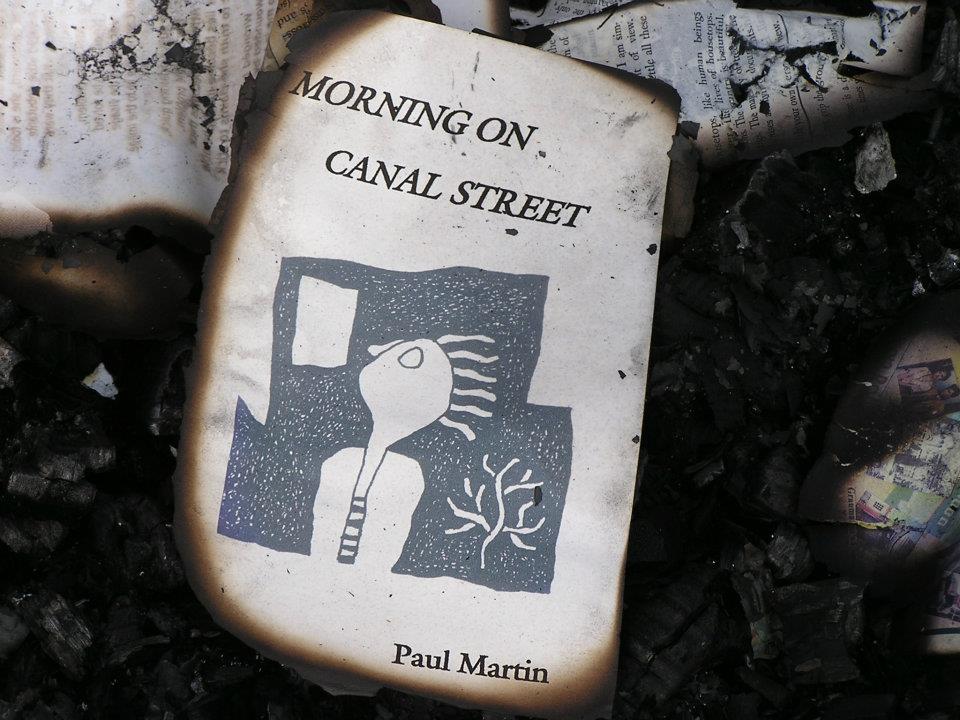
Last week, Michael Czarnecki, publisher and sole proprietor of FootHills Publishing, was vacationing in Maine when he learned his house and business had burned to the ground. I have heard that phrase before–but it was literally the case: to the ground. With the loss of clothing, memorabilia, musical instruments, furniture, etc. came the loss of livelihood and the loss of FootHills’ archive of 20+ years of small-press publishing. Many, many books went up in flames, a life’s work.

Paul Martin's chapbook

Paul Martin’s lovely chapbook Morning on Canal Street, FootHills Publishing.

Michael has been documenting the remains and posting images on his Facebook Page. Pictured here, what’s left of a copy of Paul Martin’s chapbook, one of the few that were still recognizable after the tragedy. Paul is a colleague of mine, and this photo makes me sad.

I am sure Michael has not yet done a full accounting of his destroyed inventory. The two books of mine he published are certainly among the casualties, and I feel a selfish pang over that. If he gets the press up and running again–and he plans to (he is an optimist and a hard worker)–he’ll probably try to reprint at least some of the 300 or so books FootHills has produced over the years. The more recent books will be easier to reprint, as he had his computer with him and it was not lost in the fire…pdf files of some of the books are intact. But the “history” of the press…its archival, early chapbooks, may be gone for good.

Once again, I reflect on ephemera. One of the most moving photos Michael took is one of his sons’ birth certificates, charred, the edges the same color as the tiny footprints that are still visible. We are so vulnerable.

And we endure, too. Our art helps us to manage these difficult passages. Love helps us navigate the ashes.

If you are interested in and financially able to help FootHills Publishing recover and rise, phoenix-like, from the ashes, you can go to the FootHills website and donate through PayPal or send a check to

FootHills Publishing
PO Box 68
Kanona, NY 14856

Thanks very much. As Michael Czarnecki says, “Never stop asking for poems.”

Poems that help us to endure

I’ve recently completed reading Eugenia Semyonovna Ginzburg’s memoir Journey into the Whirlwind. What has struck me about the memoir is, in particular, Ginzburg’s reliance on poetry as a means to enduring prison, deprivation, oppression.

In several selections, she reiterates how reciting or recalling poetry–Pushkin, Pasternak, Blok, Mandelstam, and lesser-known (to us Westerners) poets such as Tyutchev, Chorny & Nekrasov–gave her hope or encouraged her to keep on in the face of awful situations, or just to remind her that others have endured harsh and terrible conditions and found the means to express themselves despite it all.

I believe poems–and art of all varieties–help us to endure. Some poets who have helped me to endure include Anna Akhmatova, Mark Doty, Mary Oliver, Gregory Orr, John Donne, Yehudi Amichai, Stanley Kunitz, Donald Hall, Emily Dickinson, Adrienne Rich, Marie Ponsot, and others. Too many to name.

Who has helped you to endure? Whose art, whose poetry, whose stories, whose music?

When we reflect on these creations, perhaps we can learn more about ourselves.

Berries

My region, like many others, has been sweltering through a heat wave lately. The mild winter pushed bloom times and fruiting times a bit earlier than usual; blackberries started ripening ten days ago, and now we have blueberries before July.

But not much before July. In celebration of blueberries and other joys of summertime, here’s a poem from my collection Small Things Rise & Go.

The Blue of July

We pick the first blueberries
while lilies gape at us,
peering over their green fans.
Birds’ tirades scatter over wind
and into our ears,
buffeting us with scold and caw and
something not melody but song:

a song of fruit, of seeds and
mealybugs and inchworms,
the wild clack of bamboo
or maple branches.

Summer’s like a mulberry,
a blueberry, dark and vivid.
It stains the day sweaty,
leaves bright pollen on our noses
as we inhale the sun

on lilies, as white clover gathers
like clouds upon the grass
and, sweet in our mouths,
the day explodes—blue.

~

A note to anyone who has ordered or wishes to order Water-Rites: The order has gone to the printer. Possibly 2-3 weeks before my book is in your hands. Many thanks.

A Poet’s Craft

I am enjoying a text by Annie Finch, a fine poet–but this is not a book of her poems. Finch is the director of the MFA program at Stonecoast (Univ. of Maine); and her new book, A Poet’s Craft, draws on her experience teaching people to write poetry. She begins in the best possible way: teaching people how to read poetry.

It’s a gentle, encouraging book but passionate. The examples she gives are excellent, varied, and surprising, spanning centuries and continents. Even if you have no  intention of ever writing a poem but would like to learn how to read and appreciate the art and craft of poetry, you should consider getting this book.

Meanwhile, a thunderstorm approaches. Time to close up shop at the computer and get back to reading!

Generous community of writers

Lately, my days have been busy with gardening and household chores and efforts to promote my book Water-Rites. I find I can jot ideas into my notebooks but that more sustained creative writing efforts are not possible at this time. That’s okay. Writing, for me, often comes cyclically, with the slow periods acting as collecting points and reflective opportunities that may result in poetry later on. Also, when I am not writing much, I have time to read.

On this blog, I have a page devoted to ART which featured links to work by painters, sculptors, and other artists of my acquaintance. Today, I’m posting links to websites of and books by friends. One thing about the solitary life of writers is that we still require community of some kind: readership, first and foremost; but also reviewers, friendly but useful critique, emotional and career support, and misery-loves-company ranting and hilarity. This community develops many ways–face-to-face, mentorship, virtual collegiality, networking, even postal mail–and sustains the generous community of writers over years and miles.

The event that precipitated my desire to post these links was reconnection with poet Alfred Encarnacion, whose first chapbook, At Winter’s End, David Dunn and I published in the early 1980s when we were running LiMbo bar&grill books. You can find Alfred’s 2012 collection The Outskirts of Karma here.

One poet who has quietly been disseminating poetry for 25 years from his tiny press in Kanona, NY is Michael Czarnecki of FootHills Publishing. From his website, you can order books by many of the people in my writing community: Michael himself, and also Craig Czury, Heather Thomas, Karen Bashkirew, Paul Martin (whose beautiful 2009 full-length collection is available here), Steve Myers, Kelley Jean White, Elizabeth Bodein and many others…including two of my own chapbooks.

Finishing Line Press, which sells through Amazon as well as its own site, has published many of my colleagues in the poetry community and particularly supports female writers; I urge you to purchase books by Celia Lisset Alvarez, Kelley Jean White, Nancy Scott, Elizabeth Bodein. Finishing Line also sells my book The Minor Fauna.

Through Dave Bonta, I met the folks behind Phoenicia Publishing and, through Dave and through the Women’s Poetry Listserv, met Ren Powell. Dave’s book and Ren’s book are available through Phoenicia, and so are print issues of Dave’s online blog literary journal, qarrtsiluni. Also through Dave, my literary community grew through meeting Luisa Igloria, whose books you should definitely check out. Another connection with the inimitable Dave Bonta? That would be Ron Mohring of Seven Kitchens Press, which will be publishing Dave’s next collection and which advocates for the work of Pennsylvania-based poets such as the late Lou McKee and another of my colleagues-in-writing, Harry Humes. August Evening with Trumpet is a particularly lovely book, and Harry is a master. Other Pennsylvania poets to whose tribe I am happy to belong include my much-lauded friend Barbara Crooker, the unpredictable and enthusiastic Barbara DeCesare, Patricia Goodrich (sculptor and poet), and that magnificent woman of letters, Elaine Terranova.

Attending an MFA program at Goddard College granted me an immediate community for which I continue to be grateful many years later. Books by my fellow students and by my mentors include but are not limited to the following (really, there are too many to recall!):

Alan Smerdjian, Jessamyn Johnston-Smyth, Elena Georgiou, Christian Peet, Bea Gates, Ian Haight, Barbara DeCesare, Jan Clausen, Janice Goveas, Bill Moser, Jen McConnell, and forgive me for running short on time or forgetting others…and from my long-ago days at The New School, the amazing Maurice Eidelsberg, whose poems in Shit, Sex, Love, Palsy will have you viewing life from a perspective you may never have imagined.

Through the Women’s Poetry Listserv I mentioned earlier and through conferences and festivals, the generous community of writers has led me to Diane Lockward, Pat Valdata, Elizabeth Raby, Rosemary Starace, Julie Kane, Elaine Heveron, Lori May, Juilene Osborne-McKnight and Steven Allen May of Plan B Press; Ned Balbo, Jane Satterfield, April Lindner among many others. Wendy Ellsworth has written a book on beading and spirituality; my cousin Scott entered the world of book writing with a children’s book you can find here. And my brother, a true Renaissance man, has published a novel and is working away at a non-fiction Rip Van Winkle-type story of archeology, empiricism, Stephen Jay Gould and Samuel Morton.

So  you see, the life of a writer need not be–and seldom is–solitary. Writers love to read, and they therefore support one another inadvertently. My community also includes Shakespeare, Mark Twain, Charles Dickens, Emily Dickinson, Jane Austen, Vladimir Nabokov, Elizabeth Bishop, Robinson Jeffers, Dante, and Dostoevsky. To name a few.