Memorial

snowdrop

At last, the snowdrops: spring has deigned to return.

Renewal, rebirth–and remembrance.

~

In a post from 2011, I wrote about poet Chris Natale Peditto, a long-time friend who had recovered from a serious cerebral arteriovenous malformation that resulted in a temporary loss of his abilities to read, write, and speak.

Chris died in November of 2013, just before his 70th birthday. This afternoon, I will be attending a celebratory event in his memory in the city he loved and left, Philadelphia. We will be reading his poetry, letters, and prose, speaking poems aloud as he loved to do. There will be many artists of many kinds attending this gathering, and we will be honoring his place among us.

Outside this morning, a pelting rain, expected to clear a bit later today. A weather report that suits the mood.

Steel roots: Flower Show

Steel Roots series, Steve Tobin, at the Philadelphia Flower Show 2014

Steel Roots series, Steve Tobin, at the Philadelphia Flower Show 2014

Terrific place for Steve Tobin’s steel roots sculptures: this year’s annual Philadelphia Flower Show. Usually, I attend–and this year’s theme is art!--but circumstances prevent it this time. But the PHS (Philadelphia Horticultural Society) has an up-to-date website, and the Flower Show has its own Facebook page; so I can attend virtually without braving the icy roads and the crowds. I will, however, miss the marvelous olfactory thrill of walking into the main hall and getting stunned by the scent of fresh flowers.

Spring is a long time coming this year. I still can’t see anything but snow in my garden. Here’s hoping for thaw and the charming sight of snowdrops blooming…

Poetry reading in Bloomsburg

This is just to say

(a little William Carlos Williams title phrase to acknowledge the natal day of a truly “American” 20th-century poet)

…that tomorrow, September 18th, I will be reading from Water-Rites, and presenting a few newer poems, at Bloomsburg Pennsylvania’s Moose Exchange. The venue is a non-profit cultural arts center in the college town of Bloomsburg PA. More on the event here.

Wednesday evening, there’ll be a full moon over the Susquehanna River, which flooded two years ago this month and stranded many college students (though they were without electricity and water, they were on the hill). The floodwaters inundated the lower part of town, including the main streets and many businesses; the damage to town and the homes of many citizens was devastating. Bloomsburg creative writing professor Jerry Wemple had invited me to read at a poetry festival that very week. The festival was, of course, canceled. Jerry was kind enough to invite me to give a CVPA reading at Moose Exchange this year. Fortunately, the weather for this week is forecast to be quite sunny.

For another WCWilliams moment, click here.

https://i0.wp.com/www.keylimepietree.com/Red_Plums_on_tree.jpg

plums (“so sweet”)

Gratitude & Qigong

My mother is still living. I am grateful for that.

My mother and I get along well. In that, we are fortunate.

Furthermore, although she is an octogenarian, my mother is in reasonably good health. Another reason for gratitude.

Her interests are varied, and she’s willing to try new things. My mother has always been quietly innovative about life. She has pursued alternative therapies for health and emotional well-being, read difficult texts, studied disciplines and subjects that challenged her, traveled the world, lived in foreign lands.

Mostly, she has been a care-giver of one kind or another. This past weekend, I took my mother with me to a Qigong and Mindfulness retreat, thinking she could use a couple of days of restorative practices and a little time off from care-giving for others in order to care for herself. In addition to several hours of “medical qigong” (Yi gong), we learned some practices for spiritual qigong (Tao gong), got information about implementing a plant-based diet, observed a tea ceremony, tried our hands at Chinese bamboo brush painting, and followed a labyrinth path in a walking meditation. It was quite a significant conclusion (of sorts) to my recent weeks of thinking about consciousness as presented by various “Western” thinkers on the subject.

Yin-Yang

Kirkridge Retreat Center hosted the weekend. Kirkridge’s organization is dedicated to peace, compassion, and community–to the concerns of social justice and to individual healing. It is a peaceful place, located on a steep, wooded hill. The setting alone fosters a sense of restorative energy. Our teachers were excellent, informative, and full of grace. The meals were terrific. The crickets sang sweetly and the moon shone amidst the clouds. My mother and I felt grateful for the event, the weather, the place, the people, for the breaths animating our bodies and for one another.

Here’s something lovely

…from Maria Popova at the Brainpickings site: book loving and writing and art and literacy and library connect to produce this event/display at the New York Public Library. I was in the city just last week–rats, I missed this. (But I did see Ken Price at the Metropolitan Museum of Art and spent part of a lovely afternoon at Untermyer Park again).

~ Please click on the links! (I know they’re kind of hard to see on this theme)~

MEANWHILE…

I’m on blogging hiatus again while I get accustomed to my work week and while we prepare for the Goschenhoppen Folk Festival (or on Facebook here) this coming Friday and Saturday. Not a time to get much writing done, nor much reading.

A festival participant prepares apples for drying

A festival participant (19th c) prepares apples for drying

Young apprentices (18th c) at work

Young apprentices (18th c) at work

“Next Big Thing”

A friend & colleague-in-poetry, April Lindner, has invited me to participate in the round-robin writing blog event (termed a “blog hop”) called “The Next Big Thing.” Thanks to Molly Spencer for coordinating this web-event, which has been going awhile, so she is no longer curating it as actively. At the end of this post, I’m linking my readers to a handful of other participants. From their sites, you can locate others…and so on! We hope to foster discovery of writers our own blog followers–or random visitors–are not yet familiar with, and to spur readership in general. I love to read, and I have a mission to introduce more people to reading, to poetry, and to contemporary artists–especially word-artists. Therefore, I’m thrilled to be asked to add my 2¢ to The Next Big Thing…even though some of the formulated “interview questions” lend themselves more to fiction writers than to poets. Some of the answers may end up sounding a bit far-fetched, or simply silly.

But poets do possess senses of humor, folks. We are not all depressive garret-dwelling introverted cynics. [Ha!]

~

Now to commence with the interview questions:

What is the working title of your next book (or story, or project)?

I have two. One manuscript is finished, and I am seeking a publisher–that one is titled The Red Queen Hypothesis. The work-in-progress is tentatively called Barefoot Girls.

Where did the idea come from for the book?

imagesThe Red Queen Hypothesis seems to be culled from a bunch of my poems musing on science. I love science because it is so weird, much odder than so-called real life. Also, the nomenclature…I swoon over those latinates, Greek roots, and things-named-after-other-things. Here’s the biological definition of the Red Queen Hypothesis from Wikipedia: “an evolutionary hypothesis which proposes that organisms must constantly adapt, evolve, and proliferate not merely to gain reproductive advantage, but also simply to survive while pitted against ever-evolving opposing organisms in an ever-changing environment.” As Alice and the Red Queen are hurriedly running through the chessboard of Wonderland in Through the Looking-Glass, the Queen remarks, “Now, here, you see, it takes all the running you can do, to keep in the same place.” Don’t we often feel that way?

PBS has a good little article on it here, for those who want to learn a little science with their poetry.

Barefoot Girls evolves as I revise. As of now, the poems are memoir-based about being a teenaged girl in New Jersey, and many of them allude to Bruce Springsteen songs. The collection is, I suppose, lyrical narrative in style. Mostly free verse but with some ballad-type pieces and even a sonnet or two. I may have some trouble getting that manuscript into print because I have to get Springsteen’s permission to use a couple of epigraphs. God knows how long that will take–or if it is even possible!

What genre does your book fall under? Poetry. No other genre need apply.

Which actors would you choose to play your characters in a movie rendition?  

I would love to have Gary Cooper or Barbara Stanwyck play characters in my poems, which makes about as much sense–since they are dead–as making a movie of a poetry collection.

What is the one-sentence synopsis of your book?   

Life, love, family, environment, death, memory, animals, youth, curiosity, god.

Will your book be self-published or represented by an agency?

1) No.

And 2) –you have got to be kidding! Literary agents in the USA generally avoid poets as though we harbor west Nile virus.

How long did it take you to write the first draft of your manuscript?

Four years, generally, though some individual poems evolve more slowly. My first full-length collection, Water-Rites, took much longer…closer to ten years.

Who or what inspired you to write this book?

Ah, the “inspiration” question. I have a deep indifference to the question of inspiration. I suggest you read other writers on this topic.

What else about your book might pique the reader’s interest?

The Red Queen Hypothesis includes numerous poems that employ formal strategies, as well as plenty of nonce forms; I think of them as experiments, the way scientists frame their work though experiment.There are also philosophical undertones. It is a book of questions that are scientific, speculative, spiritual and philosophical. Barefoot Girls, the project in process, also poses questions–but of a different kind. More social and gender-related questions, more coming-of-age curiosity. The fact that these poetry pursuits came one after the other intrigues me since they seem in many ways fairly unrelated. Perhaps I will discover the relationship as I continue to revise Barefoot Girls.

Meanwhile, if anyone can suggest a publisher for RQH, I’m all ears!

Who are you tagging for The Next Big Thing?

~As The Next Big Thing is on hiatus, I suggest my readers browse for it or follow the links below that will lead to other links & literary discoveries!!

Here are some other Next Big Thing posts:

http://boysinger.wordpress.com/2013/02/24/the-next-big-thing/

Favorite poems

In my last post, when writing about reading poems of grief, I mentioned Robert Pinsky–former US Poet Laureate. When Pinsky was Laureate, he promoted the program now called “The Favorite Poem Project.” The concept was to demonstrate that poetry appeals to a diverse audience; there are so many styles and types of poetry, on so many topics, that anyone can find a poem that appeals. Teachers, plumbers, teenagers, soldiers, business executives, mail carriers, truckers, grandparents, schoolchildren–anyone who had a poem that had special meaning was invited to say a bit about why or how that poem meant so much and then to read the poem aloud to an audience. Pinsky’s project included favorite poem reading events, and videorecordings of such events, now archived at the site…and a book.

This year–this past Tuesday, to be quite exact–I took part in a favorite poem reading at the college where I work. I find these readings rejuvenating. Sometimes the stories that surround the poem choice are heartwarming, sad, or funny. Some readers tell an anecdote about a favorite teacher, relative, friend, or book; it’s wonderful how those stories “work” with the chosen poem. The director of information technology related the story of how, when her mother was in labor with her, her mother was taken to the hospital by hearse because taxis in the south did not serve her “black neighborhood.” A dance professor offered the romantic story of his long-distance courtship with his (now) wife via letters and poems…and Neruda. An instructor spoke of his fascination with attics and his father’s estrangement from the family and then read Stanley Kunitz‘s amazing poem “The Portrait.”

The poem I read was also a Kunitz poem, “The Snakes of September,” one of his later works. I am not sure this is my favorite poem–indeed, I would be hard pressed to come up with one only, and I might choose Ben Johnson’s “On My First Son” or Mary Oliver’s “Wild Geese” or Li-Young Lee’s “The Gift” or…well, there are dozens. I just chose one I thought would suit the evening, a poem with a garden in it, and an allusion to Eden, and the lovely phrase “the wild/braid of creation/trembles.” It speaks to me.

Look for poems that speak to  you. Keep them near  you, on the fridge or by your desk, in a notebook by your bed, or in your heart. Share them if you feel the urge; you will be doing good.

Blessings for National Poetry Month and always.

“The difference between Despair/And Fear”

~

Events such as the tsunamis in Indonesia and Japan, devastating earthquakes or hurricanes that result in high death tolls, industrial accidents that destroy communities—these seem impossible to control and blame is hard to place, even in the latter case. News coverage in such situations tends to focus on damage and recovery efforts, then shifts to the next drama. Tragedies wrought by specific human perpetrators, however, become media spectacles here in the USA. The same few seconds of terrible footage repeatedly fill television and computer screens; viewers feel drawn into the activities of SWAT teams and reporters and the compelling speculations of forensic psychologists, terrorism experts, social commentators, politicians, witnesses. There are heated exchanges on social media forums.

~

I’m beginning to believe societies get the popular culture they want or, alas, deserve (late Rome’s “bread and circuses,” anyone?). The circuses give us what society’s members, apparently, want to consume. Art, however, offers what they need, whether or not they want it. During times of media frenzy, when the culture in which I live seems numbed by “infotainment” and nonstop visual and audio coverage of tragic events, I find myself turning to art—usually poetry—for grounding, for solace, for affirmation of the human spirit and for a way to confront human truths.

~

I do not suggest that poetry necessarily comforts. Often, it wears me ragged, forces me to wrestle with ambiguities, to question my values. Sometimes, art brings me to tears.

I do not consider these results to be negative results. These reactions are human reactions; I am reminded of my humanity through my engagement with art.

A good little anthology for times of grief is The Handbook of Heartbreak, edited by Robert Pinsky. Pinsky’s selections cover the human spectrum of sorrows: broken romances, dead pets, war, disaster, family and social losses and the desolate emptiness of depression, sorrow that is concrete and existential, spiritual and personal and cultural.

~

Speculation is something inquisitive minds do well, but it is easy to believe our speculations, to forget they are merely imaginings that may or may not be valid. When a crime becomes a widely-broadcast web of information blips, the suspect is forejudged in the court of public opinion; I feel concerned about our nation’s commitment to the concept of innocent until proven guilty in a court of law (how on earth will that be possible?). What irks me most about media coverage of the Newtown, Virginia Tech, Aurora, Tucson, Boston Marathon, Columbine and other killings is the retreat into a kind of contorted deductive reasoning based on imaginative constructions of human intent and purpose—the search for motivation that drives the forensic end of these crimes becomes a news story led by experts who imply they can get to the truth. But can we ever know the truth? Each human being is unique and ultimately unexplainable, and often the way we are best reminded of that fact is through art: fiction, theater, paintings, poetry. On his New Yorker blog, Adam Gopnik notes:

Experts tell us the meaning of what they haven’t seen; poets and novelists tell us the meaning of what they haven’t seen, either, but have somehow managed to fully imagine. Maybe the literature of terrorism, from Conrad to Updike (and let us not forget Tolstoy, fascinated by the Chechens) can now throw a little light on how apparently likable kids become cold-hearted killers. Acts of imagination are different from acts of projection: one kind terrifies; the other clarifies.

~

We need clarity.

~

I might add that in my day job, I work with young people between the ages of 17 and 24, day in, day out. These young adults experience varying levels of frustration, confusion, numbness, fear, anxiety, excitement, need for risk, need for security, withdrawal, social discomfort, and inner turmoil. I cannot look at the perpetrators of recent civilian massacres without thinking of my students. I do not mean that I am wary or that I think one of my students might snap; what I mean is that I feel compassion for the conflictedness each human being is capable of feeling and that I understand all too well that not all of us are capable of contending with that conflict.

Some of us can accomplish through acts of imagination the confrontation with what terrifies or numbs us. These people include our artists. Those who cannot express or embrace the confrontation are at risk of projecting the inner conflict, fear, or insecurity elsewhere, as Gopnik makes clear.

Can art make us safe? We live in the world: not an inherently safe place. I think if we embrace what art offers us we will not be in retreat from the truths of the human experience but will learn to confront truths, even those that are uncomfortable. Art gives us insight, a step toward understanding. Can art grant us clarity? I think so.

Therefore, Emily Dickinson (305):

The difference between Despair
And Fear—is like the One
Between the instant of a Wreck—
And when the Wreck has been—

The Mind is smooth—no Motion—
Contented as the Eye
Upon the Forehead of a Bust—
That knows—it cannot see—

~


Judging poems

During National Poetry Month, a local newspaper (Lehigh Valley Press) sponsors, with a local public radio station (WDIY), a poetry contest for children ages 6-17. This year I was one of seven people, most of us educators, on the judging panel.

Judging poetry is always a rather fraught endeavor, and when one is reading the work of novices–particularly very young ones–setting standards can be challenging. What were we looking for, exactly? How could we decide whether the writing of one 14-year-old was “better” than the work of another? How to assess the poetry of 8-year-olds?

Our coordinator and organizer began with such questions and by asking us to describe what each of us seeks in any poem–not poems by children, but any good poem. Would children’s work feature any of these attributes? Successful attempts at poetic strategies or craft, for example–we may be able to determine that a 10-year-old’s work shows signs of poetic craft. Imagery that moves beyond the expected or clichéd? Young people often prove quite capable of that part of writing.

We are experienced in the classroom, too, and can usually tell when a child’s work shows signs of being ‘overly-coached’ by a well-meaning adult. Alas, all too often an adult’s interference deadens the imaginative if occasionally grammatically-incorrect approach children take. We can also tell which poems come of a classroom assignment when we get submissions of numerous 7-line poems on “snow.” This is not to suggest that none of the poems are worthy of note: an imaginative writer of any age can probably create a lovely piece conforming to the assigned framework. But, as teachers, we found ourselves responding to the assignments themselves (“That’s clever and would work well with third-graders, too;” “They must be studying the Black Plague;” “Looks as though they made a word bank for this one;” and so on). We had to remind ourselves to look at the work itself for the earmarks of imaginative ideas and use of language.

Interestingly, first-place poems seemed obvious and agreement was usually unanimous. This was true for elementary school, middle school, and high school writers: the best work does stand out.

Choosing the second and third place poems was more difficult and resulted in lively conversation about what makes a good poem, what matters more: authenticity of experience? discernible voice? vivid imagery? clear use of craft? emotional expression? imagination? Each of the judges had useful insights that reminded me of the value of thoughtful criticism and the value of poetry-as-art.

It was also heartening to read the work of so many young people who showed a willingness to play with words, to think about aesthetics and feelings and language, and to show their work to others. I’m grateful to the teachers who took the time to introduce their students to poetry and to encourage their pupils to write.

AWP follow-up

photo Ann E. Michael

winterhazel

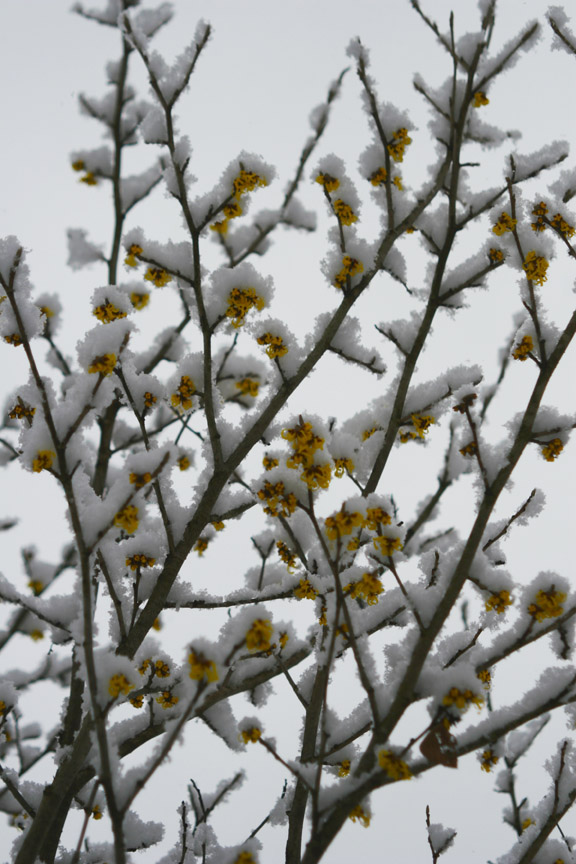
Snow fell on Boston. Not a big snow, however, and rather typical for a late-winter storm: damp, swirling but not biting, swift-melting once the sun appeared two days later. Early Friday morning, I trudged with a friend over the as-yet unshoveled sidewalks to breakfast on Newbury Street at Steve’s. We met with conference buddies who are all members of the WOM-PO [women’s poetry] listserv. It is lovely to meet face-to-face people who have been virtual colleagues and splendid to discuss poetry over a good breakfast.

~

It is also a relief to realize that I have finally learned how to manage conference-going. It is all a matter of pacing and, I suppose, of taking poet William Stafford’s advice and lowering one’s expectations. The hardest challenge is making the choice between blowing the budget on terrific food (in a big city, wonderful restaurants abound) or on books, because the bookfair at the Associated Writing Programs’ annual conference is enough to inspire swooning among literary bibliophiles.

In three huge exhibit rooms, small presses and literary and university presses displayed chapbooks, literary journals, and books that range from minuscule to tabloid-sized, books that are handmade, letter-pressed, offset, print-on-demand, stapled, ribbon-sewn, die-cut, fancy-boxed, reprinted, spare, florid, illustrated, edgy, deckle-edged, marbled, second-hand, one-of-a-kind, limited-edition, mass produced, commercial, educational…in all genres including mixed-genre, collaborative, collage, anthology, with an emphasis more on the literary than the commercial text. These books can be devilishly hard to locate, even with the existence of Amazon and online sellers; and holding them in your hands is a far more convincing sell than seeing a picture file on your computer screen.

Heaven for poetry-readers, there are also wonderful creative non-fiction books, collections of short stories, novels, books on prosody and poetics, the craft of writing, on creativity and inspiration and toil and revision and on the complex and controversial topic of teaching writing. Oh, and there are people, too. Most of the attendees are writers of one stripe or another who are congenial and curious or else walking about with the glazed expression of the overwhelmed.

Or some combination of the two.

~

I exercised considerable restraint and managed not to load my bedside table with two months or more of reading material (see a related post here). And I got some terrific ideas for teaching writing to college students and found some wonderful poets whose work I want to study. The last night of the conference, I listened to the mesmerizing Anne Carson read an indescribable take-down of the fifth book of Proust’s À la recherche du temps perdu, the section titled The Captive (Albertine). It’s been years since I read Proust, which I did almost out of stubbornness in my junior year of college, but the book came back vividly enhanced by Carson’s peculiar approach to pacing, language, scholarship, whimsy and satire. I like what the Poetry Foundation’s biography says about her after the release of her text The Autobiography of Red:

According to John D’Agata in the Boston Review, the book “first stunned the classics community as a work of Greek scholarship; then it stunned the nonfiction community as an inspired return to the lyrically based essays once produced by Seneca, Montaigne, and Emerson; and then, and only then, deep into the 1990s, reissued as “literature”and redesigned for an entirely new audience, it finally stunned the poets.” D’Agata sees Carson’s earlier work as an essayist everywhere in her poetry, along with her deep absorption in Classical languages. Carson’s work, D’Agata alleges, asks one to consider “how prosaic, rhetorical, or argumentative can a poem be before it becomes something else altogether, before it reverts to prose, to essay?”

~

Altogether, Boston provided nourishment of many kinds: gustatory, intellectual, emotional, poetical…food for thought.